The Metropolis of Tomorrow by Hugh Ferriss

ferriss01.jpg

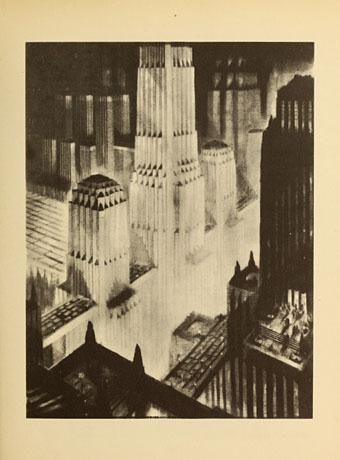
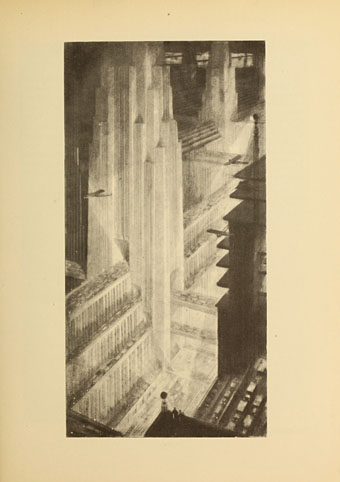
Crowding Towers.

The work of architectural renderer Hugh Ferriss (1889–1962) has appeared here before. The Metropolis of Tomorrow (1929) was a major influence on the architectural style I deployed in the Reverbstorm series, together with Berenice Abbott’s photographs of New York City in the 1930s. Ferriss’s hazy proposals for cities of the future are more visible today than they used to be thanks to the popularity of those sites that enjoy outmoded visions of the future.

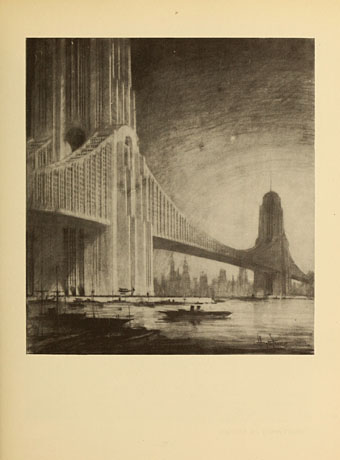
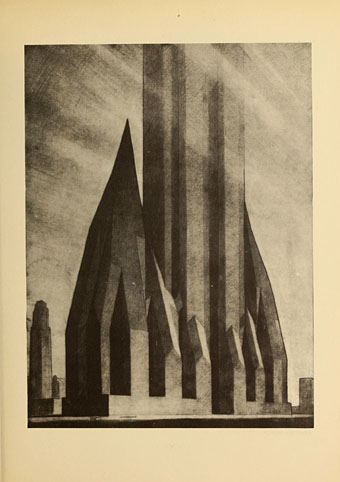
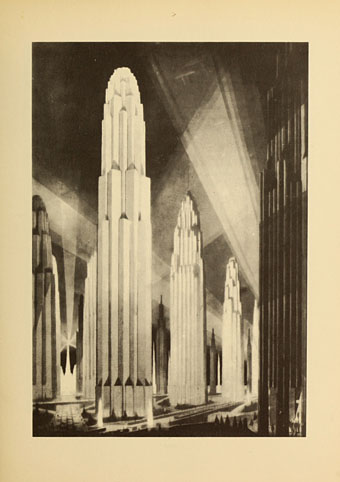
Flickr has been a good source of Ferriss’s drawings in the past but the Internet Archive recently posted the entirety of The Metropolis of Tomorrow, pages as well as pictures. The book appeared a couple of years after Fritz Lang’s Metropolis, and shares that film’s idea of the future city as a kind of superannuated New York. Skyscrapers were still a relatively new idea so this seemed a natural development at the time, as did the concept of super-highways and rooftop aerodromes. Human beings in Ferriss’s future are either ant-like specks or they’ve vanished altogether among the massed ranks of towers which often look more like less like buildings and more like Art Deco spacecraft. Lang’s vision was dystopian only in the way it relegated its workers to the underworld, while Ferriss’s proposals were wholly optimistic. Looking back we’re more aware of the shortcomings of such ideas, and from my perspective it wasn’t so difficult to bring out the latent menace inherent in these megastructures. Ferriss’s metropolis, like that of Fritz Lang, is a fun place to visit but you wouldn’t necessarily want to live there.

Browse the rest of the book here or download it here.

ferriss02.jpg

Overhead traffic-ways.

ferriss03.jpg

Apartments on bridges.

ferriss04.jpg

Evolution of the set-back building: second stage.

ferriss05.jpg

Verticals on wide avenues.

Continue reading “The Metropolis of Tomorrow by Hugh Ferriss”

Ikarie XB 1

ikarie1.jpg

A science fiction novel by Stanisław Lem (The Magellanic Cloud, 1955).

ikarie2.jpg

Illustration by Teodor Rotrekl.

A film by Jindřich Polák, adapted from Lem’s novel by Polák and Pavel Jurácek. (1963).

ikarie3.jpg

A Second Run DVD (2013).

With the exceptions of Tarkovsky’s Solaris and Stalker (both in a league of their own), I’ve never been very enthused about Eastern Bloc science-fiction cinema. If I hadn’t been watching some Czech films recently, and listening to the soundtrack music of Zdeněk Liška, I might not have bothered with this one despite its being promoted as a visual influence on 2001: A Space Odyssey. Ikarie XB 1 won the Grand Prize at the Trieste International Science Fiction Film Festival in 1963, a tie with Chris Marker’s La Jetée. (Umberto Eco was one of the judges.) Fifty years on, Marker’s film has hardly dated at all while Ikarie XB 1 seems very much of its time. But Polák’s film still has some things going for it, surprisingly so considering the director was more used to making comedies.

Ikarie XB 1 is a spaceship travelling to Alpha Centauri in the year 2163. The DVD subtitles don’t translate the name Ikarie so unless you already know it means “Icarus” there’s no foreshadowing of any possible threat, at least until the opening shots of a deranged crewman stumbling through empty corridors. Many of the scenes which follow seem over-familiar but only because the scenario of space-crew as interstellar family has become such a standard feature of filmed space opera from Star Trek on. The production design is dated, of course, but the film makes great use of black and white in the lighting patterns, on-screen visuals, clothing designs, etc. It’s easy to see why Kubrick thought it was a cut above other SF films of the period, especially with its widescreen compositions. The DVD booklet (and Kim Newman’s interview on the disc) mention Kubrick’s stylistic borrowings; judge for yourself with these screen-grabs. I was hoping the Liška soundtrack might be more electronic than it is. It’s very much a Liška score—at times you can’t help but imagine a Švankmajer puppet lurking round a corner—but with added reverb and spectral organ chords. The latter assist a sequence where two of the crew members explore an apparently derelict space station.

This page reviews the film in some detail (complete with plot spoilers). For the curious, the entire film is a free download at the Internet Archive.

Previously on { feuilleton }
Fiser and Liska
Two sides of Liska
Liska’s Golem
The Cremator by Juraj Herz

Stone Tapes and Quatermasses

penguin.jpg

Quatermass paperbacks from Jovike’s Flickr pages.

This may be another occasional series in the making since there’s already been a post about Roadside Picnic/Stalker music, and one about music inspired by the cosmic horror of William Hope Hodgson. I was going to write something earlier this year about music derived from the works of Nigel Kneale after rewatching all of Kneale’s major works. The reappraisal was prompted by the publication in January of The Twilight Language of Nigel Kneale, an excellent anthology of essays/speculations (and a China Miéville interview) about Kneale’s film and TV dramas. The delay in writing was a result of having to wait several months after ordering a CD of the Tod Dockstader album (see below) which for some reason the distributors couldn’t manage to get in the post.

In the Twilight Language book there’s a piece by Ken Hollings about electronic music, some of which has material connections with Kneale’s work, notably the Radiophonic Workshop’s creation of sound effects for Quatermass and the Pit. Early copies of the book came with a bonus cassette tape of Kneale-inspired music; more about that below. The men and women of the Radiophonic Workshop are the godparents of the following Kneale soundworks, most of which are British, and inevitably tend towards the grinding, droning and doom-laden end of the electronic spectrum. Given the enduring influence of Kneale’s work, especially the Quatermass serials and their film equivalents, it’s surprising there isn’t more Knealesque music to be found. (I’m avoiding the obvious film soundtracks, and any bands such as Quatermass who may be named after Kneale’s work but whose music doesn’t reflect it.) If anyone can add to this list then please leave a comment.

quatermass.jpg

Quatermass (1964) by Tod Dockstader

The American master of tape manipulation here processes hours of recordings of cymbals, pipes, tone generators, a vacuum hose and rubber balloons to create what he calls “a very dense, massive, even threatening work”. Dockstader hadn’t seen any of the Quatermass films or serials when he chose the name but he said that it sounded right. It certainly does, as does the unnerving, shrieking morass of sound he manages to craft using the most primitive equipment. The Starkland CD containing the Quatermass suite includes two further edits of the source material entitled Two Moons of Quatermass.

seance.jpg

The Séance At Hobs Lane (2001) by Mount Vernon Arts Lab

Mount Vernon Arts Lab is Drew Mulholland and various collaborators. The Séance At Hobs Lane is an abstract concept album based on Mulholland’s lifelong obsession with Quatermass and the Pit (an idée fixe he writes about in the Twilight Language book), plus “Victorian skullduggery, outlaws, secret societies and subterranean experiences”. Among the collaborators are Coil, Norman Blake of Teenage Fanclub, Barry 7 of Add N to (X), and Adrian Utley of Portishead. The album was reissued in 2007 on the Ghost Box label.

ouroborindra.jpg

Ouroborindra (2005) by Eric Zann

And speaking of Ghost Box… This album has been mentioned here on several occasions, a one-off release that’s the most consciously horror-oriented of all the works in the Ghost Box catalogue. The artist “name” and track titles reference Lovecraft and Machen but it’s included here for the dialogue quote in the insert from Kneale’s ghost drama The Stone Tape. In addition to the Mount Vernon reissue other Ghost Box references to Kneale can be found in the samples from Quatermass and the Pit (TV version) on The Bohm Site from We Are All Pan’s People by The Focus Group, and the title of the track which follows: Hob’s Rumble. Continue reading “Stone Tapes and Quatermasses”

Digital Grotesque

3d1.jpg

These organic forms are details of an architectural environment produced in sandstone using a 3D printer. The project is a collaboration between Michael Hansmeyer and Benjamin Dillenburger who use a series of algorithms to create the shapes the printer produces:

In the Digital Grotesque project, we use these algorithms to create a form that appears at once synthetic and organic. The design process thus strikes a delicate balance between the expected and the unexpected, between control and relinquishment. The algorithms are deterministic as they do not incorporate randomness, but the results are not necessarily entirely foreseeable. Instead, they have the power to surprise.

The resulting architecture does not lend itself to a visual reductionism. Rather, the processes can devise truly surprising topographies and topologies that go far beyond what one could have traditionally conceived.

3d2.jpg

The diagram below shows the scale of the completed structure. Regular readers won’t be surprised to hear that the first thing that came to my mind when looking at these photos was “Lovecraft!” This unpredictable rendering process immediately solves the problem of how to depict or construct a non-human architecture without resort to anything Earth-bound. Those ridged and fluted columns could be R’lyeh or they could equally be the vast and ancient buildings that Dyer and Danforth discover in At the Mountains of Madness. I’ve been waiting for a while for 3D printing to start moving beyond the mere replication of existing objects; this is a very promising development. There’s more detail about the process and construction at the Digital Grotesque site.

3d3.jpg

Previously on { feuilleton }
At the Mountains of Madness

The Bunker of the Last Gunshots

bunker1.jpg

Jean-Pierre Jeunet is known these days as a director in his own right but he started out working in collaboration with Marc Caro, a writing and directing partnership that lasted up to The City of Lost Children in 1995. Given how much I enjoyed that film, and their earlier Delicatessen (1991), I suspect it’s Caro’s sensibility I respond to. I loathed Jeunet’s Alien Resurrection so much I refuse to watch it again (for me the Alien series ends with Ripley’s swan dive at the end of the third film), and I’ve shunned Amelie and everything he’s done since.

bunker2.jpg

The Bunker of the Last Gunshots (1981) is an early Caro/Jeunet work set in the same retro environment as Delicatessen and The City of Lost Children, with equally eccentric or unpleasant characters and the same antiquated technology. There’s no dialogue, and the narrative is conveyed obliquely at best. Even more than their feature films this is a vehicle for conveying a mood, the concern here being less with story and more with monochrome visuals, chiaroscuro lighting and bits of grotesquery among the all-male inhabitants of a bunker from some unspecified war. For a low-budget piece it’s very assured, and if you’d seen this in 1981 you’d be expecting the pair to go on to bigger and better things. The Bunker of the Last Gunshots runs for 25 minutes; there’s a rough copy on YouTube or a better one at Vimeo.