Weekend links 650

phillips.jpg

A detail from Tom Phillips’ cover design for Starless And Bible Black (1974) by King Crimson.

• RIP Tom Phillips. The term “polymath” is often used by monomaths to describe people who are proficient in two areas instead of just one. Tom Phillips was a model polymath, an artist whose work ranged wherever his curiosity took him, from conventionally realist portraiture to abstract painting and computer art, from collage, sculpture and stage design to 20 Sites n Years, a long-term photographic work. When Phillips decided to illustrate Dante’s Inferno he first translated the book himself; the Dante project subsequently evolved into a TV/film production made in collaboration with Peter Greenaway and Raúl Ruiz. As for A Humument, this is the artist’s book by which all others should be judged, a unique reworking of a Victorian novel which now exists in multiple editions and sub-works. Humument extracts became a kind of Phillips signature (you can see one at the top of this post), a series of often cryptic fragments and pronouncements that appeared in prints and paintings while also supplying the libretto for Phillips’ first opera, Irma, one of his many musical compositions. Some years ago I posted a quote by Brian Eno about his former art teacher; those words (from A Year With Swollen Appendices) are worth repeating:

It’s a sign of the awfulness of the English art world that he isn’t better known. Tom has committed the worst of all crimes in England. He’s risen above his station. You can sell chemical weapons to doubtful regimes and still get a knighthood, but don’t be too clever, don’t go rising above your station.

The smart thing in the art world is to have one good idea and never have another. It’s the same in pop—once you’ve got your brand identity, carry on doing that for the rest of your days and you’ll make a lot of money. Because Tom’s lifetime project ranges over books, music and painting, it looks diffuse, but he is a most coherent artist. I like his work more and more.

• “The most radical thing about Ever So Lonely is the instrumental when it breaks down and for eight glorious bars you’re dancing to a classical raga and loving it, whoever you are.” Sheila Chandra again on the fleeting pop career of Monsoon.

• Something to look forward to for next summer: Worlds Beyond Time: Sci-Fi Art of the 1970s, a book by Adam Rowe, curator of 70s Sci-fi Art at Tumblr.

• Mix of the week: Groove Orient: South Asian Elements in Psychedelic Jazz at Aquarium Drunkard.

• “Physicists create a wormhole using a quantum computer.” Natalie Wolchover explains.

Pattern Collider is a tool for generating and exploring quasiperiodic tiling patterns.

• “Infernal Affairs is still Hong Kong’s greatest crime saga,” says James Balmont.

Secret Satan, 2022, the essential end-of-year book list from Strange Flowers.

• Also no longer with us as of this week, comic artist Aline Kominsky–Crumb.

• New music: Violet Echoes by Subtle Energy.

Il Trio Infernale (1974) by Ennio Morricone | Firebird Suite: Infernal Dance Of King Kastchei (Stravinsky) (1975) by Tomita | Infernal Devices (2011) by Moon Wiring Club
Weekend links 647

oneill.jpg

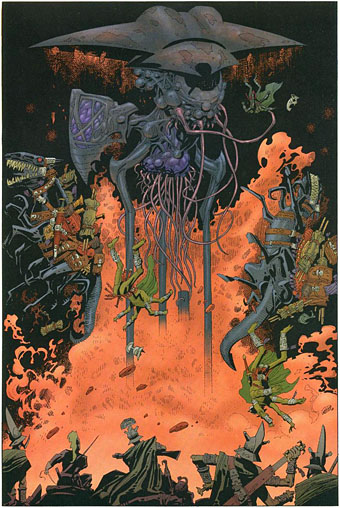
A local dispute on the planet Mars. Art by Kevin O’Neill from The League of Extraordinary Gentlemen.

• “…this image has puzzled enthusiasts of the scientific mystic’s works, both for its obscure provenance and cryptic symbolism. With its pastiche of Renaissance visual style and medieval caption — “A missionary of the Middle Ages tells that he had found the point where the sky and the Earth touch” — the illustration was once thought to have originated centuries before Flammarion published his text.” Hunter Dukes on the enduring mystery of the “Flammarion Engraving”.

• “For Spare, radio, and the waves that carried the music he loved to listen to, were more than just a metaphor for the spirit world. They were an active mode of conveyance for occult energies and vibrations – the swirling, ectoplasmic tendrils from which odd figures emerge in some of his most dense and haunting work.” Mark Pilkington explores Austin Osman Spare’s influence on the world of music.

• At Spine: Design studio Milk & Bone’s designer Alicia Raitt re-imagines all 14 of Kurt Vonnegut’s book covers to celebrate his 100th birthday.

• Farewell to Kevin O’Neill and Nik Turner, both of whom headed to the Western Lands this week.

Mean, moody and magnificent: film noir studio portraits – in pictures.

• Mix of the week: XLR8R Podcast 773 by Roméo Poirier.

• New music: Evergreen by Patrick Shiroishi.

Brainstorm (1972) by Hawkwind | Hurricane Fighter Plane (1985) by Inner City Unit | Brainstorm (1993) by Monster Magnet

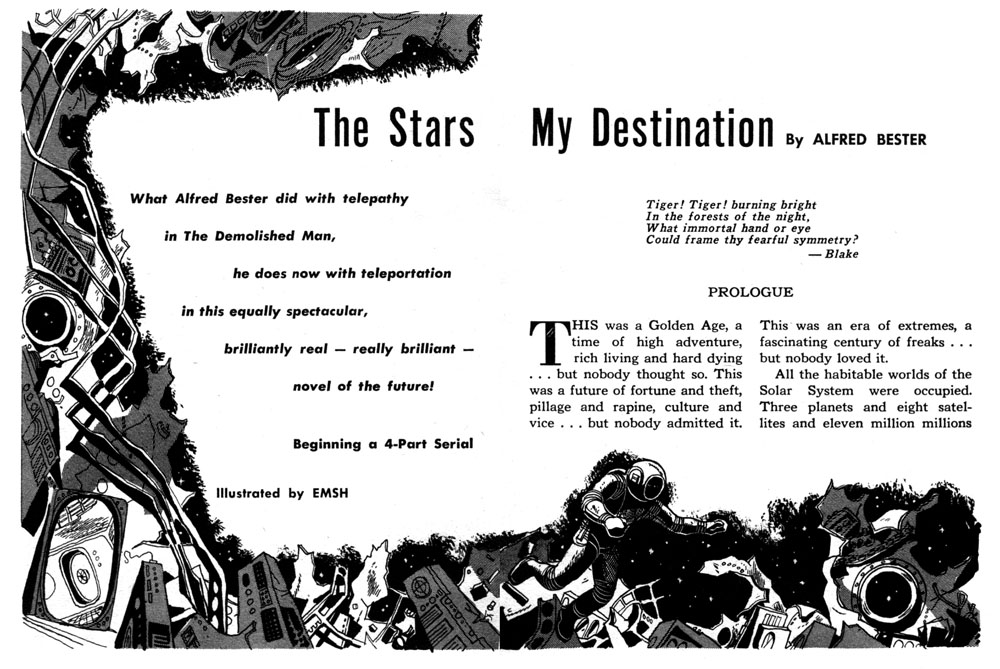
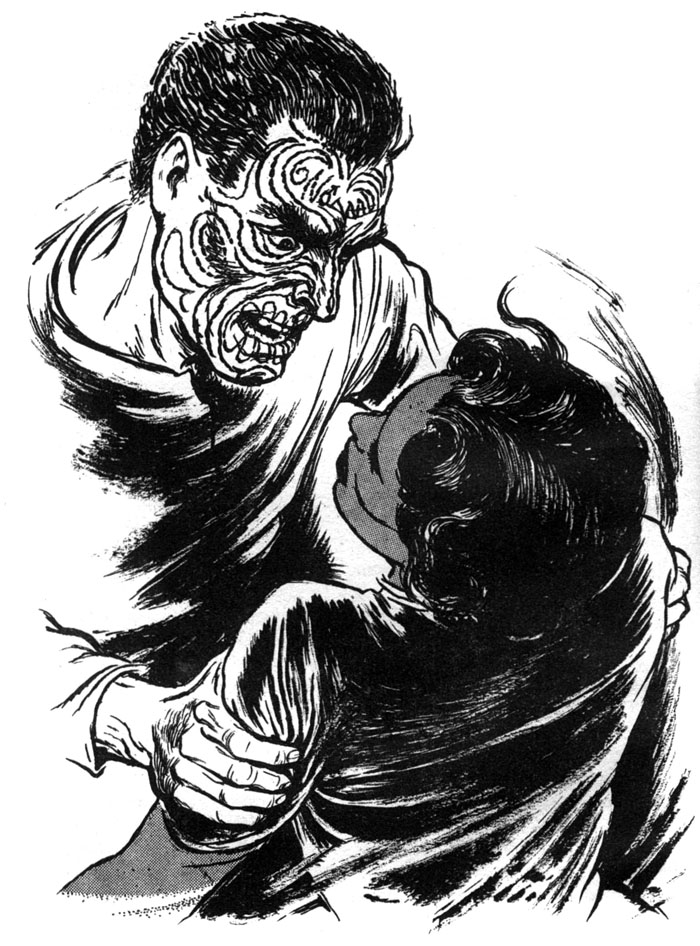
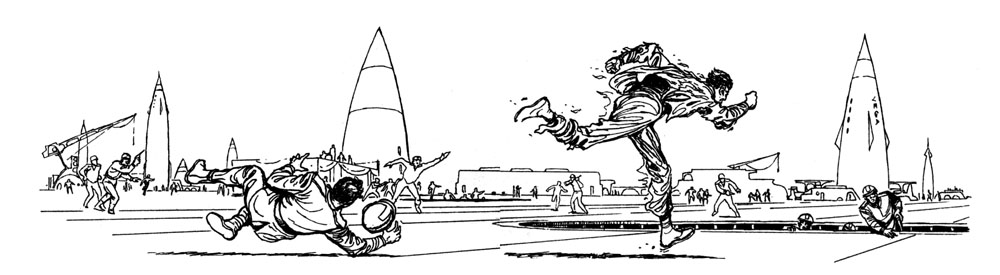
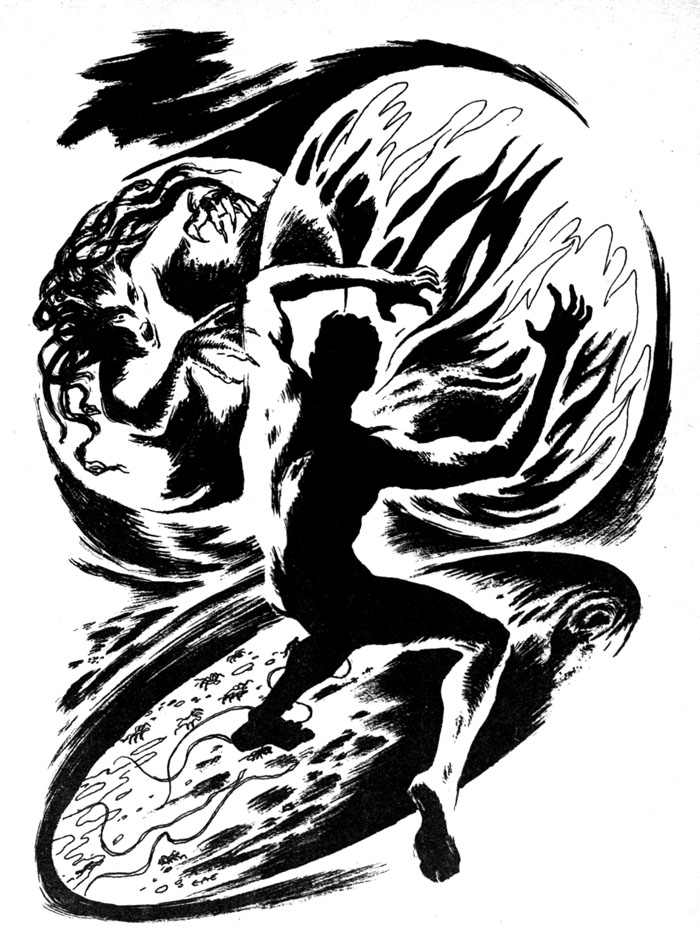
Emshwiller illustrates Bester

emshwiller01.jpg

Having finished reading The Count of Monte Cristo I thought I’d, er jaunt from the 1840s into the far future by revisiting Alfred Bester’s Dumas-derived The Stars My Destination. I prefer the alternate title to Bester’s novel, Tiger! Tiger!, but Stars… is the one that’s more commonly used, with the unfortunate side-effect of making the book sound like a typical space opera of the 1950s. The story may begin in space but most of it takes place on Earth in the 24th century. Bester borrows the revenge theme and a couple of other details from The Count of Monte Cristo but wisely resists any attempt to imitate the labyrinthine plotting of the Dumas novel.

emshwiller02.jpg

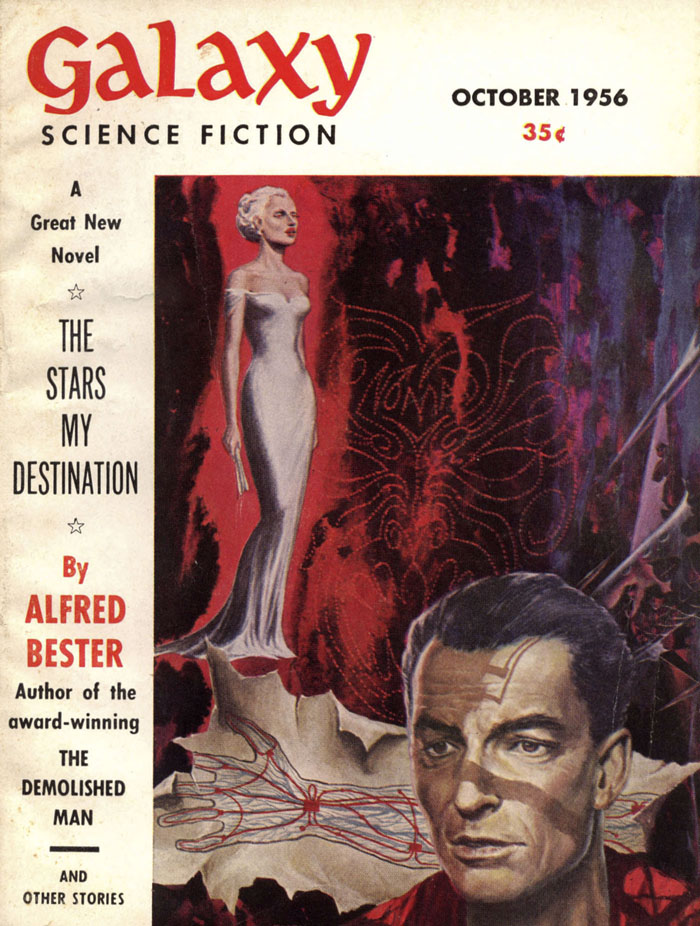
Before publication in book form, the story was serialised in four parts in Galaxy magazine, from October 1956 to January 1957; Ed “Emsh” Emshwiller illustrated each instalment as well as the cover of the debut issue. I’ve said before that one of the great benefits of being able to browse old magazines online is having the opportunity to turn up neglected illustrations like these. Bester’s novel has long been regarded as a genre classic—Michael Moorcock and William Gibson both refer to it as a favourite—but its print editions haven’t generated many memorable covers. Here we have Emshwiller illustrating the entire story, and doing an excellent job, yet his drawings have been buried for years.

emshwiller03.jpg

For the purposes of this post I’ve removed the text surrounding some of the illustrations in order to highlight the drawings. The original printings, plus the full text of the serialised story, may be found at the links below:

Galaxy, October 1956
Galaxy, November 1956
Galaxy, December 1956
Galaxy, January 1957

emshwiller04.jpg

emshwiller05.jpg

Continue reading “Emshwiller illustrates Bester”

Georges Méliès, Mage

melies01.jpg

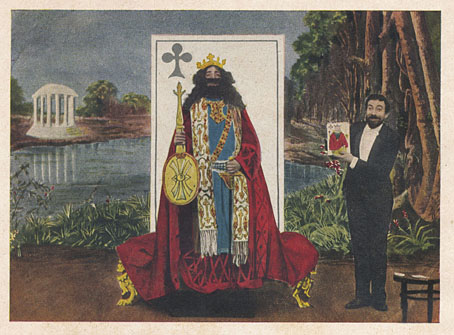
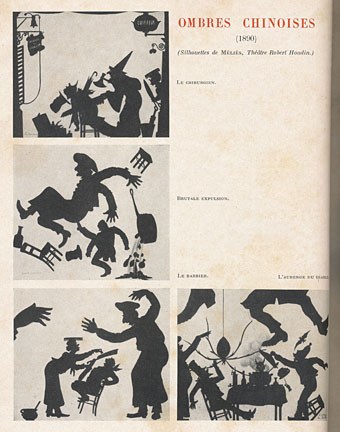
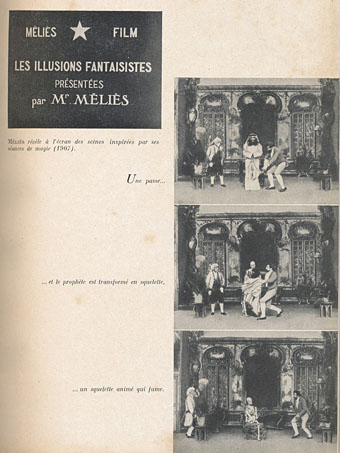
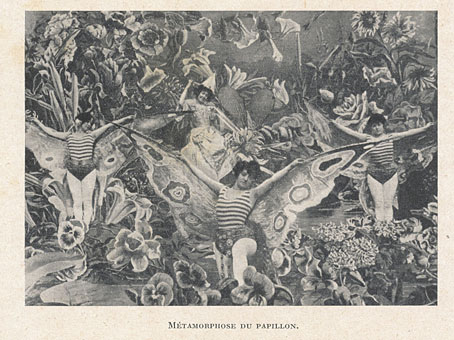
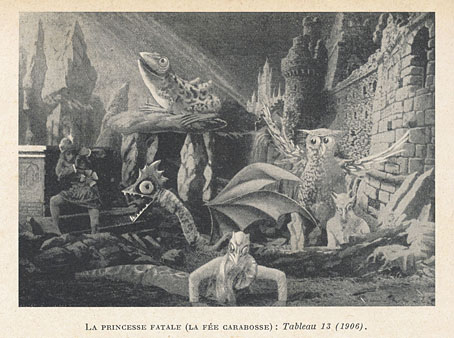
Georges Méliès: magician. Yes, indeed. I was watching Martin Scorsese’s Hugo again recently, a film I found more enjoyable the second time around mostly for the Méliès side of the story. The flashback to the Star Films studio offers in miniature a history that this book delivers in detail. Georges Méliès, Mage (1945) by Maurice Bessy and Joseph-Marie Lo Duca is a copiously illustrated guide to Méliès’ entire career, beginning with his early years as a conjuror and a creator of the kinds of theatrical fantasies that formed the basis for his first films. The text is in French throughout but there’s a wealth of pictorial material, with many production sketches and drawings that show how some of his more complex effects were achieved.

melies02.jpg

One of the things I’ve always found attractive about Méliès’ films is the way they resemble 19th-century illustrations brought to life. The same can be said about some of the later Hollywood productions, especially the Douglas Fairbanks Thief of Bagdad, but they lack the overt theatricality of Méliès. For a taste of those hand-tinted marvels, go here.

melies03.jpg

melies04.jpg

melies05.jpg

Continue reading “Georges Méliès, Mage”

Weekend links 639

alphaville.jpg

Japanese poster for Alphaville (1965).

Peter Bogdanovich: I think we’d better have your thoughts on Godard.

Orson Welles: Well, since you’re so very firm about it. He’s the definitive influence if not really the first film artist of this last decade, and his gifts as a director are enormous. I just can’t take him very seriously as a thinker—and that’s where we seem to differ, because he does. His message is what he cares about these days, and, like most movie messages, it could be written on the head of a pin. But what’s so admirable about him is his marvellous contempt for the machinery of movies and even movies themselves—a kind of anarchistic, nihilistic contempt for the medium—which, when he’s at his best and most vigorous, is very exciting.

• RIP JLG. I was watching Alphaville again just two weeks ago after a DVD turned up in the local charity shop. Still the only Godard film I like 100% but “liking” seems beside the point. His influence today is everywhere, so fully absorbed into the language of cinema that people barely notice it.

• “The things that cause my gaze to linger are usually the portraits or landscapes that spark a feeling of unease, disquiet and discomfort. A shadow amongst the summer trees, a lurking silhouette reflected in a perfect blue iris, a vibrant flower in the early stages of decay.” S. Elizabeth talking to Beautiful Bizarre about her new book, The Art of Darkness: A Treasury of the Morbid, Melancholic and Macabre.

• Allow John Waters (again) to dictate your film viewing with a Letterboxd list of his favourite films, based on comments in his writings and interviews. On the subject of Godard, Waters’ Crackpot book contains a whole chapter about Hail Mary.

• Astor’s Electrical Future: Iwan Rhys Morus explores a vision of the year 2000 recounted in A Journey in Other Worlds (1894), a “scientific romance” by John Jacob Astor IV, with illustrations by Daniel Carter Beard.

• Strange Attractor has announced a Kickstarter campaign to fund the publication of an Austin Osman Spare Tarot deck.

• At Wormwoodiana: The Parrot, the Unicorn and the Golden Dragon: Some 17th Century Booksellers’ Signs.

• At Bandcamp: Andy Thomas on Chris Watson‘s post-Cabaret Voltaire career in nature recordings.

• A new outlet for cinematic obscurities: Radiance Films.

Alphaville (1978) by Klaus Schulze | Alphaville (1979) by The Monochrome Set | Alphaville (1999) by Scanner