Manuel Orazi’s Salomé

orazi1.jpg

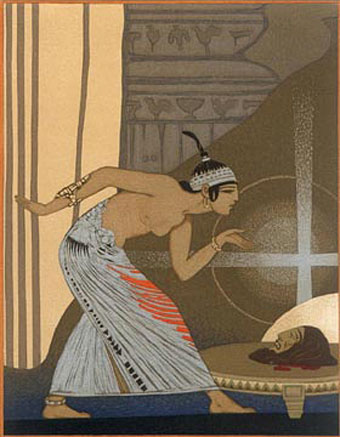
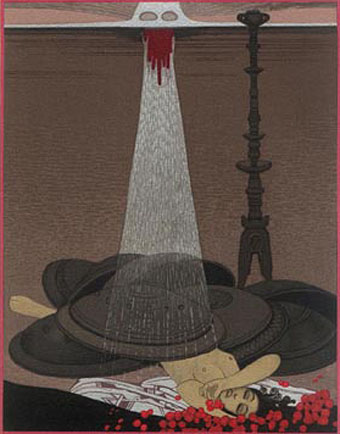
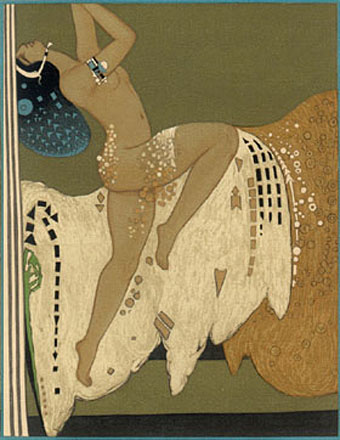
The Biblical bad girl returns in three pictures from an illustrated edition of Oscar Wilde’s play, published as a limited run in 1930. Manuel Orazi (1860–1934) was a French artist whose work has appeared here before, and no doubt will do again very soon since I’ve been finding further examples of his illustrations and designs. These drawings are closer to Gustav Klimt or George Barbier than his earlier illustrations which owed much to the stylisation of Mucha’s Art Nouveau.

orazi2.jpg

orazi3.jpg

Elsewhere on { feuilleton }
The illustrators archive
The Salomé archive

inevitable undeniable necessary by Bharti Kher

kher1.jpg

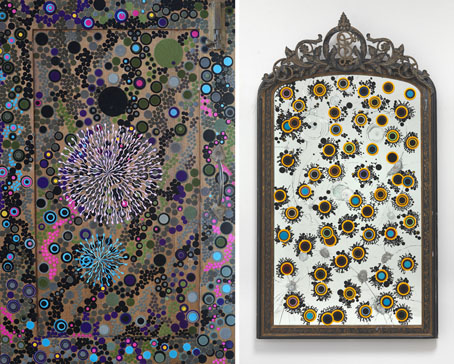
left: confess (detail) (2009–2010); right: indra’s net mirror 1 (2010).

Works from inevitable undeniable necessary, a solo exhibition by Bharti Kher at Hauser & Wirth, London. Kher was born in Britain but lives and works in New Delhi, India. This is her first solo exhibition in London and it runs to May 15, 2010.

kher2.jpg

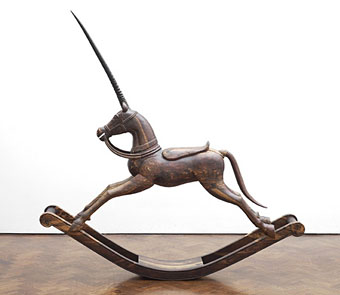
the great chase (2009–2010).

Penda’s Fen by David Rudkin

penda4.jpg

This is a post I’d been intent on writing for the past four years but kept putting off: why go to great lengths to describe another television drama which people can’t see? And how do you easily appraise something which haunted you for twenty years and which remains a significant obsession? My hand has been forced at last by a forthcoming event (detailed below) so this at least has some fleeting relevance, but before getting to that let’s have some facts.
penda3.jpg

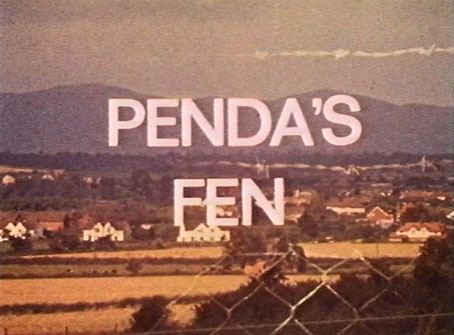
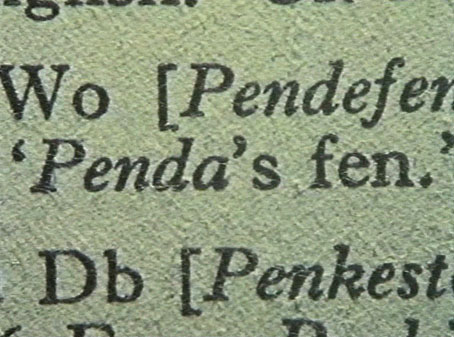
Penda’s Fen was a TV play first screened in March 1974 in the BBC’s Play For Today strand. It was shot entirely on film (many dramas in the 1970s recorded their interiors on video) and runs for about 90 minutes. The writer was David Rudkin and it was directed by Alan Clarke, a director regarded by many (myself included) as one of the great talents to emerge from British television during the 1960s and 70s. The film was commissioned by David Rose, a producer at the BBC’s Pebble Mill studios in Birmingham, as one of a number of regional dramas. Rudkin was, and still is, an acclaimed playwright and screenwriter whose work is marked by recurrent themes which would include the tensions between pagan spirituality and organized religion, and the emergence of unorthodox sexuality. Both these themes are present in Penda’s Fen, and although the sexuality aspect of his work is important—pioneering, even—he’s far from being a one-note proselytiser. Alan Clarke is renowned today for his later television work which included filmed plays such as Scum (banned by the BBC and re-filmed as a feature), Made in Britain (Tim Roth’s debut piece), The Firm (with Gary Oldman), and Elephant whose title and Steadicam technique were swiped by Gus Van Sant. Penda’s Fen was an early piece for Clarke after which his work became (in Rudkin’s words) “fierce and stark”.

The most ambitious of Alan Clarke’s early projects, Penda’s Fen at first seems a strange choice for him. Most scripts that attracted Clarke, no matter how non-naturalistic, had a gritty, urban feel with springy vernacular dialogue (and sometimes almost no dialogue). David Rudkin’s screenplay is different: rooted in a mystical rural English landscape, it is studded with long, self-consciously poetic speeches and dense with sexual/mythical visions and dreams, theological debate and radical polemic—as well as an analysis of Elgar’s The Dream of Gerontius. But though Penda’s Fen is stylistically the odd film out in Clarke’s work, it trumpets many of his favourite themes, in particular what it means to be English in the last quarter of the twentieth century.

Howard Schuman, Sight & Sound, September 1998

Spencer Banks is the principal actor in Penda’s Fen, playing Stephen Franklin, an 18-year-old in his final days at school. The BBC’s Radio Times magazine described the film briefly:

Young Stephen, in the last summer of his boyhood, has somehow awakened a buried force in the landscape around him. It is trying to communicate some warning, a peril he is in; some secret knowledge; some choice he must make, some mission for which he is marked down.
penda2.jpg

The magazine also interviewed Rudkin about the film:

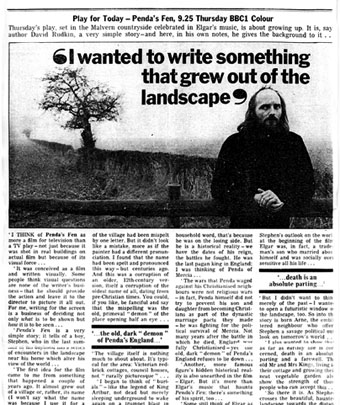
“I think of Penda’s Fen as more a film for television than a TV play—not just because it was shot in real buildings on actual film but because of its visual force…

“It was conceived as a film and written visually. Some people think visual questions are none of the writer’s business—that he should provide the action and leave it to the director to picture it all out. For me, writing for the screen is a business of deciding not only what is to be shown but how it is to be seen…

Penda’s Fen is a very simple story; it tells of a boy, Stephen, who in the last summer of his boyhood has a series of encounters in the landscape near his home which alter his view of the world…
Continue reading “Penda’s Fen by David Rudkin”

The art of Melchior Lechter, 1865–1937

lechter1.jpg

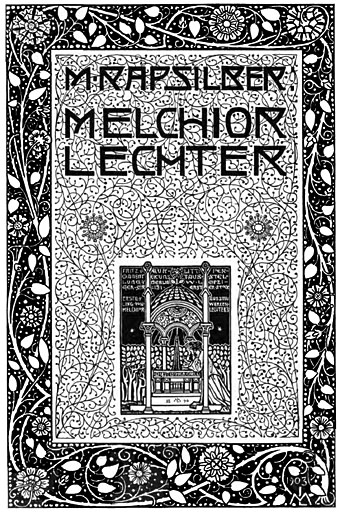
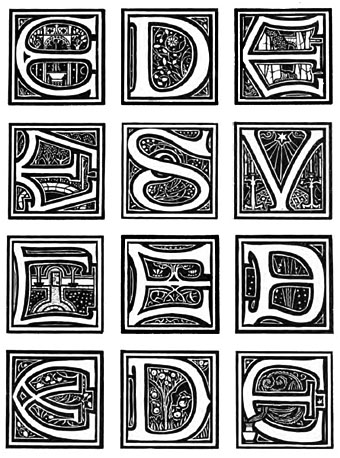
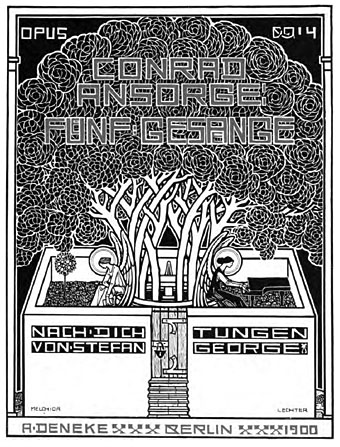
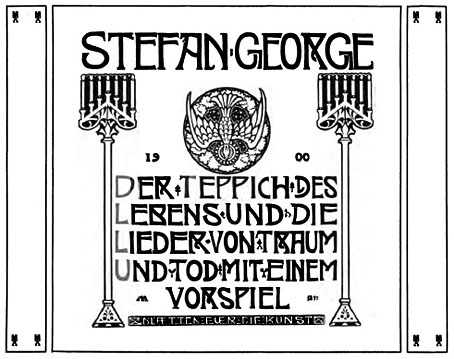
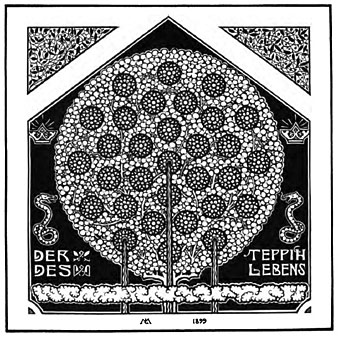
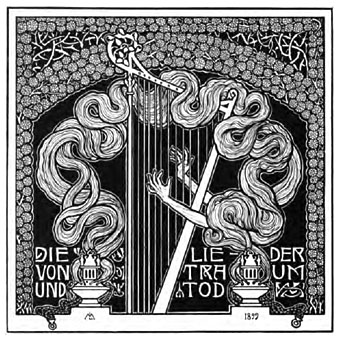
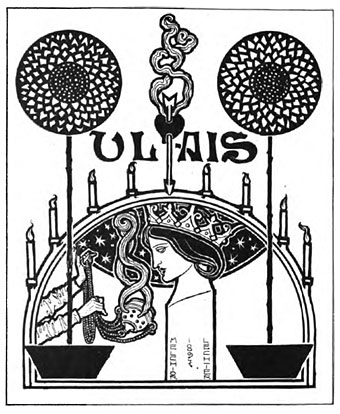
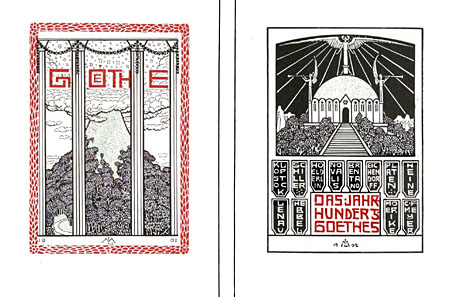
The first issue of yesterday’s arts and crafts magazine Deutsche Kunst und Dekoration includes an article about Melchior Lechter, a German artist and designer whose illustration work I knew from books by gay poet Stefan George but who seems unjustly neglected by fin de siècle art histories. The reminder prompted me to search a bit more actively and doing so turned up another Internet Archive document, Melchior Lechter, a monograph from 1904 by Maximilian Rapsilber. These are Google scans and the quality is very good for once, with a collection of impressive graphic works in Lechter’s religious Art Nouveau style, as well as photos of his furniture and stained glass window designs. I can’t say much more about artist since all the available documentation is in German but the visuals in Rapsilber’s book make me wish we could see more of his work.

(Note: if you want to download the full PDF, do so here.)

lechter2.jpg

lechter3.jpg

lechter4.jpg

lechter5.jpg

lechter6.jpg

lechter7.jpg

lechter8.jpg

Elsewhere on { feuilleton }
The illustrators archive

Previously on { feuilleton }
Deutsche Kunst und Dekoration

Weekend links 3

orator.jpg

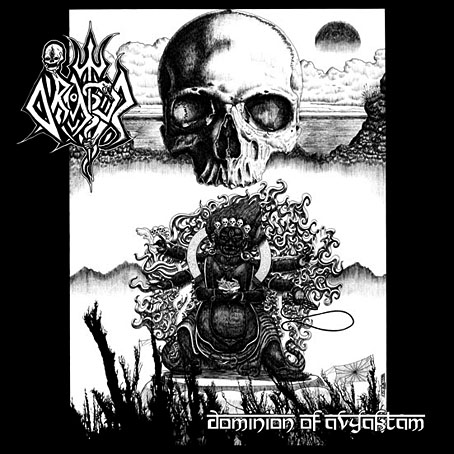
It’s a curious feeling when a drawing which is nearly 26 years old makes it out into the world. The image above is the cover of a new 7″ single release, Dominion of Avyaktam by metal band Orator, the picture being something I drew in 1984 entitled Mahakala after the Tibetan deity which it depicts. The inspiration was the cover of another recording, a Nonesuch Explorer album, Tibetan Buddhism – Tantras Of Gyütö: Mahakala, and also the track Mahakala by 23 Skidoo from their 1983 album The Culling is Coming. The skull is drawn from a real one I was given. Looking at this today none of the elements seem to work together—and the landscape stuff looks like a lazy way of filling in space—but it’s nice to see it find a home. Dominion of Avyaktam is out now on the Legion of Death label.

• Surprise of the week: two books I’ve worked on were nominated for Nebula Awards, Jeff VanderMeer’s Finch, and Kage Baker’s The Hotel Under the Sand whose interior I designed.

• More music: a recording of Paul Schütze’s Third Site played live in 1999 (with Clive Bell, Raoul Björkenheim, Simon Hopkins & Thomas Köner’s voice) is now available as a free download on his website. More Schütze: Paul Schütze & Simon Hopkins playing a set at the Horbar in Hamburg on December 28, 2009.

• The incredible pinscreen animations of Alexander Alexeieff and Claire Parker are finally available on DVD. Also new to DVD, Alan Bennett at the BBC, a four-disc set of some of his TV plays including a particular favourite of mine, his Kafkaesque drama The Insurance Man.

• More Ghost Box business: Jon Brooks aka The Advisory Circle has a blog. And Ghost Box’s Jim Jupp was interviewed recently by Peter Bebergal at Mystery Theater. Related (forgot to mention this last week): The ASDA Mix, a great mixtape of spooky retro weirdness by Moon Wiring Club available for free at The Wire.

The trailer for Mellodrama, a documentary about the Mellotron by Dianna Dillworth.

• The Parajanov Festival will be screening some of the director’s films in London and Bristol.

• Lots of weird and wonderful exhibits at the ~Wunderkammer~.