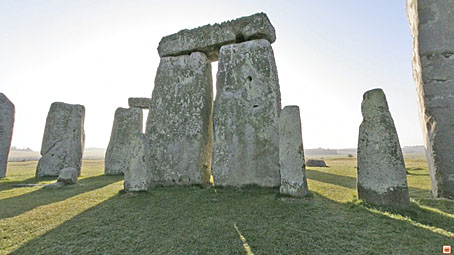
Stonehenge panorama

stonehenge.jpg

I would have posted this for the Solstice yesterday had it not been for the Chronophage. The panorama is at a BBC page since the corporation is one of the few organisations with the weight to gain permission to photograph the stones up close. Unless you’re an archaeologist or an English Heritage official your view is restricted to the path which surrounds the monument, something you can experience via Google Maps. There did used to be exceptions to this. I was fortunate to be at the Stonehenge Festival in 1982 which took place for a few days over Midsummer in one of the fields a short distance away. On Solstice Day the people from English Heritage let everyone—festival-goers and bemused tourists alike—wander inside the circle where a couple of pagan weddings took place. A couple of years later further festivals were prevented with heavy police action so I feel privileged to have been there on that day.

There was more Stonehenge recently at Bldg Blog with a post about Harold Egerton’s stunning photograph of the stones at night. And while we’re on the subject, let’s not forget Woodhenge, Seahenge , Timisoara’s Stonehedge, and the Ballardesque Carhenge.

Elsewhere on { feuilleton }
The panoramas archive

Three Heads Six Arms by Zhang Huan

huan.jpg

A new sculpture by Chinese artist Zhang Huan which was officially dedicated in San Francisco’s City Hall Plaza last week. The photo is by Flickr user David Dasinger and similar views can be found in this Flickr pool. Huan’s copper figures may be intended to evoke Buddhist serenity but I can never see that plaza without remembering the horrible ending of Philip Kaufman’s Invasion of the Body Snatchers.

Three Heads Six Arms is part of a series of monumental works depicting the fragmented extremities of Buddhist statues. The series was inspired by Zhang’s discovery of religious sculptures that had been destroyed during the Cultural Revolution for sale in a Tibetan market. (More.)

Via Erik Davis.

Previously on { feuilleton }
The art of Arnaldo Pomodoro
Sculptural collage: Eduardo Paolozzi
Dead monuments
The art of Igor Mitoraj

Strangest Genius: The Stained Glass of Harry Clarke

clarke1.jpg

I mentioned Harry Clarke’s stained glass work last year since Flickr now has some decent photos of Clarke’s incredible window designs. Published this month is Strangest Genius: The Stained Glass of Harry Clarke by Lucy Costigan and Michael Cullen, the first proper book-length study of the windows and other stained glass work produced by the Clarke studio. It’s costly but then this is a unique book showcasing the entirety of the artist’s work in the medium. Further details here.

clarke2.jpg

Harry Clarke posing as Christ in his studio.

Previously on { feuilleton }
Joseph Cavalieri’s stained glass
Harry Clarke’s stained glass
Poe at 200
IKO stained glass
Harry Clarke’s The Year’s at the Spring
The art of Harry Clarke, 1889–1931

Weekend links: the queer edition

queer.jpg

A T-shirt design by artist Daryl Vocat.

Tove Jansson: Out of the Closet. The unorthodox life and work of the woman who gave us the Moomins.

Submissions are now open for PANK’s October special online issue featuring Queer prose, poetry & art.

• More new magazines: Zeus and Made in Brazil Magazine, the latter being a spin-off from the justly-praised weblog of Brazilian hotness.

• An old magazine, called, er…Magazine: “Everything about Magazine was new, from the stark photoless cover design with its bold typeface to the way the men were photographed. The pictures weren’t overtly sexual, but proudly confronted the viewer in a different way: “To us, showing a face was the most important thing because back in 1980, gay people still had to hide their faces,” Lestrade says.” A few pictures from Magazine.

Revealed: The Tradition of Male Homoerotic Art, an exhibition at the Leslie-Lohman Gallery, NYC, from May 12th.

• The programme for the International Dublin Gay Theatre Festival which is running to May 16th.

scissors.jpg

Scissor Sisters have a new album, Night Work, out next month. The cover picture is a photo of dancer Peter Reed by Robert Mapplethorpe. Antony and the Johnsons have announced a new album (and accompanying book) for October.

• Headline of the week: “Christian right leader George Rekers takes vacation with ‘rent boy’ ”. Rekers took issue with the story; his Rentboy.com escort took issue with Rekers’ issue-taking. Then things became unpleasant. And now another escort has come forward.

Henry & Glenn Forever, “a love story to end all love stories”. “Who knew Rollins was such a caring spouse? Who knew Hall and Oates were so infernally evil—yet so considerate?”

• This week’s Tumblr silliness: Lesbians Who Look Like Justin Bieber.

• I’m not on Facebook, nor will I ever be. If you are, however, here’s ten reasons why you should quit. The EFF has six things you need to know about Facebook Connections. Wired thinks that Facebook has gone rogue and an alternative is needed. What does Facebook publish about you and your friends? Finally, Gawker has ten reasons why you’ll be on Facebook forever.

The Prague Pneumatic Post.

How to serve absinthe.

Cthulhu is not cute.

• Song of the week: Gay Messiah by Rufus Wainwright.

Ricardo Bellver’s El Ángel Caido

bellver1.jpg

This Luciferian statue by Spanish sculptor Ricardo Bellver (1845–1924) was drawn to my attention in the comments a while back and I thought it about time it had a post of its own. Statues of Satan/Lucifer or fallen angels are usually depicted at the mercy of Saint Michael’s feet and sword, it’s unusual to see such a work where the forces of Heaven are implied rather than shown. It’s even more unusual to have such a figure on display in a public park, as Bellver’s is.

The sculpture … of great dramatism and originality, obtained the First Medal at the Spanish National Fine Arts Exhibition in 1878, and the same year was cast in bronze for the third Paris World’s Fair. Later on, the Prado Museum donated it to the City of Madrid, and in 1885 it was installed in a square with the same name in the Retiro Park (the largest one in Madrid).

The writhing serpents are probably a nod to the Laocoön and manage to impose modesty as well as evoke an erotic frisson, a familiar ambiguity as I’ve noted before. Wikimedia Commons has a lot more photos while Flickr has even more here and here.

bellver2.jpg

Previously on { feuilleton }
Melancholy Lucifers
Angelo Colarossi and son
Dark Angel
Men with snakes
Angels 4: Fallen angels