Labyrinths

labyrinth.jpg

The Breamore Miz-Maze, Hampshire. Photo by Jim Champion.

As part of the work-related research this week I was looking for designs of old turf labyrinths. It turns out I have two pages of the things in a book I’d earlier considered dropping into Oxfam so that particular volume may have gained a reprieve. Before I went to the bookshelves I’d been browsing the rather wonderful Labyrinthos site which is just the kind of detailed resource you hope to find in these circumstances. There we find an explanation for the difference between a maze and a labyrinth (the general rule being that a maze has more than one choice of route), and a wealth of examples from ancient history to the present day. I’ve long been fascinated by the labyrinths found in churches and cathedrals, of which the most famous example is the one in Chartres Cathedral. They’re a rare incidence of a symbolic device in Christian architecture which is near-universal, and which has clear antecedents in the labyrinths and mazes found in ancient temples. Labyrinthos has a guide to some of the surviving examples to be found in England. As to England’s turf labyrinths, there’s a page devoted to those here with a number of photos.

Previously on { feuilleton }
Jeppe Hein’s mirror labyrinth

Danby’s Deluge

danby1.jpg

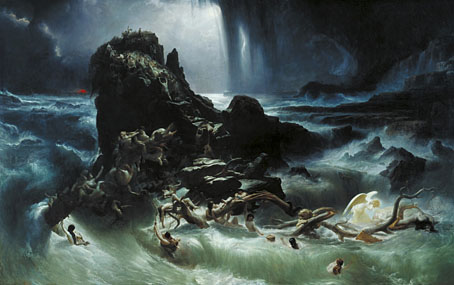
Since John Martin’s tumultuous canvases are back in the news it’s worth remembering another 19th-century painter of Biblical cataclysm, Francis Danby (1793–1861), whose enormous The Deluge (1840) used to hang in the same room as the Martins at Tate Britain. Danby was a contemporary of Martin although not as enthusiastic about this kind of subject matter. Visions of apocalypse proved to be popular, however, so Danby painted his Flood and similar works with reluctance. (Even Turner wasn’t above painting the occasional disaster.) Danby’s Deluge impressed me as much as Martin’s work when I first saw it not least for its having some believable human figures which give the vast canvas a tragic dimension. Martin’s figures are perfunctory and invariably dwarfed by the scale of events.

danby2.jpg

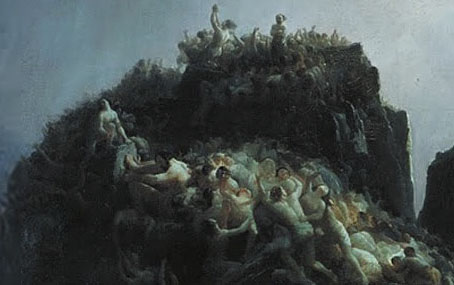
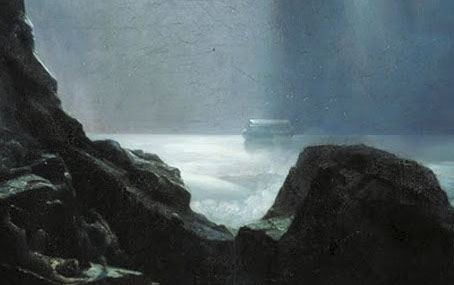
These details are from the Google Art Project which unfortunately don’t show us as much detail as they might. This is one of those paintings which encourages a lengthy contemplation, with a composition that draws the eye away from the swirling waters to a glowering sun and the shape of Noah’s ark on the distant horizon.

danby4.jpg

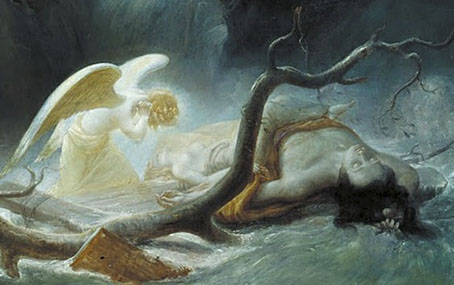
I’ve always been intrigued by the curious detail of the angel caught in the flood, and the even more curious detail of a drowned giant beside it. For the first time, however, I’ve noticed that the angel is peering into the face of a dead woman draped over the giant’s body. Paintings such as these often toured the country accompanied by the artist responsible who would lecture a paying audience about the various details. Besides the storytelling Danby gives the water in the foreground an astonishing transparent quality which Google’s photos can’t replicate. All the more reason to see his paintings for yourself if you’re in London.

Francis Danby at Tate Britain

danby3.jpg

Previously on { feuilleton }
John Martin: Heaven & Hell
Darkness visible
Death from above
The apocalyptic art of Francis Danby

Weekend links 68

dorosheva.jpg

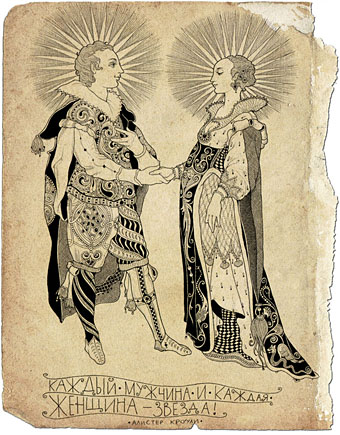
Every man and every woman is a star by Sveta Dorosheva.

• Matt Taylor (illustration) with Gregg Kulick and Paul Buckley (design) provide new Penguin covers for John Le Carré. I love the look which seems inspired by Daniel Kleinman’s title sequence for Casino Royale even if it doesn’t quite suit the shabby world of George Smiley and the Circus.

[Deborah Kass] told me that when she was going to art school in the ’70s, she tripped on LSD almost every week and she said she felt it was her “moral duty as an artist to take the trip.” […] I think psychedelic experience makes you think that there are multiple realities, that there isn’t just this one normal real world to which we’re supposed to conform, but that the reality changes depending on the state of consciousness that we’re in when we’re experiencing it. So, any different kind of art kind of posits a different reality. (more)

New York Times art critic Ken Johnson discussing his new book Are You Experienced?: How Psychedelic Consciousness Transformed Modern Art.

• “That got me thinking that evolution really isn’t survival of the fittest, when it comes to these things, it is more like survival of the interesting, survival of the beautiful, survival of the weird, cool stuff that managed to evolve.” Laurie Anderson and David Rothenberg discuss music and animals.

• Laura Cumming on the late Lucian Freud. And Stephen Heller on Alex Steinweiss, the originator in 1939 of the artistic record sleeve who also died last week.

• Alan Moore says “Think Locally: Fuck ‘Globally'”. He and Queen Calluz explain how Dodgem Logic magazine puts their ideas into practice.

Adam Curtis gets interviewed while Alan Bennett returns to Armley Public Library in Leeds.

Peacock’s Garden, a celebration of pavonine splendour.

• A visit to Seher Shah’s studio in Brooklyn, New York.

• Maximum androgyny at Epicenity, a Tumblr.

Does your god have a penis?

Chrysalide (1978) is an album of “cosmic” guitar instrumentals by Michel Moulinié which sounds at times like a French equivalent of Manuel Göttsching. It’s never been released on CD but a copy can be found here.

Weekend links 66

kunz.jpg

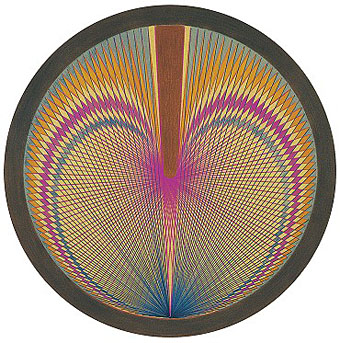
A design by Emma Kunz (1892–1963).

• Following the news this week it’s worth reminding people of a great post put together by Adam Curtis back in January, Rupert Murdoch—A portrait of Satan. One detail there concerns the death of chat show host Russell Harty in 1988. This week the London Review of Books posted an extract from Alan Bennett’s diaries referring to the Harty episode where he notes how the tabloid practice of getting private phone numbers from the police was common and widespread, not simply the actions of a single newspaper. For more about the deathbed hounding of Russell Harty (and Bennett’s loathing of Murdoch) see Writing Home. Related: Dennis Potter shortly before his death discussing his desire to kill Rupert Murdoch.

• Don’t get mad, get even: Hakim Bey’s Black Djinn Curse: “How to invoke a terrible curse on a malign institution.” See also: Black magic as revolutionary action.

Village Voice talks to Linda Manz about her experience as a young actor in Days of Heaven, The Wanderers and Out of the Blue.

Truth Wins Out infiltrates the “ex-gay” clinic run by Michelle Bachmann’s husband.

Free Situationist booklets by Larry Law. Related: films by Guy Debord at Ubuweb.

• Have tea with Doctor Dee in Mortlake, London, next Wednesday.

Publisher Peter Owen: Sixty years of innovation.

Wilhelm Reich: the man who invented free love.

A conversation with Brian Eno by Ben Sisario.

The mysterious minaret of Jam, Afghanistan.

Stereolab cover designs at Hardformat.

Orgone Accumulator (1973) by Hawkwind | Cloudbusting (1985) by Kate Bush | Orgasmatron (1986) by Motörhead | Orgasmatron (1993) by Sandoz | Orgone Donor (2004) by Deathprod.

Derek Jarman’s Neutron

tilda.jpg

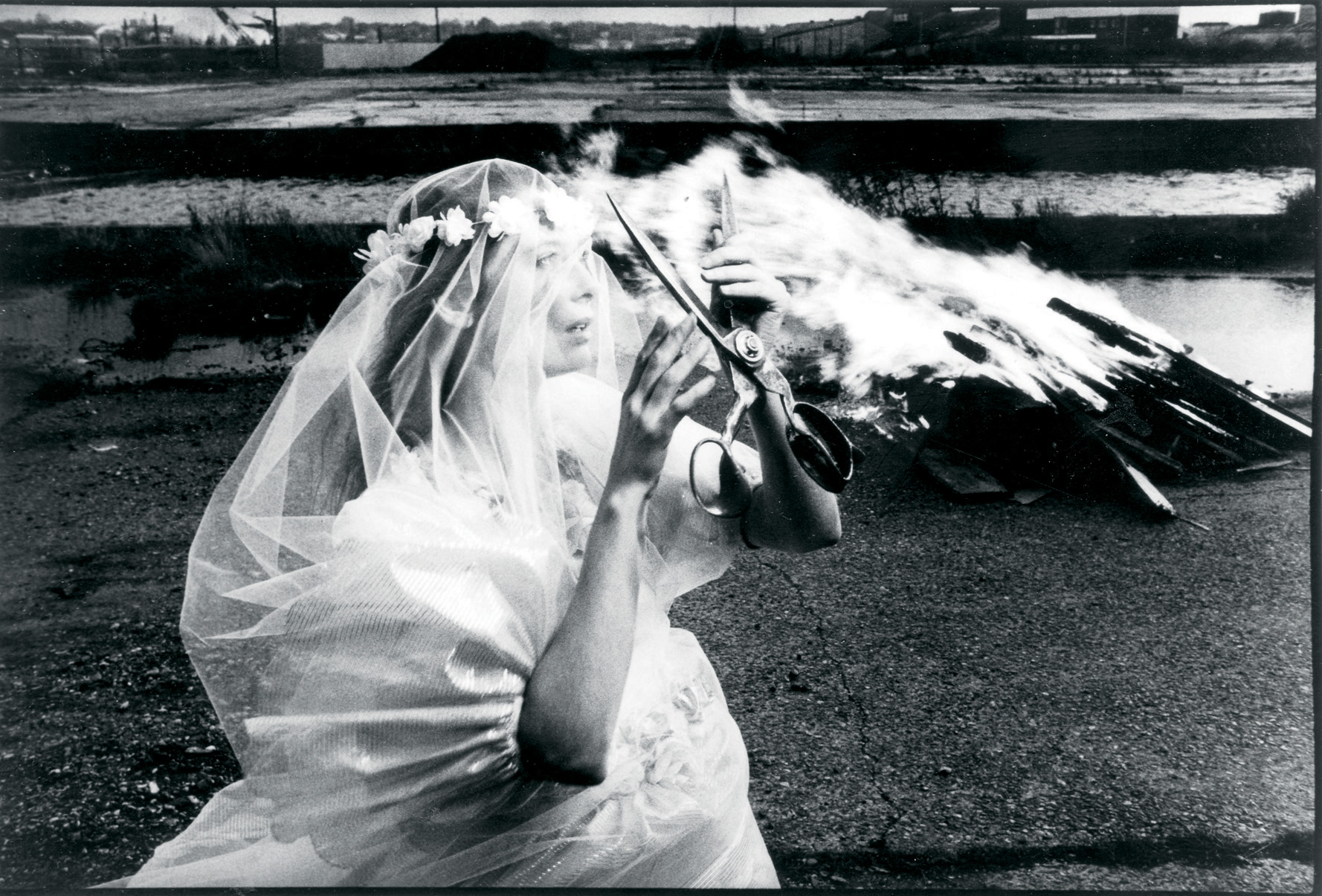
Tilda Swinton in The Last of England (1988).

John Dee turned up in Derek Jarman’s Jubilee after scenes from an earlier script about the Elizabethan magus were grafted onto the punk dystopia. Jarman’s career was to be littered with these unrealised projects, the strangest of which was Neutron, an apocalyptic science fiction film he was planning following the comparative success of The Tempest in 1979. The description he gives in his “Queerlife”, Dancing Ledge, is as follows:

There are six published manuscripts of Neutron, which zig-zag their anti-heroes Aeon and Topaz across the horizon of a bleak and twilit post-nuclear landscape. ‘Artist’ and ‘activist’ in their respective former lives, they are caught up in the apocalypse, where the PA systems of Oblivion crackle with the revelations of John the Divine. Their duel is fought among the rusting technology and darkened catacombs of the Fallen civilization, until they reach the pink marble bunker of Him. The reel of time is looped—angels descend with flame-throwers and crazed religious sects prowl through the undergrowth. The Book of Revelations is worked as science fiction.

Lee [Drysdale] and I pored over every nuance of this film. We cast it with David Bowie and Steven Berkoff, set it in the huge junked-out power station at Nine Elms and in the wasteland around the Berlin Wall. Christopher Hobbs produced xeroxes of the pink marble halls of the bunker with their Speer lighting—that echo to ‘the muzak of the spheres’ which played even in the cannibal abattoirs, where the vampire orderlies sipped dark blood from crystal goblets.

If that doesn’t whet your appetite I don’t know what would. Later drafts of the script were written with Jon Savage. If the film had been made it might well have been terrible, of course, but Christopher Hobbs, who worked with Jarman on later films, as well as on Velvet Goldmine and the BBC’s Gormenghast, would at least have made it look great. David Bowie is very good in The Man Who Fell to Earth but his acting is seldom as successful elsewhere. Steven Berkoff would have been a better bet but a Bowie film would have received far more attention. Bowie discusses his involvement in a 1999 interview here (and also slags off Velvet Goldmine…booo!).

All this was happening circa 1980 when Reagan and Thatcher had just begun their insidious reigns and the Cold War was moving into a new era which generated a great deal of apocalyptic anxiety. Jarman’s response to all of this materialised in 1988 with The Last of England, his bleakest film, and a work in which we can perhaps see some of the nightmare scenes which Neutron would have conjured. I’ve never liked The Last of England very much but it contains a few sequences worth savouring, especially shots of the luminous Tilda Swinton dancing through the wasteland devastation. There’s a fragment of that here with her ripping her dress to pieces accompanied by the voice of Diamanda Galás. Meanwhile, does David Bowie still have the production designs for Neutron? If so, when do we get to see them?

Previously on { feuilleton }
Mister Jarman, Mister Moore and Doctor Dee
The Tempest illustrated
In the Shadow of the Sun by Derek Jarman
Derek Jarman at the Serpentine
The Angelic Conversation
The life and work of Derek Jarman