Listen to the Colour of Your Dreams: Part One

mojo.jpg

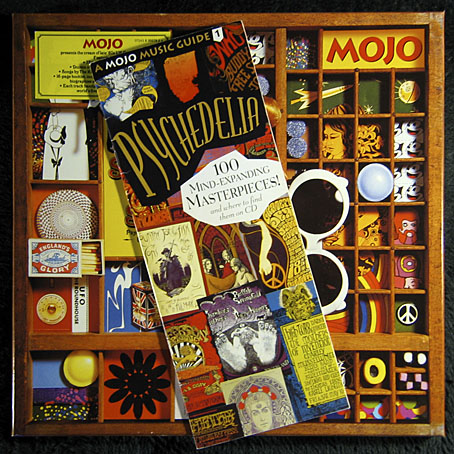
Blame these things: the Jon Savage booklet, and Mojo Presents Acid Drops, Spacedust & Flying Saucers (design by Phillip Savill).

One of the commissions for the New Year is psychedelia-related so to get in the mood I’ve been listening to the six CD compilations of psychedelic songs I made some years ago. I must have spent about five years gathering everything on these discs which comprise 132 selections in all, three for UK music and three for the USA, covering the years 1966–1969. The impetus was an annotated booklet listing “100 mind-expanding masterpieces” that Jon Savage had compiled for Mojo magazine in 1994; a revised list was published in 1997 along with some debatable contemporary additions. Things came to a head (so to speak) in 2001 when Savage and fellow Mojo journalists put together a four-CD collection of prime UK psychedelia for EMI, Acid Drops, Spacedust & Flying Saucers, which included many of the songs from Savage’s list. That collection and the Rhino Records Nuggets box began the mania to accumulate everything on Savage’s list. Once I’d started burning my own compilations the Savage 100 quickly expanded when I realised that I ought to include more favourites of my own.

To start the year, then, I’m uploading all six compilations to Mixcloud beginning with the UK selection. Despite all the effort and the number of songs this still isn’t a definitive collection. As Savage observes in his notes, the late 1960s was a time of massive over-production by record companies with hundreds of singles released, especially in the UK. Many one-off releases by obscure bands are as good as those that topped the charts which is why psychedelic compilations are so numerous, and why omissions are unavoidable.

With that proviso here’s the first part of the UK collection covering the years 1966 to 1967. The tracklist below indicates in bold the songs from the Savage 100 with notes about my additions. The listing is by order of release although this isn’t strictly accurate throughout. I’ll be uploading the rest of the compilations over the next few weeks.

UK Psychedelia, Part One by Feuilleton on Mixcloud

Dialogue — Alice In Wonderland (From Jonathan Miller’s BBC film, 1966.)
The Beatles — Tomorrow Never Knows
The Rolling Stones — Paint It Black
The Creation — Making Time
Craig — I Must Be Mad (A ferocious single by a band that only released one other 45 before splitting. Carl Palmer is on drums.)
Donovan — Season Of The Witch
The Yardbirds — Happenings Ten Years Time Ago
The Misunderstood — I Can Take You To The Sun (An American band who moved to London in 1966. This was their second and final single, and one of John Peel’s all-time favourites.)
Cream — I Feel Free
The Beatles — Strawberry Fields Forever
Pink Floyd — Interstellar Overdrive (Savage has the version from Tonite Let’s All Make Love In London which runs for almost 17 minutes. The version here is the shorter one from Piper At The Gates Of Dawn.)
The Smoke — My Friend Jack
The Poets — In Your Tower
The Move — I Can Hear The Grass Grow
The Troggs — Night Of The Long Grass
Traffic — Paper Sun
The Jimi Hendrix Experience — Are You Experienced?
Tomorrow — My White Bicycle (Savage has a later single, Revolution, but I much prefer this earlier 45.)
John’s Children — Midsummer Night’s Scene
Dialogue — Yellow Submarine
The Beatles — It’s All Too Much
The Attack — Colour Of My Mind
Small Faces — Green Circles

Previously on { feuilleton }
What Is A Happening?
My White Bicycle
Ogdens’ Nut Gone Flake
Tomorrow Never Knows
The Dukes declare it’s 25 O’Clock!
Yellow Submarine comic books
A splendid time is guaranteed for all
Saga de Xam by Nicolas Devil

saga01.jpg

Saga de Xam, a large-format comic book published by Éric Losfeld in 1967, is another example of French erotic psychedelia that remained off my radar until I got my hands on the exhibition catalogue for the Musée d’Orsay’s Art Nouveau Revival show in 2010. The glorious drawing below was used as the background for the exhibition poster, and appeared inside the catalogue with two more pages from this rare and sought-after book, described in the catalogue as “the best and most precocious example of French BD directly inspired by American psychedelia”.

saga02.jpg

Éric Losfeld is a fascinating character, a kind of pop-culture equivalent of Maurice Girodias, the founder of Olympia Press. Both men published erotic novels, and both had problems with the authorities as a result; but Losfeld also found a niche in art and graphics, producing albums of erotic comic strips—Jean-Claude Forest’s Barbarella, Guy Peellaert’s Jodelle and Pravda, Guido Crepax’s Valentina, Philippe Caza’s Kris Kool—and lavish portfolios from the weirder end of the erotic art spectrum, showcasing work by Raymond Bertrand, Jean-Marie Poumeyrol and others. It’s common for Brits to consider France a more enlightened nation where sex and comic-art is concerned but in the 1960s comics in France were considered an unsuitable medium for sexual material. Many of Losfeld’s comic-books of the late 60s and early 70s endured the kind of censure that was occurring in Britain and elsewhere. An early non-erotic title was Lone Sloane: Mystère des Abîmes in 1966, the first Lone Sloane story by Philippe Druillet. This no doubt explains Druillet’s involvement with Saga de Xam a year later.

saga16.jpg

Saga de Xam: les créateurs.

The comics by Forest, Peellaert and Crepax all featured attractive (often naked) woman as their lead characters. Saga de Xam continued the trend, a story in seven chapters that reads like an amalgam of all the comics Losfeld had published up to that point, Druillet included. The book is credited to Nicolas Devil, and based on a scenario by film director Jean Rollin. (Druillet would later design some posters for Rollin’s vampire films.) Devil, aka Nicolas Deville, was one of Rollin’s art directors who also worked for a time as a comic artist and illustrator. For Saga de Xam Devil was the principal artist in the first six chapters, and wrote most of the text and dialogue. In the final chapter other hands are involved: Jim Tiroff, an actor from Julian Beck’s Living Theatre, provided a poem in English, while the artwork is an unusual exercise in the Surrealist “Exquisite Corpse” technique with Devil, Druillet and several other artists—Barbara Girard, Merri, Nicolas Kapnist—collaborating on a series of improvised splash pages. The final chapter also features arrangements of text that resemble layouts from avant-garde art magazines. Druillet’s contributions are easy to identify since they resemble invasions from his Lone Sloane series, even including references to the Necronomicon.

Continue reading “Saga de Xam by Nicolas Devil”

Weekend links 236

carvalho.jpg

The Three Witches (2014) by Lorena Carvalho.

Immersion, a new album by Grey Frequency, “…is a recording of the broken signals, wraiths in the ether from lost futures and utopias which were once promised…”. Box Of Secrets (1999) is an album of electronica by Ian Boddy that’s a free download until the end of December.

• “Hothouse flowers, Egyptian statuary, jewels, Nubian servants, crystal balls, cocaine, opium and champagne were just some of the things she spent her money on…” Lucy Davies explores the riotous world of Marchesa Luisa Casati.

• “London is a network of complete nexuses, coincidences, overlaps, references…” Stephanie Boland talks to Iain Sinclair about his new book 70×70: Unlicensed Preaching: A Life Unpacked in 70 Films.

My Women’s Studies professors would say: “You don’t know how hard we fought for you.” And yet, when they told me my sexuality was not correct, I felt embarrassed. I knew I had longings that didn’t line up with the politics, but I refused to repress them, particularly in my writing. I fought to unravel a political correctness that was censoring desire.

Screenwriter Erin Cressida Wilson on sex, cinema and secrets

Cthulhu, Fiction and Real Magic, a lecture by Ian ‘Cat’ Vincent at Treadwell’s, London, on December 3rd. For those who can’t attend, Erik Davis has just posted his essay about Lovecraft and contemporary occultism.

• “John Gielgud was obsessed with trousers, loved corduroy and leather. And so he wrote a film set in a menswear shop.” Gielgud’s unfilmed screenplay for gay porn director Peter de Rome may now be filmed.

• “The stories are even more fantastic and full of marvels than those in the Arabian Nights.” Robert Irwin on the newly-translated Tales of the Marvellous.

• Mixes of the week: The Advisory Circle present Winter From Out Here; Fall by The Ephemeral Man; Secret Thirteen Mix 136 by Cosmin TRG.

Danny Cooke‘s drone views of Pripyat, Chernobyl. Related: Into the Zone: Gasworks Park (Seattle, WA) by Christina Scholz.

• Watch Dragnet’s 1967 LSD episode. More psychedelics: “Magic mushrooms change brain connections“.

• Earth Magic: Peter Bebergal on photography of witches at play and at ritual.

• Düsseldorf 1970: The crucible of Krautrock by those who were there.

• It’s Alright Ma, It’s Only Witchcraft (1968) by Fairport Convention | Witch’s Will (1973) by Wilburn Burchette | Witches’ Multiplication Table (1982) by Holger Czukay

John Austen’s Little Ape

austen1.jpg

British illustrator John Austen (1886–1948) illustrated many classic works of fiction throughout the 1920s, one of which, Hamlet, was recently reprinted by Dover Publications. His other work isn’t so easy to find, however, and I’d not seen Little Ape and Other Stories (1921) until Nick H drew my attention to a copy for sale at silver-gryph’s eBay pages. (Thanks, Nick!)

Ralph Holbrook Keen’s story collection was Austen’s first illustrated edition although you wouldn’t necessarily take it for a debut work. There are the familiar nods to Beardsley—the black-and-yellow cover especially—and possibly Harry Clarke whose influence is more evident in the Hamlet drawings. Clarke and Austen exhibited together in 1925. The skeleton with a floral crown makes me think of the rose-crowned skeleton in Edmund J. Sullivan’s Rubáiyát (1913), although this may be a result of Sullivan’s drawing having been made very familiar by its use on Mouse & Kelley’s posters for the Grateful Dead. One of the many connections between the Golden Age of Illustration and the Golden Age of Psychedelia.

austen2.jpg

austen3.jpg

Continue reading “John Austen’s Little Ape”

Weekend links 235

shadows.jpg

Shadows (1974) by Pawel Nolbert & Lukasz Murgrabia, one of three images recreating Francis Bacon’s Triptych–August 1972.

Breaking the Code (1996), a BBC film by Herbert Wise based on Hugh Whitemore’s stage play about Alan Turing. Wise’s film has been linked here before but it’s relevant again thanks to the release of The Imitation Game. Derek Jacobi played Turing on stage and screen, and Whitemore’s script managed to deal with Turing’s life and work without insulting the man or the intelligence of its audience.

• “…if you listen to A Beacon From Mars by Kaleidoscope or if you listen to some Turkish taxim then something starts happening.” Robert Plant talking to Julian Marszalek about the music that excites him.

• “CGI has become wearingly dull and clichéd. Can its deep weirdness be recovered and filmgoers’ minds stretched again?” asks Jonathan Romney.

The cult of the Thirty-Seven Nats is unique to Burma. […] The junta’s attempts to subdue nat worship had an unintended effect: the role of the nat wife was embraced by an already marginalized group. Homosexuality is illegal in Burma and has been since its British colonizers instituted a late-nineteenth-century ban on “intercourse against the order of nature”. Government restrictions opened a professional vacuum, says scholar Tamara C. Ho. Becoming a nat kadaw offered the achauk—a Burmese term for gay and transgender men—both “a vocation and queer visibility”.

After the Green Death by Will Boast

• “Cat memes and other frivolities aren’t the work of an Internet culture. They’re the work of an American one, ” says Caitlin Dewey.

• Hear the cavernous reverb of Berlin’s Kraftwerk captured by Emptyset’s James Ginzburg and Yair Elazar Glotman.

• Take part in the first #psychedelicpride photoshoot in central London on Saturday, December 13th.

• Mix of the week: FACT Mix 470 by Jonny Trunk who also appears in the list of vinyl hoarders below.

• Queer Noise: Abigail Ward on the history of LGB music and club culture in Manchester.

More photos of the steampunk exhibition at 751 D-Park, Beijing, China.

A chronological list of synth scores & soundtracks.

• Animated photography by Julien Douvier.

• A Third Ear Band archive at SoundCloud.

The secret lives of vinyl hoarders.

Taxim (1968) by Kaleidoscope | Water (1970) by Third Ear Band | Love Is The Devil (1998) by Ryuichi Sakamoto