More Esteban Maroto

maroto05.jpg

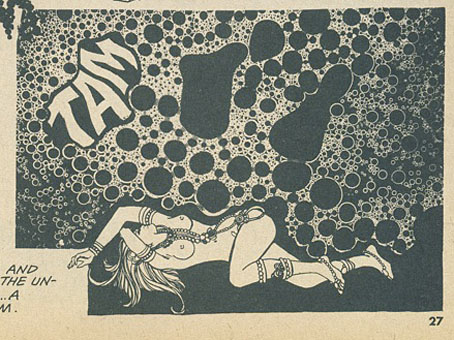
Psychedelic Kali from Vampirella 18.

Copies of the Dracula comics may be scarce these days but two of the artists who appeared in the title—Esteban Maroto and José Beá—were also appearing regularly in Vampirella around the same time. The Internet Archive has a large collection of Warren titles including an almost complete run of Vampirella. Esteban Maroto’s work stands out for me for his draughtsmanship, his page layouts, the atmosphere of heady eroticism, and the frequent touches of psychedelia of which the panel above is one of the more striking examples. The best strips are the ones he wrote himself; when he works with American writers the results tend to be more restrained. It’s a shame Vampirella was mostly a black-and-white title, so many of these pages would benefit from the same colour treatment as Wolff.

maroto01.jpg

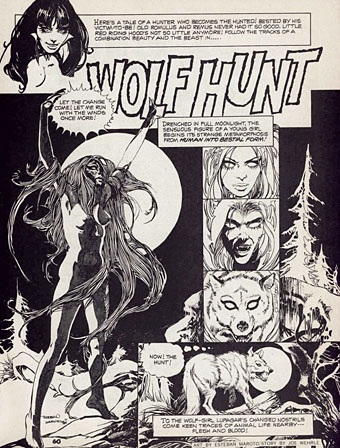
Wolf Hunt from Vampirella 14.

And speaking of wolves, there’s a similar collection of witches and lycanthropes in these stories.

maroto02.jpg

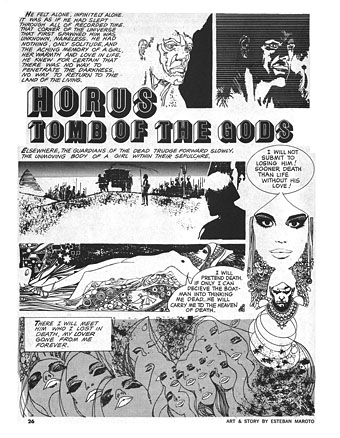
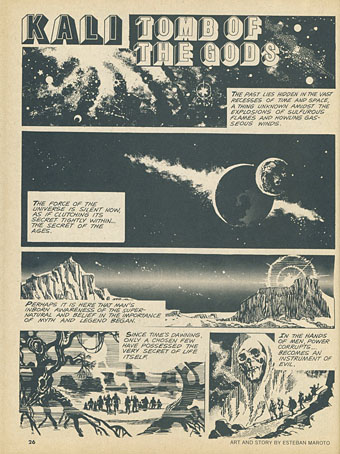
Tomb of the Gods: Horus from Vampirella 17.

Tomb of the Gods is a short series in which mythological stories are explored Maroto-style. The exception is Gender Bender, a piece of science fiction with masculine and feminine psyches pitted against each other in a virtual arena. The story title is a surprise for anyone thinks that phrase originated in the 1980s.

maroto03.jpg

Tomb of the Gods: Kali from Vampirella 18.

Continue reading “More Esteban Maroto”

The Dracula Annual

wolff1.jpg

A comment by Modzilla in last month’s post about psychedelic comic book Saga de Xam is responsible for this recent book purchase. Dracula was a full-colour large-format comic book from notorious pulp imprint New English Library (later to be distributors for my colleagues at Savoy Books) that repackaged Spanish horror strips for a British audience. The comic ran for 12 issues in the early 1970s; the pages shown here are from the hardback annual that gathered all the issues into a single volume. I remember this being around in secondhand shops for years but I never paid it any attention at all so the artwork has been a revelation.

NEL’s Dracula isn’t much of a horror comic, despite its title; Dracula himself only appears in one story, and that’s a jokey throwaway piece. The two main episodic strips are Wolff, a Conan clone searching for his lost wife in a world ravaged by witches, werewolves and other supernatural threats; and Agar-Agar, a deliriously psychedelic picaresque concerning a hyper-sexual “sprite” (or a hippyish young woman with blue hair and magic powers) from the planet Xanadu. Everything in the book is redolent of the early 1970s when strains of psychedelia were still percolating through pop culture. Watered-down psychedelia used to bore me because I wanted the authentic stuff but forty years on this kind of work is much more attractive.

wolff2.jpg

Wolff is the work of Esteban Maroto whose splash pages and inventive layouts give Barry Windsor-Smith’s Conan the Barbarian (which was running at this time) some serious competition. Wolff is very much in the Conan mould—he even shouts “Crom!” at crucial moments—a pawn of supernatural forces he often fails to comprehend. The artwork in Smith’s Conan was often praised for its details and decor but the Art Nouveau influence in Maroto’s work is much more overt. Maroto’s flame-haired witches are like Alphonse Mucha sirens—one panel even borrows from Mucha’s Salammbô—and he’s no slouch with the Frazetta-like demons either. The scripting is perfunctory but I don’t mind that when it turns up pages like these. There’s also a brief nod to Lovecraft when “R’Lyeh” is mentioned.

wolff3.jpg

wolff4.jpg

Continue reading “The Dracula Annual”

Weekend links 253

mackey.jpg

A painting by Stephen Mackey.

• “Creativity is visual, not informed thought. Creativity is not polite. It barges in uninvited, unannounced—confusing, chaotic, demanding, deaf to reason or to common sense—and leaves the intellect to clear up the mess. Above all else, creativity is risk; heedful risk, but risk entire. Without risk we have the ability only to keep things ticking over the way they are.” Revelations from a life of storytelling by Alan Garner. Related: Tygertale on Garner’s Elidor (1965), “the anti-Tolkien”. The BBC’s 1995 adaptation of Elidor remains unavailable on DVD but may be watched on YouTube.

• “One of my revelations was to reverse everything I’d been taught. Making lettering as illegible as possible falls into that way of thinking.” Psychedelic artist and underground cartoonist Victor Moscoso talks to Nicole Rudick about a life in art and design. Related: “I’ve gotten a lot of bad write-ups in newspapers over the years and they like to refer to my stuff as ‘kitsch’…Well, my stuff is way fuckin’ kitsch. It’s kitsch to an abstract level, you understand. It’s fuckin’ meretricious.” I love it when Robert Williams kicks the art world.

• “…a cerebral, challenging, visually stunning piece of 1970s American science fiction that enweirds the human perspective by challenging it with a nonhuman one.” Adam Mills on the inhuman geometries of Saul Bass’s Phase IV.

• “[Delia Derbyshire] taught me everything I knew about electronic music.” David Vorhaus talks to David Stubbs about White Noise and why he prefers the latest technology to old synthesizers.

• Costumes from Alla Nazimova’s film of Salomé (1923) have been discovered in a trunk in Columbus, Georgia.

• Mix of the week: The Ivy-Strangled Path Vol. I, “music for a residual haunting” by David Colohan.

• At Dangerous Minds: Queer, boho or just plain gorgeous: photographs by Poem Baker.

Grimm City, a speculative architectural project by Flea Folly Architects.

Mad Max: “Punk’s Sistine Chapel” – A Ballardian Primer.

In Search of Sleep: photographs by Emma Powell.

Drains of Manchester

Road Warrior (1985) by The Dave Howard Singers | Warriors Of The Wasteland (Original 12″ mix, 1986) by Frankie Goes To Hollywood | Drive It Mad Max (Super Flu Remix, 2009) by Marcus Meinhardt

Metastasis, a film by Toshio Matsumoto

metastasis.jpg

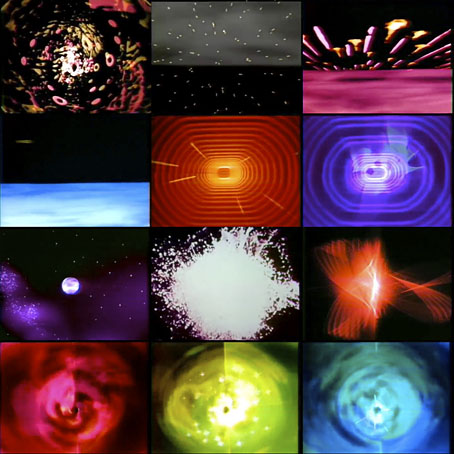
Or Toshio’s Psychedelic Toilet. Toshio Matsumoto is known to cineastes for feature films such as Funeral Parade of Roses (which I’ve still not seen—sorry, Thom!), but he’s also responsible for a number of experimental films like this one. In Metastasis (1971) we watch a toilet bowl for 9 minutes while the colours and contrast shift continually. Matsumoto said (in a scrambled quote):

I used the Erekutoro Karapurosesu (Electro Color Processor), which is mainly used in the field of medicine and engineering, to create moving image textures Metastasis, I was interested in layering images of a simple object and its electronically processed abstraction. The electronic abstract image is manipulated in a certain rhythm, depicting an organic process.

This might be tedious if it didn’t also have a decent electronic score by Toshi Ichiyanagi. Watch it here.

Chumlum, a film by Ron Rice

chumlum.jpg

25 minutes of superimpositions, hammock swinging, fabric waving and costume play with Jack Smith as master of ceremonies. The music by Angus MacLise (under the direction of Tony Conrad, whatever that means) gives the proceedings a suitably dreamy and hallucinatory air, like an attic restaging of Kenneth Anger’s Inauguration of the Pleasure Dome. Yesterday’s Doctor Benway operation featured Warhol Superstar Jackie Curtis as the nurse, and there are two more Superstars among the participants here: Mario Montez and Gerard Malanga; Montez had appeared in Jack Smith’s Flaming Creatures a year before. (Tony Conrad was the sound recordist on that occasion.) Ron Rice’s film was made in 1964, and is another of those products of the mid-60s that anticipates the later excesses of the decade. Watch it here.

Previously on { feuilleton }
The Invasion of Thunderbolt Pagoda, a film by Ira Cohen