Weekend links 695

pirner.jpg

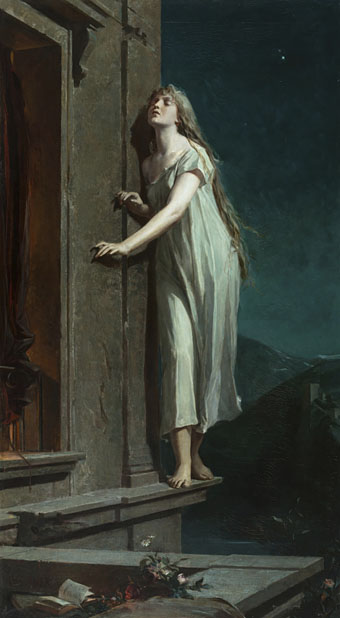
The Sleepwalker (1878) by Maximilián Pirner. Via.

• The latest non-fiction book from A Year In The Country is Threshold Tales, “an exploration of the edgelands, borderlands and liminal places in film; of the places whether literal, in the mind, cultural or amongst the paranormal realm where the boundaries between worlds, ways of life, the past and the future become thin and porous.” Featuring some useful viewing tips for the Spook Season, no doubt.

• Spoon & Tamago reports on VHS cafe opening in Tokyo’s Shimokitazawa district. I was happy to see the end of VHS format but I admire the Japanese dedication to redundant technology.

• There are more seasonal viewing (and reading) recommendations at Unquiet Things where Ms. E. has been blogging her way through the month. Begin here.

• At Public Domain Review: Edmund Fry’s Pantographia: A Specimen Book of All the Alphabets Known on Earth (1799).

See 12 winning images from the Wildlife Photographer of the Year Contest.

Wyrd mail (and further links to other things) for autumn from Wyrd Daze.

• At The Daily Heller: The Art of Invented Scripts, Meaning Optional.

• Mix of the week is DreamScenes – October 2023 at Ambientblog.

• New music: N/Y by The Haxan Cloak.

Sleepwalker’s Timeless Bridge (1972) by Amon Düül II | Sleepwalkers Woman (1983) by Scott Walker | Sleepwalking (1985) by Cabaret Voltaire

Weekend links 692

pearse.jpg

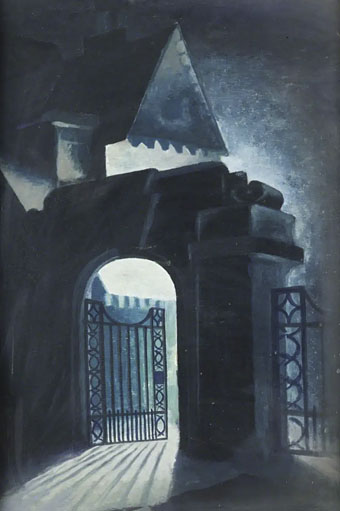
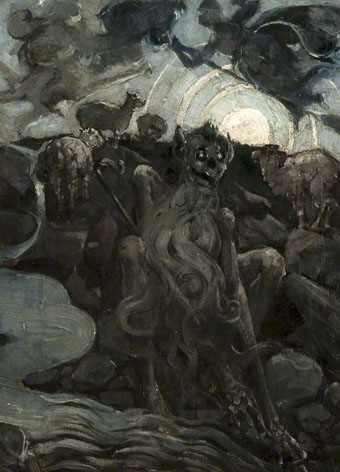
Illustration by Alfred Pearse for The Horror of Studley Grange by Clifford Halifax & LT Meade. Via.

The Haunting at 60: Guy Lodge asks “Is it still one of the scariest films ever made?” I say yes but then it’s always been a favourite. Also, Robert Wise is something of a cult figure in this house, not for his big-budget directing jobs on The Sound of Music and Star Trek: The Motion Picture, but for his RKO horror entries (The Curse of the Cat People and The Body Snatcher), his film noir (Born To Kill, The Set-Up, Odds Against Tomorrow), and two smaller science-fiction films from different decades, The Day the Earth Stood Still and The Andromeda Strain. All this and he also edited Citizen Kane.

• “This show makes an irrefutable case for her technical mastery while also affirming her as a first-rate fabulist whose disparate influences—chivalric romance, medieval architecture, tarot, psychology, astronomy, and much more—cohere into a visionary whole.” Jeremy Lybarger reviewing Science Fictions, the retrospective devoted to the art of Remedios Varo.

• New music: Improvisation On Four Sequences by Suzanne Ciani; Incorporeal by Hidden Horse; Atlas by Laurel Halo; Infinito (Version) by Moritz von Oswald.

While Ballard’s more outwardly conventional books may give us solider, more stable realities, what these realities often present…is a child (or childlike figure) frolicking against a backdrop provided by the destruction of an older order of reality that the world previously took for granted. It’s a cipher for his oeuvre as a whole: endlessly playing among the ruins, reassembling the broken or “found” pieces (styles, genres, codes, histories) with a passion rendered all the more intense and focused by the knowledge that it’s all—culture, the social order, the beliefs that underpin civilization—constructed, and can just as easily be unconstructed, reverse engineered back down to the barbaric shards from which it was cobbled together in the first place. To put it in Dorothean: In every context and at every level, Ballard’s gaze is fixed, fixated, on the man behind the curtain, not the wizard.

Tom McCarthy: JG Ballard’s Brilliant, Not “Good” Writing

• At Public Domain Review: Behold the Nebulous Smear: ‘Abd al-Rahman al-Sufi’s Illustrated Book of Fixed Stars (ca. 1430).

• At Unquiet Things: Shake, Shiver, and Shriek: The Haunted Gothic Nightmares of George Ziel.

Winners of Nature TTL Photographer of the Year 2023.

• The Strange World of…Gavin Bryars

Watch The Stars (1968) by Pentangle | Stars (1983) by Brian Eno with Daniel Lanois & Roger Eno | Kelly Watch The Stars (1997) by Air

Weekend links 691

kruger.jpg

Arcus (2019) by Markus Matthias Krüger.

• “Listeners can only make an educated guess as to what the experience of working with Slapp Happy might have done for Faust.” Fergal Kinney on the 50th anniversary of Sort Of by Slapp Happy, an eccentric intersection of Anglo-American rock and German experimentalism.

• Now that the summer is over people are making mixes again. Take your pick this week between a mix for The Wire by Shane Woolman at Stihia festival, The Observatory by Jay Keegan, or DreamScenes September 2023 at Ambientblog.

• Quantum poetics: “How Borges and Heisenberg converged on the notion that language both enables and interferes with our grasp of reality.” William Egginton explains, with a little help from Funes the Memorious.

“I feel as if I am entering Jorge Luis Borges’s Library of Babel, a universe of books and records, or maybe a labyrinth of paper and vinyl,” a flabbergasted Szwed relates. “The temptation is to read and listen to every one of them in hopes of at least finding the meaning behind Harry Smith the reader and listener.” He adds, with pointedly Borgesian anxiety, that “maybe my book is in there, already written.”

Ed Halter reviewing Cosmic Scholar: The Life and Times of Harry Smith by John Szwed

• At The Daily Heller: Photographs of lost buildings and American ruins.

• At Dennis Cooper’s: The unknowable presents…Secretly encoded.

• At The Paris Review: Six photos from WG Sebald’s albums.

Winners of the Astronomy Photographer of the Year 2023.

The Art of Cover Art: A Substack by Rachel Cabitt.

• New music: Le jour et la nuit du réel by Colleen.

Familiar Reality (1971) by Dr John | Reality Dub (Virtual Reality Mix) (1993) by Material | Reality Net (1994) by Richard H. Kirk

Weekend links 688

horna.jpg

Ascending to the Cathedral, Barcelona (1938/1960) by Kati Horna.

The rise and fall of Kowloon Walled City, Hong Kong’s infamous urban monolith. Related: a four-and-a-half-hour walkthrough of Stray, a game in which you help a cat escape from a deteriorated robot-filled housing complex.

• Quote of the week: “The true master requires the precision of a poet and the imagination of a scientist.” Thus Vladimir Nabokov at Lawrence Weschler’s Wondercabinet.

• New music: Orion Nebula by Christian Wittman, and Chthonic by Lawrence English & Lea Bertucci.

Chapter by chapter, Flaubert lampoons his poor pair, who fail at discipline after attempted discipline: landscape architecture, anatomy, history, literature, phrenology, religion, even love, and on and on. In each pursuit, they never lose the optimism or the hubris of thinking they can put their knowledge to work in the world. When they become interested in pedagogy, they adopt a pair of abandoned children who are at turns mystified by and contemptuous of their efforts to improve their well-being. The fruit trees fail, the novel is abandoned, a cat is boiled alive, the children cause scandals.

David Schurman Wallace explores the hazards of distraction with a detour through Flaubert’s Bouvard and Pecuchet

• At AnOther: Peter De Potter’s new book explores the erotic performance of social media.

• At Dennis Cooper’s: Hobart LaRoche presents…15 experimental video games.

Take a look at a book chronicling the albums of Island Records.

• At Colossal: Gabriel Schama’s laser-cut plywood reliefs.

Orion (1986) by Metallica | Shades Of Orion (1993) by Shades Of Orion | Orion (2001) by Jah Wobble and Bill Laswell

Weekend links 686

bickus.jpg

The Great Lab (2020); speculative architecture by Gytis Bickus. “This room is where the majority of the hallucinogenic substances are archived, within the walls & floors. It seems as though the architecture itself is being affected by the hallucinogenic substances stored within its fabric.”

• “They ran the recording through a vocoder, so it sounded staticky, like a voice infused with white noise, and put it at the end of the song. Then they went home.” Mark Dent on Change The Beat by Beside (aka Bee-side or Beeside), a song produced by Bill Laswell & Michael Beinhorn that includes one of the most sampled vocal lines in hip-hop. A great piece of audio-archaeology: I knew the sample but had no idea this song was its source. I only got to hear the Change The Beat very recently when I found a copy of Materialism, a collection of early Laswell productions, in a charity shop.

• At Unquiet Things: Artist, Chemist, Goofball: Catching Up With Tyler Thrasher.

• DJ Food looks at psychedelic posters created for London’s Middle Earth club.

His last commissioned work for Radio Berlin was a fantastical play he had composed himself. The transcript, titled “Lichtenberg: A Cross-Section,” ranks among the strangest things that he ever wrote. Beings who live on the moon are charged with the task of investigating the career of Georg Christoph Lichtenberg, a prominent physicist of the German Enlightenment. The moon beings have uncanny names—Labu, Quikko, Sofanti, and Peka—and they convene as the Moon Committee for Earth Research, which deploys odd contraptions for its work, each of them “easier to use than a coffee grinder.” There is a “Spectrophone,” which permits them to hear and see everything that happens on Earth; a “Parlamonium” that translates human speech into music; and an “Oneiroscope” that allows the researchers to observe human dreams. With the aid of these devices, the moon beings seek to understand why humans are so afflicted with misery. Their investigations finally reach the tentative conclusion that even if humans are unhappy, “perhaps it is their unhappiness that allows them to advance.” To honour the scientific achievements of Herr Lichtenberg, they conclude by naming a crater in his honour, a crater from which shines a “magical light that illumines the millennium.”

Peter E. Gordon on Walter Benjamin’s radio years

• At Dennis Cooper’s: Spotlight on…Brigid Brophy In Transit (1968).

15 lighthouses from the Smithsonian Magazine Photo Contest.

Sathnam Sanghera’s favourite songs.

• RIP William Friedkin and Jamie Reid.

• New music: The Long Song by Drøne.

Lighthouse (1978) by Tim Blake | Walk To The Lighthouse (1980) by John Carpenter | The Lighthouse (1994) by Hector Zazou ft. Siouxsie