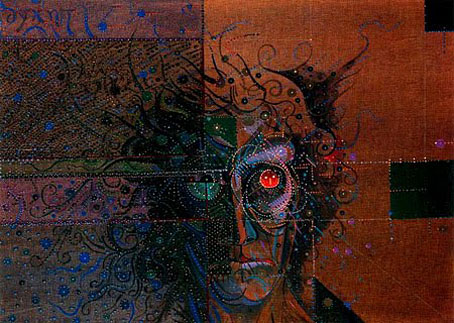
Ésser del Cap (1977–78).
A pair of works by a Catalonian artist whose varied and occasionally Surrealist output can be viewed here. There’s further work and career details here but not in English. Via.
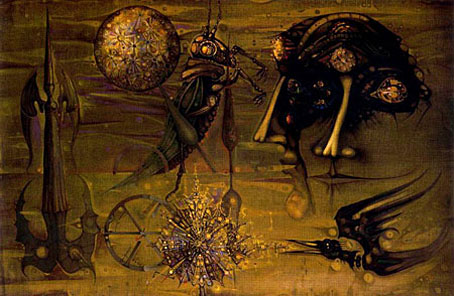
Sin título (1982).
A journal by artist and designer John Coulthart.
Painting
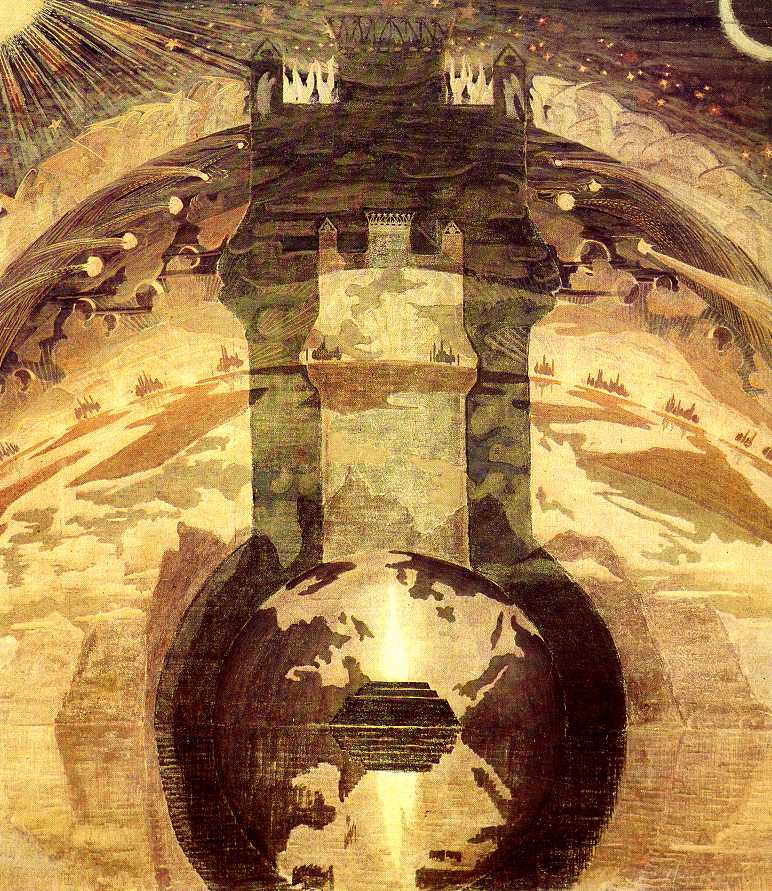
Rex (1909).
Another relatively obscure Symbolist, Mikalojus Ciurlionis was a Lithuanian artist and composer whose painted output might have graded to total abstraction if he’d lived a few more years. This site has a substantial gallery section and details of his life and other work.
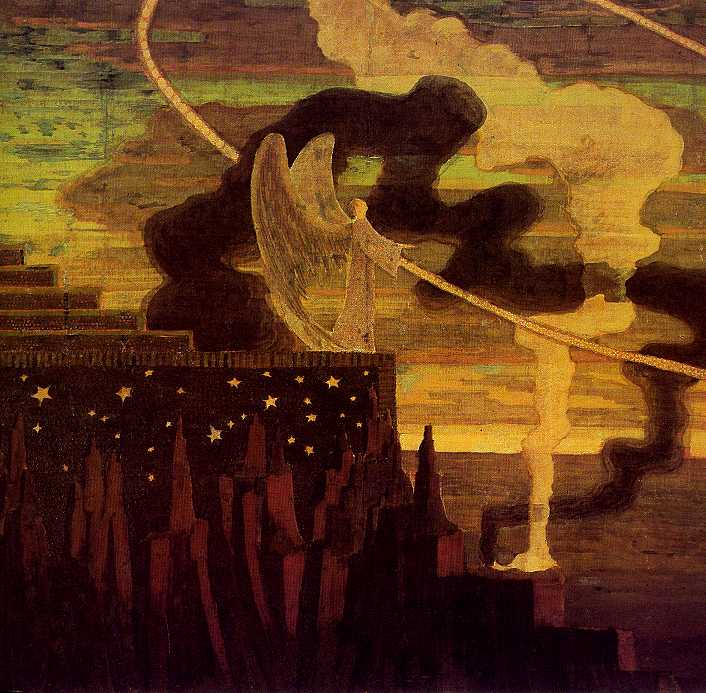
The Offering (1909).
Previously on { feuilleton }
• Delville, Scriabin and Prometheus
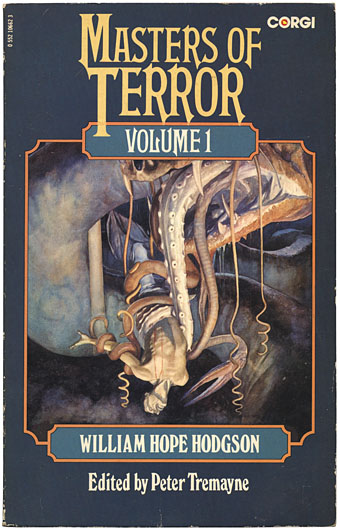
Masters of Terror, Vol 1, Corgi Books, 1977. No illustrator credited.
It was all happening this week so there’s a lot to get through. Are you ready? Deep breath…
For ye Hogge doth be of ye outer Monstrous Ones, nor shall any human come nigh him nor continue meddling when ye hear his voice, for in ye earlier life upon the world did the Hogge have power, and shall again in ye end.
The Hog (c. 1910) by William Hope Hodgson.
• “The Hog is Hodgson’s most nakedly Jungian setpiece; fetid waves of archetypes sweep repeatedly against the thin walls of quotidian reality.” Thus Iain Sinclair, writing in a 1991 afterword to Carnaki the Ghost-Finder which I highly recommend to both Hodgson and Sinclair enthusiasts. China Miéville dissected Hodgson’s Hog on Wednesday and a few hours later a student protest in London turned into an assault on the Tory HQ. Coincidence? Here at {feuilleton} we only offer the facts, it’s up to you to join the dots. M John Harrison approved. Of the protest, that is, not the raising of Porcine Malevolence from the Gulfs Beyond, although he might approve of that as well.
• Further Hodgsonia: Science of The Night Land: Dying Suns and Earth Energy while for real devotees there’s Andy Robertson’s Night Land site.
• “Amplifying the vibrations of the ether” for a view “beyond the limits of ordinary life”: The Fugitive Futurist (1924), a remarkable short film at the BFI’s YouTube channel in which Trafalgar Square is flooded, a monorail crosses Tower Bridge and a dirigible takes to the air over the Houses of Parliament. Also Trafalgar Square Riot (1913), a newsreel with suffragettes at the centre of a civil disturbance. Some of the critics of Wednesday’s events seem to have forgotten that women gained the vote in this country only after repeatedly smashing windows and causing trouble.
• Related to the above: How to Hex a Corporation at Arthur magazine. And let’s not forget Hakim Bey’s Occult Assault on Institutions.
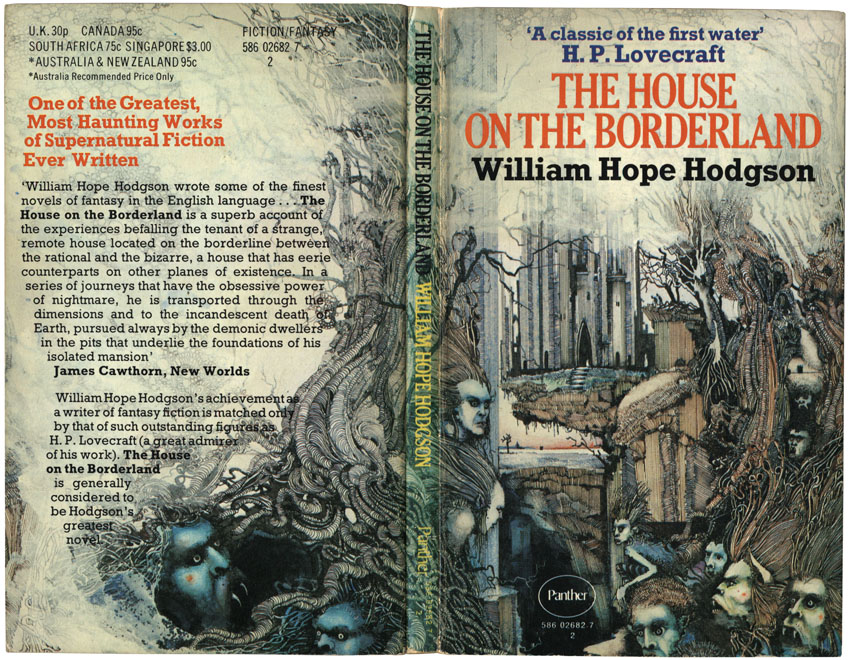
Cover illustration by Ian Miller (1972). The other great cover for THOTB was by Ed Emshwiller in 1962.
The wanderings of the Narrator’s spirit through limitless light-years of cosmic space and Kalpas of eternity, and its witnessing of the solar system’s final destruction, constitute something almost unique in standard literature.
HP Lovecraft reviewing Hodgson’s The House on the Borderland in Supernatural Horror in Literature.
• Lovecraft has long cast a shadow over Hodgson’s fevered visions even though words of praise like those above have done much to keep the earlier writer’s work in print. I’ve been talking for years about doing a series of illustrations for The House on the Borderland and may yet make good on that threat; never say never. Meanwhile, Rick Poyner returned to Design Observer this week pondering the challenge of non-Euclidean architecture in What does HP Lovecraft look like?
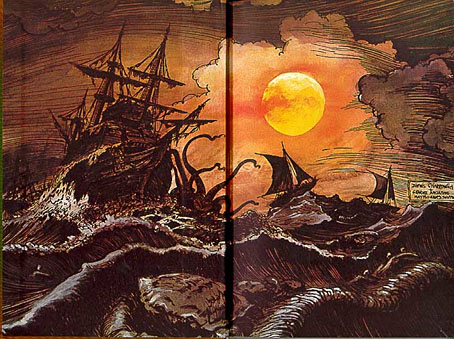
Druillet illustrates Hodgson (1971).
• In his latest piece of Barney Bubbles detective work, Paul Gorman discovered the identity of BB’s first design employer, the alluded to but never named Michael Tucker. More surprising for me than the Robert Brownjohn connection is that there’s now a tenuous link between Barney Bubbles and William Gerhardi.
• 777 classical music album covers from the collection of Dr Horst Scherg. Related: The Golden Age of Wacky Classical LP Covers — Westminster Gold and the Westminster Gold discography.
• Chez Fini: Little Augury looks at the work and workplaces (and cats!) of the marvellous Leonor Fini.
• There’s yet more Lovecraft (and much else besides) in Nomad Codes, a new book from Erik Davis.
• The Irrepressibles: “They’re scared of what we’re going to do next”.
• New Scientist asks Is this evidence that we can see the future?
• Of Electricity And Water: A Thomas Dolby Interview.
• Jarvis Cocker talks to Brian Eno.
• Hog Callin’ Blues (1962) by Charles Mingus. Play loud and often.
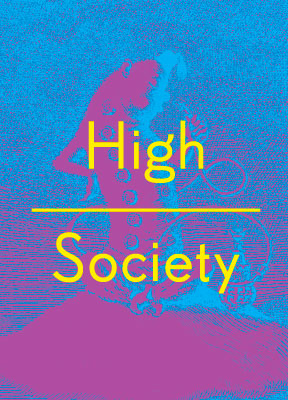
Mervyn Peake’s Caterpillar from Alice’s Adventures in Wonderland finds itself used to promote High Society, an exhibition at the Wellcome Collection devoted to the long history of human drug-taking. There’s more about the exhibition here and also an accompanying book by Mike Jay from Thames & Hudson. Related: The Most Dangerous Drug:
A group of British drug experts gathered by the Independent Scientific Committee on Drugs (ISCD) rated alcohol higher than most or all of the other drugs for health damage, mortality, impairment of mental functioning, accidental injury, economic cost, loss of relationships, and negative impact on community.
• Unless the magazine Man, Myth & Magic was advertised on TV in 1970 (and I suspect it would have been) Austin Osman Spare’s work has never been seen on British television, certainly not in any detail or with a credit to the artist. This week the BBC finally paid him some attention with a brief spot on The Culture Show as a result of the Fallen Visionary exhibition which is still running (until November 14) in London. Alan Moore, Fulgur‘s Robert Ansell and others attempt to summarise Spare’s career in seven minutes.
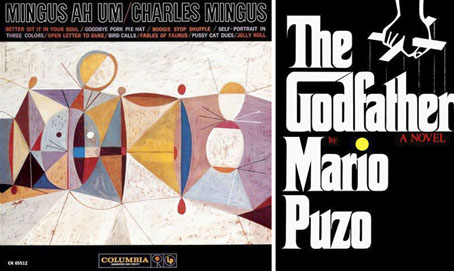
Neil Fujita designs: Mingus Ah Um (1959) and The Godfather (1969).
• RIP graphic designer Neil Fujita. Related:
“By taking the “G” and extending it to the “D,” I created a house for “God.” The way the word was designed was part of the logo and so was the type design. So when Paramount Pictures does a film version or Random House, which bought out the book from Putnam, does another Godfather book, I still get a design credit. In fact, before the first Godfather film opened in New York I saw a huge billboard going up in Times Square with my design on it. I actually got them to stop work on it until we were able to come to an agreement.” Waxing Chromatic: An Interview with S. Neil Fujita
• French SF illustration. Related: Where did science fiction come from? A primer on the pulps, a feature by Jess Nevins with some of the craziest covers you’ll see this month.
• Gay-bashers in 1970s San Francisco had to beware the wrath of the Lavender Panthers.
• More Marian Bantjes as she discusses her work in an audio interview.
• Music from Saharan cellphones.
• Better Git It In Your Soul (1959) by Charles Mingus.
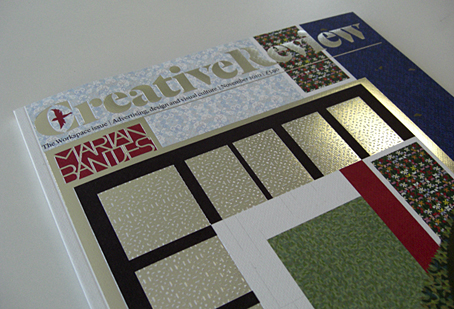
Marian Bantjes designs the cover of the latest Creative Review and there’s a feature about her work inside.
• “…the question: ‘was Shakespeare gay?’ strikes me as so daft as to be barely worth answering. Of course he was. Arguably he was bisexual, of sorts, but his heart was never on his straight side.” Don Paterson throws the cat among the pigeons in an examination of the Shakespeare’s sonnets. Related (sort of): Shakespeare and Company: The bookshop that thinks it’s a hotel. Also related: Jeanette Winterson revisits Shakespeare and Company.
• 100 orbs of light float in the Schuylkill River. Also in Philadelphia: Animators Amok in a Curiosity Cabinet: the Brothers Quay are making a film in the Mütter Museum. Can’t wait to see it.
• More Alan Moore: Fossil Angels, a lengthy essay about magic and the occult, was written in 2002 but hasn’t been given a public airing until now.
• Alberto Manguel is always worth reading:
As Borges was well aware even then, the history of literature is the history of this paradox. On the one hand, the deeply rooted intuition writers have that the world exists, in Mallarmé’s much-abused phrase, to result in a beautiful book (or, as Borges would have it, even a mediocre book), and, on the other hand, to know that the muse governing the enterprise is, as Mallarmé called her, the Muse of Impotence (or, to use a freer translation, the Muse of Impossibility). Mallarmé added later that all who have ever written anything, even those we call geniuses, have attempted this ultimate Book, the Book with a capital B. And all have failed.
• Here Comes Everybody: Wake In Progress is a self-described “foolhardy attempt to illustrate Finnegans Wake”. Easier to illustrate than make a film of the book, I’d have thought, and Mary Ellen Bute already attempted the latter.
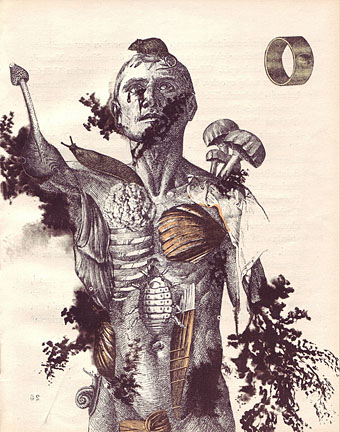
Psychic Explosion: Adolf Hoffmeister’s illustrations for a 1967 edition of Lautréamont’s Poesies at A Journey Round My Skull.
• Craig Colorusso’s Sun Boxes can be seen at Turner Falls, Massachusetts, during November.
• Clive Hicks-Jenkins has a book and retrospective exhibition of his art due next year.
• A sneak peek into The Steampunk Bible to which I’m a contributor. And also here.
• “Human or other; depends who comes”: the Ballardian films of Paul Williams.
• Transmission (1979) by Joy Division; Transmission (1995) by Low; Monkey (2010) by Robert Plant.