Weekend links 729

demorgan.jpg

Phosphorus and Hesperus (1881) by Evelyn De Morgan.

• Mix of the week, or possibly the entire year: The Deep Ark, 167 tracks (over 8 hours of music), most of which are from the electronic deluge of the early 1990s. The download link may not work for all browsers—it didn’t for one of mine—but it is active. Via Simon Reynolds who has more about the Deep Ark project.

• At Nautilus: Betsy Mason on the use of stage magic to investigate animal behaviour. “By performing tricks for birds, monkeys, and other creatures, researchers hope to learn how they perceive and think about their world.”

• At The Daily Heller: Mad and the Usual Gang of Idiots. Meanwhile, Mr Heller’s font of the month may prove useful for this election season, a Jonathan Barnbrook design named Moron.

Looking back, you can see a pattern in those eras in which interest in telepathy boomed. Coined by Myers and his fellow psychical researchers in the 1880s, telepathy gained traction because it was formulated inside a moment of scientific and technological revolution, where uncanny transmissions proliferated across the visible and invisible spectrum, seeming to collapse the natural and the supernatural together. In the 1970s, telepathy returned, if under different names, as part of another moment of crisis. The Cold War arms race was an essential part of this, feeding a strange supplemental world of fantasy technologies, from mind control to brainwashing, and playing on an all-too-widespread psychological paranoia around being seen, infiltrated and manipulated by invisible agents.

Roger Luckhurst looks back at a century of psychic research

• New music: Portable Reality Generator by Field Lines Cartographer, and Sublime Eternal Love by Chrystabell and David Lynch.

• Coffee and Chocolates for Two Guitars: Robert Fripp interviewing John McLaughlin in July, 1982.

• Paintings by Ithell Colquhoun currently showing at the Ben Hunter gallery, London.

• At Public Domain Review: Eye Miniatures (ca. 1790–1810).

• ESP (1965) by Miles Davis | ESP (1990) by Deee-lite | ESP (2002) by Comets On Fire

Weekend links 728

wadsworth.jpg

Composition: Cones and Spirals (1929) by Edward Alexander Wadsworth.

• “Repeating items over and over, called maintenance rehearsal, is not the most effective strategy for remembering. Instead, actors engage in elaborative rehearsal, focusing their attention on the meaning of the material and associating it with information they already know.” John Seamon on the vicissitudes of memory, and how actors remember their lines.

• “Mary McCarthy described it as ‘Fabergé gem, a clockwork toy, a chess problem, an infernal machine, a trap to catch reviewers, a cat-and-mouse game, and do-it-yourself novel’, among other things.” Mary Gaitskill on the pleasures and difficulties of Nabokov’s greatest novel, Pale Fire. Also a reminder that I ought to read it again.

• New music: Movement, Before All Flowers by Max Richter; A Thread, Silvered And Trembling by Drew McDowall; Unspeakable Visions by Michel Banabila.

• Among the new titles at Standard Ebooks, the home of free, high-quality, public-domain texts: Ulysses by James Joyce.

• The latest cartographical design from Herb Lester Associates is Facts Concerning HP Lovecraft and His Environs.

• At the Daily Heller: A look back at the craze for poster stamps.

• Mix of the week: A tuning mix for The Wire by Tashi Wada.

• At Dennis Cooper’s: Michael Lonsdale Day.

• Annie Hogan’s favourite music.

• Clockworks (1975) by Laurie Spiegel | Tin Toy Clockwork Train (1985) by The Dukes Of Stratosphear | Clockwork Horoscope (2008) by Belbury Poly

Weekend links 727

maar.jpg

Untitled (Hand-Shell) (1934) by Dora Maar.

• “The Secret Public…reads like the book he was born to write…and speaks to the taboo around homosexuality which the bravest pop stars did their best to dispel.” Alex Needham reviewing The Secret Public: How LGBTQ Resistance Shaped Popular Culture (1955–1979) by Jon Savage. Anyone buying the book should also find themselves a copy of Savage’s Queer Noises compilation.

• At Dangerous Minds: Richard Metzger advises everyone to seek out Sion Sono’s 237-minute Love Exposure (2008), “Japan’s eroto-theosophical answer to the allegorical journeys of Alejandro Jodorowsky”.

• Prince – Sign O’ The Times (Live at Paisley Park 12/31/87). Pro-shot video of the last performance of the Sign O’ The Times tour, with a unique contribution from Miles Davis.

• Old music: Camembert Electrique by Gong. A rocking riposte to the stereotype of the group as a bunch of whimsical hippies.

• New music: Lambda by ZULI. This is another release on the Subtext label which I designed.

• The Devil in the Flesh: Patrick Clarke on David Sylvian’s Red Guitar at 40.

• Milky Way photographer of the year 2024.

• The Strange World of…Gastr del Sol.

• Jungle Guitar (1961) by The Palatons | Lunatic Guitar (1980) by Ippu-Do | Naive Guitar (1982) by Adrian Belew

Pin culture

pins1.jpg

In the mail this week, a pair of new pins from the pin-maker and seller who made the exquisite Future Days pin. (eBay shop | Etsy shop) The Ege Bamyasi pin isn’t as effective as the earlier Can design but I feel compelled to encourage the effort, especially when most of the designs from this maker are for punk or post-punk bands. I also enjoy the novelty of seeing things like this at all. The years when I was discovering German music via secondhand releases (late 70s, early 80s) coincided with a period when I spent a lot of time scouring local shops for unusual badges. Growing up in a holiday resort gave me access to a greater quantity of cultural ephemera than you’d find in nearby towns, yet during this time I never saw any badges related to the German groups, not even Kraftwerk. As for prestige enamel items, you seldom saw these outside concert merchandise stalls where hardcore fans could be relied upon to pay more for their memorabilia.

pins2.jpg

Official pins from Hawkwind, Magma and Ghost Box Records.

The recent emergence of a cottage industry devoted to enamel pins means that these aren’t the only such items you’ll find on eBay or Etsy, but most of the others I’ve seen are either substandard (like another attempt to rework the Future Days cover) or are from North American sellers who want you to pay £25 or more for postage. Nein danke. But wherever the pin makers are located they all face the problem of how to create something related to groups who didn’t have a graphic identity that can easily be converted to metal and enamel. Where Can are concerned you could at least do this with their name as it appears on the Tago Mago cover. (Maybe such a thing exists already?) And I was amused to see that one pin maker has managed to reduce Manuel Göttsching’s chessboard cover for E2–E4 to pin size. What I’d really like now is a Neu! pin in black and white like the design on the cover of Neu! 75. Here’s hoping…

Previously on { feuilleton }
• A Can pin
• Rock shirts

Weekend links 726

ferriss.jpg

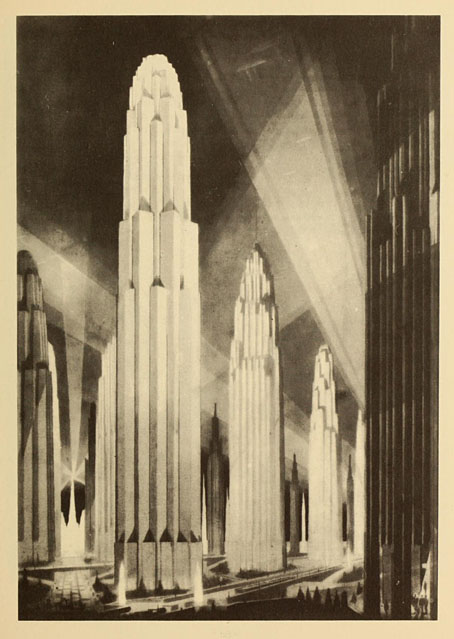
Verticals on Wide Avenues from The Metropolis of Tomorrow (1929) by Hugh Ferriss.

• Megalopolis, the futuristic epic written and directed by Francis Ford Coppola, now has a trailer and a handful of mixed reviews. I recall Coppola saying years ago that he was the kind of director who would happily make films in any genre, science fiction included. I’ve wondered ever since what a full-on Coppola SF film might look like. (Captain EO and Peggy Sue Got Married don’t count). Now it seems we’re about to find out. Given his previous missteps I remain sceptical yet curious about this one. I’ve avoided his output since Bram Stoker’s Dracula but I’m still happy to see him being so ambitious while retaining his independence.

• And RIP Roger Corman who Coppola remembered as “my first boss, task-master, teacher, mentor, and role model. There is nothing about the practical matter of making movies I didn’t learn by being his assistant.” Related: It rained on the Sunday: a career interview with Roger Corman by Matthew Thrift.

• At Retro-Forteana: Fortean-themed music, from opera to metal. A difficult subject for a such short post, as the author admits. I’m amused to see one of my Hawkwind album covers in the list although the album itself doesn’t seem very Fortean to me.

• “Did you know that, if things had gone differently, the Pompidou Centre could have been an egg?” Oliver Wainwright on architecture that might have been.

• At Cartoon Brew: A closer look at great animated title sequences. I deplore the omission of Richard Williams’ titles for The Charge of the Light Brigade (1968).

• At Public Domain Review: Love Spells and Deadly Shrieks: Illustrations of Mandrakes (ca. 650–1927).

• At Wormwoodiana: “That Strange Little Book”: Ding Dong Bell by Walter de la Mare.

• At Unquiet Things: The latest collection of Intermittent Eyeball Fodder.

• Mix of the week: DreamScenes – May 2024 by Ambientblog.

• Mandrake Root (1968) by Deep Purple | Mandrake (1975) by Gong | The Mandrake’s Hymn (2019) by Earth