The Great God Pan

pan_daphnis.jpg

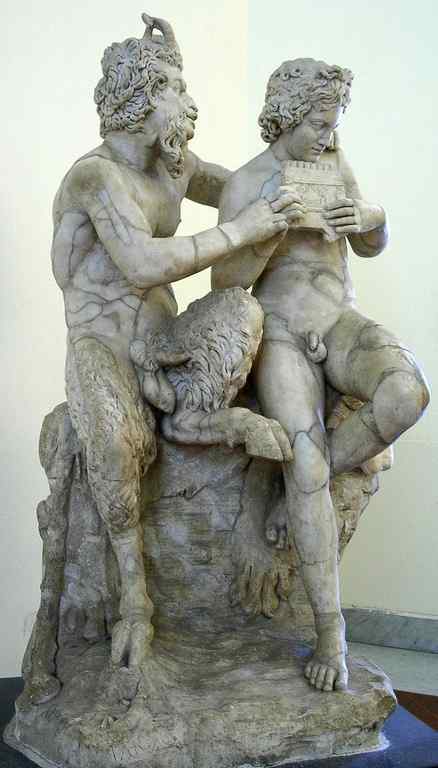
Pan teaching Daphnis to play the panpipes; Roman copy of a Greek original from the 3rd-2nd centuries BCE by Heliodoros.

“The worship of Pan never has died out,” said Mortimer. “Other newer gods have drawn aside his votaries from time to time, but he is the Nature-God to whom all must come back at last. He has been called the Father of all the Gods, but most of his children have been stillborn.”

So says a character in The Music on the Hill, one of the slightly more serious stories from Saki’s The Chronicles of Clovis (1911). Saki’s Pan is a youthful spirit closer to a faun than the goatish creature of legend. But being a gay writer whose tales regularly feature naked young men (surprisingly so, given the time they were written) I’m sure Saki would have appreciated the Roman statue above. There’s nothing chaste about this Pan with his “token erect of thorny thigh” as Aleister Crowley put it in his lascivious 1929 Hymn to Pan, a poem which caused a scandal when read aloud at his funeral some years later. The Roman statue was for a long while an exhibit in the restricted collection of the Naples National Archaeological Museum where all the more scurrilous and priapic artefacts unearthed at Pompeii were kept safely away from women, children and the great unwashed. These are now on public display and include the notorious statue of a goat being penetrated by a satyr.
Continue reading “The Great God Pan”

Max (The Birdman) Ernst

birdman.jpg

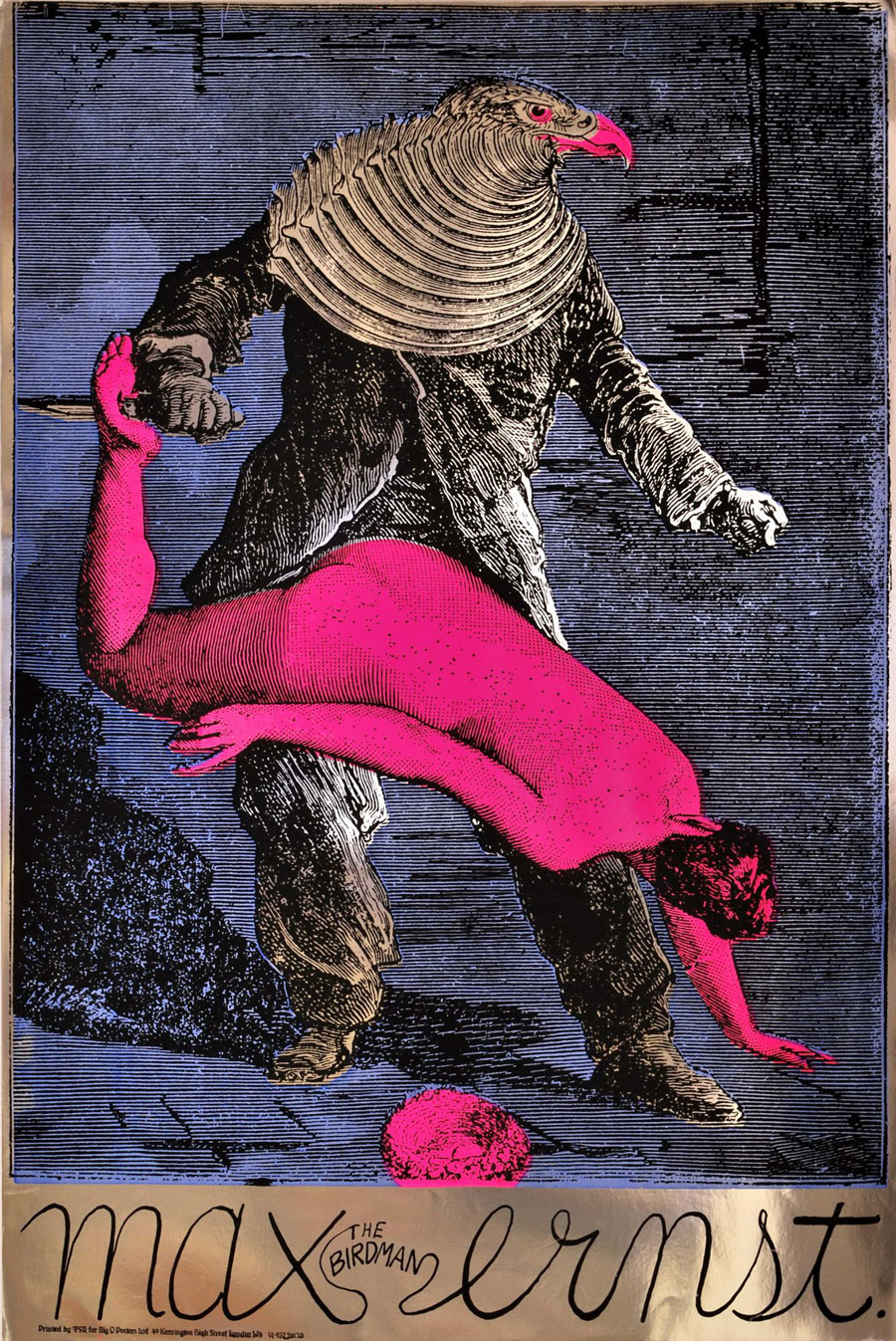
Max (The Birdman) Ernst (1967).

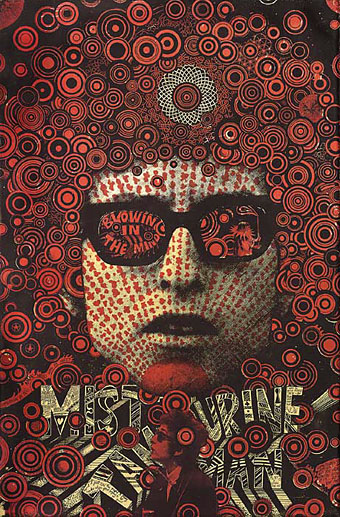
Psychedelia is never far away here at { feuilleton }. Yesterday’s film poster reminded me of this work from the psychedelic era by Martin Sharp, an Australian artist who moved to London and became closely-associated with Oz magazine and London’s other leading psych poster designers, Michael English and Nigel Waymouth, aka Hapshash & the Coloured Coat. Sharp’s homage to the great Max was one of a number of his designs produced on metallic foil sheets, the reflective nature of which often presents difficulties for reproduction in other media.

performance.jpg

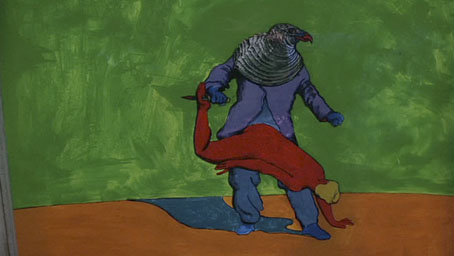
Performance (1970).

I wonder how many people who admired Sharp’s poster puzzled over the meaning of the image, one of twenty-eight similar collages from the fourth chapter of Ernst’s 1934 “collage novel” Une Semaine de Bonté. Chapter four—Wednesday; Blood—concerns the criminal travails of a series of bird-headed individuals (or possibly the same individual in different guises) which end in abduction, possible rape/murder, and suicide. This picture of Ernst’s has always struck me as a very obvious rape metaphor with the woman stretched over the birdman’s lap and the knife piercing her foot. Ernst’s dark imagination—informed by Freudian concerns, as were most of his fellow Surrealists—separates the picture from the more lightweight Art Nouveau/Beardsleyesque stylings of the other London artists. Martin Sharp was producing collages of his own during this period so it’s easy to see why he was attracted to Ernst. And the popularity of his poster may explain why the birdman turns up in a painted version in Donald Cammell & Nicolas Roeg’s Performance, seen when Pherber (Anita Pallenberg) goes to pick mushrooms in the greenhouse. Ernst’s sinister birdman suits Performance very well, a token of the film’s atmosphere of weirdness and violence. (“A heavy evil film, don’t see it on acid” warned underground newspaper International Times.)

sharp_dylan.jpg

Bob Dylan: Blowing in the Mind (1967).

And to compound the connections a little more, Sharp’s famous Bob Dylan collage portrait (another foil sheet production) also turns up in Performance as part of the collage-covered screen in one of Turner’s rooms. Unlike his fellow Hapshash artists, Sharp’s work is under-documented on the web beyond pages such as this one. The same goes for Ernst’s collage novel but then the best way to experience that is to buy the Dover book edition.

Previously on { feuilleton }
• The Robing of The Birds
• Gandharva by Beaver & Krause
• The Look presents Nigel Waymouth
• The New Love Poetry
• Judex, from Feuillade to Franju
• Further back and faster
• Quite a performance
• Borges in Performance

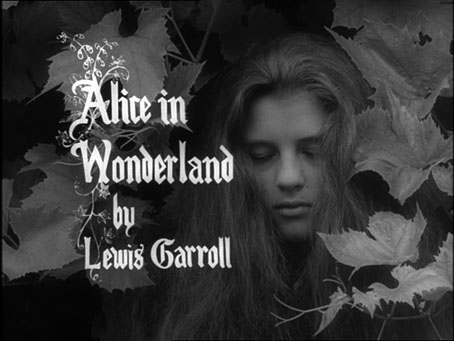
Alice in Wonderland by Jonathan Miller

miller1.jpg

I said, “Girl, you drank a lot of Drink Me,
But you ain’t in a Wonderland
You know I might-a be there to greet you, child,
When your trippin’ ship touches sand.”

Donovan, The Trip (1966)

Most of the key texts of the psychedelic period tend to be either non-fiction—Aldous Huxley’s Doors of Perception, Timothy Leary’s The Psychedelic Experience—or spiritual works such as The Tibetan Book of the Dead, the volume upon which Leary’s book is based and which subsequently provided John Lennon with lines for Tomorrow Never Knows. The key fictional work of the era has to be Lewis Carroll’s Alice in Wonderland, a fact that would no doubt have surprised the book’s legions of enthusiastic Victorian readers, never mind its author. Grace Slick created the definitive Alice song with White Rabbit in 1965, written while she was with the Great Society but only recorded properly in 1967 after she’d joined Jefferson Airplane. But Alice’s adventures run a rich seam of Victorian whimsy through the music of 1966 to ’69, especially among the British bands whose lyrics tend to be far more childish and frivolous than their American counterparts. Donovan probably got there first among the Brits with The Trip on his Sunshine Superman album. Among the profusion of later references can be found one-off singles such as Alice in Wonderland (1967) by the Dave Heenan Set (who recorded songs for the Barbarella soundtrack as The Glitterhouse) and Jabberwock/Which Dreamed It? (1968) by Boeing Duveen & The Beautiful Soup, a band whose songwriter is better known today as Hank Wangford.

Continue reading “Alice in Wonderland by Jonathan Miller”

Gandharva by Beaver & Krause

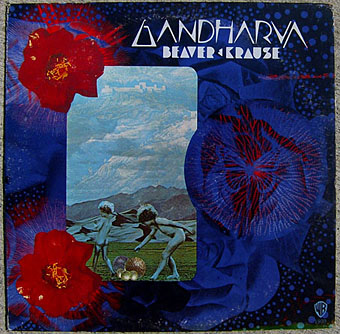
gandharva.jpg

I mentioned Wilfried Sätty’s collage work last week and this album sports one of his few cover designs. A cult object for several reasons, not least Sätty’s involvement. The title lettering was by fellow psychedelic artist David Singer who I had the good fortune to meet in California in 2005 whilst researching Sätty’s career. That chunky Seventies lettering style now looks distinctly contemporary having come back into fashion over the past couple of years.

Beaver & Krause were among the pioneers of Moog-based electronic music in the 1960s and notably provided the throbs and drones which Jack Nitzsche mixed into the soundtrack for Donald Cammell & Nicolas Roeg’s Performance. Gandharva was released in 1971 and one of the few all-electronic pieces on the album, Nine Moons in Alaska, is an outtake from those sessions. The first side is very uneven, with a blues jam and a gospel piece that don’t sit well with each other, never mind with the Moog tracks. Side two, however, is a far more successful suite of improvisations with organ, electronics, guitar, harp and saxophone (played by Gerry Mulligan) recorded live in Grace Cathedral, San Francisco.

Cover photo from the Psychedelic Music Flickr pool which features many fine examples of cover design from the late Sixties on.

Elsewhere on { feuilleton }
• The illustrators archive

Elsewhere on { feuilleton }
• The album covers archive

Previously on { feuilleton }
• Ginsberg’s Howl and the view from the street
• Further back and faster
• Quite a performance
• Borges in Performance