Metronomes

metronomes.jpg

An automated performance of György Ligeti’s Poème symphonique for 100 metronomes at Ubuweb.

Since its world premiere in the Netherlands in 1963, Poème symphonique for 100 metronomes has been very rarely performed in public. The complicated scenographic staging, the detailed preparation by hand, the need for around ten technicians to activate more or less simultaneously the 100 metronomes, makes the demand for performances limited. Thirty-two years after the premiere, the sculptor and installation artist Gilles Lacombe heard a recording of the work. Impressed, he decided to invent a machine able to perform the piece automatically. After six months, he set up this ingenious device. Ever since, Poème symphonique can be performed accurately, at any time, and in public. Please understand that at its world premiere in 1963, the concert was filmed by Dutch television. On that night, after the final tick-tock of the metronome, there was a heavy silence, followed by booing, screaming, and threats. The concert was never broadcast.

manray.jpg

And while we’re on the subject, let’s not forget Man Ray’s Object to be Destroyed (1923) (aka Indestructible Object). Richard Cork looked at its origin and meaning for the Tate magazine.

Previously on { feuilleton }
The Avant Garde Project

Hawk things

hawkmask1.jpg

The Barney Bubbles revival continues with news of Space Ritual 09, a concert dedicated to BB by ex-Hawkwind members at the Roundhouse, London on March 8th. The headline band is a new version of Hawklords, notably sans Dave Brock who controls the Hawkwind name and hasn’t been too happy recently with Nik Turner’s revisionist activities. Quarrels aside it’s good to see them honouring Barney’s memory and the Roundhouse is the place to do it, being the venue where Hawkwind played a very stoned set in 1972 as part of the Greasy Truckers concert.

All of which had me searching in vain for a double-page ad from the NME for Hawkwind’s Urban Guerilla single; you can see the ad in a smaller vertical version on the original Barney Bubbles post. I was hoping to find the full thing and scan it for display here but it seems to have gone astray for the time being. As it was the search turned up these photocopies of some later Bubbles Hawkwind ads created for the band’s UK tour of winter 1973/74. A pair of typically meticulous ink and Letratone renderings and also another example of what you might call Barney’s interactive design since these instruct the reader to glue the masks to card, colour them in then cut them out and wear them to the gig. David Wills has featured some other examples along these lines, including this cut-out doll birthday card. Did anyone ever try wearing these masks? And if so, is there photo evidence?

hawkmask2.jpg

Previously on { feuilleton }
The Sonic Assassins
Reasons To Be Cheerful, part 2
Barney Bubbles: artist and designer

New things for February

ssowb.jpg

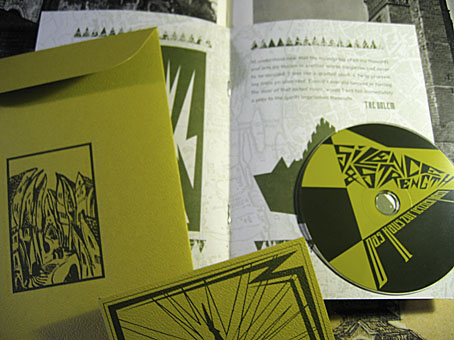
More new work appeared recently although as usual this was something I completed a while ago. Einstein’s Getaway is a short album by Stranger Son of WB who play a kind of over-amped muscular harangue which you might call Post Rock if that wasn’t a very tired term by now. Mr Simon Reyonolds should give them a listen. Heavily rhythmic and bass-driven, this is as much Post Punk as anything, bringing to mind bands such as This Heat, The Pop Group and (in the vocal department especially) The Fall. I was responsible for the design of this release only, not the avocado suite backdrops, and you can see the rest of the layout here. This is one of the first releases on a new label, White Box, and I’ve already designed the next release in the catalogue.

mobile.jpgMeanwhile, those of you addicted to mobile phones may like to know that {feuilleton} is now available via a mobile RSS feed. There’s a permalink at the top of the third column on this page although if you arrived here using a mobile network there’s a new WordPress plugin running which converts the site to a mobile feed automatically. I don’t browse the web with my phone very much since its capabilities are so limited it’s hardly worth bothering but this page does at least load the posts now without breaking. Not all of them work, however, since the images are far too big. WP creates thumbnails for each uploaded image so I imagine there’s some way of tweaking the feed to deliver thumbnails. iPhone users shouldn’t have any problem and the optimiser creates a feed just for them. Those of us who remain iPhone-less can experience a vicarious thrill here.

Lux Interior, 1946–2009

lux.jpg

Lux on stage in Glasgow, 1990.

Lux Interior, co-founder of the Cramps and the group’s singer, lyricist, cultural archaeologist and a superb stage performer. Also one of the few people who could successfully enthuse about the delights of female sexuality while wearing nothing more than a pair of high heels and a black G-string.

That exhilarating manifestation of deviant intent and skull-denting impact remains Lux and Ivy’s exclusive domain. Where punk rock was a barrage of refutation that fomented rabid exultation, the Cramps reclaimed the hillbilly power long since flushed down the Mersey. Through a self-stated “disdain for the myth of musical progress,” they melded their mutant propensities to emerge as a guiding voice in the wilderness, a commanding force that redefined the rock & roll spectrum while outgunning almost everyfuckingbody in the game. Jonny Whiteside, LA Weekly.

The Cramps’ Lux Interior: A life in pictures
• The Cramps on The Tube, 1987: part 1 | part 2 | part 3

Thursday Afternoon by Brian Eno

thursday.jpg

Cover painting by Tom Phillips, design by Russell Mills.

A post for a Thursday.

Brian Eno’s ambient music receives a lot of playing time here, especially Music for Airports, On Land, The Shutov Assembly and, when something really minimal is required, Neroli. But it’s Thursday Afternoon that receives the most attention. Recorded at the request of Sony Japan in 1984, Thursday Afternoon is a single piece that originally accompanied seven of Eno’s “video paintings”, each of them showing Christine Alicino warped and blurred by ultra-slow motion and video noise. Like his earlier static views of the New York skyline, Mistaken Memories of Medieval Manhattan, filming vertically means that proper viewing can only be achieved by turning the TV on its side. The soundtrack is a beautifully rendered composition which uses Eno’s customary process of letting a number of looped phrases form a shifting musical moiré.

Compositionally, Thursday Afternoon belongs to the family of works which also includes Discreet Music and Music for Airports. Like them it is an even-textured, spacious and contemplative piece in which several musical events appear and recur more or less regularly. Each event, however, recurs with a different cyclic frequency and thus the whole piece becomes an unfolding display of unique sonic clusters. Eno has characterised this style of composition as “holographic”, by which he means that any brief section of the music is representative of the whole piece, in the same way that any fragment of a hologram shows the whole of the holographic image but with a lower resolution. (From the album notes.)

Daniel Lanois, Roger Eno and Michael Brook were all involved in the creation and production of Thursday Afternoon and the piece works as well played very quietly as it does at louder volume. When played louder more of the background detail becomes apparent, including some very faint birdsong which is most discernible at the end when much of the music has faded away. Perfect for colouring the atmosphere of a room whilst reading, working or talking with friends. It’s also a favourite of mine for playing in the bedroom with someone special.

Thursday Afternoon was released on video cassette then appeared on CD in 1985. As a single track of 61 minutes, this was one of the first original recordings which made specific use of the extended running time of the CD format. The cover painting was by {feuilleton} favourite, artist Tom Phillips, with design by artist and designer Russell Mills. Ten years earlier, Eno had used a detail of Phillips’ painting After Raphael on the cover of Another Green World.

eno.jpg

All of which is a long-winded way of saying that you can now see the original sound and vision version of Thursday Afternoon at Ubuweb. Not ideal by any means but it gives you an idea of the complete work rather than the trunctated versions on YouTube. Eno’s video paintings, Thursday Afternoon included, are now available on DVD should you require them in higher quality. Just be prepared to turn your TV on its side.

Update: Eno’s ambient processes have now reached the iPhone with the Brian Eno and Peter Chilvers app, Bloom.

Elsewhere on { feuilleton }
The album covers archive

Previously on { feuilleton }
Tiger Mountain Strategies
20 Sites n Years by Tom Phillips
Generative culture
Exposure by Robert Fripp
My Life in the Bush of Ghosts