Weekend links 526

colquhoun.jpg

La Cathédrale Engloutie (1952) by Ithell Colquhoun.

• Many of the recent lists of “where to start with the music of [x]” aren’t filling an urgent requirement, but in the case of Sun Ra—whose discography runs to 95 albums—any guide is a useful one: Sean Kitching chooses 10 recordings from the Ra galaxy. I’m not unacquainted with Sun Ra’s music but there’s so much of it that almost all these suggestions are news. Related: Namwali Serpell on the life and work of a cosmic visionary.

• Coming soon from Strange Attractor, Ithell Colquhoun: Genius of The Fern Loved Gulley by Amy Hale, the first book-length study of the life and work of the British Surrealist and occult artist.

• I doubt I’ll get to see it but I’m pleased to know that the prematurely shuttered Aubrey Beardsley exhibition is returning to Tate Britain. You’ll need a Decadent face-mask.

• And speaking of music lists, Alexis Petridis compiles a ranking of all the songs by a little-known post-punk band from Manchester.

• The Last Arcadian (Process Mix): more psychotropic nougat from Moon Wiring Club.

• Kill Me Again… Ken Hollings on Ennio Morricone and the music of the future.

• Mervyn Peake‘s visual archive has been acquired by the British Library.

• Anitra Pavlico on the fantastic world (and music) of Maurice Ravel.

• Stanley Stellar‘s photos of the New York gay scene in the 1980s.

• At Dennis Cooper’s: Fetish.

• RIP Judy Dyble.

• Wikidelia

• Chelsea Morning (1968) by Fairport Convention | I Talk To The Wind (1968) by Giles, Giles & Fripp feat. Judy Dyble | Morning Way (1970) by Trader Horne
Notes from the Underground

hawkwind1.jpg

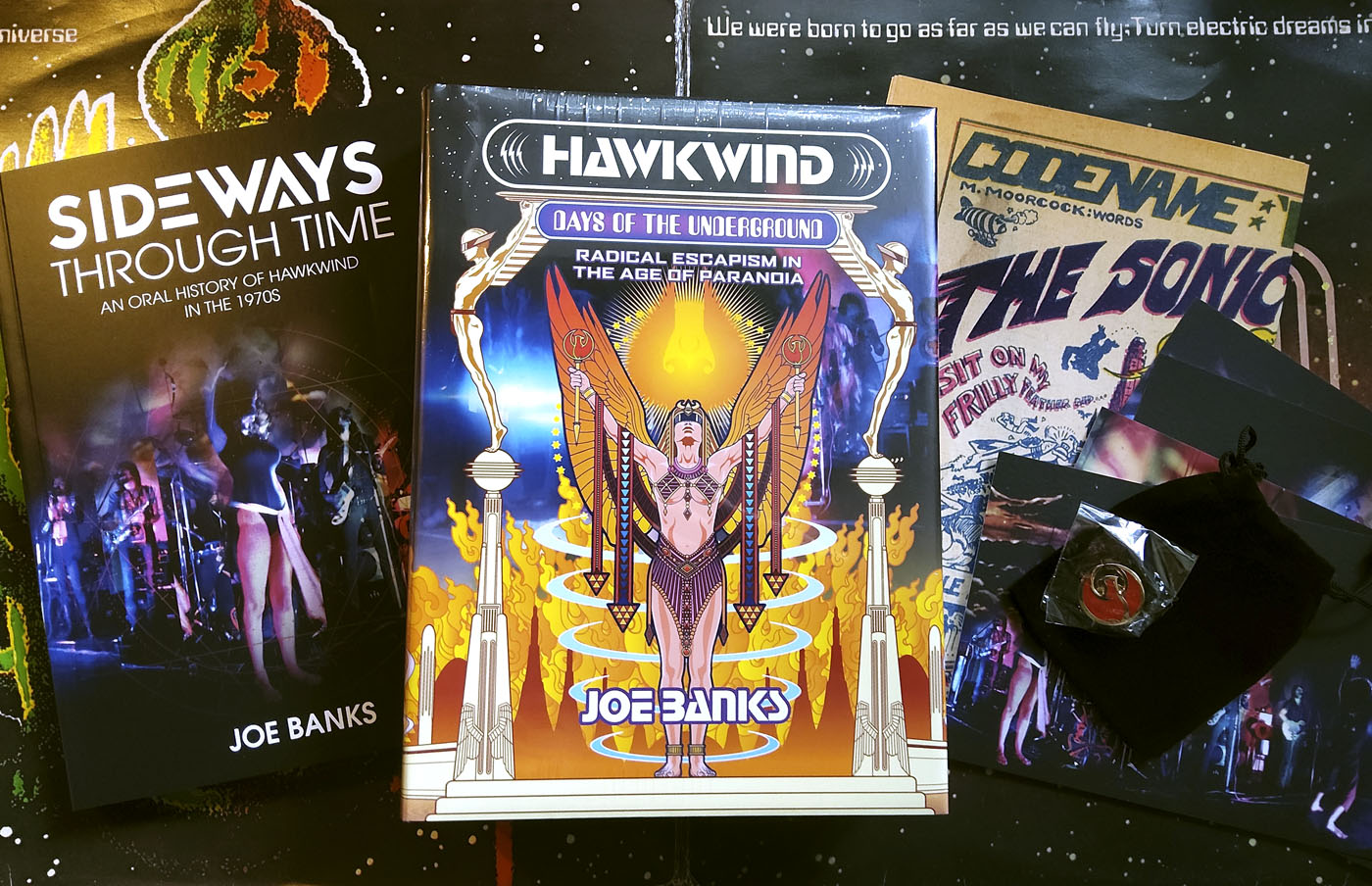
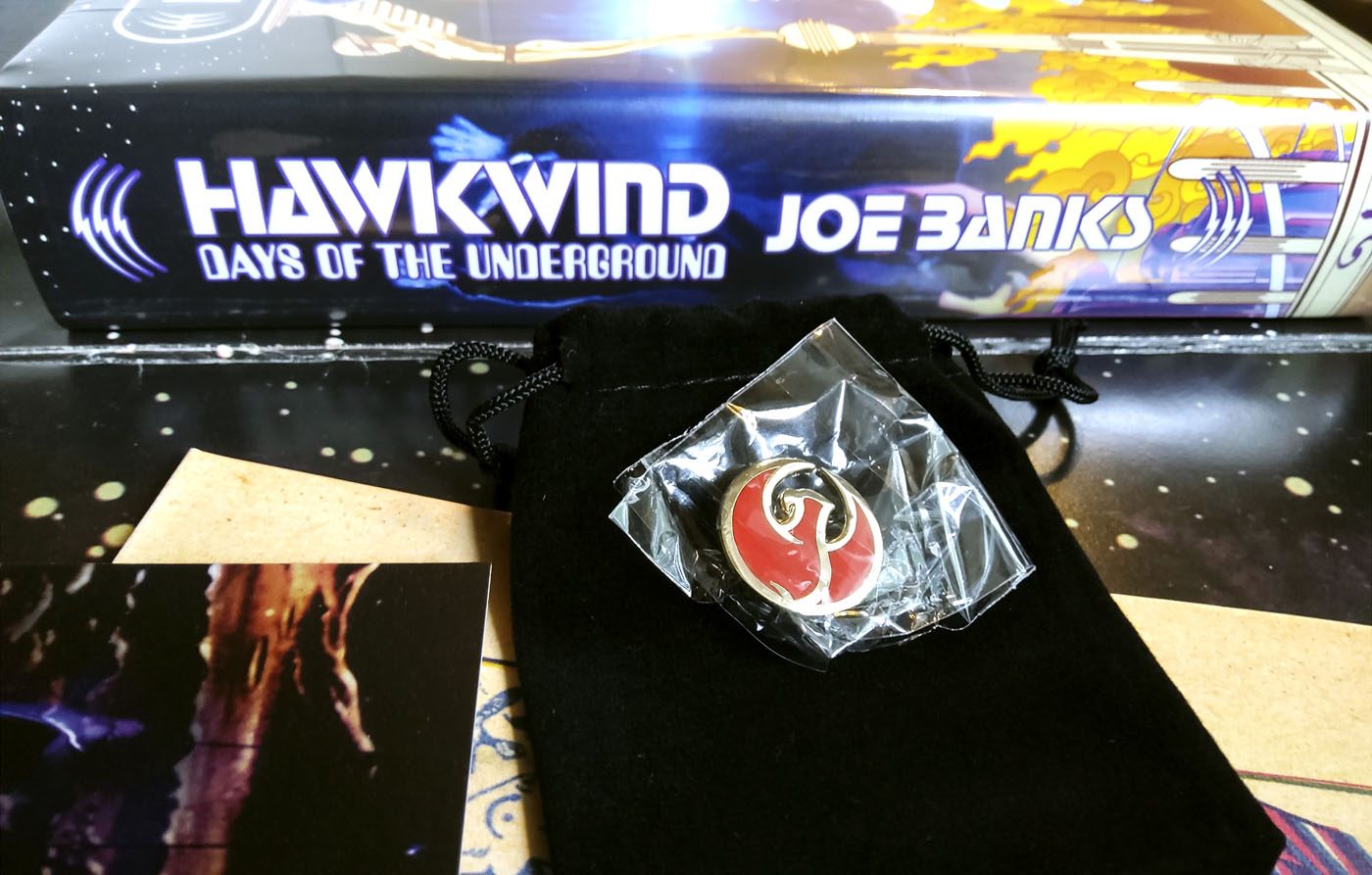
This time last year I was about to start working on the cover of Joe Banks’ Hawkwind book, and here it is at last, after a considerable delay. The special edition has been worth the wait since it comes with an additional 200-page volume, Sideways Through Time, containing the interviews that Joe used for his research. There’s also a set of cards with photos by Laurie Lewis from the session used for the cover of Space Ritual (we used some of the same photos on the book cover), and a print of the Moorcock/Cawthorn Hawklords comic strip from Frendz which further developed the group’s self-mythologising begun by the In Search Of Space “Hawklog”. And for people who pre-ordered the book last year then had to wait for months, there’s a bonus enamel pin based on the hawk design I supplied for the front board. I like badges, and I designed a few for Hawkwind in the past, but this is a better design and a nicer object than any of those I did in the 1980s.

hawkwind2.jpg

It’s a big book.

Now that the book is out I can show off the full cover wrap. As mentioned earlier, I followed Barney Bubbles’ preference for retro futurism by creating a cityscape based on the Deco-styled architecture that Frank R. Paul liked to use in his pulp illustrations. Some of the details refer obliquely to Hawkwind’s cover art or songs of the 1970s, so the speeding car can be taken as a reference to both Kerb Crawler and Death Trap, as well as the speeding Art Deco vehicle on the cover of Roadhawks. The flying saucers are a nod to those by Barney Bubbles on the inner sleeve of the Doremi album (and on one of his black-and-white posters from the same period), while the Philippe Druillet rocket refers to Barney’s own appropriation of a Druillet figure in his Hawk graphics. The combination of vehicles fleeing a burning city gives us the recurring theme in the group’s lyrics about the need to escape from a self-destructing society/planet. Welcome to the future.

Hawkwind: Days of the Underground is available now from Strange Attractor.

Previously on { feuilleton }
• Hawkwind: Days of the Underground
• The Chronicle of the Cursed Sleeve
• Rock shirts
• The Cosmic Grill
• Void City
• Hawk things
• The Sonic Assassins
• New things for July
• Barney Bubbles: artist and designer

Miles and Miles

discs.jpg

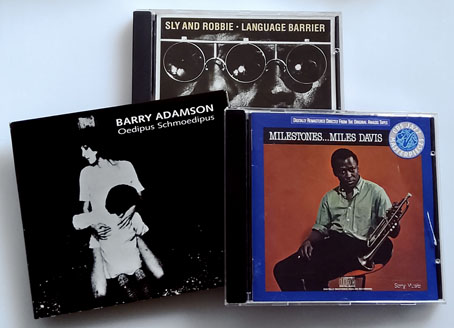
I listen to music all the time when I’m working but it’s not always a good idea to give new music an airing when you’re also concentrating on new work. What often happens on these occasions is that the album will fail to make an impression and end up being laid aside in favour of more familiar sounds, which is what happened to the copy of Milestones (1958) by Miles Davis that I bought last year in a charity shop. Listening to it again this week provoked a “Wow!” response as well as making me realise that I’d heard the tune of the fourth track, Miles, somewhere before. Miles, or Milestones as it’s confusingly also known, is covered by Barry Adamson on his 1996 album, Oedipus Schmoedipus, a simpler version but still jazzier than everything else on the album. I’d always suspected that Adamson was referring to Miles Davis with the title but since I’d never looked at the writing credits until this week I didn’t make the connection. Davis had a habit of naming new pieces of music after people he knew—John McLaughlin, Billy Preston, Mtume, producer Teo Macero, etc—so Miles (as opposed to Milestones) can be taken as an early example of the habit even though it refers to him and also doubles as a reference to measurement rather than a person.

The same title, but not the same piece of music, appears on a 1985 album by Sly & Robbie, Language Barrier, the track in this case being a renamed reworking of Black Satin from Miles Davis’s On The Corner album. Language Barrier in turn was produced by Bill Laswell who later remixed the original Black Satin for his excellent compilation/reconstruction of Davis’s electric period, Panthalassa, and who may have suggested that Sly & Robbie record their own version of the Davis piece. Whatever its origin, Miles (Black Satin) is credited to “B. Laswell, M. Davis, R. Shakespeare & S. Dunbar” which brings us back to Barry Adamson whose Miles has a similar credit at Discogs (but not on my CD…) although Laswell is now (bizarrely) “William Laswell”. I still don’t know what connection Laswell or Sly & Robbie have with Adamson’s track, unless it’s a Discogs error or contains a sample I’ve missed, but the ghost of M. Davis might at least be satisfied that he was influencing popular music after so many years on the outside looking in. Always miles ahead. And that’s the title of another Davis album I’ve yet to acquire…

Weekend links 525

mademoiselle.jpg

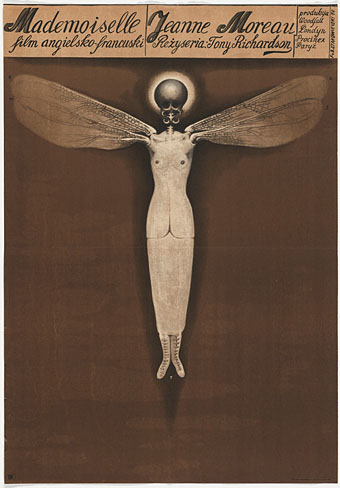
Polish poster by Franciszek Starowieyski, 1970.

• Tony Richardson’s Mademoiselle (1966) is one of those cult films that’s more written about than seen, despite having Jeanne Moreau in the lead role as a sociopathic schoolteacher, together with a screenplay by Marguerite Duras and Jean Genet, plus uncredited script-doctoring by David Rudkin. John Waters listed the film as a “guilty pleasure” in Crackpot but it’s been unavailable on disc for over a decade. The BFI will be releasing a restored print on blu-ray in September.

“While the hurdy-gurdy’s capacity to fill space with its unrelenting multi-tonal dirge is for some the absolute sonic dream, for others it is the stuff of nightmares.” Jennifer Lucy Allan on the pleasures and pains of a medieval musical instrument.

• “I truly believed”: Vicki Pollack of the San Francisco Diggers talking to Jay Babcock for the fifth installment of Jay’s verbal history of the hippie anarchists.

• “If you want to call yourself a composer, you follow every step of the instrumentation.” Ennio Morricone talking to Guido Bonsaver in 2006.

• Dutchsteammachine converts jerky 12fps film from the NASA archive to 24fps. Here’s the Apollo 14 lunar mission: landing, EVA and liftoff.

• New music: Suddenly the World Had Dropped Away by David Toop; Skeleton and Unclean Spirit by John Carpenter; An Ascent by Scanner.

• Peter Hujar’s illicit photographs of New York’s cruising utopia. Not to be confused with Alvin Batrop‘s photos of gay New York.

• Mixes of the week: XLR8R Podcast 651 by Dave Harrington, and Mr.K’s Side 1, Track 1’s #1 by radioShirley & Mr.K.

• Simon Reynolds on the many electronic surprises to be found in the Smithsonian Folkways music archive.

• The Gone Away by Belbury Poly will be the next release on the Ghost Box label.

• At Dennis Cooper’s: Ed Emshwiller Day.

• Shirley Collins’ favourite music.

• Mademoiselle Mabry (1969) by Miles Davis | Hurdy Gurdy Man (1970) by Eartha Kitt | Danger Cruising (1979) by Pyrolator

Ennio Morricone, 1995

em1.jpg

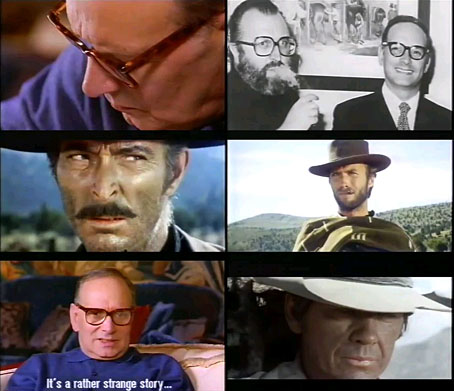
David Thompson made this 40-minute Ennio Morricone documentary for the BBC in 1995. I taped it at the time but haven’t watched it since so it was good to find again. The highlight is the lengthy interview with the man himself but there are also contributions from Christopher Frayling, Brian de Palma, Bernardo Bertolucci, Gillo Pontecorvo and others.

em2.jpg