Weekend links 670

mutzel.jpg

An octopus catching a lobster (1894) by Gustav Mützel.

• RIP Barry Humphries. He emailed me a couple of years ago in his capacity as a collector of fin-de-siècle art, hoping I might answer a question about a very obscure artist. If you require justifications for the blogging habit then add this to the list. Humphries’ first book, Bizarre (1965), is a more cerebral counterpart to Charles Addams’ Dear Dead Days, and a compendium of oddities that I’d buy if I ever saw it in a secondhand shop. RIP also to incendiary singer Mark Stewart.

• “Schulz gets compared to Kafka because of his dreamy, disconcerting stories, but in Balint’s book, a version of Schulz emerges that is closer to one of Kafka’s characters—a man on the run who can’t get past the city walls; an artist exiled by a shape-shifting, unknowable tormentor—than to Franz himself.” Leo Lasdun reviewing a new biography of Bruno Schulz by Benjamin Balint.

• “Instead of asking whether an octopus shows aspects of human intelligence, perhaps the better question is whether humans can show aspects of octopus intelligence.” David Borkenhagen on octopuses and what they might teach us about the perception of time.

• “Uproar was my element, I wanted to get people moving, the more they roared, the bolder I became.” The pioneering theatrical performances of Valeska Gert are explored at Strange Flowers.

• Digital copies of albums by the mighty Earth may currently be purchased at the group’s Bandcamp page for $1 each. I’ve got everything already but you may wish to sample something.

Charles Drazin on the director who dared to tell uncomfortable truths: Lindsay Anderson at 100.

Steven Heller on Commercial Art, a magazine from the 1920s that chronicled UK design.

• At Unquiet Things: The luminous drama of Frants Diderik Bøe’s bejewelled floral still lifes.

• New music: This Vibrating Earth by Field Lines Cartographer, and Draw/Orb by Extra.

• Mix of the week: XLR8R podcast 796 by Gold Panda.

• The Strange World of…Andrzej Korzynski.

The Jewel In The Lotus (1974) by Bennie Maupin | Jewel (1985) by Propaganda | Black Jewelled Serpent Of Sound (1985) by The Dukes Of Stratosphear
Weekend links 669

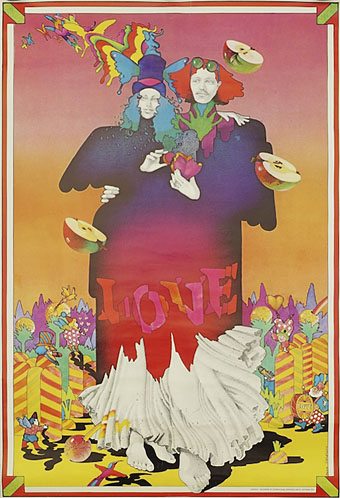
claveloux.jpg

Love (1973), a poster by Nicole Claveloux.

• “Warner Brothers had been keen on a Rolling Stones movie. Jagger was keen on being a movie star. But Donald Cammell’s script was no Beatles’ jolly japes musical comedy…” Des Barry examines the ninth minute of Cammell & Roeg’s Performance.

• “…part of what made his 1970s work so original was the degree to which his band cross-pollinated guitar with synthesizer.” Aquarium Drunkard explores the esoteric jazz-rock of Steve Hillage.

• Magma, the cosmic jazz-rock group from France, have been around for 50 years without making a music video. Hakëhn Deïs is their first.

There was half-Tarkovsky embedded in async, “Solari” and “Stakra” and “Walker”, a hand outstretched to those great poems of living and light that we call films. “I had a strange dream last night,” Andrey Tarkovsky wrote in one of the diary entries collected in Instant Light, “I was looking up at the sky and it was very, very light and soft; and high, high above me it seemed to be slowly boiling, like light that had materialised like the fibres of a sunlit fabric, like silken living stitches in a piece of Japanese embroidery.”

David Toop remembers Ryuichi Sakamoto

• “Floor796 is an ever-expanding animation scene showing the life of the 796th floor of the huge space station…”

• The Electrifying Dreamworld of The Green Hand: Dan Clowes on the comic-art of Nicole Claveloux.

• At Bandcamp: Andy Thomas on the post-punk pop subversion of David Cunningham.

• At Unquiet Things: An enigmatic baroness and her collection of skulls.

• New music: River Of Dreams by Romance & Dean Hurley.

• Steven Heller’s font of the month is Ray Gun.

• Mix of the week: DreamScenes – April 2023.

• RIP Al Jaffee.

Skulls Of Broken Hill (1996) by Bill Laswell | The Bees Made Honey In The Lion’s Skull (2008) by Earth | Black Skulls (2018) by Jóhann Jóhannsson

Weekend links 668

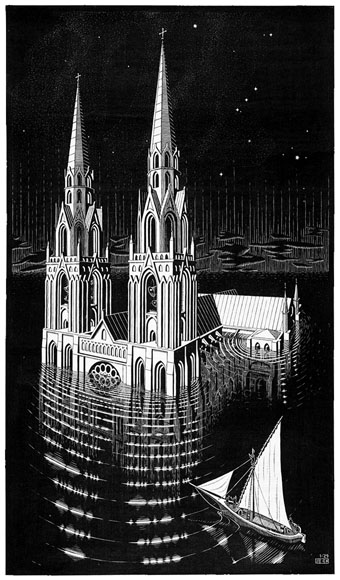
escher.jpg

The Drowned Cathedral (1929) by MC Escher.

• “All Saints’ was the last of the seven parish churches to fall headlong into the waves. The drowned church was doomed to lie in a gulley not far out to sea, a habitat for sponges and crabs, and yet it lives on, unvanquishable; for—as the story of Britain’s lost cities, ghost towns, and vanished villages tells us—what has disappeared beneath the sea can rebuild itself in the mind.” Matthew Green explores the history of Dunwich, Suffolk.

• “Why do certain artists endure and become (dread word) ‘iconic’, while some are forgotten or sidelined or only grudgingly acknowledged?” Ian Penman talking to Jeremy Allen about his new book, Fassbinder Thousands of Mirrors.

• Coming soon from Strange Attractor: A new edition of England’s Hidden Reverse, David Keenan’s study of the lives and music of Coil, Nurse With Wound and Current 93.

• “What is electronic music?” Daphne Oram, Desmond Briscoe and David Cain of the BBC Radiophonic Workshop are here to explain.

• “Direct evidence of the use of multiple drugs in Bronze Age Menorca (Western Mediterranean) from human hair analysis.”

• New music: Timespan by Majeure, and Microdosing by African Head Charge.

• “Future of Borges estate in limbo as widow doesn’t leave will.”

Arooj Aftab’s favourite albums.

Paperback Covers on Tumblr.

The Engulfed Cathedral (1974) by Tomita | Engulfed Cathedral (1981) by John Carpenter | La Cathédrale Engloutie (2003) by Sora

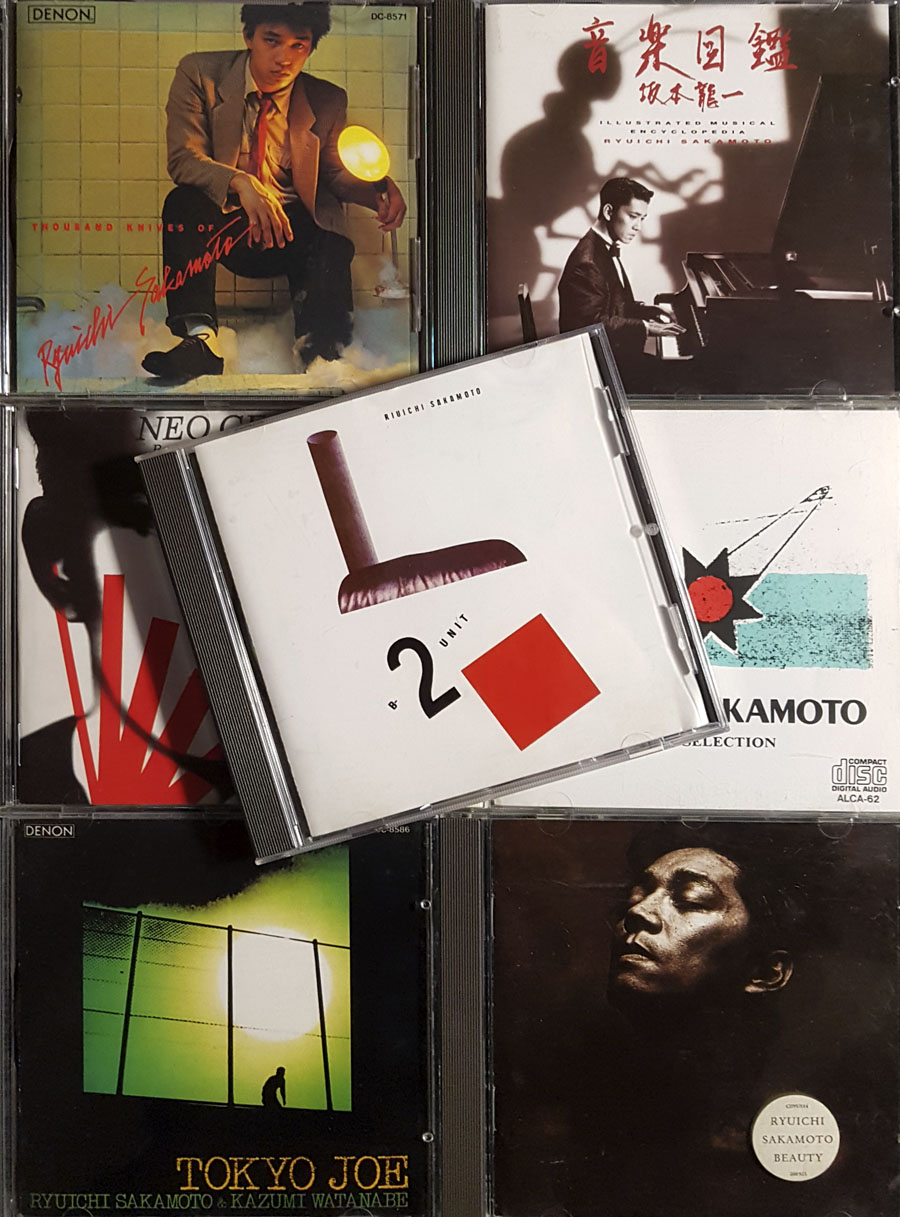
B-2 Unit by Ryuichi Sakamoto

sakamoto1.jpg

RIP Ryuichi Sakamoto. I bought quite a few of his albums over the years but these are only a small fraction of his huge and diverse discography; Discogs lists 116 albums recorded solo or in collaboration with other artists. B-2 Unit, released in 1980, was the first one I discovered, and it’s still a great favourite. The CD shown here was a replacement for a secondhand vinyl copy I bought circa 1982, at a time when albums by Japanese artists were often hard to find unless you could afford expensive imports. As with albums on German labels such as Brain and Sky, if you saw anything like this secondhand you grabbed it, even if the artists were a complete mystery.

sakamoto2.jpg

Design (after El Lissitzky) by Takeo Aizawa and Tsuguya Inoue.

Sakamoto wasn’t a mystery—I was already listening to Yellow Magic Orchestra and some of the other people he’d worked with—but I wasn’t sure what to expect from a solo release, especially one with such an enigmatic title. B-2 Unit turned out to be closer to the more experimental post-punk albums than anything by YMO: jerky rhythms, scratchy guitar, atonal electronics, distorted vocals, offbeat songs, plus that staple of post-punk music, dialogue samples from TV and radio. Subsequent interviews revealed that Sakamoto had arrived in London with the intention of making a dub (or dub-style) album like the one Andy Partridge released as Take Away/The Lure Of Salvage, hence the credits on B-2 Unit for both dub producer Dennis Bovell, who engineered some of the recording, and Partridge himself, the presence of the latter seeming very unusual at the time, as well as being hard to locate in the music when two guitarists are credited. (YMO ally Kenji Omura is the other guitarist. Andy Partridge apparently gave Sakamoto a tape of those scratchy guitar lines which were then dropped into the recordings.) The dub influence is most evident on E3-A, and the album’s stand-out track and only single, Riot In Lagos, a piece which sounds like an electronic composition deconstructing itself while it plays. The minimal documentation means it can be hard to tell who did what on the album but I’d be surprised if Hideki Matsutake hadn’t helped with the programming, if not the deconstruction, of Riot In Lagos. Matsutake was the synth programmer for YMO, he’s often referred to as the fourth member of the group, yet you never see his name mentioned in discussion of B-2 Unit. As for Sakamoto, he never did anything like this again. His experimental side still came to the fore now and then, especially the superb run of albums and EPs he recorded with Alva Noto, but his solo work during the 1980s and 90s was increasingly commercial, on albums over-burdened with international guests. For a taste of his less commercial side, here’s an improvisation with Carsten Nicolai (aka Alva Noto) in Philip Johnson’s Glass House, recorded one evening while the daylight was fading.

Previously on { feuilleton }
Zen-Gun and The Zen Gun
El Lissitzky record covers

Weekend links 666

solar.jpg

Muy Mago (Portrait of Aleister Crowley) (1961) by Xul Solar.

• “…snails amaze with their capacity to move so far, to spread so widely, while doing so little. This, it seems to me, is one of the real marvels of snail biogeography. Individuals do not need to exert great effort because natural selection has acted for them, acted on them, acted with them, to produce these beings that are so unexpectedly but uniquely suited to a particular form of deep time travel, drifting. From such a perspective, rather than being any kind of deficiency, the highly successful passivity of snails might be seen as a remarkable evolutionary achievement.” Thom van Dooren on how snails cross vast oceans.

• “Slow art has layers. And this is why it requires time and effort. We should see this as a good and necessary thing. If this is a kind of obstacle in the way of easy assimilation then it is an obstacle that is integral to the value of the thing itself. The mind is calmed, or disturbed, or made exultant by the art that rewards us for our goodwill and our capacity to take our time.” In Praise of Slow Art by Chris Horner.

• “I have set naturalism and the supernatural in binary opposition but perhaps there is a third way. Let’s call it the supranatural stance…” Paul Broks explores the roots of coincidence.

• At Unquiet Things: The art of Hector Garrido, an illustrator who specialised in the Gothic staple of women in gowns fleeing at night from sinister mansions.

• “The writer Jorge Luis Borges once referred to his friend the artist Xul Solar as ‘one of the most singular events of our era’,” writes Miriam Basilio.

• At Spoon & Tamago: Japanese craftsmanship meets Pokemon at Kanazawa’s National Crafts Museum.

• At Public Domain Review: Martin Frobenius Ledermüller’s Microscopic Delights (1759–63).

• New music: Rest Of Life by Steve Roach.

The Four Horsemen (1972) by Aphrodite’s Child | Supper’s Ready (1972) by Genesis | Six Six Sixties (1979) by Throbbing Gristle