Dreaming Out of Space: Kenneth Grant on HP Lovecraft

grant.jpg

Going through some of my loose copies of Man, Myth and Magic recently turned up this article by Kenneth Grant that I’d forgotten about. I have two separate sets of Man, Myth and Magic: a complete edition in binders, and a partial collection of loose copies of the weekly “illustrated encyclopedia of the supernatural”. The partial collection is worth keeping for the unique articles that ran across the last two pages of every issue, all of which are absent (along with the magazine covers) from the bound edition. These articles formed the Frontiers of Belief series, a collection of essays of the kind one might find in magazines today such as Fate or Fortean Times. An earlier essay about Wilfried Sätty, Artist of the Occult, was reproduced here a few years ago; none of these pieces have ever been reprinted so it seems worthwhile putting another of the more interesting pieces online.

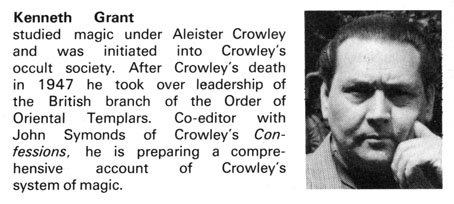
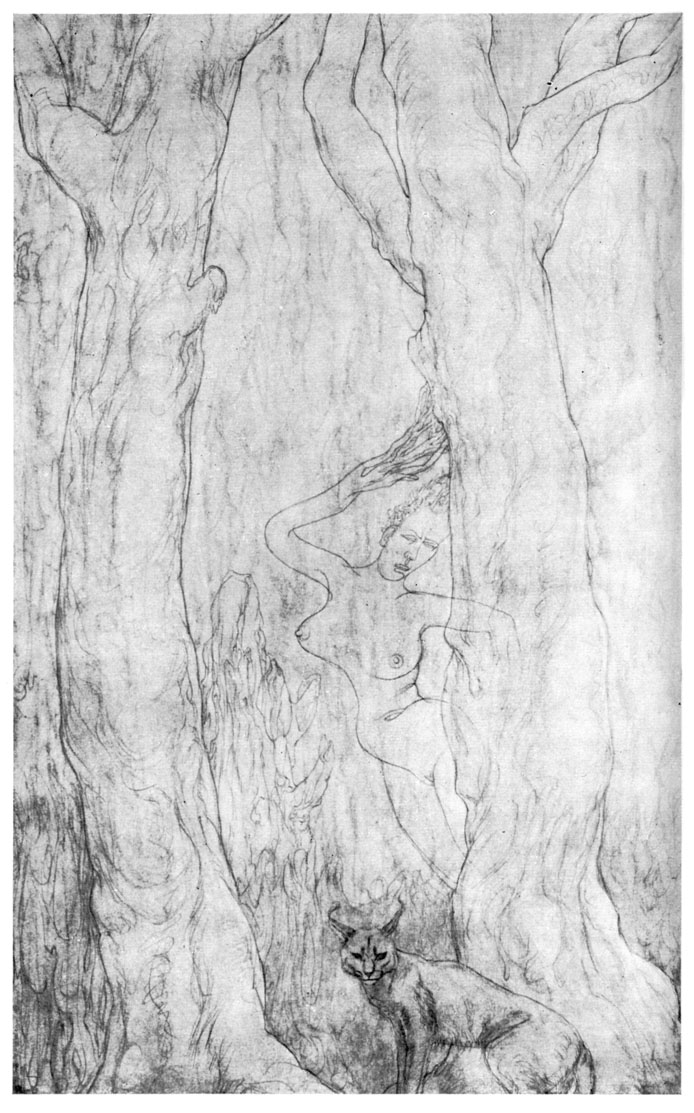
Kenneth Grant was the only active occultist among Man, Myth and Magic‘s roster of very serious and well-regarded writers and experts. Grant wrote several of the encyclopedia entries although not the one about Aleister Crowley, as you might expect, that entry going to Crowley’s executor and biographer, John Symonds. Grant was also a lifelong champion of HP Lovecraft’s fiction which explains this article; many of Grant’s later occult texts have a distinctly Lovecraftian flavour, and they often refer to Lovecraft and Arthur Machen as being the unconscious recipients of actual occult emanations or presences. Grant’s belief that the authors channelled these emanations into their fiction is central to this piece, a belief that Lovecraft would have dismissed even though several of his stories (not least The Call of Cthulhu) concern exactly this process. Grant connects Lovecraft with another artist whose work he championed throughout his life, Austin Osman Spare. It was Grant’s involvement with Man, Myth and Magic that put one of Spare’s drawings on the cover of the first issue, and further drawings inside the magazine, introducing the artist’s work to a new, highly receptive audience. The drawing below (Were-Lynx) appears in the magazine behind Grant’s text so I’ve scanned a text-free copy from Grant’s Cults of the Shadow (1975).

DREAMING OUT OF SPACE by Kenneth Grant

Malevolent powers are lurking in wait to project themselves into the sleeping minds of men: this terrifying idea is a recurring theme in the stories of Howard Phillips Lovecraft, who claimed that they came to him in nightmares. But were they simply bad dreams, or was he in fact receiving communications from an unknown source, as Kenneth Grant here suggests?
spare.jpg

“I have watched for dryads and satyrs in the woods and fields at dusk”; illustration by Austin Osman Spare, who sensed the forces looming behind Lovecraft’s work, and was inspired to illustrate these presences.

Howard Phillips Lovecraft died in 1937; but the myth-cycle which he initiated in unrivalled tales of cosmic horror now raises the question whether it was a mere fiction engendered in the haunted mind of an obscure New England writer, or whether it foreshadowed a particularly sinister kind of occult invasion.

According to a well-known occult tradition, when Atlantis was submerged, not all perished. Some took refuge on other worlds, in other dimensions; others “slept” a willed and unnatural sleep through untold aeons of time. These awakened; they lurk now in unknown gulfs of space, the physical mechanism of human consciousness being unable to pick up their infinitely subtle vibrations. They lurk, waiting to return and rule the whole earth, as was their aim before the catastrophe that destroyed their corrupt civilization.

This tradition was a major theme in Lovecraft’s work. Until quite recently people read his stories and shuddered (if sufficiently honest and sensitive enough to admit their uncanny impact), not suspecting for a moment that such things could be.

Few know that Lovecraft dreamed most of his tales. And he sometimes thought that these dreams, or rather, nightmares, were caused by misdeeds in remotely distant incarnations when, perhaps, he had aimed at acquiring magical powers. These dreams were memories of the past and prophecies of the future, for he said that “nightmares are the punishment meted out to the soul for sins committed in previous incarnations—perhaps millions of years ago!”

In his life as Howard Phillips Lovecraft he tried again and again to bring himself to face squarely the ordeal through which he knew he would have to pass, if he were finally to resolve his spiritual difficulties. The issue is brought to the surface perhaps more clearly and urgently in his poems than in his stories. He is on the brink of making the critical discovery, of surprising the secret of his inner life, and he is forced back repeatedly by the dread, the stark soul-searing fear which he bottles up in his work and which he communicates so successfully—in neat doses—to his readers.

One of Lovecraft’s most vivid creations is the ancient book of hideous spells composed to facilitate traffic with creatures of unseen worlds. He ascribed its authorship to Abdul Alhazred, a mad Arab who flourished in Damascus about 700 AD. This grimoire, during the course of its mysterious career, is supposed to have been translated by the Elizabethan scholar Dr John Dee, into Greek, under the title of Necronomicon. It contains the Keys or Calls that unseal forbidden spaces of cosmic sleep, inhabited by elder forces that once infested the earth. The Keys are in a wild, unearthly tongue reminiscent of the Calls of Chanokh, or Enoch, which Dr Dee actually obtained through contact with non-terrestrial entities during his work with the magician, Sir Edward Kelley, whom Aleister Crowley claimed to have been in a previous life. It is possible that the “evil and abhorred Necronomicon” was suggested by the clavicles or Keys of Enoch, which Dee and Kelley discovered, and which Crowley later used to gain access to unknown dimensions.

Continue reading “Dreaming Out of Space: Kenneth Grant on HP Lovecraft”
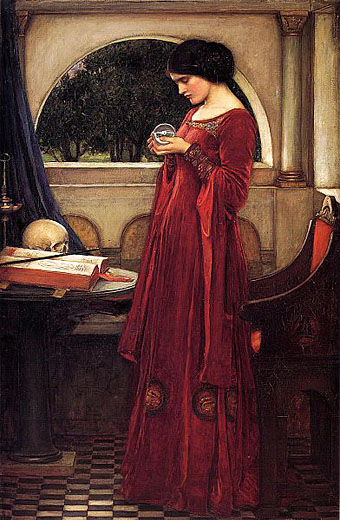
Crystal balls

crystal04.jpg

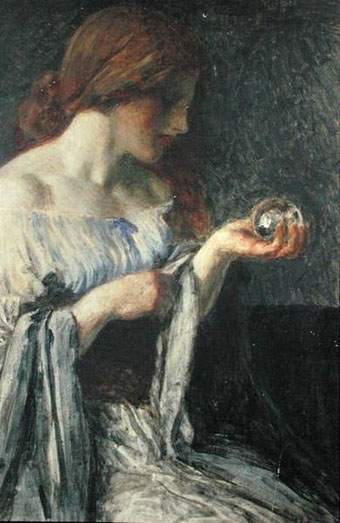
The Crystal Ball (c. 1900) by Robert Anning Bell.

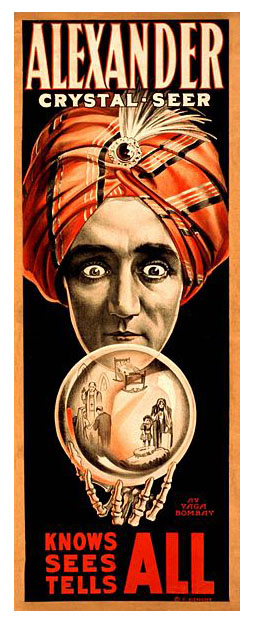
Crystal balls in art, film and the pulp magazines.

crystal05.jpg

The Crystal Ball (1902) by John William Waterhouse.

crystal02.jpg

Alexander, Crystal Seer (1910).

Continue reading “Crystal balls”

New Life for the Decadents by Philippe Jullian

jullian1.jpg

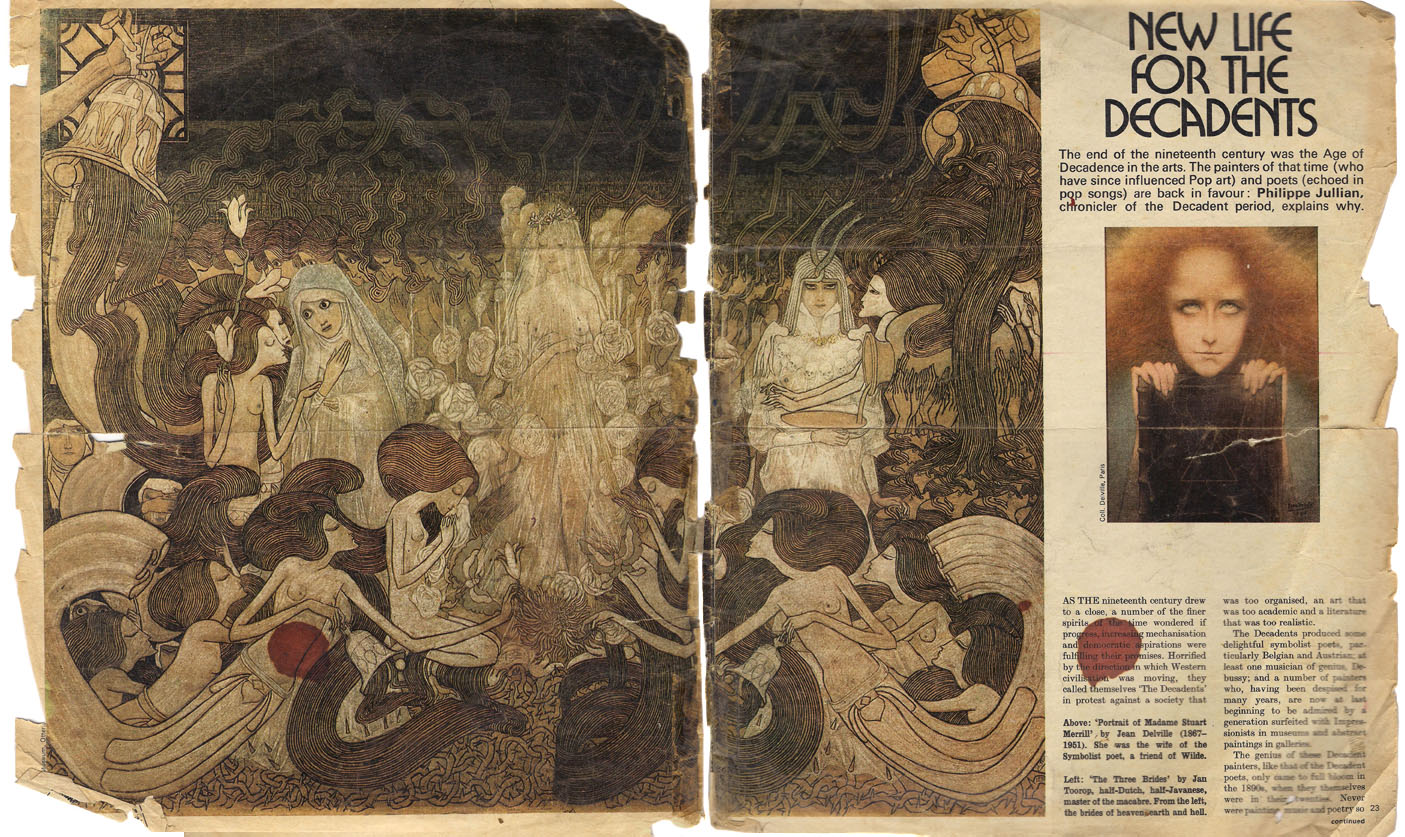
This essay by cult writer Philippe Jullian appeared in an edition of the Observer colour supplement in 1971, shortly after Jullian’s chef d’oeuvre, Dreamers of Decadence, had been published in Britain. Esthètes et Magiciens (1969), as Jullian’s study was titled in France, was instrumental in raising the profile of the many Symbolist artists whose work had been either disparaged or ignored since the First World War. A year after the Observer piece, the Hayward Gallery in London staged a major exhibition of Symbolist art with an emphasis on the paintings of Gustave Moreau; Jullian alludes to the exhibition in his article, and also wrote the foreword to the catalogue. His Observer article is necessarily shorter and less detailed than his introductory essay, emphasising the reader-friendly “Decadence” over the more evasive “Symbolist”. But as a primer to a mysterious and neglected area of art the piece would have served its purpose for a general reader.

Many thanks to Nick for the recommendation, and to Alistair who went to the trouble of providing high-res scans that I could run through the OCR. The translators of the article, Francis King and John Haylock, had previously translated Jullian’s biography of Robert de Montesquiou.

*

New Life for the Decadents

The end of the nineteenth century was the Age of Decadence in the arts. The painters of that time (who have since influenced Pop art) and poets (echoed in pop songs) are back in favour: Philippe Jullian, chronicler of the Decadent period, explains why.

AS THE nineteenth century drew to a close, a number of the finer spirits of the time wondered if progress, increasing mechanisation and democratic aspirations were fulfilling their promises. Horrified by the direction in which Western civilisation was moving, they called themselves “The Decadents” in protest against a society that was too organised, an art that was too academic and a literature that was too realistic.

The Decadents produced some delightful symbolist poets, particularly Belgian and Austrian; at least one musician of genius, Debussy; and a number of painters who, having been despised for many years, are now at last beginning to be admired by a generation surfeited with Impressionists in museums and abstract paintings in galleries.

The genius of these Decadent painters, like that of the Decadent poets, only came to full bloom in the 1890s, when they themselves were in their twenties. Never were painting, music and poetry so close to one another. The gods of the Decadents were primarily Wagner and Baudelaire, then Swinburne and Poe. The Decadent movement, so active all over Europe, turned towards two great sources of inspiration: the Pre-Raphaelites, and a French painter whose glory was for a while eclipsed by the Impressionists but who is now once again accorded his place among the great—Gustave Moreau.

The women whom the Decadents loved and of whom they dreamt resembled the women created 30 years previously by Rossetti, Burne-Jones and Moreau.

Nothing could be more naturalistic than the artistic style elaborated by the Pre-Raphaelites in the middle of the nineteenth century. Dante Gabriel Rossetti’s model, inspiration, mistress and finally wife was the sweet and sad Elizabeth Siddal, on whom so many fin-de-siècle ladies had to model themselves on the Continent as did all the aesthetic ladies of England in the 1880s. She posed for Rossetti as Beatrix and as the Belle Dame sans Merci.

She was a rare spirit, about whom everything was nebulous and evanescent: the thick, wild hair; the tunic of a simplicity to challenge the elaboration of the crinolines then in vogue; the frail hands burdened with lilies; the gaze turned towards eternity. She also posed, fully dressed and lying in a bath, her hair outspread around her bloodless face, as Ophelia for another Pre-Raphaelite, Millais. Elizabeth died of pulmonary tuberculosis in 1862.

A macabre episode, which might have been imagined by Poe, was the exhumation of a sheaf of Rossetti’s poems that had been buried in Elizabeth Siddal’s coffin. When this symbol of the New Woman died, the grief-stricken poet had insisted on placing the poems inspired by her under her long hair before the coffin was sealed.

jullian4.jpg

Beata Beatrix (1864–1870) by Dante Gabriel Rossetti.

Continue reading “New Life for the Decadents by Philippe Jullian”

Weekend links 242

kroll.jpg

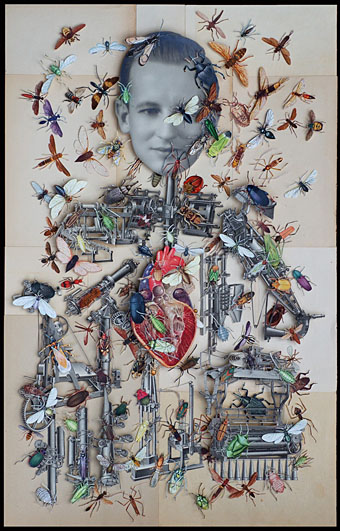
Ghost in the Machine (2012) by Hope Kroll.

Nothing Here Now But The Recordings, an album of William Burroughs’ personal tapes originally released by Industrial Records is reissued on vinyl this month. Andrew Spragg reviews it here. Burroughs’ readings fill several collections but this one was the first I owned, and it’s always been a favourite. The album features recordings of early texts such as The Last Words of Hassan I Sabbah, as well as cut-up tape experiments which fuelled some of the chapters in the Nova Trilogy.

• The Melancholy of Perversion: a study of Caitlín R. Kiernan’s Metamorphosis A by Scott Dwyer. More weird fiction: “Written with real psychological depth, these enigmatic tales rise far beyond straightforward ghost stories.” Chris Power on Robert Aickman.

• At Dangerous Minds: Gay Semiotics, a taxonomy of San Francisco life in the 1970s. Related: The case of One, a gay magazine from Los Angeles prosecuted for obscenity in 1958.

Poe’s mind was by no means commonplace. In the last year of his life he wrote a prose poem, Eureka, which would have established this fact beyond doubt—if it had not been so full of intuitive insight that neither his contemporaries nor subsequent generations, at least until the late twentieth century, could make any sense of it. Its very brilliance made it an object of ridicule, an instance of affectation and delusion, and so it is regarded to this day among readers and critics who are not at all abreast of contemporary physics. Eureka describes the origins of the universe in a single particle, from which “radiated” the atoms of which all matter is made. Minute dissimilarities of size and distribution among these atoms meant that the effects of gravity caused them to accumulate as matter, forming the physical universe.

Marilynne Robinson on Edgar Allan Poe

Vanished City: London’s Lost Neighbourhoods, a book by Tom Bolton with photographs by SF Said.

• Mix of the week: Secret Thirteen Mix 143, a selection of soundtrack music by Las CasiCasiotone.

• “I am in Brussels, numbering the Bruegels.” Toby Ferris conducts a Brueg[h]el Census.

Mothmeister “taxidermy collector & curiosity cabinet”.

Ben Zurawski collects and makes flip books.

Akira Kurosawa’s 100 favourite films

The Trip (1965) by Kim Fowley | The Trip (1966) by Donovan | The Trip (1967) by Park Avenue Playground

Weekend links 241

clerc.jpg

A drawing by Lucille Clerc.

• The usual imbalance of heat versus light this week but Kenan Malik and Teju Cole had some worthwhile things to say. Related: Atlantic illustrators respond to the events of Wednesday. And some history: covers of Charlie Hebdo‘s parent magazine, Hara-Kiri, whose legacy of bad taste and confrontation was overlooked in the rush to express disapproval.

• At The Quietus: Virginie Sélavy, Mark Pilkington and Stephen Thrower of the Miskatonic Institute talk to Mat Colegate about horror old and new. There’s more horror cinema in Mat Colegate’s interview with animator Carla MacKinnon.

• Mixes of the week: Sleepwalkers of the Montgomery Canal by The Geography Trip, and Secret Thirteen Mix 142 by Helena Hauff.

• Jazz legend Julian Priester reflects on his fusion classic Love, Love, Sun Ra, Herbie Hancock, and a lot more.

• “No gays, no blacks, no fat people”: Ryan Gilbey on how film advertising continues to betray filmmakers.

Paul Gorman on the drumheads that Barney Bubbles painted for Hawkwind’s Simon King in 1972.

Massive: Gay Erotic Manga and the Men Who Make It, edited by Anne Ishii & Graham Kolbeins.

NASA’s exoplanet travel bureau wants you to pack your bags.

• The New Humanist on imagining a world without work.

• At Strange Flowers: 15 books for 2015.

Ghosts in the TV

Prologue/Love, Love (1974) by Julian Priester | The Jewel in the Lotus (1974) by Bennie Maupin | Rima (1975) by The Headhunters