Hodgson versus Houdini

whhhh.jpg

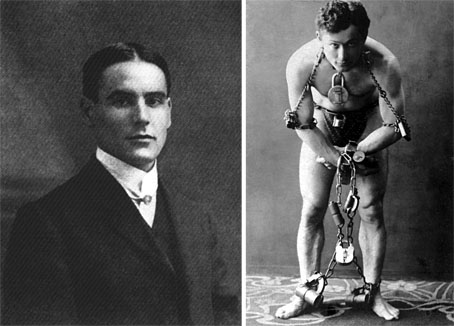
William Hope Hodgson and Harry Houdini.

Work this week has had me scouring the Internet Archive’s scanned books more than usual for source material. You’ll see the fruits of this in due course, but the search turned up a small book from 1922, The Adventurous Life of a Versatile Artist: Houdini, an anonymous account of the escapologist’s career padded out with many newspaper reports of his exploits in various cities. One of these is the notorious meeting between Houdini and writer William Hope Hodgson on the stage of the Palace Theatre, Blackburn, Lancashire, in 1902. Hodgson was still running his School of Physical Culture in the town at this time, and was otherwise unknown. He only began writing the weird fantasy for which he’s celebrated when the school failed and he needed to earn a living some other way.

The following account has been reprinted often enough in collections of Hodgson ephemera but this is the first time I’ve seen it in a Houdini book. Houdini was a hero of mine when I was 12 or 13, not so much for his escapology but for his magic tricks. I had an obsession with stage magic for a while, and had read and re-read JC Cannell’s The Secrets of Houdini (1932), a book which exposed for the first time the workings of Houdini’s tricks and many of his escape acts. It was a surprise after discovering Hodgson’s work to read about the Houdini encounter. Strangest of all is that Hodgson’s books were later championed by HP Lovecraft who ghost-wrote Under the Pyramids (aka Entombed with the Pharaohs or Imprisoned with the Pharaohs) for Houdini, a story published in Weird Tales in 1924. I’ve wondered for years whether Houdini or Lovecraft were aware of this connection. Probably not. Hodgson in 1902 was unknown, and Houdini’s career and fame were such he would have been far too busy to dwell on the matter or care what happened to the diminutive bodybuilder who treated him so badly that evening.

*

AN EPISODE IN HOUDINI’S LIFE.

Star, Blackburn, England, Saturday, Oct. 25, 1902.

MANACLED BY A STRONG MAN.
TRUSSED TILL MIDNIGHT.
Unparalleled Scenes at the Palace Theatre.

Never in the history of Blackburn or music hall life has there been witnessed so remarkable a scene as occurred last night. Houdini, the Handcuff King, and Mr. Hodgson, principal of the School of Physical Culture, provided a big sensation for the patrons of the Palace Theatre, Blackburn.

Houdini, who has been appearing at the Palace during the week, claims to be able to release himself from any of the regulation shackles or irons used by the police of Europe or America, and offered nightly to forfeit £25 if he failed to prove his claim. Mr. Hodgson, of the Physical Culture School, Blackburn,took up the challenge, stipulating that he was to use his own irons and fix them himself. Houdini consented, and deposit the £25 with the editor of the Daily Star.

The trial of skill and strength was fixed to take place last night, and the crowd which came together to witness it crammed the theatre literally from floor to ceiling — even standing room being ultimately unobtainable.

Shortly after ten o’clock the parties to the challenge faced each other, and excitement at once became intense.

Mr. Hodgson produced 6 pairs of heavy irons, furnished with clanking chains and swinging padlocks. These were carefully examined by Houdini, who raised some disappointment and much sympathetic cheering by stating that his claim was that he could escape from “regulation” irons. The “cuffs ” brought by Mr. Hodgson, he said, had been tampered with — the iron being wrapped round with string, the locks altered, and various other expedients adopted to render escape more difficult.

Mr. Hodgson’s answer, given dramatically from the stage,was that he stipulated that he should bring his own irons.

Houdini again protested that Mr. Hodgson was going beyond the challenge, but added that he was quite willing to go on, if only the audience would give him a little time in which to deal with the extra difficulties.

This announcement was greeted with great cheering, and the work of pinioning proceeded.

First, Mr. Hodgson, with the aid of a companion, fixed a pair of irons over Houdini’s upper arm, passing the chain behind his back and pulling it tight, and fixing the elbows close to the sides.

To make assurance doubly sure, he fixed another pair in the same way, and padlocked both behind.

Then, starting with the wrists, he fixed a pair of chained “cuffs” so that the arms, already pulled stiffly behind, were now pulled forward. The pulling and tugging at this stage was so severe — the strong man exercising his strength to some purpose — that Houdini protested that it was no part of the challenge that his arms should be broken.

He also reminded Mr. Hodgson that he was to fix the irons himself.

This led to Mr. Hodgson’s assistant retiring.

Proceeding, Mr. Hodgson fixed a second pair of “cuffs” on the wrists and padlocked both securely, Houdini’s arms being then trussed to his side so securely that escape seemed absolutely impossible.

Still Mr. Hodgson was not finished with him.

Getting Houdini to kneel down, he passed the chain of a pair of heavy leg irons through the chains which bound the arms together at the back. These were fixed to the ankles,and after a second pair had been added, both were locked,and Houdini now seemed absolutely helpless.

A canopy being placed over Houdini in the middle of the stage, the waiting began, and excitement grew visibly every minute.

Meanwhile Mr. Hodgson and others kept strict watch on the movements of Houdini’s wife and brother (Hardeen), who were both on the stage.

At the end of about 15 minutes the canopy was lifted and Houdini was revealed lying on his side, still securely bound.It was at first thought he had fainted, but he soon made it known that all he wished was to be lifted up. This Mr. Hodgson refused to do, at which the now madly excited audience hissed and ” booed ” him for his unfair treatment, and Hardeen lifted his brother to his knees. The curtain of the cabinet was again closed.

Another 20 minutes passed, and again the curtain was lifted. This time Houdini said his arms were bloodless and numb owing to the pressure of the irons, and asked to have them unlocked for a minute so that the circulation could be restored.

Mr. Hodgson’s reply, given amidst howls, was: “This is a contest, not a love match. If you are beaten, give in.”

Great shouting and excited calling followed, which was renewed when Dr. Bradley, after examining Houdini, said his arms were blue, and it was cruelty to keep him chained up as he was any longer.

Still Mr. Hodgson was obdurate, and the struggle proceeded, Houdini again appealing for time.

Fifteen minutes more: Houdini appeared and announced that one hand was free.

This was the signal for terrific cheering, which was continued after the canopy was dropped.

At intervals Houdini now appeared, and announced further progress in his escape; and when, shortly after midnight, he came out with torn clothing and bleeding arms, and threw the last of the shackles on the stage, the vast audience stood up and cheered and cheered, and yelled themselves hoarse to give vent to their overwrought feelings. Men and women hugged each other in mad excitement. Hats, coats, and umbrellas were thrown up into the air, and pandemonium reigned supreme for 15 minutes.

Houdini, when quietness had been restored, said he had been doing the handcuff trick now for 14 years, but never had he been subjected to such brutality as that to which his bleeding arms and wrists gave witness.

When Houdini again obtained a hearing, it was to state that, not only had the irons been altered, but the locks had been plugged.

It was well after midnight when the huge audience left the theatre, and broke up into excited, gesticulating groups.


Previously on { feuilleton }
Weekend links: Hodgson edition
Druillet meets Hodgson

Design as virus 14: Curse of the Dead

curse.jpg

Curse of the Dead (1966).

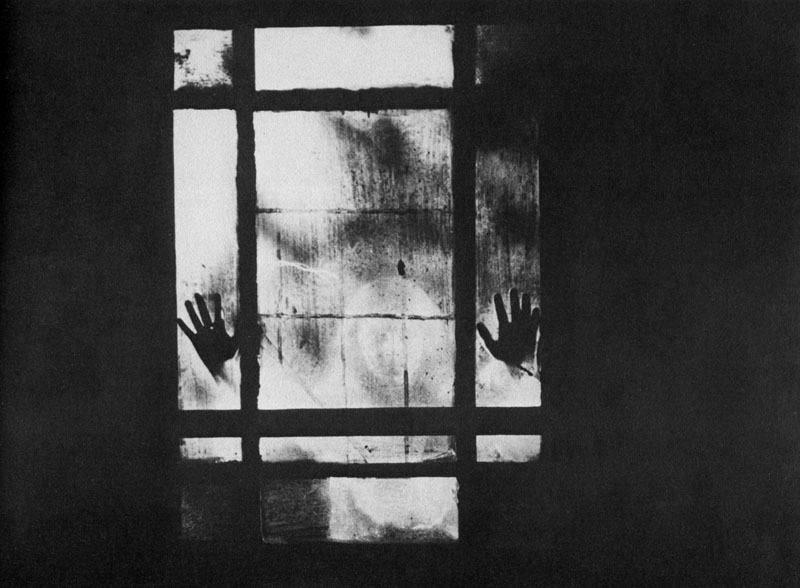
Continuing an occasional series. This photograph, reproduced in Denis Gifford’s A Pictorial History of Horror Movies (1973), intrigued me for years. Gifford’s book is a very good collection of stills from horror films of all kinds, ranging from the earliest days of cinema to the 1970s. The pictures are mostly black-and-white, and are often far more stimulating than the films they would have been promoting. The text generally refers to the films depicted but in the case of this picture there’s only a single credit, Curse of the Dead (1966), a film I’d never heard of. These kinds of mysteries have been banished for good now we have resources like IMDB where you can learn immediately that Curse of the Dead is a Mario Bava film whose original Italian title was Operazione Paura. (It’s also known, with the usual hyperbole, as Kill, Baby…Kill!) “An 18th century European village is haunted by the ghost of a murderous little girl” says the summary. Bava’s films were always visually impressive so it’s really no surprise to find it was one of his.

carnacki.jpg

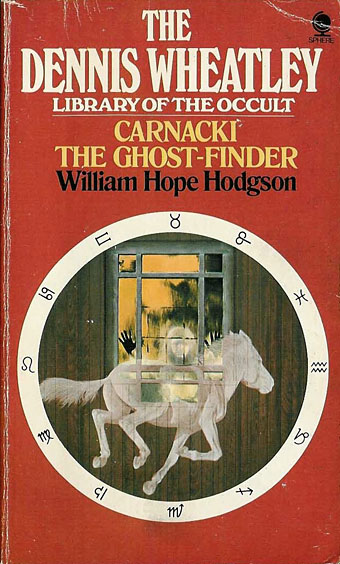
The first repeat usage I know of is this cover from the Dennis Wheatley Library of the Occult series published by Sphere books from 1974–77. Sphere used Wheatley’s name to sell a lot of reprints but the series was substantial and featured a number of titles that would have been appearing in paperback for the first time. Unfortunately the best thing about the covers was the uniform design of the horoscope circle against a coloured background. The quality of the illustrations was very uneven so it’s probably for the best that the artists and photographers went uncredited.

arkham.jpg

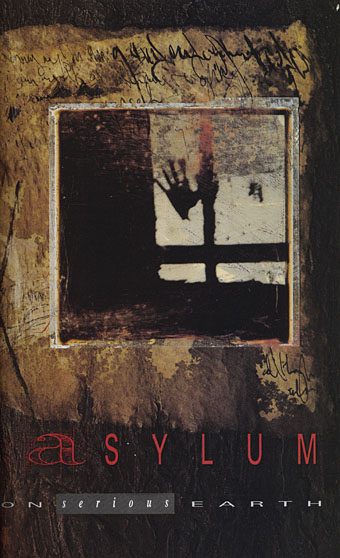
Then there’s one of Dave McKean’s title pages for Arkham Asylum (1989), the heavily symbolic Batman book he created with Grant Morrison. There’s only a portion of the picture but I’d say it’s a good guess he used the Gifford book since at least one of the panels in his earlier Violent Cases was based on another of the Gifford photos.

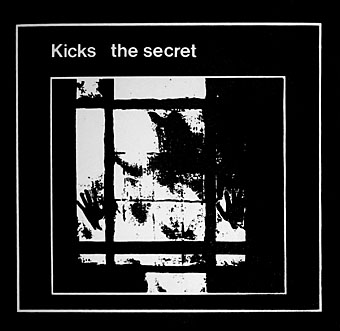
This isn’t all, I’m sure I’ve seen the Gifford picture used on a record sleeve but there’s little way of discovering which one unless somebody recognises the photo. If anyone knows, please leave a comment. And despite all of this I still haven’t seen Bava’s film even though I’m told it had a strong influence on Twin Peaks. This account at The Horror Digest is slightly disappointing when a colour equivalent of the Gifford still lacks the particulated creepiness of the black-and-white version. More surprising is finding yet another film featuring the arms-out-of-the-walls motif. This obviously requires further investigation.

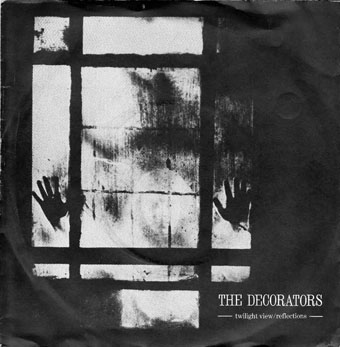
Update: Thanks to Irv in the comments for finding the following singles so quickly. The Decorators sleeve was the one I remembered. (See it larger here.) Kicks were an Australian band. Odd that these were both released in the same year.

decorators.jpg

Twilight View (1980) by The Decorators. Design by Malcolm Garrett.

kicks.jpg

The Secret (1980) by Kicks.

Previously on { feuilleton }
Design as virus 13: Tsunehisa Kimura
Design as virus 12: Barney’s faces
Design as virus 11: Burne Hogarth
Design as virus 10: Victor Moscoso
Design as virus 9: Mondrian fashions
Design as virus 8: Keep Calm and Carry On
Design as virus 7: eyes and triangles
Design as virus 6: Cassandre
Design as virus 5: Gideon Glaser
Design as virus 4: Metamorphoses
Design as virus 3: the sincerest form of flattery
Design as virus 2: album covers
Design as virus 1: Victorian borders

Weekend links 110

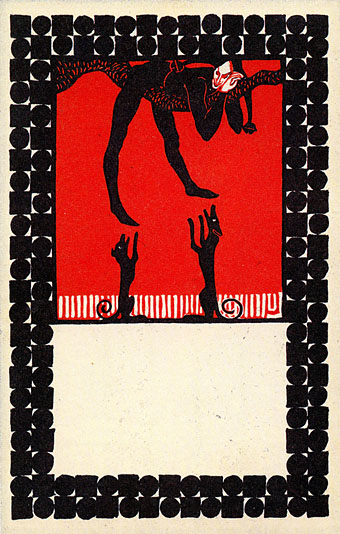
janke.jpg

Til Eulenspiegel by Urban Janke. From Twenty Postcards of the Wiener Werkstätte at 50 Watts.

Rorschach Audio by Joe Banks is “essential reading for everyone interested in air-traffic control, anechoic chambers, artificial oxygen carriers, audio art, bell-ringing, cocktail parties, cognitive science, communications interference, compost, the death penalty, Electronic Voice Phenomena, evangelism, evolutionary biology, experimental music, ghosts, the historiography of art, illusions of sound and illusions of language, lip-reading jokes, nuclear blast craters, predictive texting, singing hair, sonic archives, sound design, steam trains, tinnitus, the Turing Test, Victorian blood painting, visual depth and space perception, ultrasonic visual music, ventriloquism, voices and warehouse fires and robberies.”

• “Freud did not understand female sexuality. Klimt did. Klimt’s women please themselves. The realization that women have an independent sexual life was an insight in art.” Eric Kandel discusses his new study The Age of Insight: The Quest to Understand the Unconscious in Art, Mind, and Brain, from Vienna 1900 to the Present.

• Three new books already mentioned here receive further attention: Stan Persky on Christopher Bram’s Eminent Outlaws : The Gay Writers Who Changed America. | Matthew Aquilone on Paul Russell’s The Unreal Life of Sergey Nabokov. | Karin L. Kross on the new translation of the Strugatsky’s Roadside Picnic.

The creative writing moment/movement baffles me and it intrigues me. What does it signify, all this creative longing? And why through language? Specifically fiction, poetry, memoir? […] The crazy part of it is that we are breeding professional, competent, homogenised writers who will go on to teach writing that is professional, competent and homogenised. The intriguing part of it is whether this movement towards creativity and self-expression is really the start of a kind of Occupy – that it could be dangerous and confrontational, not homogenised at all.

Dangerous? But then they won’t get published and win awards and get film deals and… Jeanette Winterson prepares to teach creative writing at Manchester University.

The Underground New York Public Library is a visual library featuring the Reading-Riders of the NYC subways.

Hob by No Man: “Constructed from soundtrack noises from both version of Quatermass and the Pit.”

Stephen Thrower talks about his soundtrack music for The Erotic Films of Peter De Rome.

John Waters surprises everyone by hitchhiking across the US.

• Sounds & the City: An interview with Julia Holter.

The Dead Dream of the Dirigible.

Meditation (1979) by Edward Artemyev.

Rex Ingram’s The Magician

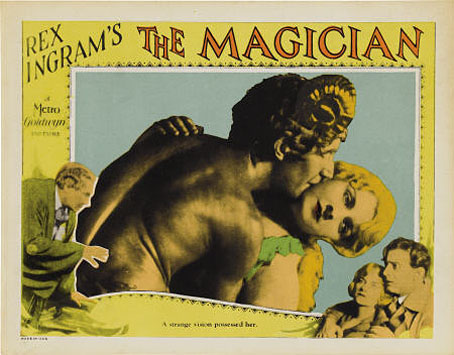
magician1.jpg

The Magician (1926), Rex Ingram’s curious occult horror film, receives a rare screening with live music accompaniment at the Brighton Fringe Festival on Tuesday, 22nd May. The film is notable for being based on the 1908 Somerset Maugham novel of the same name whose modern-day magus character, Oliver Haddo, was modelled on Aleister Crowley. The screening will feature an introduction by Gary Lachman, and a live soundtrack by the fabulous Ragged Ragtime Band, featuring members of Blondie, Indigo Octagon, Raagnagrok and Time. Booking details and other information here.

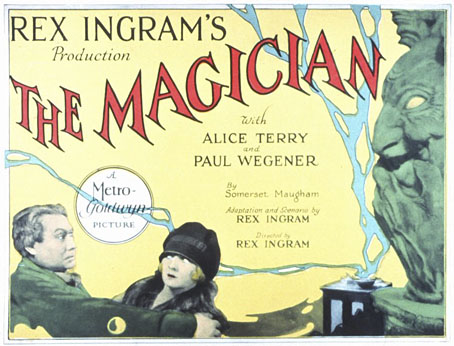
magician2.jpg

Maugham’s book has always been easier to find than Ingram’s film, more’s the pity when the film—despite some flaws—is the superior article. Read today, the novel comes across as a template for the standard Dennis Wheatley tale of middle-class innocents imperilled by grandiloquent villainy. A young couple, Arthur Burdon and his fiancée, Margaret, are pitted against Haddo’s extravagant diabolisms; for assistance they have a friend, Dr Porhoët, a Van Helsing type, older than the couple and with a convenient (but purely intellectual) interest in the occult. Haddo kidnaps Margaret and forces her with hypnosis into an unconsummated marriage. Haddo’s goal is to create artificial life—homunculi—and for that he requires a virgin’s blood. Maugham later described his novel as “lush and turgid”, an honest and accurate appraisal. Aleister Crowley was amused at being portrayed as a “Brother of the Shadows” but pretended to be scandalised by Maugham’s alleged plagiarism which he condemned in a Vanity Fair review that he signed “Oliver Haddo”. The best parts of the novel certainly owe something to other authors, usually the scenes concerning the sinister magus and his occult activities; the rest of the characters are lifeless by comparison. Some of the better passages read like HP Lovecraft writing Dorian Gray, and Maugham not only quotes from Walter Pater but also (uncredited) from Wilde’s Salomé.

magician4.jpg

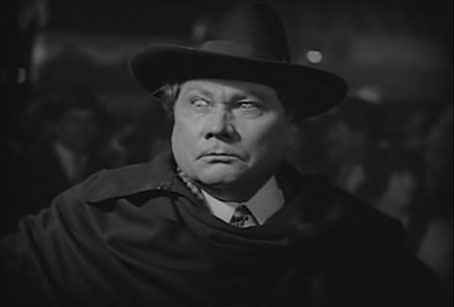
Paul Wegener as Oliver Haddo.

Continue reading “Rex Ingram’s The Magician”

The Telephone Box

telephonebox.jpg

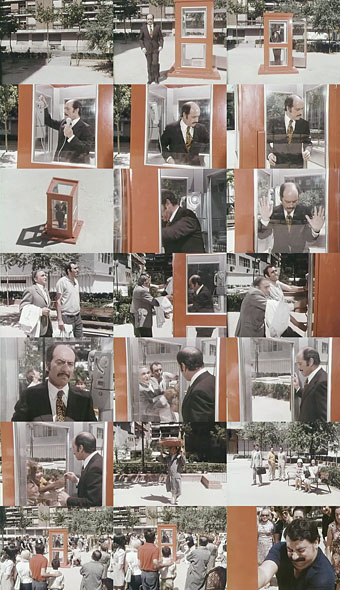
Ah, The Telephone Box, or La Cabina, to give Antonio Mercero’s half-hour film its original Spanish title. Made in 1972, I saw what was probably the first UK TV screening sometime around 1980, and for years afterwards was asking people whether they ever saw that film about the guy stuck in a phone box. Eventually I got in on tape following another TV screening and would foist it on anyone who hadn’t seen it. Thom at Form is Void linked to a YouTube copy a while back, and Stephen Gallagher reminded me of it a few hours ago, so here it is, one of those simple but memorable dramas in which a small problem escalates into a nightmare.

Previously on { feuilleton }
Les Temps Morts by René Laloux