Jiří Barta’s Pied Piper

barta1.jpg

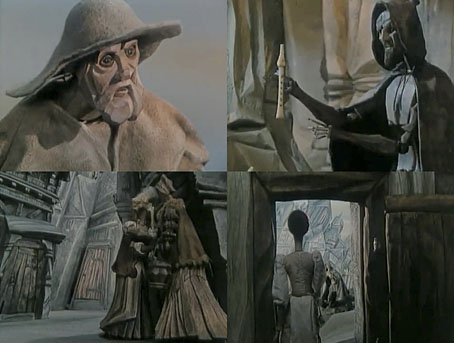
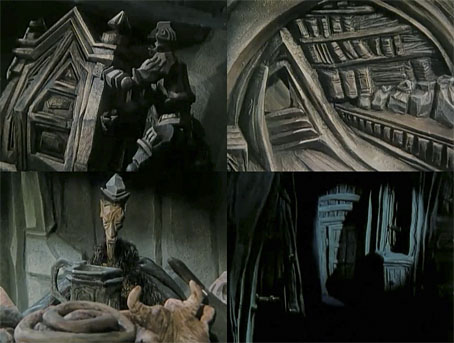
The last time I mentioned Jiří Barta’s extraordinary animation of the Pied Piper story there were only short clips on YouTube. That was several years ago, in which time the 53-minute film has been posted in its entirety. Barta pulls the tale away from its sanitised derivations back to its darker origins in the folk mythology of Central Europe; he also gives the end of the story a twist which I won’t reveal here. The characters are almost all angular wooden figures, while their rat-infested town is constructed from the disjunctive perspectives of German Expressionism. The whole effect is so successful it makes you wish even more that Barta might have completed his feature-length version of the Golem story.

barta2.jpg

Previously on { feuilleton }
Gloves
More Golems
Barta’s Golem

Hodgsonian vibrations

utpatel.jpg

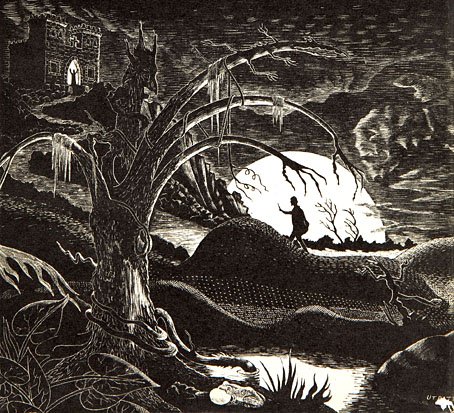
Illustration by Frank Utpatel from the 1947 Arkham House edition of Carnacki, the Ghost-Finder.

“Presently I got hold of myself a bit, and marked out a pentacle hurriedly with chalk on the polished floor; and there I sat in it almost until dawn. And all the time, away up the corridor, the door of the Grey Room thudded at solemn and horrid intervals. It was a miserable, brutal night.”

The Gateway of the Monster (1913) by William Hope Hodgson

“Word falling – Photo falling – Time falling – Break through in Grey Room”

The Ticket That Exploded (1962) by William S. Burroughs

Among other things, 2013 is the centenary of the first book publication of William Hope Hodgson’s collection of weird tales, Carnacki, the Ghost-Finder, and while I don’t believe that William Burroughs was referring to the supernatural eruption that occurs in Hodgson’s Grey Room it would be remiss of me to ignore the connection. Listening this week to Music for Thomas Carnacki by Jon Brooks (he of The Advisory Circle) had me wondering whether there’s any other Hodgson-derived music of note. Lovecraft has inspired hours of musical endeavour while Hodgson’s weird contemporaries, Algernon Blackwood and Arthur Machen, are referenced on some of the Ghost Box releases. Hodgson is the poor relation in these celebrations, often passed over despite the sonic potential of Carnacki stories such as The Whistling Room, The Horse of the Invisible, and especially The Hog, a tale whose manifestations are almost wholly perceived through the medium of sound. Searching around turned up the following examples.

tactile.jpg

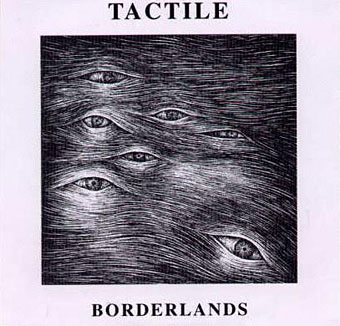
Borderlands (1999) by Tactile.

The House on the Borderland is the big favourite in this list, this album being a series of tracks by John Everall based on Hodgson’s novel. John Balance of Coil appears on the first track, Grief, reading the poem which opens the book.

Continue reading “Hodgsonian vibrations”

Weekend links 150

feanne.jpg

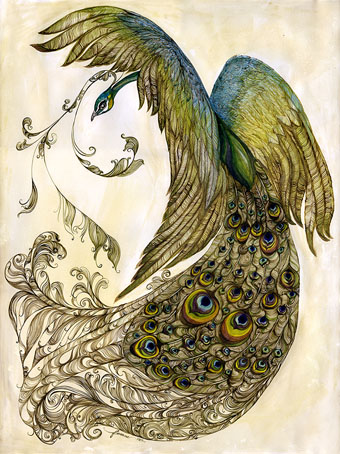
One of A Pair of Peacocks (2012) by Feanne.

Jonathan Barnbrook reveals his package design for the new David Bowie CD. The Barnbrook studio has also designed the catalogue for the forthcoming V&A Bowie exhibition. And there’s more (don’t worry, it’ll be over soon): Jon Savage on When Bowie met Burroughs.

• “Witches have a fashion moment,” says the NYT. Nice clothes but the writing trots out too many of the usual lazy clichés. Related: A Tale of Witches, Woodland and Half-remembered Melodies…, a new mix by Melmoth the Wanderer.

Calidostópia! is a free album (FLAC & mp3) from Marcus Popp aka Oval: “an enticing 16-track collaboration…with seven wonderful singers/musicians from all over South America”.

Before meeting Moorcock in person, [Hari] Kunzru went on to say, ‘I didn’t realise the role he’d played in connecting so many different scenes and undergrounds together – the psychedelic music scene, the science fiction scene, the hip experimental literature scene around people like William Burroughs, pop art’.

Brave New Worlds: A Michael Moorcock Retrospective by Carol Huston. Moorcock’s Elric novels will be published by Glénat in new bande dessinée adaptations later this year.

• More art by Michael W. Kaluta at The Golden Age. And more fantastic comics/illustration by Philippe Caza at 50 Watts. There’s more Caza here.

• Mine and David Britton’s new book, Lord Horror: Reverbstorm, was reviewed at The Spectator.

Google Street Scene: “Moments of cinema captured by Google Street View cameras”.

Cosmic Sentinels and Spiral Jetties: JG Ballard, Robert Smithson & Tacita Dean

• Strange Flowers showcases the heads of Pavel Tchelitchew, 1949–1952.

Setting in the East: Diamanda Galás on Women and Real Horror

Little Joe: “A magazine about queers and cinema, mostly.”

Nanoparticles loaded with bee venom kill HIV.

Treatises on Dust: Antic Found Texts

The Wizard Blew His Horn (1975) by Hawkwind (with Michael Moorcock) | Brothel In Rosenstrasse (1982) by Michael Moorcock’s Deep Fix | Running Through The Back Brain (1983) by Hawkwind (with Michael Moorcock)

Weekend links 149

bowie.jpg

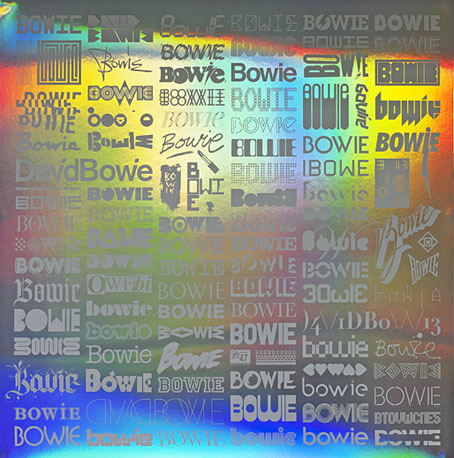
It’s not cheap but it’s rather tasty: The Changing Faces of Bowie, a limited print at the V&A shop produced for the forthcoming David Bowie exhibition. One hundred artists and designers were asked to choose or create a Bowie-related type design, the collection being printed on holographic paper. Creative Review looked at some details. Related: Bowie’s new album, The Next Day, is now streaming in full at iTunes.

• Marisa Siegel reviews The Moon & Other Inventions: Poems After Joseph Cornell by Kristina Marie Darling, “a fully enchanting if somewhat mysterious collection of poems, written entirely as footnotes”. BlazeVOX has an extract here.

• “[Clement] Greenberg came round to our house in Camden Square. He started telling Bill what he should do to improve a work. Dad lost patience and kicked him out.” Alex Turbull of 23 Skidoo on sculptor father William Turnbull.

“You get the impression that a lot of these young directors have never gained much experience of life outside their film schools or their video-rental stores.”

Anne Billson met Roman Polanski in 1995 to discuss Death and the Maiden.

• Max Beerbohm’s The Happy Hypocrite, and Ronald Firbank’s Vainglory are available in new print-on-demand and ebook editions from Michael Walmer.

• “Bring Back the Illustrated Book!” says Sam Sacks. Some of us would reply that it never went away but merely remains subject to much unexamined prejudice.

The Forest and The Trees: A blog by Genevieve Kaplan about altered texts and book art by herself and other artists.

The Homosexual Atom Bomb: Sophie Pinkham on gay rights, Soviet Russia and the Cold War.

Who’s Afraid Of The Art Of Zang Tumb Tuum? A blog devoted to the ZTT record label.

• Nigel Kneale’s TV ghost drama, The Stone Tape, is reissued on DVD later this month.

• The drawings of Victor Hugo.

David Bowie at Pinterest.

•  The Man Who Sold The World (1994) by Nirvana | V-2 Schneider (1996) by Philip Glass | ‘Heroes’ (2000) by King Crimson
Nigel Kneale’s Nineteen Eighty-Four

1984-1.jpg

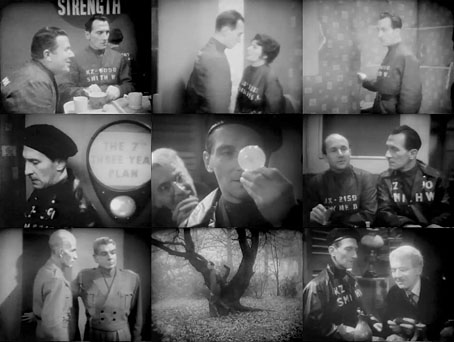
If I’d been more diligent I would have posted this yesterday which happened to be the UK’s first George Orwell Day. The Quatermass Experiment and this adaptation of Nineteen Eighty-Four are the two outstanding dramas from the very early days of British television. Both were written by Nigel Kneale and directed by Rudolph Cartier, an expatriate Austrian who brought to the small screen skills honed at the UFA studios before the war. The Quatermass Experiment was the first major collaboration between the pair after which they adapted Wuthering Heights. Nineteen Eighty-Four followed, a production that was screened twice in November 1954, and which caused considerable controversy at the time on account of its oppressive atmosphere and the scenes of Winston Smith’s torture.

1984-3.jpg

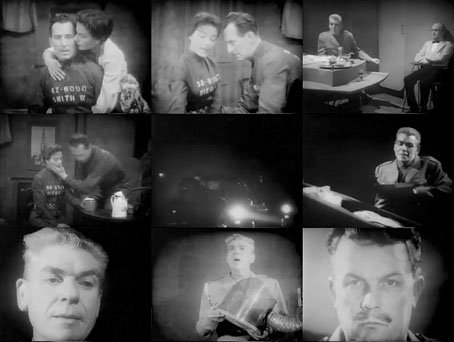
Kneale’s drama, which was performed live in the studio on both occasions, looks primitive compared to everything that’s followed but in many ways I prefer this adaptation to Michael Radford’s glossier feature film. For a start it has a great cast: Peter Cushing plays Winston Smith, Yvonne Mitchell is Julia, Donald Pleasence is Syme, and André Morell (who later played Professor Quatermass in the BBC’s Quatermass and the Pit) is O’Brien. Also among the cast there’s Wilfrid Brambell in two minor roles, one of them a precursor of the crusty old man he’d spend the rest of his life portraying. Neither Cushing nor Pleasence were known as film actors at this time; both would no doubt have been surprised to be told that their subsequent careers would involve a great deal of horror and science fiction.

1984-2.jpg

Cartier and Kneale didn’t have the budget to compete with feature films but for once the claustrophobic nature of a studio production works in the favour of a drama where there’s little intimacy or privacy. With the exception of a few filmed inserts almost everything is close shots. As the story grows more desperate so the shadows close in, until the final scenes are all spotlit faces in darkened rooms. The power of Cushing’s performance still resonates today, and gives an idea of how shocking this must have been to a home audience expecting little more than light entertainment on a Sunday evening. The YouTube copy is the entire 107-minute film, and is worth a watch if only to see Donald Pleasence when he had an almost complete head of hair.

• From 2009: Robert McCrum on The masterpiece that killed George Orwell.

Previously on { feuilleton }
The Stone Tape