The art of Peter Knoch

knoch1.jpg

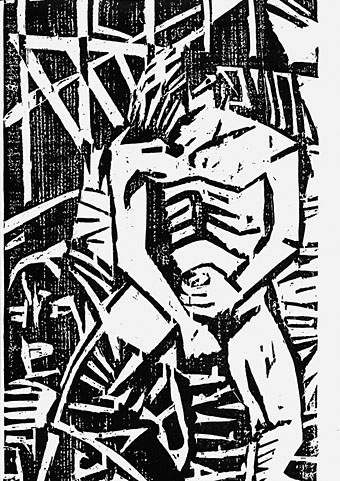
Junger Mann.

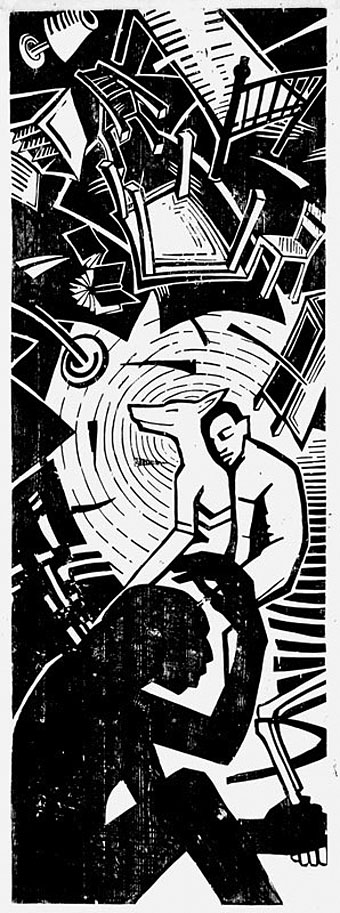
You don’t often see woodcuts like these by German artist Peter Knoch which combine a homoerotic quality with a jagged graphic style familiar from Expressionism. Some were for an AIDS-themed series for which a harsh visual treatment might be thought fitting although the first two here are from a separate series. Knoch’s work encompasses paintings, ceramics, detailed puppet environments, theatre design and graphic design. There’s more to see at his website, and at B-E-A-S-T. (Thanks to Callum for the tip!)

knoch2.jpg

Jean.

knoch3.jpg

Traum.

Elsewhere on { feuilleton }
The gay artists archive

Weekend links 297

floridxfauna.jpg

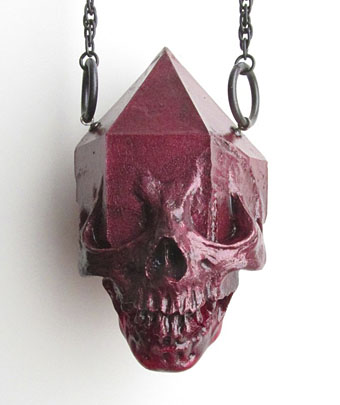
Crimson Metallic Emergent Skull Crystal Pendant by Kristen Phillips aka Floridxfauna.

The Noise-Arch Backup at the Internet Archive is 30GB of mp3s from noise-arch.net, a collection of cassette-based releases and artwork: “material represented includes tape experimentation, industrial, avant-garde, indy, rock, diy, subvertainment and auto-hypnotic materials…” 30GB is an intimidatingly large amount of material so it’s better to browse The Noise-Arch Archive, a selection of 468 releases.

• The week in erotica: Claire Voon on Ancient Erotic Dreams and Explicit Scenes in the New York Public Library Collection; Melanie Porter on Great Grandporn: Hardcore Pornography of the Silent Era; Cathy Camper on The Comics of Dale Lazarov: Illustrated Explorations of Sexual Inventiveness.

Void Beats/Invocation Trex by Cavern of Anti-Matter (Holger Zapf, Joe Dilworth & Tim Gane) was released this week. The opening number is Tardis Cymbals. Tom Furse condensed the 73-minute album into a 17-minute mini-mix.

Indeed, if you had to “place” ­Williams—put him alongside writers with whom he had something in common—it would be with the mystical autodidacts, the backstreet Rosicrucians more than with the pipe-smoking, tweedy Inklings. To that extent, the only unsatisfactory thing about Grevel Lindop’s book is its title. True, Williams went to Oxford when war broke out and became friends with the famous circle around C. S. Lewis. But he was not an Inkling in spirit. He was not at home in Oxford, and his arrival, far from consolidating the Inklings, actually broke them up by bewitching Lewis, and making Lewis neglect the central friendship of his life, that with ­Tolkien. Another scholar of Old English literature, C. L. Wrenn, said that meeting Williams made you realize why inquisitors thought they had the right to burn people. Tolkien agreed: “Williams is eminently combustible.”

Certainly, Williams’s books had an influence on the Inklings. Lindop is right to say that the central plotline of Many Dimensions suggests the story of The Lord of the Rings. In the Williams novel, it is a stone of great power, rather than a ring, but it has the same effect on those who bear it: They become its possession, not its possessor.

AN Wilson reviews Charles Williams: The Third Inkling by Grevel Lindop

• Russ Fischer recommends five films by Andrzej Żuławski (RIP). Possession (1981) is still the easiest to find, and a good place to start. I enthused about On The Silver Globe (1977–87) last year.

England’s Hidden Reverse: A Secret History of the Esoteric Underground by David Keenan has been published in a revised and expanded edition by Strange Attractor.

The Preservation Man (1962): Artist and collector Bruce Lacey (RIP) filmed by Ken Russell for the BBC’s Monitor.

Barry Adamson: “I’ve been called the outsider’s outsider”.

• At Dangerous Minds: Six degrees of Marty Feldman.

• Mix of the week: FACT mix 536 by Not Waving.

• The Alan Clarke page at the BFI shop.

Umberto Eco (RIP): Porta Ludovica

Possessions (1980) by The Residents | Possessed (1992) by The Balanescu Quartet | Possessed (2001) by Sussan Deyhim & Shirin Neshat

The art of Tatsuji Okawa, 1904–1994

okawa1.jpg

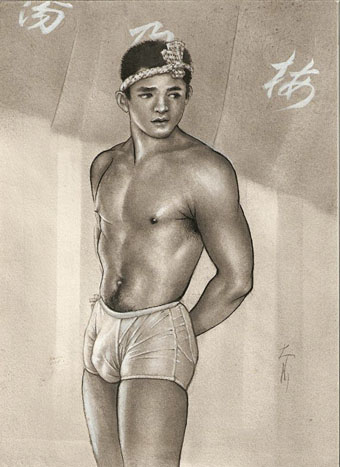
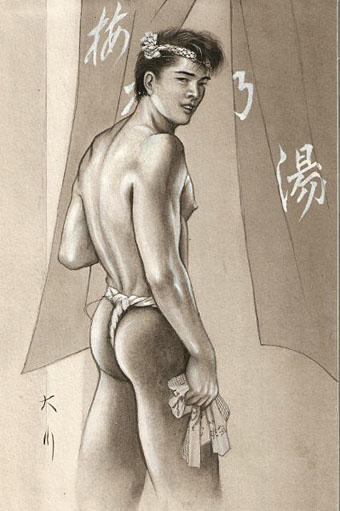
More from Japan. I found some of Tatsuji Okawa’s bondage drawings on a website some years ago but there was no information about the artist other than his name. The reproductions were also poor quality, being grainy scans from books. These drawings are from the excellent Japanese Gay Art site, a wonderful resource that also sells the work on display. Most of the drawings deal with bondage and/or humiliation—popular themes in Japanese porn—but there are a few portrait-style pieces like the ones below. No surprise to read that Yukio Mishima enjoyed Okawa’s work.

okawa2.jpg

okawa3.jpg

Elsewhere on { feuilleton }
The gay artists archive

Weekend links 293

meyohas.jpg

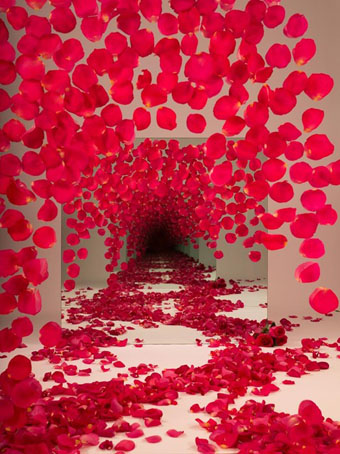
Red Petals by Sarah Meyohas.

• “For MMoB, I want it to be like a [Werner] Herzog movie, so at our concerts the people on stage aren’t necessarily people who are named. We’re trying to create an entity that is beyond music and relates visually and sonically with everything in a way that’s different.” Randall Dunn talks to Simona Mantarlian and Daniel Jones about the Master Musicians of Bukkake and his production work for other artists.

• “Is reel-to-reel tape the new vinyl?” asks FACT mag. It’s certainly better than cassette tape (if less convenient) but it was always a niche format for albums, even in the 1970s. Rene Chun made a similar argument for an emerging trend last October. Those expensive machines do look tempting… Early adopters should start collecting here before prices rise.

Airwaves: Songs From The Sirens is a new release of spectral audio transmissions by A Year In The Country: “…a gathering of scattered signals plucked from the ether, cryptograms that wander amongst the airwaves…” Physical versions come with the usual plethora of monochrome artefacts.

A vivid memory to his friends, Litvinoff was one of those people whose performance was their life. His most lasting achievement was the profound influence he had on Performance – the hallucinatory film directed by Nic Roeg and Donald Cammell, and starring Mick Jagger, which captured the London of the late 1960s, merging pop stardom, violent criminality, illegal drugs, gender-blurring, the occult and Jorge Luis Borges.

Jon Savage on David Litvinoff

• Virgin Prunes “are THE #1 most underrated group of the post-punk era” says Richard Metzger. I’d say that honour goes to The Passage but the Virgin Prunes were unique even if they’re too often dismissed as a freak footnote in the U2 story.

Magic, Witches & Devils in the Early Modern World is a free exhibition at the John Rylands Library, Manchester, that will run until August 2016. Related: “John Dee painting originally had circle of human skulls, x-ray imaging reveals.”

• “What I’m seeing now is an awful lot of people just following things. We tried to find our own thing and ask, ‘What else is there?'” Charles Hayward on the past and present of post-punk band This Heat.

• “I’ve never been tempted to write anything that was not essentially nightmarish.” Thomas Ligotti in a comprehensive profile (originally run in 2010) at Dennis Cooper’s blog.

• Mixes of the week: An introduction to Stereolab by Jon Dale, and Silent Radio Transmission Jan 2016 by SilentServant.

• Kicked Toward Saintliness: Max Nelson on the dark erotics of Jean Genet’s Our Lady of the Flowers.

• Reverse Engineering: Danny Hyde on Coil, Backwards and NIN.

Fuck Yeah! Anna von Hausswolff

Harry Flowers (1970) by Jack Nitzsche | Flowers In The Air (1970) by Sally Eaton | Darkness: Flowers Must Die (1972) by Ash Ra Tempel

The art of Willem Arondeus, 1894–1943

arondeus06.jpg

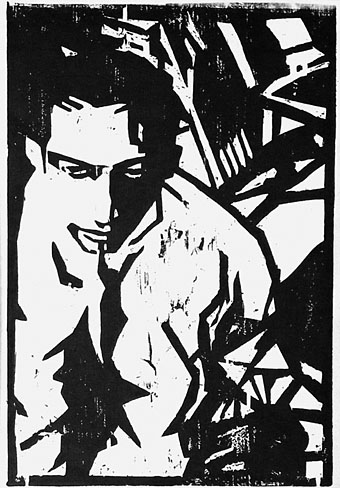
Salomé (1916). “Your eyes are like black holes burned by torches in a Tyrian tapestry.”

This marvellous Salomé design is by a Dutch artist I hadn’t heard of before, Willem Arondeus, who might have had a longer career had his life not been cut short by a Nazi firing squad in 1943. Arondeus helped with the Dutch Resistance during the war, forging papers for fleeing Jews, and bombing the Amsterdam Public Records Office. His work warrants a place in the ever-popular gay artists archive not for any homoerotic qualities but because Arondeus was open about his homosexuality for his entire life, his last message to the world being “Let it be known that homosexuals are not cowards.” The work that can be seen online is in that hybrid style that you see a lot from the 1920s on, a blending of the prevalent Art Deco manner with some hangover from the Art Nouveau period. The Salomé piece is particularly good for the way it entangles Salomé’s figure in writhing foliage and clustered architecture.

arondeus05.jpg

De Elfenzetel (1919).

arondeus04.jpg

Stamp advert (1923).

Continue reading “The art of Willem Arondeus, 1894–1943”