Le livre blanc by Jean Cocteau

cocteau1.jpg

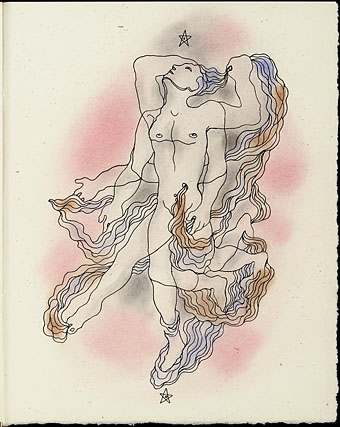
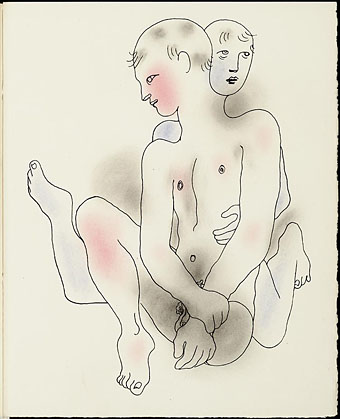
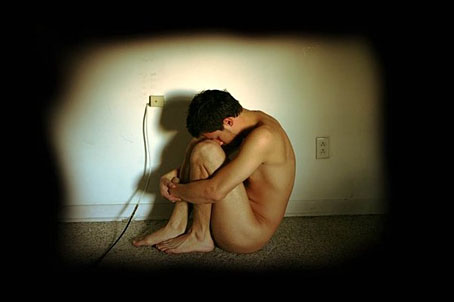
Two illustrations by Jean Cocteau for his homoerotic novel Le livre blanc. Cocteau never publicly acknowledged his authorship of the book but his illustrations (coloured by MB Armington) decorated the second edition published by Éditions du Signe in 1930. He also provided an introduction. The Koopman Collection has further illustrations and page scans.

Cocteau wrote Le livre blanc in 1927 in Chablis, where he was staying with Jean Desbordes, the successor to Cocteau’s great love. Cocteau’s drawings have been described as obscenely pious. They are established by quick, flowing lines, partially erotic and often sultry, featuring classical elements such as busts and centaurs. Erotic images were popular articles in France, where they were sold under the counter; people were extra careful about homosexual erotica. Cocteau described his first sexual experiences in Le livre blanc: his excitement upon seeing a naked peasant boy on horseback and two naked young gypsies on his father’s estate. (More.)

cocteau2.jpg

Elsewhere on { feuilleton }
The gay artists archive

Previously on { feuilleton }
Cocteau’s sword
Cristalophonics: searching for the Cocteau sound
Cocteau at the Louvre des Antiquaires
La Villa Santo Sospir by Jean Cocteau

Entomologia

bittle.jpg

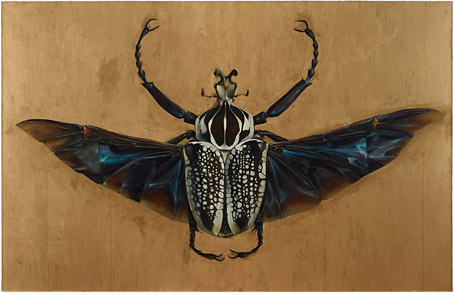
A Royal Family (Goliath Beetle) (2003) by Joianne Bittle.

More insect art. Entomologia is a group exhibition of art incorporating and inspired by insects, on view at Observatory, Brooklyn, NY, from February 26th to April 4th, 2010. There are fourteen artists involved but not all of them have websites showing the work one might expect to see there, unfortunately. The gallery will also host a series of events tied to the exhibition; more details here. Among the contributors is photographer Brian Riley whose chiaroscuro studies of male nudes have featured here previously.

Previously on { feuilleton }
Jewel beetle
How many leaf beetles can dance on the head of a pin?
The art of Jo Whaley
Endangered insects postage stamps
Brian Riley

Ode to the Classics

gloeden.jpg

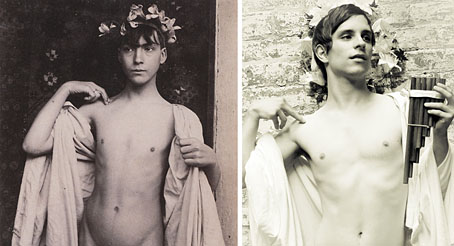
In which photographer Mikel Marton works variations on Wilhelm von Gloeden’s nude studies of the boys of Taormina, Sicily. “Classic” has a double meaning here since Von Gloeden’s photographs are now considered classic works of early homoerotica (Oscar Wilde was an enthusiast) as well as borrowing their props and poses from Classical antiquity. The very attractive model in the new shots is one Barry K and Mikel also posts some pictures by Sascha Schneider whose deeply strange and mystical illustrations have featured here in the past.

Previously on { feuilleton }
Uranian inspirations
Forbidden Colours
Mikel Marton
The art of Sascha Schneider, 1870–1927
Toxicboy
Evolution of an icon

The recurrent pose 31

knight.jpg

Two more variations on the Flandrin pose. The photo above is by Chris Knight who has a selection of luscious homoerotica if you look in his “Human Form” gallery. Thanks again to Thom!

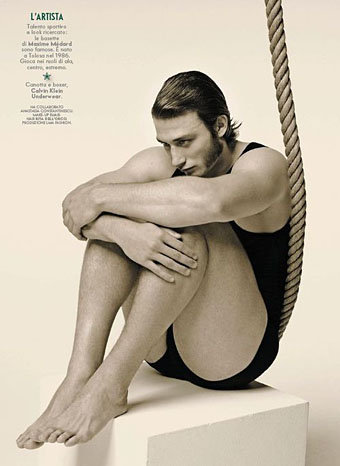
The picture below of French rugby player Maxime Médard is from a recent feature in Vanity Fair Italia with photography by Claudio Carpi. Although this deviates slightly from the customary posture, I try and thrown in some beef now and then for those who feel deprived by the surfeit of lithe and twinky creatures. Via VGL.

medard.jpg

Elsewhere on { feuilleton }
The recurrent pose archive

Michelangelo’s Dream

michelangelo.jpg

The Dream of Human Life by Michelangelo (1533).

Michelangelo was of course homosexual. That obvious fact still needs restating, simply because generations of art historians have been embarrassed by it. Attempts to deal with the subject have a certain comic interest. E. H. Ramsden, who translated Michelangelo’s letters, refutes the slur of homosexuality with a resounding old-fashioned “Tush!” Anthony Burgess gives an equally Victorian shudder over the David, “so epicene that it invokes unpleasing visions of Michelangelo slavering over male beauty.” Many nineteenth century critics denied him any sexuality at all, apparently preferring a eunuch to a deviant; and even today, it is a common ploy to argue that his genius inhabits some transcendently bisexual—and therefore nonsexual—realm. The evidence for his homosexual loves is too strong to be denied, particularly in the letters to and about one of his models Febo di Poggio, and those about the fifteen-year-old Cecchino de’ Bracci. And it is immediately obvious in his art.

So writes Margaret Walters in The Nude Male: A New Perspective (1978). Appraisals of the great artist’s sexuality have thrown off the prudery in the past thirty years, and a new exhibition at the Courtauld Gallery, London, looks directly at Michelangelo’s attraction to young men. The central work is The Dream of Human Life (or The Dream), one of a number of drawings Michelangelo presented to Tommaso de’ Cavalieri, a Roman nobleman and (we’re told) very handsome youth he met in 1532. No pictures of Cavalieri exist, unfortunately, so we have to take his good looks on trust but it’s unlikely that a 57-year-old artist would have plied a boy with beautiful drawings and hundreds of love poems without good reason. Guardian critic Jonathan Jones has a book about Michelangelo published soon and he writes enthusiastically about the exhibition:

The Courtauld Gallery, that sombre, academic institution, dares to go where Irving Stone never went in his bestselling novel about Michelangelo, The Agony and the Ecstasy. It refutes, with all the authority at its command, centuries of bowdlerisation that have left the nude saints in Michelangelo’s painting The Last Judgment still – in 2010 – emasculated by prudish drapes. It gives us the unmade movie Michelangelo in Love, pouring out his soul in art and verse to a handsome youth whose beauty crystallised all the longings inherent in Michelangelo’s art ever since he carved his teenage masterpiece The Battle of the Centaurs, with its vision of life as a tumult of wrestling male bodies. (More.)

Also on display are previously unexhibited handwritten poems. The Courtauld site has more details about Michelangelo’s Dream which runs from February 18 to May 16, 2010.

Elsewhere on { feuilleton }
The gay artists archive

Previously on { feuilleton }
The fascinating phallus
Behold the (naked) man
Michelangelo revisited