Bill Travis revisited

travis1.jpg

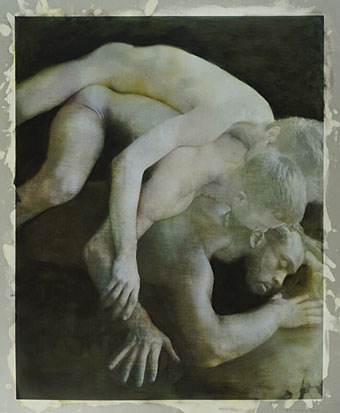
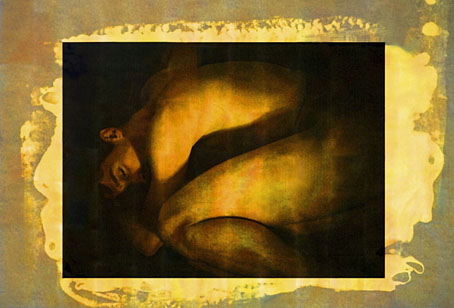
“Todd,” backlit alternative process photo with wax, 28 x 41 in., 2017.

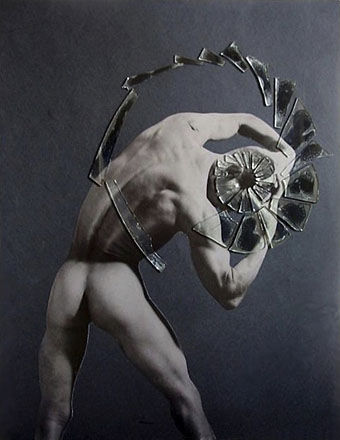
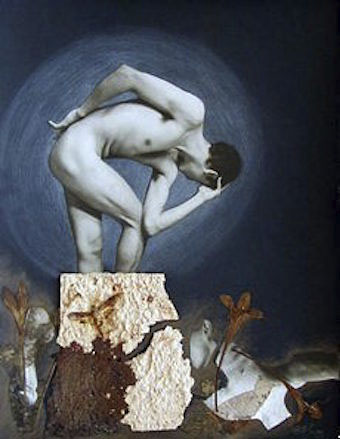
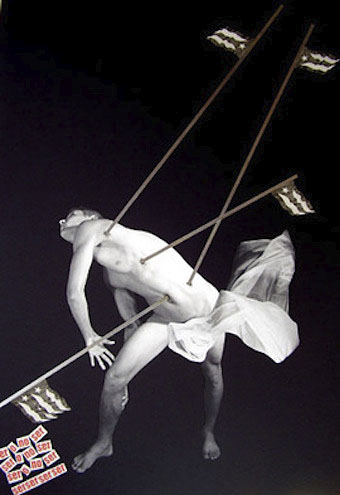
Bill Travis was in touch last week to let me know about his new website which showcases his latest artwork. Travis’s photographs of male bodies. pastoral views and cityscapes are processed in a manner that gives them a painted finish, with the prints being further backlit to create the luminosity commonly associated with stained-glass windows. It’s a beautiful effect that enhances the inherent beauty of the images. Some of the prints are available for purchase.

travis2.jpg

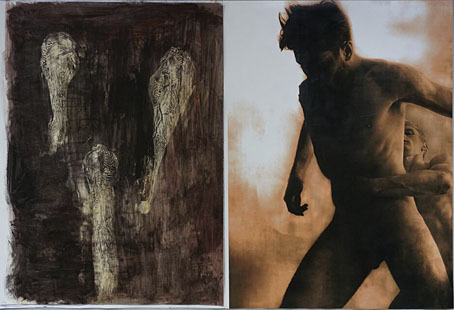
“Dancers 1,” backlit alternative process photo with wax and oil paint, 22 x 18 in., 2019.

travis3.jpg

“Receive Me Darkness” (artist book), pp. 36-37, mixed media, 24 x 36 in., 2021.

Elsewhere on { feuilleton }
The gay artists archive

Previously on { feuilleton }
The art of Bill Travis

Weekend links 597

okazaki.jpg

Untitled art by Toshio Okazaki from JCA Annual 5, 1984.

• “Yeah, when I first started writing it, nobody knew what to call it at all. I mean, the publishers didn’t know what to call it. They thought that Tolkien was (writing about) a post-apocalyptic nuclear world. That’s the only way they could perceive an alternate world, in other words. And it was the same with Mervyn Peake… they’re all interpreted that way. The idea of putting ‘fantasy’ on a book meant usually meant that it was a children’s book. And if you put fantasy as the genre, they usually put ‘SF’ larger than ‘fantasy’ to show that it was what it was.” Michael Moorcock (again) talking to Derek Garcia about fiction, games, and (of course) Elric.

• “Non-payment, low payment, late payment and promises of jam tomorrow, or at some unspecified future date, bedevil the freelance life as they did five centuries ago.” Indeed. Boyd Tonkin on Albrecht Dürer, patron saint of stroppy freelancers.

• “All at once, Non-Stop Erotic Cabaret is tender, outrageous and daft.” Patrick Clarke compiles an oral history of Soft Cell’s debut album.

Yeah, it was kind of a media hype. In January [1967], the media said, [breathless] ‘Oh my god, San Francisco is the place to be. Come to San Francisco, wear flowers in your hair.’ So we had a meeting of the people in the Haight-Ashbury about how we were going to deal with so many people coming. The Diggers decided to kind of make it a university of the streets, an alternative anarchist culture.

We knew that all these people were coming to San Francisco, and we knew they weren’t going to stay. And we thought, well, the best thing we could do would be to kind of educate them about the kinds of things that are possible in society, and then let them go back to where they’re from, and they would carry these ideas. And that is what happened. We were quite successful in that.

Judy Goldhaft of the San Francisco Diggers talking to Jay Babcock for another installment of Jay’s verbal history of the hippie anarchists

• “What ‘impossible’ meant to Richard Feynman; what I learned when I challenged the legendary physicist,” by Paul J. Steinhardt.

• At Strange Flowers: part one of James Conway’s essential end-of-year shopping list, Secret Satan.

• Mixes of the week: Part II and Part III of the three-part At The Outer Marker series by David Colohan.

• At Dennis Cooper’s: Olivia Duval presents…Suave: A History of Les Disques du Crépuscule.

Mystery and Truth of the Cthulhu Myth, a Japanese guide to the Cthulhu Mythos.

• Intimacy, Loss and Hope: Inside Florian Hetz’s beautiful 2020 photo diary.

• New music: The Tower (The City) by Vanessa Rossetto/Lionel Marchetti.

Nite Jewel’s favourite albums.

• RIP Stephen Sondheim.

Nothing Is Impossible (1974) by The Interns | Mission Impossible Theme (1981) by Ippu-Do | Impossible Guitar (1982) by Phil Manzanera

Weekend links 596

hoshiyama.jpg

Jam III (2021) by Kotaro Hoshiyama.

• “Powell and Pressburger are peerless in realizing what Orson Welles would term plotless scenes—extra bits that ostensibly do not advance the story, but are a story unto themselves, and aggregate such that they’re vital to how we understand the characters who are living the story.” Colin Fleming says thanks for the Archers.

• A short promo for The Incal: The Movie. Hmm, okay. A film that adapted all 300 pages of the original story without changing anything or trying to explain away the weirdness would be worth seeing. But I doubt that’s what this will be. Read the book.

• “If a single word distills the New Wave aesthetic, it’s plastic…ironically flaunted artificiality became a leitmotif of the era.” Simon Reynolds reviews Reversing Into the Future: New Wave Graphics 1977–1990 by Andrew Krivine.

• Mixes of the week: a mix by Princess Diana Of Wales (not that one) for The Wire, and At The Outer Marker Part I, a Grateful Dead Twilight Zone mix by David Colohan.

The Bloomingdale Story: read the never-before published Patricia Highsmith draft that would become Carol (aka The Price of Salt).

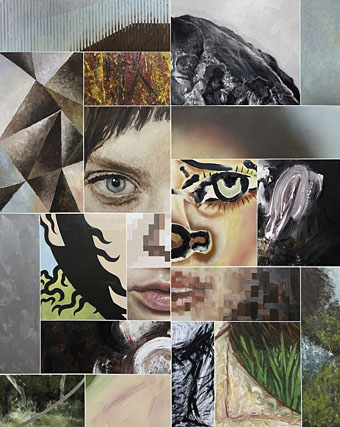
• At Spoon & Tamago: Multiple panels form collaged portraits painted by Kotaro Hoshiyama.

• New music: Pyroclasts F (excerpt) by Sunn O))), and Loop return with Halo.

• At Dennis Cooper’s: William E. Jones Day.

Plastic Bamboo (1978) by Ryuichi Sakamoto | Barock-Plastik (2000) by Stereolab | Black Plastic (2002) by Ladytron

Weekend links 594

klinger.jpg

Eva und die Zukunft (1898) by Max Klinger.

• “It is no exaggeration to say that MAD invented the modern, postwar American takedown.” Thomas Larson reviews Seeing MAD: Essays on Mad Magazine’s Humor and Legacy.

• At the Internet Archive: Cartoon Modern: Style And Design In Fifties Animation (2006) by Amid Amidi, a book which has been made available as a free download by its author.

• New music: A preview of Metta, Benevolence by Sunn O))), recorded live in the Mary Anne Hobbs’ radio show in 2019; Veils by Víz; The Mountain (Blakkat Dub) by Ladytron.

• At Public Domain Review: Claude Mellan’s The Sudarium of Saint Veronica (1649), an engraving made with a single continuous line.

• “For Harry Houdini, séances and Spiritualism were just an illusion,” says Bryan Greene.

TheStencil is Steven Heller’s font of the month.

• At Dennis Cooper’s: Derek Jarman Day.

Nicky Mao’s favourite music.

Mad Man Blues (1951) by John Lee Hooker | Mad Pierrot (1978) by Yellow Magic Orchestra | Mad Keys (2002) by Al-Pha-X

The art of Eduardo Hernández Santos

santos1.jpg

From the series Aproposito los flores.

In 1993 I made Homo-Ludens, which was the first homoerotic exhibition to take place in Cuban photography after the Revolution. This show was committed to a direct, frontal discourse, but very aesthetic. It was not intended to reflect great contradictions, but to propose to society that the male body was also an object to analyze, that it was a source of pleasure, and not only to women.

Cuban artist Eduardo Hernández Santos talking in 2016 about his career (here and here). In addition to straightforward photography, Santos favours collage as a technique, combining his own photographs with fragmented slogans and other imagery. The late date of the Homo-Ludens exhibition is a result of the slow evolution of attitudes towards sexuality in Cuban society. Fidel Castro regarded gay men as degenerates, a common sentiment in Communist circles in the 1960s, and one shared by many fascists. A striking thing about homosexuality is the way you can be despised by a wide variety of people who wouldn’t agree with each other about anything else.

santos2.jpg

From the series Corpus Fragiles.

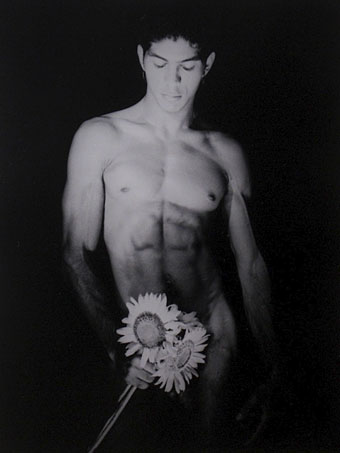
It’s tempting to wonder what Jean Genet would have thought about Santos’s photographs of male nudes with flowers. Genet used flowers for their symbolic qualities almost as much as Oscar Wilde, so even though it’s unwise to try and second-guess him I imagine he’d appreciate their use here.

santos3.jpg

Untitled (2000).

santos4.jpg

From the series Palabras.

Elsewhere on { feuilleton }
The gay artists archive

Previously on { feuilleton }
The art of Gregorio Prieto, 1897–1992
Emil Cadoo