Notre Dame des Fleurs: Variations on a Genet Classic

genet1.jpg

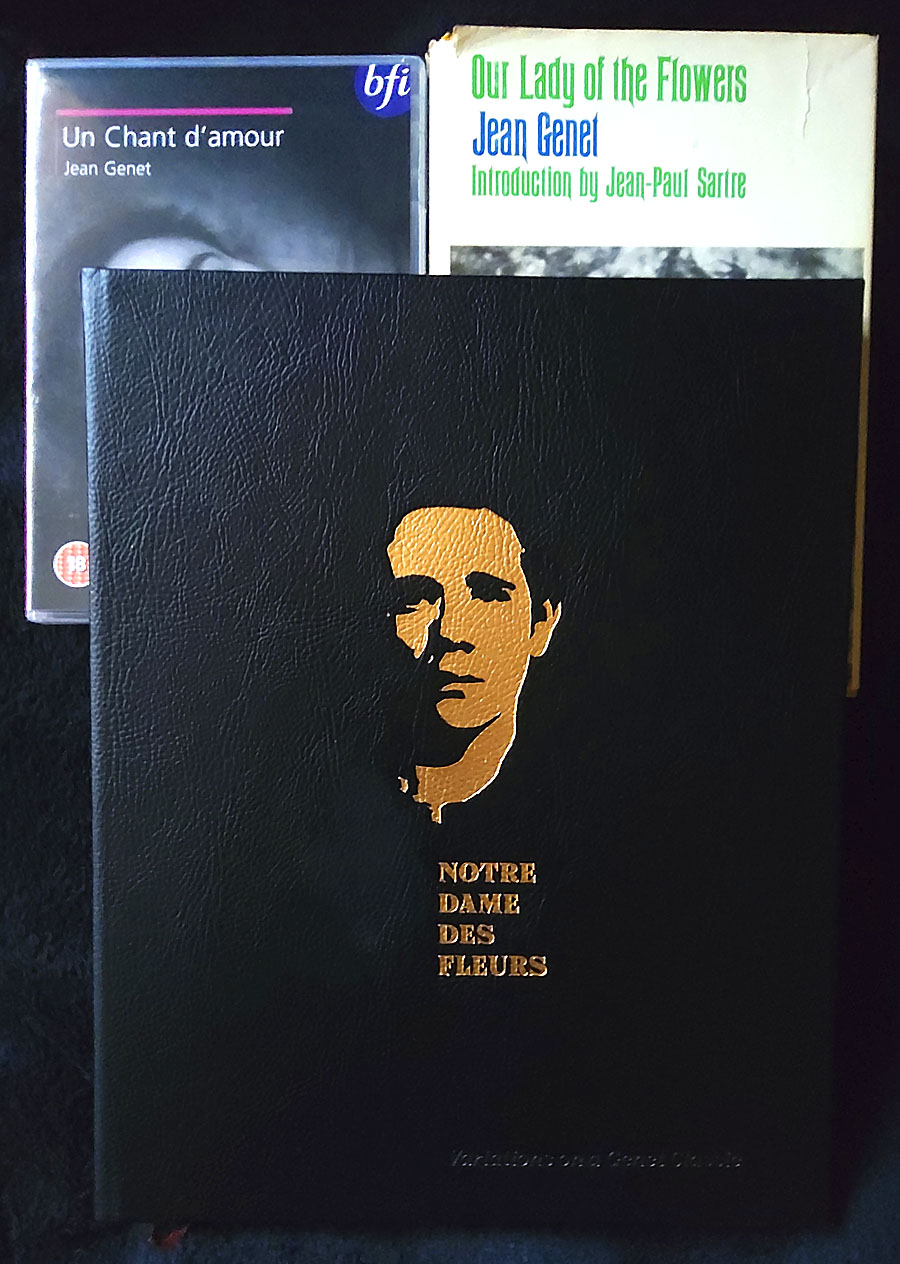
Another week, another book release. Notre Dame des Fleurs is a collection of artistic responses to Jean Genet’s debut novel, compiled and published by Jan van Rijn, for which I contributed three pieces:

Based on the English translation of the unabridged original edition, published in 1949 by Edition Paul Morihien, it is by no means a consistent illustration of the book nor is it a cohesive interpretation in form of a graphic novel. It is a truly personal collection that throws highlights on a beautiful piece of literature, printed in a run of 150 signed and numbered copies. The participating artists in alphabetical order: Michael AmpersantAntoine BernhartWim BeullensSusie Bright – John Coulthart – Lauri ElexsenRinaldo HopfAnja MolendijkBrane MozeticJohn Thomas ParadisoRexApollonia Saintclair Jan van RijnVilela Valentin

Genet’s novel caused a considerable stir when it was first published in France in 1943. Part memoir, part fiction, part masturbation aid, the book was famously written by Genet on sheets of wrapping paper in his Paris prison cell, and is probably the first account of homosexual lives—especially of homosexual erotic lives—lived on their own terms, without any apologies made to straight society or, for that matter, the straight reader. (“Straight” here applies to criminality as much as sexuality.) Antecedents exist, like Teleny Or the Reverse of the Medal, but Teleny is more assertively pornographic, which means it wanders into the fantasy world that porn always creates, a place where desire is everything and introspection doesn’t exist. Genet was writing about the people he knew in Paris before the war, the thieves and pimps and male prostitutes of Montmartre, and doing so in a manner that had to be considered as literature however transgressive the content might be for the literary establishment of the day.
genet2.jpg

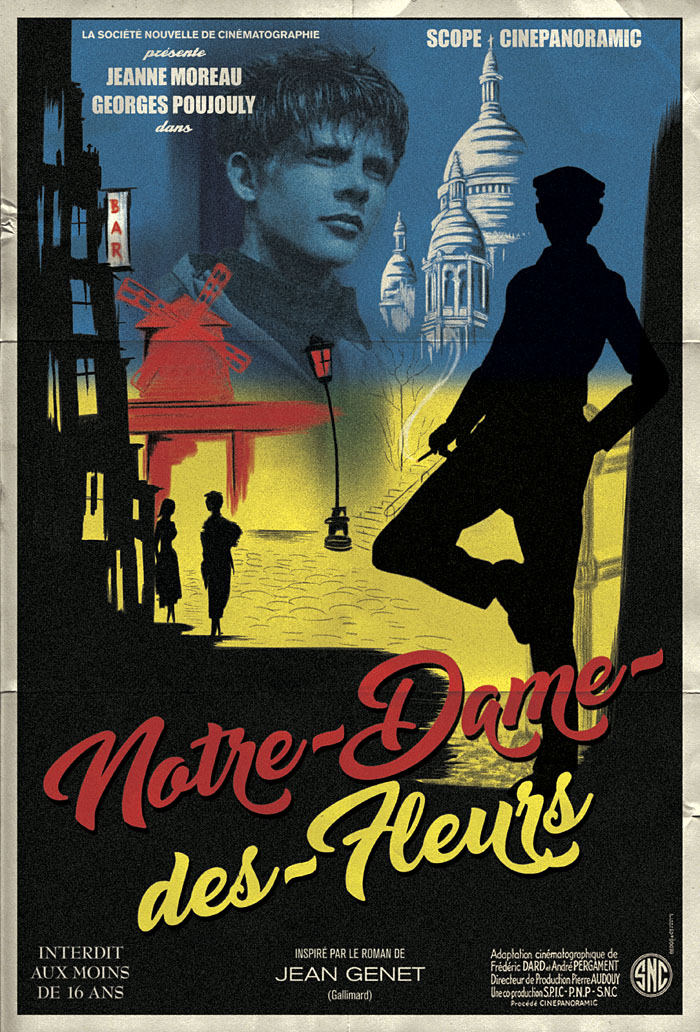
The unique qualities of the novel present difficulties for an illustrator. Literary fiction tends to look inside its characters much more than genre fiction, summoning thoughts, moods and feelings which resist easy depiction in a visual form. I’d first been asked to consider illustrating Notre Dame des Fleurs several years ago for a Graphic Classics collection of crime fiction, a request to which I agreed then had to turn down after deciding that the task of condensing the book into a few pages was a near impossibility. For Jan’s book, rather than illustrate a scene or two from the novel I opted for a conceptual approach. My three pages are intended to be promotional materials from a parallel universe in which Notre Dame des Fleurs was made into a French feature film some ten years or so after its publication, complete with hardcore sex scenes. The latter may seem unlikely but Genet was in the vanguard of presenting gay sex on the cinema screen in Un Chant d’Amour, the 26-minute silent film he made in 1950. He subsequently disowned the film, as he disowned—or “forgot”—many of his creations in later years, but it remains a pioneering and influential work.

Continue reading “Notre Dame des Fleurs: Variations on a Genet Classic”
Weekend links 555

demuth.jpg

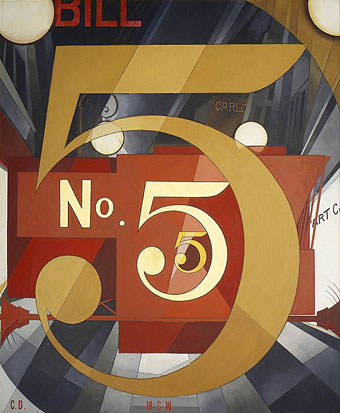
I Saw the Figure 5 in Gold (1928) by Charles Demuth.

• “Reading the new edition in 2021, I’m struck by his dismissal of CD-ROMs, of VR, of interactivity; how he anticipates contemporary debates about algorithmic bias…his prescient exhaustion.” Sukhdev Sandhu reviews Brian Eno’s diary for 1995, A Year with Swollen Appendices. Meanwhile, Eno himself says “Artists like me are being censored in Germany—because we support Palestinian rights.”

• “Kink is often pathologized in popular culture: it’s shamed, used as a punchline, and, on the whole, relegated to the margins of desire.” Greg Mania interviews R.O. Kwon and Garth Greenwell about Kink a collection of new stories about unorthodox desires.

• “This album is the king of hauntology. From where I’m sitting, I’m going back to the past, listening to an album imagining the future, imagining the past.” Tom Herdman on the fabulous Time (1981), a science-fiction concept album by the Electric Light Orchestra.

Cavafy, the ultimate Alexandrian, gave us an Alexandria that was already not quite there in his own lifetime. It kept threatening to disappear before his eyes. The apartment where he had made love as a young man had become a business office when he went to revisit it years later; and the days of 1896, of 1901, 1903, 1908, 1909, once filled with so much eros and forbidden love, were already gone and had become distant, elegiac moments that he remembered in poetry alone. The barbarians, like time itself, were at the gates, and everything would be swept in their wake. The barbarians always win, and time is hardly less ruthless. The barbarians may come now or in a century or two, or in a thousand years, as indeed they had come more than once centuries earlier, but come they will, and many more times after that as well, while here was Cavafy, landlocked in this city that is both the transitional home he wishes to flee and the permanent demon that can’t be driven out. He and the city are one and the same, and soon neither will exist. Cavafy’s Alexandria appears in antiquity, in late antiquity, and in modern times. Then it disappears. Cavafy’s city is permanently locked away in a past that refuses to go away.

André Aciman on the poetry of Cavafy and the Alexandrias of memory

DJ Food on the package design for The Superceded Sounds of…The New Obsolescents, which uses a similar foil card to the “Héliophore” stock used by Philips in their cult series of electroacoustic compositions, Prospective 21e Siècle.

Onlyou by Can, is “A relaxed studio session, recorded on a mono taperecorder in 1976 at the Innerspace”. Released in 1982 on a 34-minute cassette sealed inside a can (geddit?), and limited to 100 copies.

Olivia Rutigliano ranks 45 films containing prison escapes. I’d put the Bresson at number one but otherwise, yes.

• “…some kind of future unrealised time…” Mix of the week is a mix for The Wire by Muqata’a.

• RIP Christopher Plummer. Never mind the musical, watch him in The Silent Partner (1978).

• At Ubuweb: short films by Erkki Kurenniemi soundtracked by his own electronic music.

• New music: Neurogenesis by Robert Rich.

Kinky Boots (1964) by Patrick McNee & Honor Blackman | David Watts (1967) by The Kinks | The Dominatrix Sleeps Tonight (Dominant Mix) (1984) by Dominatrix

Weekend links 554

yokoo.jpg

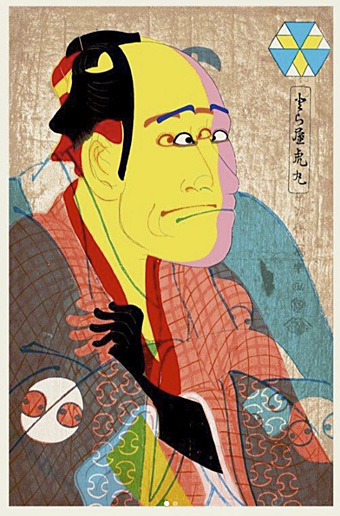
Tadanori Yokoo Emphasizes Deliberate Misalignment in Contemporary Woodblock Series.

• Another week, another Paris Review essay on Leonora Carrington. This time it’s Olga Tokarczuk exploring eccentricity as feminism. At the same publication there’s more eccentricity in Lucy Scholes‘ feature about the neglected novels of Irene Handl, a woman best known for the characters she played in many British films and TV dramas. I’ve long been curious about Handl’s writing career so this was good to see.

• “The denial of our participation in the world, [Fisher] implies—the disavowal of our desire for iPhones even as we diligently think anti-capitalist thoughts—is incapacitating. It leads to a regressive utopianism that cannot envision going through capitalism, but only retreating or escaping from it, into a primitive past or fictional future.” Lola Seaton on the ghosts of Mark Fisher.

• More ghosts: Paranormal is the latest collection of spooky, atmospheric electronica from Grey Frequency, “an audio document exploring extraordinary phenomena which have challenged orthodox science, but which have also grown and evolved as part of contemporary culture and a wider folkloric landscape.”

• “Items billed as THE BEST EVER can stop us cold, and even cause us to take them for granted, never reassessing them, as we instead gesture, often without thought, to where they sit in the corner, under a halo and backdrop of blue ribbons.” Colin Fleming on Miles Davis and Kind Of Blue.

• “Diaboliques and Psycho both achieve something very rare: a perfect plot twist but an unspoilable movie,” says Milan Terlunen.

• Richard Kirk returns once more as “Cabaret Voltaire” with a new recording, Billion Dollar.

• Even more Leonora Carrington: some of the cards from her Tarot deck.

DJ Food on Zodiac Posters by Simboli Design, 1969.

Kodak Ghosts (1970) by Michael Chapman | Plight (The Spiralling Of Winter Ghosts) (1988) by David Sylvian & Holger Czukay | The Ghosts Of Animals (1995) by Paul Schütze

Le Château du Tarot

tarot1.jpg

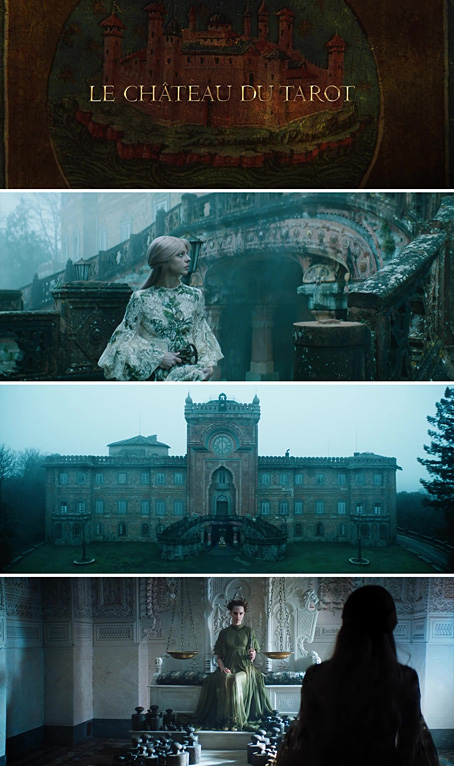
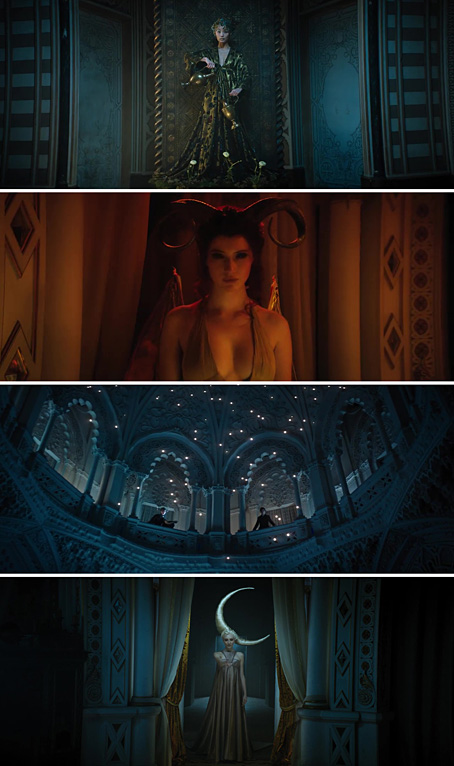
In which Christian Dior promotes its latest collection with a 15-minute Tarot-themed film directed by Matteo Garrone. The fashion world is voracious in its search for novelty so something like this feels inevitable, especially now that the art world has decided it’s no longer embarrassed by occult themes. But designer Maria Grazia Chiuri notes that Christian Dior (the person) was obsessed with divination and prophecy, while the Tarot symbolism extends to some of the clothing itself. (Given the negative associations of The Moon card I’d be wary of making that crayfish such a prominent feature.) Chiuri also mentions reading Italo Calvino’s The Castle of Crossed Destinies in order to deepen her knowledge of the cards. The novel may have suggested the narrative of Garrone’s film in which a young woman (or her spiritual avatar) finds herself in an Orientalist palazzo populated with characters from the Tarot trumps. It’s a dreamy production that’s several worlds away from the murderous Neopolitan gangsters of Garrone’s Gomorrah. Watch it here.

tarot2.jpg

Previously on { feuilleton }
The Egyptian Tarot
The Kosmische Tarot
Alas Vegas Tarot cards
Palladini’s Aquarian Tarot
Le Tarot de Philippe Lemaire
Tarotism and Fergus Hall
Giger’s Tarot
The Major Arcana by Jak Flash
The art of Pamela Colman Smith, 1878–1951
The Major Arcana

Weekend links 552

keen.jpg

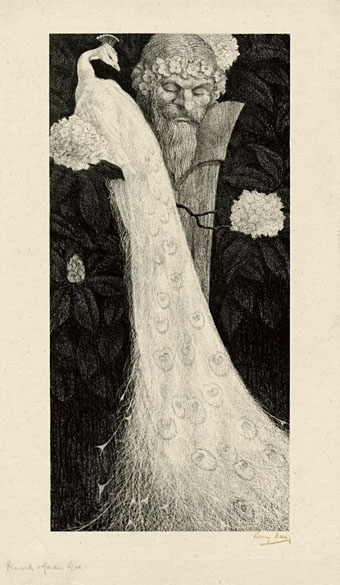
White Peacock and Garden God (c. 1922) by Henry Keen.

• “Though both writers confront some of the most unsavory and unjust dimensions of human life, Genet revels in moral ambiguity and coarse language, while Erpenbeck satisfies her audience’s desire for tidy ethical responses by using careful, equally tidy sentences. Genet’s world is dirty; Erpenbeck’s is clean.” Christy Wampole compares two newly-translated collections of non-fiction writing by Jean Genet and Jenny Erpenbeck.

• Gaspar Noé’s notorious, controversial (etc, etc) Irreversible receives the prestige blu-ray treatment from Indicator in April. Still no UK blu-ray of Enter the Void is there? I had to order a German release.

Stereolab release Electrically Possessed: Switched On Vol. 4 next month, the latest in their series of albums which collect singles, compilation tracks and other rarities.

• At Nautilus: Antonio Zadra and Robert Stickgold on how dreaming is like taking LSD.

• At Dennis Cooper’s: Bollo presents…Éliane Radigue (& The Lappetites).

• Playwriting & Pornography: Adam Baran remembers Jerry Douglas.

• At Spine: Vyki Hendy on the joy of monochrome book covers.

• Mix of the week: Subterraneans 2 by The Ephemeral Man.

John Boardley’s favourite typefaces of 2020.

• New music: Spirit Box by Blanc Sceol.

Life In Reverse (1981) by Marine | Reverse World (1995) by David Toop | Reverse Bubble (2014) by Air