Weekend links 669

claveloux.jpg

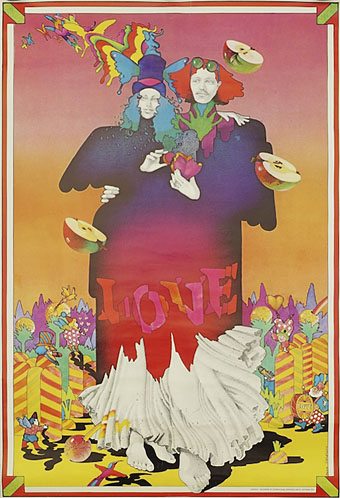
Love (1973), a poster by Nicole Claveloux.

• “Warner Brothers had been keen on a Rolling Stones movie. Jagger was keen on being a movie star. But Donald Cammell’s script was no Beatles’ jolly japes musical comedy…” Des Barry examines the ninth minute of Cammell & Roeg’s Performance.

• “…part of what made his 1970s work so original was the degree to which his band cross-pollinated guitar with synthesizer.” Aquarium Drunkard explores the esoteric jazz-rock of Steve Hillage.

• Magma, the cosmic jazz-rock group from France, have been around for 50 years without making a music video. Hakëhn Deïs is their first.

There was half-Tarkovsky embedded in async, “Solari” and “Stakra” and “Walker”, a hand outstretched to those great poems of living and light that we call films. “I had a strange dream last night,” Andrey Tarkovsky wrote in one of the diary entries collected in Instant Light, “I was looking up at the sky and it was very, very light and soft; and high, high above me it seemed to be slowly boiling, like light that had materialised like the fibres of a sunlit fabric, like silken living stitches in a piece of Japanese embroidery.”

David Toop remembers Ryuichi Sakamoto

• “Floor796 is an ever-expanding animation scene showing the life of the 796th floor of the huge space station…”

• The Electrifying Dreamworld of The Green Hand: Dan Clowes on the comic-art of Nicole Claveloux.

• At Bandcamp: Andy Thomas on the post-punk pop subversion of David Cunningham.

• At Unquiet Things: An enigmatic baroness and her collection of skulls.

• New music: River Of Dreams by Romance & Dean Hurley.

• Steven Heller’s font of the month is Ray Gun.

• Mix of the week: DreamScenes – April 2023.

• RIP Al Jaffee.

Skulls Of Broken Hill (1996) by Bill Laswell | The Bees Made Honey In The Lion’s Skull (2008) by Earth | Black Skulls (2018) by Jóhann Jóhannsson
Weekend links 668

escher.jpg

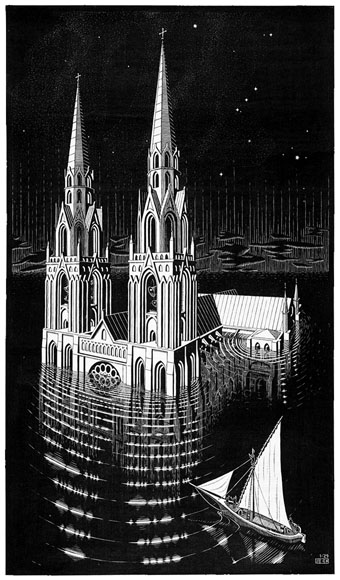
The Drowned Cathedral (1929) by MC Escher.

• “All Saints’ was the last of the seven parish churches to fall headlong into the waves. The drowned church was doomed to lie in a gulley not far out to sea, a habitat for sponges and crabs, and yet it lives on, unvanquishable; for—as the story of Britain’s lost cities, ghost towns, and vanished villages tells us—what has disappeared beneath the sea can rebuild itself in the mind.” Matthew Green explores the history of Dunwich, Suffolk.

• “Why do certain artists endure and become (dread word) ‘iconic’, while some are forgotten or sidelined or only grudgingly acknowledged?” Ian Penman talking to Jeremy Allen about his new book, Fassbinder Thousands of Mirrors.

• Coming soon from Strange Attractor: A new edition of England’s Hidden Reverse, David Keenan’s study of the lives and music of Coil, Nurse With Wound and Current 93.

• “What is electronic music?” Daphne Oram, Desmond Briscoe and David Cain of the BBC Radiophonic Workshop are here to explain.

• “Direct evidence of the use of multiple drugs in Bronze Age Menorca (Western Mediterranean) from human hair analysis.”

• New music: Timespan by Majeure, and Microdosing by African Head Charge.

• “Future of Borges estate in limbo as widow doesn’t leave will.”

Arooj Aftab’s favourite albums.

Paperback Covers on Tumblr.

The Engulfed Cathedral (1974) by Tomita | Engulfed Cathedral (1981) by John Carpenter | La Cathédrale Engloutie (2003) by Sora

Weekend links 667

kamekura.jpg

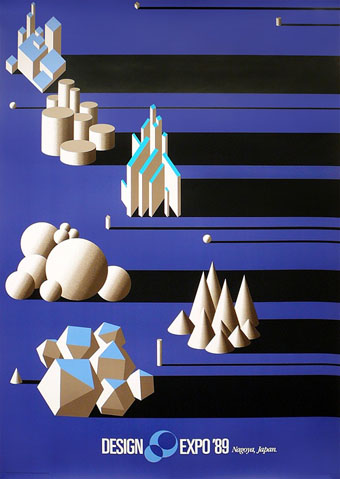
Design by Yusaku Kamekura.

• “Music and intoxication have gone hand in hand since prehistory, but the relationship of music and cannabis is particularly strong and complex, says Jono Podmore, a former habitual smoker, as he investigates a groundbreaking new study which may get us closer to understanding these links.”

• “[There] have been many instances of persons, who thought themselves metamorphosed into lanterns, and who complained of having lost their thighs.” Public Domain Review offers words to the wise from An Essay on Diseases Incidental to Literary and Sedentary Persons (1768).

• “Mathematicians have finally discovered an elusive ‘einstein’ tile.” Emily Conover explains. I thought Roger Penrose had already discovered these but none of his aperiodic patterns are created by a single tile.

Wes Anderson does science fiction…maybe. After watching The French Dispatch last month I’d caught up with the Anderson oeuvre so it’s good to have something new to look forward to.

20th century Japanese poster art. Related: Jason Booher on creating a cover for a book by Carlo Rovelli.

The Winners of Smithsonian Magazine’s 20th Annual Photo Contest.

• New music: Ghost Town Burning by The Lonely Bell.

Anthony “Surgeon” Child’s favourite music.

• RIP Raoul Servais, animator.

East Of Asteroid (1976) by 801 | Asteroide (1978) by Joël Fajerman & Jan Yrssen | Asteroid Witch (2022) by Ghost Power

Art on film: The Dark Corner

dark1.jpg

Continuing an occasional series about artworks in feature films with a post that suits a week where Surrealism has been a dominant theme.

I’ve been watching a lot of film noir recently, and I do mean a lot. Since August last year I’ve watched almost 100 films that warrant the label (I’ve been keeping a written record to avoid losing track), with more of them still to come. Many of these have been first-time viewings, an experience that’s been enlightening and mostly positive. I’ll have more to say on the subject in the future but for now here’s a discovery from The Dark Corner (1946), a detective drama directed by Henry Hathaway, and one I hadn’t seen before.

dark2.jpg

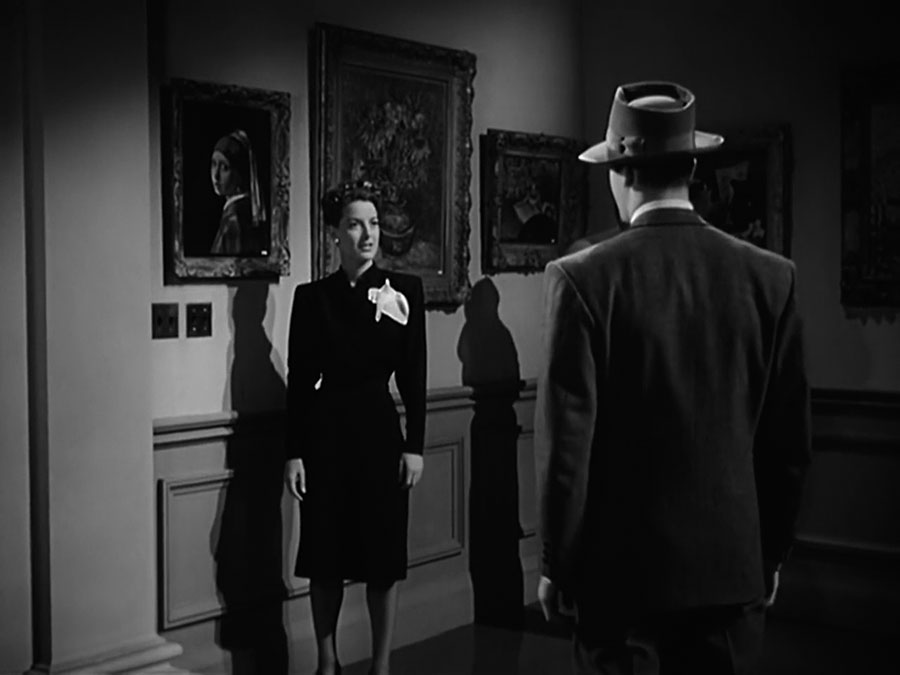
A Vermeer in a dark corner.

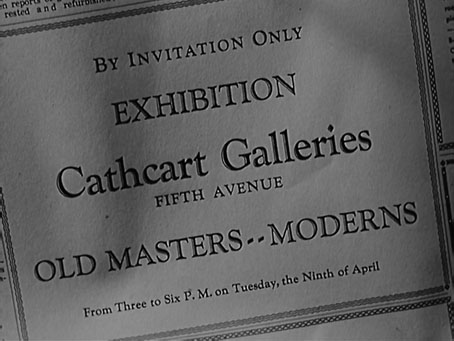
The story concerns a New York private eye, Bradford Galt (Mark Stevens), who’s being framed by parties unknown. When Galt investigates the mystery with his secretary, Kathleen (Lucille Ball in a straight role), their researches lead them to a Fifth Avenue art gallery run by Hardy Cathcart (Clifton Webb playing the same waspish aesthete as he did in Laura). Many of the art details can’t help but seem amusing or bizarre today, such as when someone brings home a genuine Vincent van Gogh painting and leaves it propped in a chair. There’s also a painting that we’re told is a rare Raphael but since this has to resemble Cathcart’s wife it looks nothing like a Renaissance picture. Elsewhere, a Donatello statue is priced at a mere $40,000, while Cathcart has Vermeer’s Girl with a Pearl Earring on sale despite the real painting having been in the collection of the Mauritshuis in The Hague since 1902.

dark3.jpg

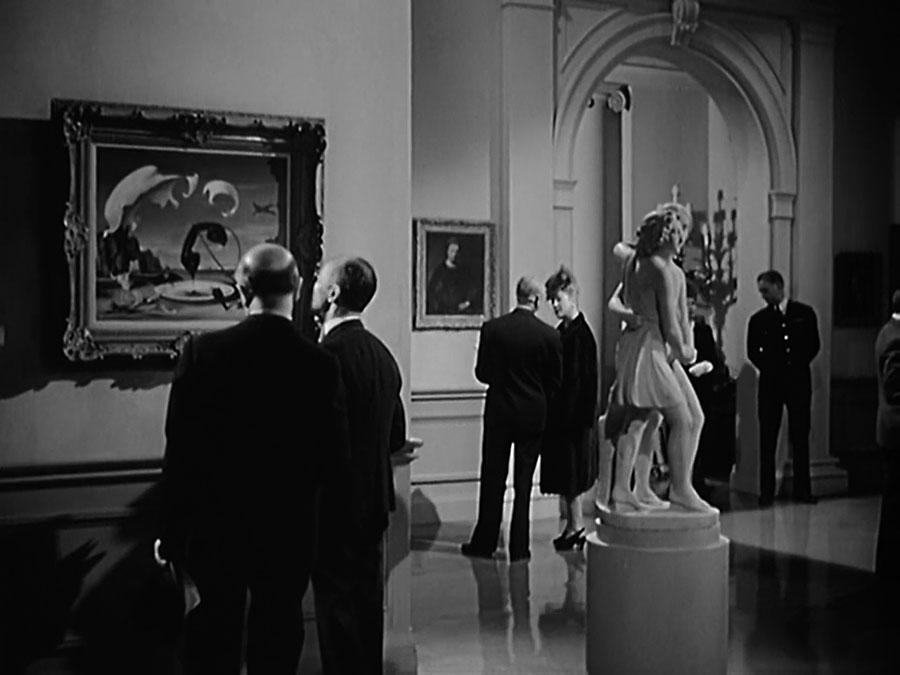
As to the Surrealism, a scene inside the gallery features a blink-and-you-miss-it moment when a pair of would-be purchasers are seen peering at this Salvador Dalí painting, one of the few pieces of contemporary art on display. Before the camera pans away we see the man on the right shaking his head. I think this painting was also created for the film but unlike the alleged Raphael it looks genuine, and resembles several pictures that Dalí painted in the 1930s (eg: this one), all of which feature telephone receivers. The choice of imagery is apt. Two years earlier Dalí had created a seven-picture sequence illustrating “The Seven Lively Arts”. The Art of Cinema is represented by a figure whose head is a giant eyeball positioned between two huge ears, and with eyelashes that are cords leading to yet more telephone receivers.

Imitation or not, the painting in The Dark Corner did at least end up on the screen. In 1946 Dalí was working with Disney’s animators on the Destino project but the results of this wouldn’t be seen for another 50 years. I’ve been wondering what other Dalínean references might be hiding in American feature films from this time. (Don’t say Spellbound, everybody knows that one…)

Previously on { feuilleton }
Art on film: Je t’aime, Je t’aime
Art on film: Space is the Place
Art on film: Providence
Art on film: The Beast

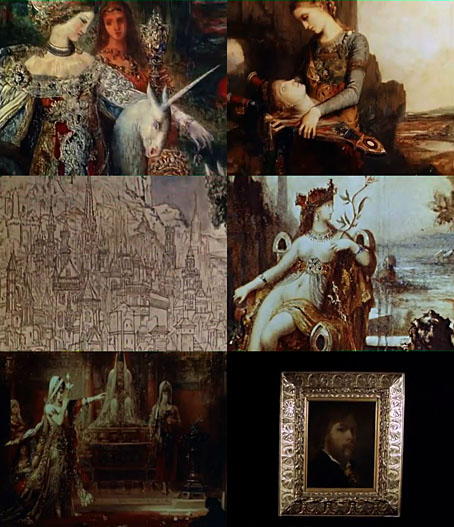
Gustave Moreau (1826–1898), a film by Nelly Kaplan

moreau1.jpg

André Breton has acknowledged that his personal ideal of female beauty was established in his adolescence when he visited the Gustave Moreau museum in Paris; like Joris-Karl Huysmans’s protagonist, Des Esseintes, Breton was enthralled by Moreau’s depiction of figures such as Salomé.

Keith Aspley, Historical Dictionary of Surrealism

André Breton happens to be one of four narrators whose voices may be heard (all speaking French) in this short study of Gustave Moreau’s paintings and drawings made in 1961. Director Nelly Kaplan was an Argentinian writer and film-maker who moved to Paris in the 1950s where she became creatively involved with Abel Gance, and with what was left of the original Surrealist movement based around the autocratic Breton. I’ve often drawn attention to Breton’s pettiness, especially his penchant for excommunicating from his circle anyone he disagreed with, but he deserves credit for championing Gustave Moreau during the decades when the artist was resolutely beyond the critical pale. A lesson I learned from the Surrealists early on is that you don’t let other people dictate the limits of your cultural tastes.

moreau2.jpg

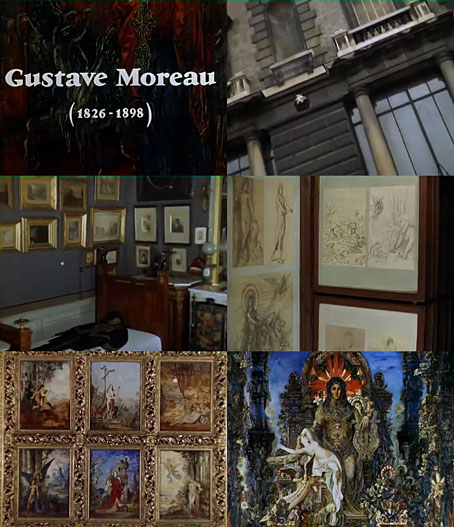
Moreau was still beyond the pale in 1961 so Kaplan’s film was in the vanguard of the reappraisals that were to take place later in the decade, culminating in major exhibitions in the early 1970s. One of the curators of the Hayward exhibition of 1972, Philippe Jullian, made an unfinished Moreau painting, The Chimeras, a key reference in his landmark study of Symbolist art, Dreamers of Decadence (1971). You see a few details from this picture in Kaplan’s film when the camera is roaming the walls of the Moreau Museum, formerly the artist’s residence in the rue de la Rochefoucauld, Paris. The years of neglect had their advantages, one of them being that the house/museum hasn’t had to change very much in order to accommodate visitors; the same goes for Moreau’s art which didn’t get scattered around the world like the works of his contemporaries. The upper floors of the museum are filled with original paintings, together with preliminary sketches which you see here in their hinged frames which allow you to leaf through them like pages of a book. No film or book does justice to the jewelled splendour of the finished paintings, however, especially the detailed works like Jupiter and Semele. You really have to see these things in person if you can.

Previously on { feuilleton }
New Life for the Decadents by Philippe Jullian
More chimeras
Philippe Jullian, connoisseur of the exotic
Ballard and the painters