A Secret Wish by Propaganda

propaganda1.jpg

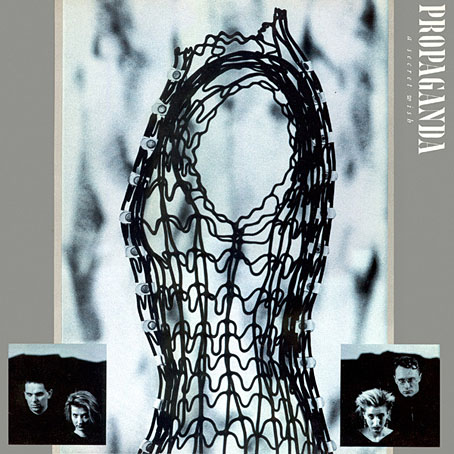
A Secret Wish (1985). Design by the London Design Partnership.

The dark Religions are departed & sweet Science reigns
— William Blake

It’s a hallmark of musical obsession when you find yourself buying the same album over and over. Propaganda’s meisterwerk from 1985, A Secret Wish, was finally released in a definitive double-CD version this week, the fourth edition I’ve bought (after the original vinyl and two other CD releases). This new set is easily the best of the lot.

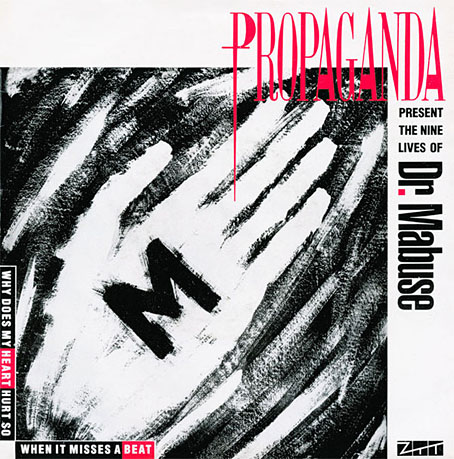
Propaganda were always my favourites among the early acts on Trevor Horn and Paul Morley’s ZTT label, smarter than Frankie Goes To Hollywood and more musical than the Art of Noise. How could I resist another quartet of Germans from Kraftwerk’s home city of Düsseldorf, a group memorably described in the music press as “ABBA from Hell”? The first single in 1984, Dr Mabuse, came along when I’d been immersed in Lotte Eisner’s celebrated study of German Expressionist cinema, The Haunted Screen; an avant-garde pop outfit devoted to the same material was just the thing I wanted to hear. Almost a mini-album, the single’s A-side was filled by an epic ten-minute song describing the nature of Dr Mabuse, a villainous anti-hero from several Fritz Lang films. On the B-side there was a cover of The Velvet Underground’s Femme Fatale (and another Lang reference in the subtitle, The Woman with the Orchid), followed by some metal bashing and a taste of the A-side’s Schönberg-esque orchestral stabs before Dr Mabuse returned again at the end. Cover versions were an important thing at ZTT, as was the idea of the 12-inch single as a self-contained work, Mabuse being a prime example. All of this came packaged in a sleeve whose Anton Corbijn painting referenced another Fritz Lang film, M… It felt as though they were doing this purely for my benefit.
propaganda2.jpg

Dr Mabuse (1984). Design by Anton Corbijn and XL.

The intertextual reference on this and subsequent releases isn’t surprising given the people involved. Paul Morley took a great delight in embellishing the ZTT releases with quotations—the Frankie album was probably the first chart-topping release with a recommended reading list—while band member Ralph Dörper had been with the Neue Deutsche Welle group Die Krupps prior to Propaganda, and it was his influence which gave the new group the abrasive industrial edge that I found so attractive. While between groups he released an experimental EP in 1983 under his own name featuring versions of In Heaven from Eraserhead and John Carpenter’s theme from Assault on Precinct 13, and it was Dörper who chose Throbbing Gristle’s Discipline as the demo song which the group used to catch the attention of ZTT. That particular cover version never made it to A Secret Wish although they did perform it live on The Tube, and a later version appeared on the remix album, Wishful Thinking. This recording is happily included on the second disc of the new reissue.

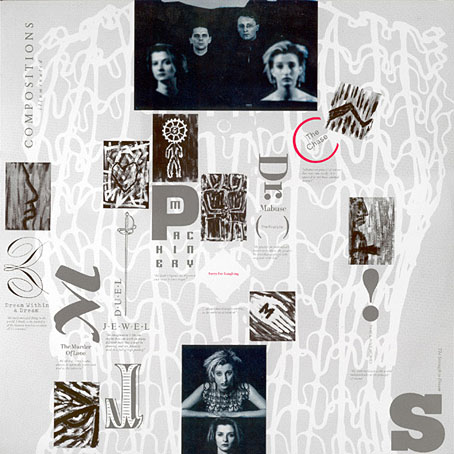
A Secret Wish was released in 1985 and pushed further buttons of obsession for me with the opening track, Dream Within A Dream, which is Edgar Allan Poe’s poem set to music. The album artwork came liberally decorated with Morley’s signifying quotes, the one for the Poe track being the opening lines from HP Lovecraft’s The Call of Cthulhu. Yes, they really were doing this for my benefit… Two further 12-inch singles appeared: Duel/Jewel was the same song presented in an “ABBA” version and a “from Hell” version: sweet and melodic versus harsh and industrial.
propaganda3.jpg

A Secret Wish inner sleeve.

The third and final single, p:Machinery, expanded the short mix from the album into another 9-minute epic whose vision of a population enslaved to industrial technology easily invokes Fritz Lang’s Metropolis, so much so that I used to play the single while running taped scenes from the film on TV. The enormous “Polish” mix of this song has always been scarce on CD, with a Japanese release in 1988, and a later reissue (with some shoddy and superfluous remixes) in 1995. Another benefit of the new edition of the album is that the extended mix provides the climax of the second disc and sounds even more enormous, its brass fanfares accurately described in a review at the time as conjuring images of cities rising from the sea.

Also present for the first time on the new CD is Do Well, the 20-minute Duel suite which was a cassette-only release, plus a number of other previously unavailable mixes. If you have this double-disc set and the Outside World single collection from 2002 then you’ll own pretty much everything that’s great about Propaganda. A lot of pop music from the 1980s sounds horribly dated now: tinny synths, empty production and a paucity of ambition. Propaganda sound as thunderingly magnificent as they did in 1985, and still unique. It’s a shame that A Secret Wish was their finest moment, things fell apart fairly soon after. But one masterpiece will always be worth fifty Duran Duran travesties.

Elsewhere on { feuilleton }
The album covers archive

Previously on { feuilleton }
Metropolis posters

Weekend links 22

pota.jpg

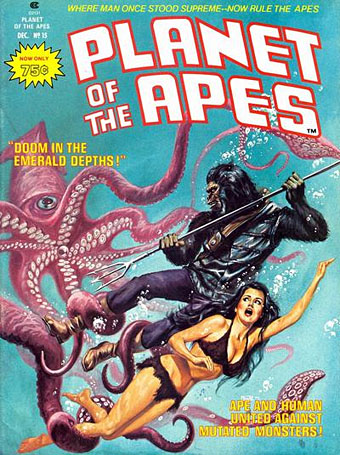
Planet of the Apes Magazine #15 (1975), art by Bob Larkin.

I never read any of Marvel Comics’ Planet of the Apes titles but the painted covers of the American editions are evidence of a distinctly lurid imagination. An excess of drugs—this was the Seventies, after all—or mere enthusiasm? You decide. Related: “The Soft Intelligence”: 5 Underrated Literary Cephalopods by China Miéville. Kudos to him for mentioning The Sea Raiders (1896) by HG Wells, a favourite story of mine when I was 12.

octopussy.jpg

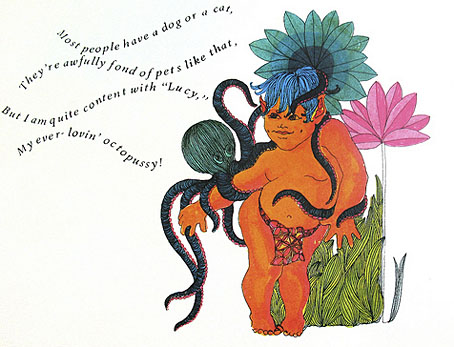
My ever-lovin’ octopussy (1970) by Jackie Black.

A Journey Round My Skull chooses selections from Ang Wyman’s flickr group Eye Candy (above), psychedelic illustration for children’s books by Nicole Claveloux, Peter Max, Heinz Edelmann and others.

• Watch out, there are “fancy gentlemen” about. It’s The Homosexual Menace!

• Design in opposition: Neville Brody announces the Anti-Design Festival.

• The Almias Rural Psychogeography Walk takes place on July 25th.

• Steven Heller on The Incredible Posters of Tadanori Yokoo.

Hipster Priest: Alan Moore interviewed at The Stool Pigeon.

FACT mix 167, a great selection by These New Puritans.

• The Orion Galaxy is a beautiful bespoke synthesizer.

• A radio portrait of Moondog at Speechification.

• RIP: Sugar Minott. RIP Tuli Kupferberg.

• Introducing Wizard’s Tower Press.

Octopus (1970) by Syd Barrett.

Surrealism, graphic design and Barney Bubbles

starowieyski.jpg

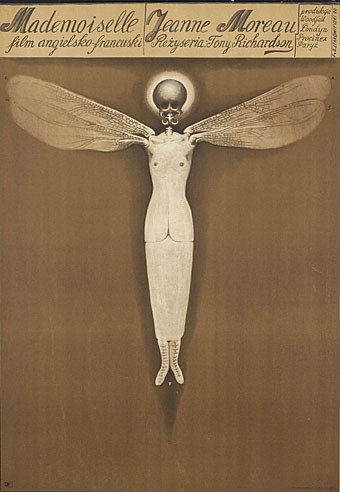
Poster for Mademoiselle (1970) by Franciszek Starowieyski.

Work has cranked into overdrive this week so posting will no doubt be minimal until some semblance of normality is restored. I can however mention two essential exhibitions which will be running through the forthcoming months.

Uncanny: Surrealism and Graphic Design at the Moravian Gallery in Brno, Czech Republic, is curated by design writer Rick Poynor and runs to 24 October, 2010. On display is an intriguing mix of work from familiar names such as Jan Švankmajer and Eva Švankmajerová, poster artist Franciszek Starowieyski, graphic designers Vaughan Oliver and Stefan Sagmeister, and many others.

Uncanny: Surrealism and Graphic Design uncovers the presence of an alternative tradition in graphic design. The Surrealist movement of the 1920s and 1930s focused on literature, painting, photography and the object, and the Surrealists’ publishing activities provided only hints of what a fully conceived Surrealist graphic design or typography might look like. Many of the most suggestive early examples came from Czechoslovakia, where Surrealism would become a lasting influence. Subsequently, Surrealist ideas and images had a profound impact on image-makers in every sphere of art and design, and by the 1960s the effects of Surrealism were widely felt in international graphic communication. Uncanny traces this intermittent line of development up to the present.

There’s further information at the gallery site including a page of related works.

process.jpg

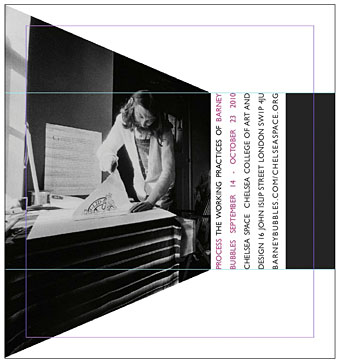
And launching later in the year is Process: The Working Practices of Barney Bubbles, a very timely exhibition of the designer’s work at Chelsea Space, London. Bubbles biographer Paul Gorman is the curator and the event will also see the launch of a second edition of his study of Barney’s life and work, Reasons To Be Cheerful.

The show will contain many never-before-seen items drawn from private collections, including student notebooks, working sketches, original artwork, paintings, books and photography. These were the raw material for videos, record sleeves, t-shirts and posters created by Bubbles for such performers as Ian Dury, Hawkwind, Elvis Costello, The Damned and Billy Bragg (who is contributing a one-off rug with a rendition of the designer’s Masereel-quoting cover for his album Brewing Up With).

Process opens on September 14 and will run to October 23, 2010.

Previously on { feuilleton }
Franciszek Starowieyski, 1930–2009
Jan Švankmajer: The Complete Short Films
Barney Bubbles: artist and designer

Brion Gysin let the mice in

gysin.jpg

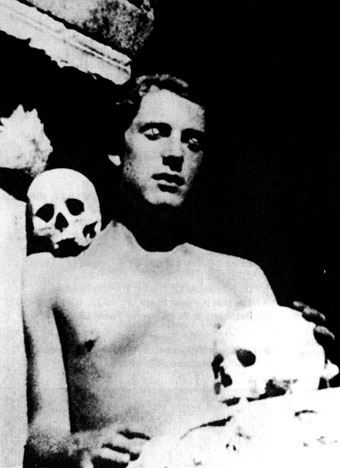
Brion Gysin—autoportrait (1935).

“A shaman to me is always a pansexual being,” says the gay Canadian filmmaker. “These guys all came out of that period where queer was really hardcore, it was part of their radical art — and of course it was illegal.” (more)

The filmmaker in question is Nik Sheehan discussing FLicKeR, his 2007 documentary about artist and writer Brion Gysin. Sheehan’s film is available for viewing at Ubuweb although I haven’t got round to watching it yet so I can’t say much about it. (Reality Studio has a review.) Gysin’s life and work is certainly worthy of study, however, his art and writing—which encompassed novels and experimental poetry—often having been overshadowed by his close association with William Burroughs. He gets a raw deal in Ted Morgan’s curiously bad-tempered biography of Burroughs, for example, despite having given his co-conspirator the cut-up technique, collaborated with him on The Third Mind, and so on. FLicKeR‘s title refers to Gysin’s Dreamachine, the first sculpture which needs to be experienced with the eyes closed, being a homemade hallucination engine which works by flickering light and shadow at a rapid rate on the closed eyelids. I made some Dreamachines of my own in the mid-1980s by carefully studying photos in RE/Search #4/5, and they certainly do work. It’s a shame that 78rpm record players are more difficult to find than they used to be since the original template devised by Gysin and Ian Sommerville needs a high speed in order to create the optimum flicker rate. As you might expect, various psychonauts have since created their own variations such as this one for a 45rpm player.

I mentioned a few weeks ago that the New Museum in NYC is staging the first US retrospective of Gysin’s work, an exhibition which they happen to call Dream Machine, and which opens on July 7th. The New York Times ran a piece about Gysin in advance of that. Ubuweb has further Gysin materials, such as this Burroughs piece about Gysin’s invention of the cut-up method, and some recordings of the permutated poems. Finally, if you’re wondering about the title of the post, it’s a reference to this.

Previously on { feuilleton }
Burroughs: The Movie
William S Burroughs: A Man Within
Emil Cadoo
The Great God Pan
The Final Academy
William Burroughs book covers
Towers Open Fire

Peacock couture

lamarr.jpg

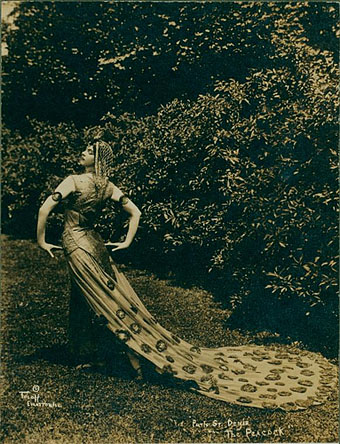
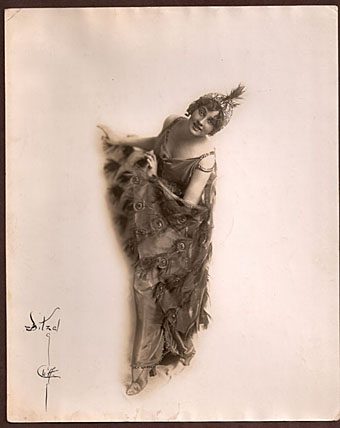
Hedy Lamarr strikes a pose in a peacock dress for Samson and Deliah (1949), one of Hollywood’s many tiresome Biblical epics. If the photo isn’t just a promo shot and Hedy appears wearing this it’s no doubt a highlight but it’s so long since I saw the film the only thing I remember is Victor Mature bringing down the temple at the end. Ms Lamarr’s outfit wasn’t the first of its kind, of course, the examples below from dancer Ruth St Denis and film star Betty Blythe have appeared here before, but Hedy’s dress is a lot more extravagant; Aubrey Beardsley would have loved it. I might have said it was the most extravagant but that honour should go to a Chinese wedding dress made of 2,009 peacock feathers which was unveiled last year. Impressive if completely impractical.

Thanks to Thom for the Hedy tip!

denis1.jpg

Ruth St Denis—The Peacock.

blythe2.jpg

Betty Blythe.

Previously on { feuilleton }
Betty Blythe
Ruth St Denis
The Feminine Sphinx
Alla Nazimova’s Salomé