Anamorphosis

quays1.jpg

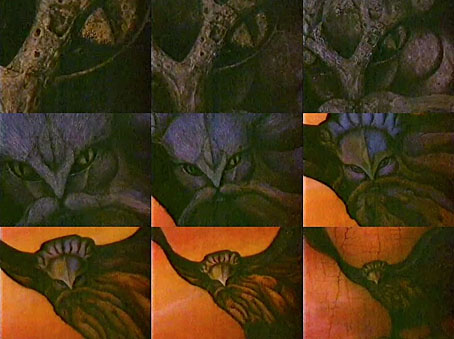
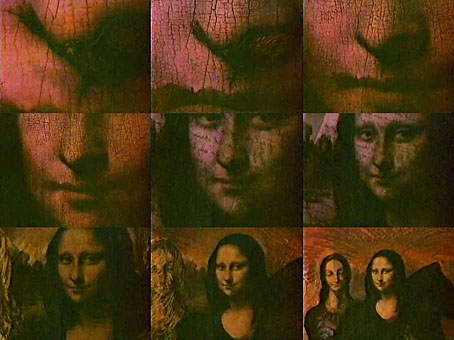
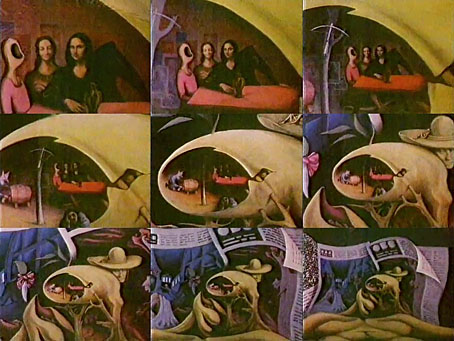
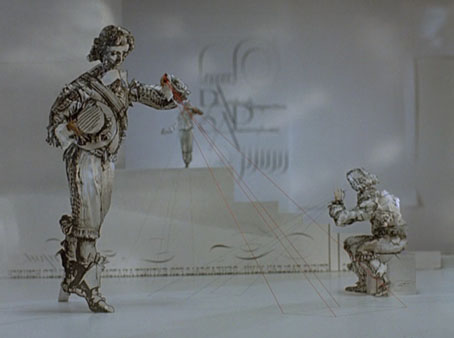
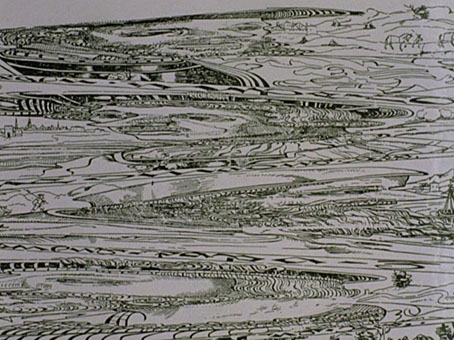
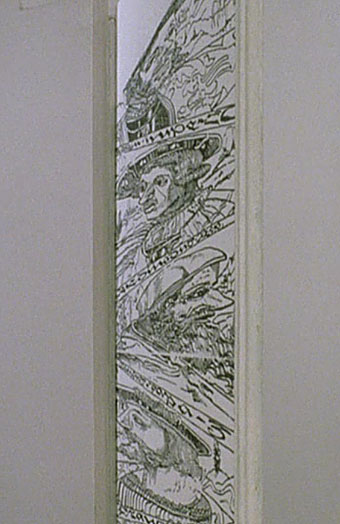
Some anamorphosis for All Fool’s Day. De Artificiali Perspectiva, or Anamorphosis (1991) is a short film by the Brothers Quay which can be seen in two parts at YouTube. (And I’d urge anyone interested to avail themselves of the essential double-disc collection of the Quays’ early work which includes this film.) There are plenty of sites devoted to anamorphosis such as this one but films tend to explain the effect better than still pictures by showing the stages of transformation to or from pictorial coherence. The stills below, for example, work better in motion than they do here. The Quay’s first feature, Institute Benjamenta (1995), also features some anamorphosis with a mural on the walls of a passage in the film’s strange school for servants.
quays2.jpg

Also at YouTube there’s a short video demonstration of mirror anamorphosis, a variation where the distorted picture corrects itself when viewed with a mirrored tube. Musician Rick Wakeman used this effect for an album he released in 1976, No Earthly Connection, a work whose cover art is more impressive than the music it embellishes. The album came with a thin sheet of mirrored plastic which could be folded to create a viewing device.
quays3.jpg

Previously on { feuilleton }
The Ambassadors in detail
False perspective
Trompe l’oeil

Weekend links 52

judd.jpg

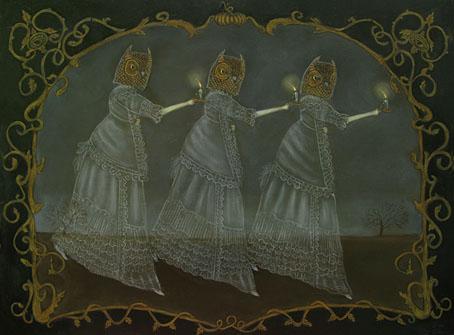
Three Seekers (2009) by Kelly Louise Judd.

Kevin Sessums talked to Elizabeth Taylor in 1997 about Tennessee Williams, her AIDS activism and related matters. Other related matters: Catholics lead the way on same-sex marriage and Mahatma Gandhi was in love with a German body-builder named Hermann.

• Cray porn (the computer, that is) at Barnbrook Design as the CD package for Interplay by John Foxx and The Maths is unveiled.

Michael Rother and Friends Play the Music Of Neu! A stream of an hour-long concert from August 2010.

One of the tragedies of drug prohibition is that we have never developed a culture in which young people can learn how to use powerful drugs properly from older, wiser and more experienced psychonauts. I count myself lucky to have encountered such good teachers to guide me with such drugs as LSD, psilocybin, DMT, MDMA and mescaline.

Dr Susan Blackmore on using LSD.

Another Dispatch in a World of Multiple Veils, a new release by Arkhonia.

Micromachina by Scott Bain “examines what makes the insect world tick”.

Down with art!: the age of manifestos. Related: The Manifesto Manifesto.

• John Patterson: “We’re all living in the future as seen by Philip K Dick.”

Music To Play In The Dark: A Wake For Peter ‘Sleazy’ Christopherson.

Albert Einstein, Radical: A Political Profile.

Was “God’s Wife” edited out of the Bible?

Porn made for women, by women.

Hallogallo (1972) by Neu! | Opa-Loka (1975) by Hawkwind | Jenny Ondioline (1993) by Stereolab | Hallogallo (1997) by Porcupine Tree.

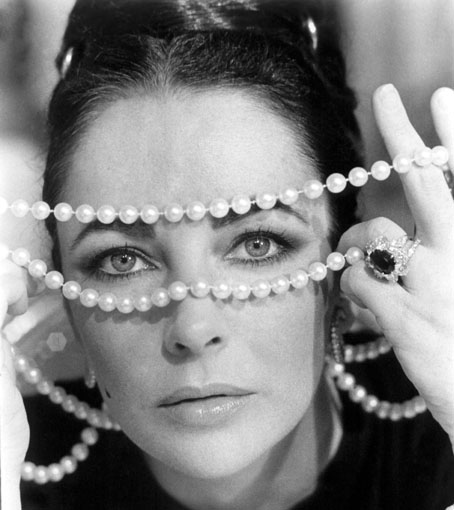
Elizabeth Taylor, 1932–2011

liz.jpg

Remember her for her incomparable beauty, her great performances in great films, the camp confections like Cleopatra and Boom, and years of activism on behalf of gay people:

There is no gay agenda, it’s a human agenda. Why shouldn’t gay people be able to live as open and freely as everybody else? What it comes down to, ultimately, is love. How can anything bad come out of love? The bad stuff comes out of mistrust, misunderstanding and, God knows, from hate and from ignorance.

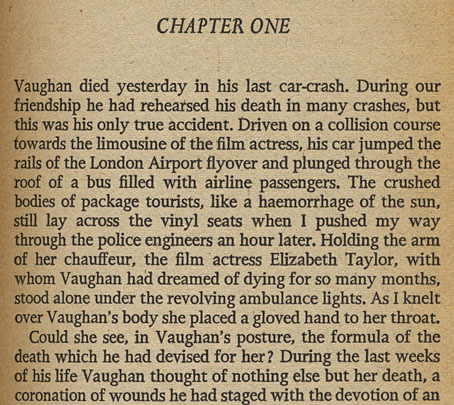
It would also be remiss of me (since no obituaries will be tasteless enough to mention it) if I didn’t note her presence at the heart of one of the more notorious novels of the past fifty years. I often used to wonder whether anyone had told her about Crash. Not that she’d want to know about it if they did; who would be eager to read detailed plans for their own horrific death? But it was her status as a 20th century icon, the nonpareil of film stardom, that made her the perfect choice as the focus of Vaughan’s obsessions in Ballard’s novel.

crash.jpg

Elizabeth Taylor: a career in clips
RIP Elizabeth Taylor: A Ballardian Primer

The Public Voice by Lejf Marcussen

public1.jpg

Lejf Marcussen is a Danish filmmaker whose animation Den Offentlige Røst (The Public Voice, 1988) I know from UK TV screenings, back in the days when the TV channels here used to screen more than cookery shows and soap operas. This is a short Surrealist piece which begins with zoom into a Paul Delvaux painting then reverses the process by pulling back from a continually changing picture some of whose details can be seen here. It is, of course, better to watch the film than read a description of it which is why I kept hoping a copy might turn up on YouTube. Sure enough, a rough copy has been languishing there for two years so I suggest you watch it here while you have the chance. These obscure shorts have a habit of getting deleted, and this miniature marvel is more obscure than most.

public2.jpg

public3.jpg

Update: changed the link to a better quality version. Thanks, Martin!

Previously on { feuilleton }
Patrick Bokanowski again
L’Ange by Patrick Bokanowski
The Hourglass Sanatorium by Wojciech Has
Babobilicons by Daina Krumins
Impressions de la Haute Mongolie revisited
Short films by Walerian Borowczyk
The Brothers Quay on DVD

Weekend links 51

narcissus.jpg

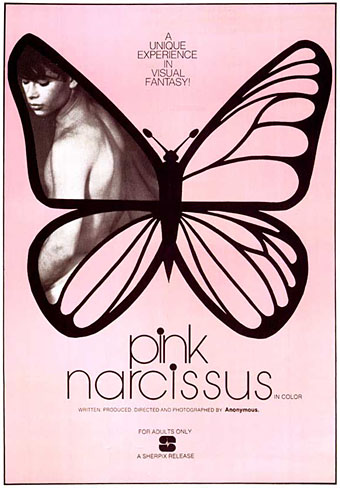
James Bidgood’s luscious and erotic micro-budget masterpiece Pink Narcissus (1971) receives a screening at the IFC Center Queer/Art/Film festival, NYC, on Monday. The film is presented by Jonathan Katz, curator of the Hide/Seek gay art show whose controversial history was recounted here in December. The NYT ran a short piece about Bidgood, now 77 and not the first artist to be disappointed by his past work; they also have a Bidgood slideshow. Hide/Seek, meanwhile, is now a touring exhibition.

• Related: the delightful Drew Daniel of Matmos (and Soft Pink Truth) posing in a jockstrap at the Club Uranus, San Francisco circa 1990; he also used to go-go dance wearing a fish.

• The Isle of Man may have one of the oldest parliaments in the world but its laws have often been out of step with its neighbour across the Irish Sea. This week the island joined the rest of the UK in granting civil partnerships to its citizens. Now the name whose punning appeal so delighted James Joyce doesn’t seem as inappropriate.

Howard Jacobson: “The novelist Yukio Mishima posed pointing a Samurai sword to his chest and ultimately had himself beheaded in public. This is what’s called taking your art seriously.”

hutter.jpg

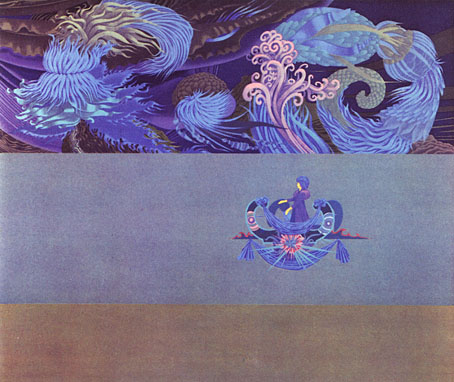
The Realm of the Queen of the Night (1974) by Wolfgang Hutter from Zauberflote at 50 Watts.

The revelatory operations of the chance encounter lie at the heart of le merveilleux (“the marvelous”)—the Surrealist conception of beauty. You find something marvelous in the world (an object, an image, a person, a place) that corresponds, like a piece clicking into a puzzle, to a deep inner need.

Slicing Open the Eyeball: Rick Poynor on Surrealism and the Visual Unconscious by Mark Dery.

Boy from the Boroughs: Alan Moore interviewed by Pádraig Ó Méalóid; Michael Moorcock interviewed at Suicide Girls.

• Illustrations from Quark, the anthology of speculative fiction edited by Samuel Delany & Marilyn Hacker in 1970.

The Residents, sans masks, filmed at their San Francisco home in the 1970s.

• Bach’s Toccata and Fugue in D minor played on a glass harp.

What art can do for science (and vice versa).

• You can never have too much Virgil Finlay.

• Lydia Kiesling reviews Lolita.

Alain Resnais film posters.

Red Mug, Blue Linen.

No GDM (dub version) (1979) by Gina X | L. Voag’s Kitchen (2004) by Soft Pink Truth.