Julius Klinger’s Sodom

klinger1.jpg

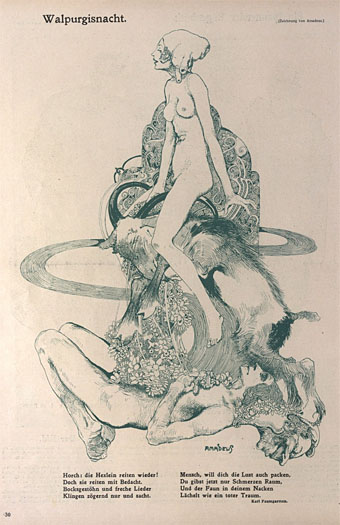
The more I look at the work of Austrian artist Julius Klinger (1876–1942), the more I like what I see. This Pinterest sample shows his versatility, equally at home with detailed illustration, often with a Beardsley-like quality, as he was with more Modernist design. Sodom (1689) (aka The Farce of Sodom, or The Quintessence of Debauchery) is the notorious Restoration drama attributed to John Wilmot, the second Earl of Rochester, which is here illustrated by Klinger for an edition privately published in Leipzig in 1909. The play is one of the most flagrantly outrageous works in the English language, with a cast of characters that includes Bolloxinion, the King of Sodom, Cuntigratia, his Queen, and so on; you can see parts of it performed in The Libertine (2004) with Johnny Depp playing Rochester, and taking the role of Bolloxinion.

Klinger produced 16 illustrations in all. His picture of Salomé gets linked to this series on a number of websites but I’ve seen other sites that list it as a separate piece. Since Salomé isn’t mentioned anywhere in Sodom I’d also be inclined to keep them separate.

klinger2.jpg

klinger3.jpg

klinger4.jpg

Elsewhere on { feuilleton }
The illustrators archive

Previously on { feuilleton }
Deutsche Kunst und Dekoration #21
Julius Klinger’s Salomé

Burt Shonberg’s Poe paintings

usher1.jpg

House of Usher (1960): Vincent Price and Mark Damon.

This post ought to have followed the one in January about the sinister portraits glimpsed in Roman Polanski’s Dance of the Vampires. I still don’t know who was responsible for those paintings but the artist who created the equally outré family portraits in Roger Corman’s House of Usher (1960) was credited for his work. Burt Shonberg (1933–1977) was a friend of Corman’s who had to produce the six portraits at speed (the entire film was shot in fifteen days) so the results are sketchier than they might have been in a production with a bigger budget. I always liked the anachronism of these pictures, the way they look very much of their time; the effect is a jarring one that adds a note of much-needed strangeness to Corman’s otherwise sparse interiors.

usher2.jpg

Shonberg was a curious artist, the gallery page on his website shows a progression from Picasso-style early works in the 1950s to his own brand of mystical psychedelia. Some of his paintings from around the time of House of Usher have that stained-glass fragmentation one finds in the work of Leo & Diane Dillon from the same period. Shonberg’s biography says Corman used more paintings in The Premature Burial (1962) but I don’t have a copy of that to hand and haven’t found any examples. There’s also the detail that Shonberg was involved for a while with Marjorie Cameron, herself an artist who appeared as the mysterious “Water Witch” in another AIP production, Curtis Harrington’s Night Tide, a year after House of Usher.

usher3.jpg

usher4.jpg

Continue reading “Burt Shonberg’s Poe paintings”

The Web by Joan Ashworth

theweb.jpg

Another animated gem, The Web (1987) is an eighteen-minute film based on Mervyn Peake’s Gormenghast novels which dramatises the lethal duel between Flay and Swelter. Director Joan Ashworth reduces the cast to manservant, cook, and bedridden earl, no doubt for reasons of economy since the film was originally a student work. Economy or not, for me this has always captured more of the flavour of the books than the BBC’s well-intended but ultimately unsatisfying television adaptation. Watch The Web here.

Previously on { feuilleton }
Peake’s glassblowers
Mervyn Peake in Coronation Street
The Worlds of Mervyn Peake
A profusion of Peake
Mervyn Peake at Maison d’Ailleurs
Peake’s Pan
Buccaneers #1
Mervyn Peake in Lilliput
The Illustrators of Alice

Jiří Barta’s Pied Piper

barta1.jpg

The last time I mentioned Jiří Barta’s extraordinary animation of the Pied Piper story there were only short clips on YouTube. That was several years ago, in which time the 53-minute film has been posted in its entirety. Barta pulls the tale away from its sanitised derivations back to its darker origins in the folk mythology of Central Europe; he also gives the end of the story a twist which I won’t reveal here. The characters are almost all angular wooden figures, while their rat-infested town is constructed from the disjunctive perspectives of German Expressionism. The whole effect is so successful it makes you wish even more that Barta might have completed his feature-length version of the Golem story.

barta2.jpg

Previously on { feuilleton }
Gloves
More Golems
Barta’s Golem

Allegro Non Troppo

allegro1.jpg

Having watched Disney’s Fantasia (1940) recently, I had to search out this as a palliative. There’s a lot I like about the Disney film but the explanatory interludes for the Great Unwashed are tiresome, I’ve always loathed Mickey Mouse’s voice (although the Sorceror’s Apprentice sequence is fine), and, for a film that aspired to artistic seriousness, the Pastoral Symphony episode has all the aesthetic gravitas of a packet of fizzy sweets.

Bruno Bozzetto’s Allegro Non Troppo (1976) was a feature-length animated riposte to Disney’s pretensions. The concept is identical—well-known pieces of classical music illustrated by animation—but in place of inadvertent vulgarity there’s a heavy helping of deliberately crude behaviour. Bozzetto replaces the coyness of the Pastoral Symphony with the erotic melancholy of an ageing satyr set to Debussy’s Prélude à l’après-midi d’un faune. The laboured explanations of Fantasia become a series of live-action slapstick moments supposedly featuring the animator, conductor, and members of the orchestra, all of which explain nothing at all.

allegro2.jpg

The one thing everyone remembers from Allegro Non Troppo is the Bolero sequence in which Bozzetto satirises Fantasia‘s evolutionary Rite of Spring. A departing spacecraft leaves a Coke bottle on the surface of a planet. The dregs left in the bottle give birth to a slime creature which crawls away and evolves along with Ravel’s music into a train of animals marching (and eating each other) across a treacherous landscape. The animation may lack Disney’s technical finesse but it’s a lot more memorable than his cartoon dinosaurs. Watch the whole sequence here.