The Flow III

flow.jpg

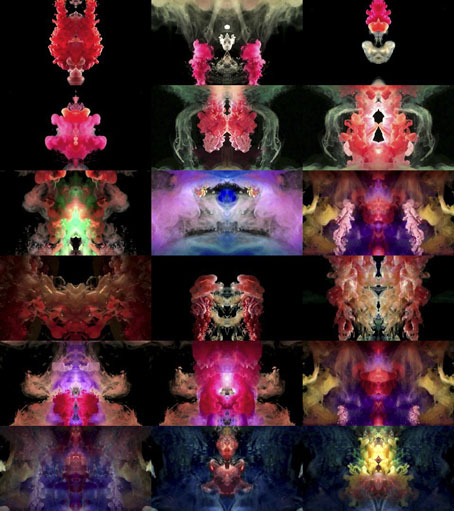
A short motion study by David Vigh for Bose Collins. Sometimes the simplest tricks are the most effective, as with these shots of coloured inks dropped into water and mirrored at their vertical axis. The resulting symmetry effortlessly prompts our pareidolia. Bose Collins has some additional experiments in this series, including one exploring the weirdness of ferrofluids.

Elsewhere on { feuilleton }
The abstract cinema archive

Heliograms by Jean Piché

piche.jpg

Heliograms (1982), an album of early digital music by Canadian composer Jean Piché has managed to stay resolutely off my electronic music radar until now following news of a reissue from Digitalis Recordings:

Jean Piché recorded “Heliograms” between the years 1977-1980 during his time at Simon Fraser University in Vancouver, BC. The music on the LP consists of works for computer, digital synthesis and acoustic instruments, and most of it was composed using the POD Interactive Compositional System that Barry Truax had developed at SFU. The four compositions that make up “Heliograms” are often dense, harmonically rich pieces that slowly evolve through time. There is a strong use of tonality throughout which characterizes Piché’s work during this period. It echoes a fascination with the music of Terry Riley, Steve Reich, and Lou Harrison, placing it firmly in a minimalist approach to electronic music, alongside the contemporary work of American composer Laurie Spiegel, then working at Bell Labs.

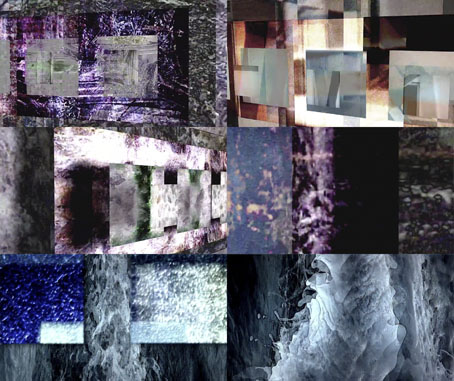
The screen grabs above are from Piché’s 18-minute sample video which gives an impressive taste of two of the tracks. There’s more of Piché’s “videomusic” at his Vimeo channel, ranging from an early Fairlight and video synthesizer piece to more recent work. Via FACT.

Previously on { feuilleton }
Creel Pone
Versum – Fluor by Tarik Barri

Weekend links 107

schwabe.jpg

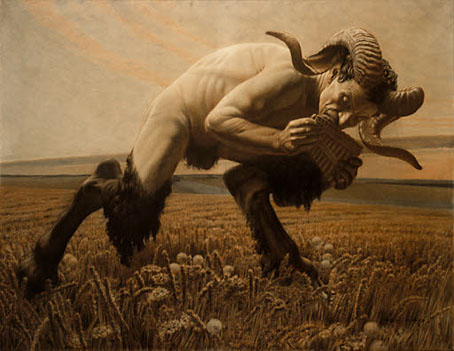
Le Faune (1923) by Carlos Schwabe.

• “When I recently attended a conference in China, many of the presenters left their papers on the cloud—Google Docs, to be specific. You know how this story ends: they got to China and there was no Google. Shit out of luck. Their cloud-based Gmail was also unavailable, as were the cloud lockers on which they had stored their rich media presentations.” Ubuweb’s Kenneth Goldsmith on why he doesn’t trust the Cloud.

• “I’m a poet and Britain is not a land for poets anymore.” A marvellous interview with the great Lindsay Kemp at Dangerous Minds. Subjects include all that you’d hope for: Genet, Salomé, David Bowie, Ken Russell, Derek Jarman, The Wicker Man and “papier maché giant cocks”.

• “As early as the 1950s, Maurice Richardson wrote a Freudian analysis which concluded that Dracula was ‘a kind of incestuous-necrophilious, oral-anal-sadistic all-in wrestling match’.” Christopher Frayling on the Bram Stoker centenary.

Björk gets enthused by (among other things) Leonora Carrington, The Hourglass Sanatorium and Alejandro Jodorowsky’s YouTube lectures.

• Before Fritz Lang’s Metropolis there was Algol – Tragödie der Macht (1920). Strange Flowers investigates.
marsh.jpg

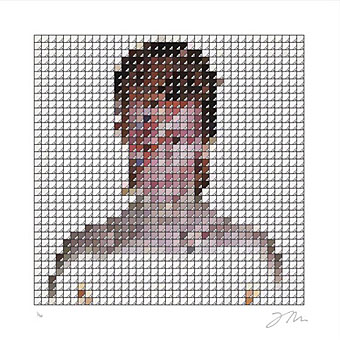
David Marsh recreates famous album covers using Adobe Illustrator’s Pantone swatches.

• New titles forthcoming from Strange Attractor Press. Related: an interview with SAP allies Cyclobe.

• 960 individual slabs of vinyl make an animated waveform for Benga’s I Will Never Change.

• An exhibition of works by Stanislav Szukalksi at Varnish Fine Art, San Francisco,

Keith Haring‘s erotic mural for the NYC LGBT Community Center is restored.

The Situationist Times (1962–1967) is resurrected at Boo-Hooray.

• Doors Closing Slowly: Derek Raymond‘s Factory Novels.

Will Wilkinson insists that fiction isn’t good for you.

• More bookplates at BibliOdyssey and 50 Watts.

The Top 25 Psychedelic Videos of All Time.

Flannery O’Connor: cartoonist.

• RIP Adam Yauch.

• Their finest moment: Sabotage (1994) by Beastie Boys.

Weekend links 106

oshiro.jpg

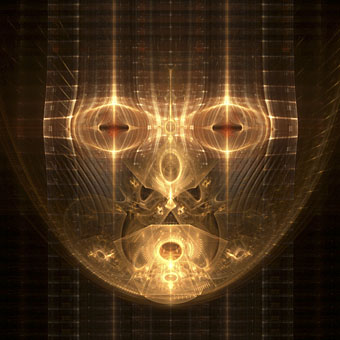
Gold Head 2 (2011) by Kouji Oshiro.

Josef Hartwig’s 1922 Bauhaus chess set. Contemporary copies can be bought from Naef Spiele but they’re not cheap. Related: Bauhaus: Art as Life, a major exhibition at the Barbican, London. Related, related: Art as life by Fiona MacCarthy.

• Rattera is a new font by Barnbrook Design for Fuse 1–20, Taschen’s collection of the experimental typography publication. Related: The Fuse poster explained.

Genesis (1981), video feedback and computer animation by Ron Hays with an electronic score by Ragnar Grippe.

Deadly Doris, a recording by Malcolm Mooney-era Can from the forthcoming Lost Tapes collection.

• “How did a pop band end up in a museum” Sasha Frere-Jones on Kraftwerk.

Philip Glass & Robert Wilson on how they made Einstein on the Beach.

• An astonishing aerial photo of post-quake San Francisco in 1906.

• More electronic music: Buddha Machine’s SoundCloud page.

My Baby, music and video from Julia Holter & Jib Kidder.

Homotography‘s photos can now be browsed at Pinterest.

Deviates, Inc., a Tumblr.

• Raoul Björkenheim live: Apocalypso pt. 1 | Apocalypso pt. 2 | 1-2-11 DMG, NYC

Anémic Cinéma

anemic.jpg

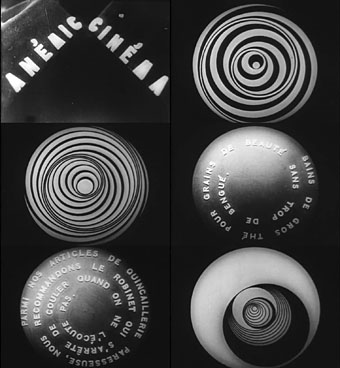
It’s no doubt up to the viewer to decide what constitutes anaemia in Marcel Duchamp’s 7-minute film. Anémic Cinéma was made the same year as Emak-Bakia with the assistance of Man Ray and Marc Allégret. Duchamp’s Rotoreliefs spin hypnotically alternating with punning epithets in French. The spinning artworks later appeared as Duchamp’s contribution to Hans Richter’s Dreams That Money Can Buy (1947).

Previously on { feuilleton }
Emak-Bakia
Un Chien Andalou
Ballet Mécanique
Dreams That Money Can Buy
La femme 100 têtes by Eric Duvivier
Entr’acte by René Clair