Children of the Stones

cots1.jpg

“Pretty phantasmagorical!” says precocious teenager Matthew when he and his father drive into the fictional village of Milbury in the opening scene of Children of the Stones. Matthew’s father is a scientist whose work requires a three-month stay in a village built in the centre of a series of ancient ramparts and stone circles. Once settled, they find many of the villagers to be blandly cheerful, while Matthew discovers that his maths skills at the local school pale beside younger children who can solve complex equations with ease. Omnipresent characters in the village are Hendrick, a retired astronomer who owns the local manor house and acts as village squire; Margaret, a newly-arrived archaeologist who knows the history of the stones; and Dai, a vagrant poacher who lives outside the circle, and who seems eager to remain free of the Stepford-like happiness afflicting his neighbours.

cots2.jpg

Matthew (Peter Demin).

Matthew’s “phantasmagorical” epithet is directed at the neolithic mound outside the village but could easily apply to the whole of this seven-part serial which I watched again recently. HTV produced Children of the Stones which was first broadcast in early 1977. A mystery serial for children involving pagan history, folk rituals and an undercurrent of science fiction wasn’t such a surprising thing in the 1970s, this being a decade when a popular interest in the occult and the paranormal was more prevalent than at any time before or since. Children’s television reflected adult trends which is why we got to see an adaptation of Alan Garner’s The Owl Service, the occult adventure series Ace of Wands (with its hero named “Tarot”), The Tomorrow People (which occasionally strayed from science fiction to science fantasy) and others (see an earlier post, Occultism for kids). Children of the Stones was the most complex of all of these, a well-crafted drama with similarities to Nigel Kneale’s TV plays, The Wicker Man and The Prisoner. With a slight change of emphasis it would have worked just as well as a serial for adults. The best children’s serials of the period were usually adaptations of novels; Children of the Stones was an original work for television, written by Jeremy Burnham & Trevor Ray, and directed by Peter Graham Scott.

cots4.jpg

Adam (Gareth Thomas), Margaret (Veronica Strong) and Hendrick (Iain Cuthbertson).

Continue reading “Children of the Stones”

World Fantasy Awards

infernal.jpg

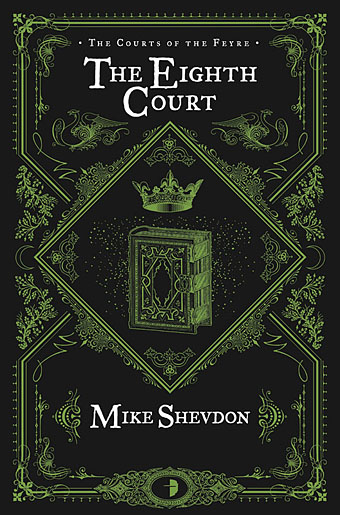
Presenting some of the cover art and interior illustration from 2011 which won me the World Fantasy Award for best artist in Toronto on Sunday. (The complete awards list is here.) It was a surprise to be nominated, and even more of a surprise to win since working in different areas—book, music, comics—is never a good way to get noticed for doing one particular thing. It’s also the case that sf/fantasy art awards tend to favour painters or virtuoso digital artists over people such as myself who I suppose are more illustrator-designers; that’s not a criticism, just an acknowledgement of the strength and popularity of highly-refined pictorial art in this area of the literary world. The recognition hazard works in the opposite direction: the design world often gives the most attention to graphic design alone, with the illustration quotient being regarded as secondary content.

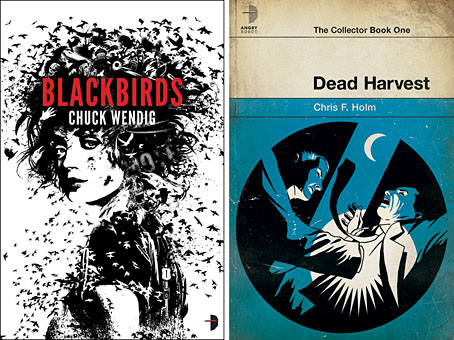
I’m not exactly sure what the judges were looking at of my work so these examples have been chosen for being published during the year under examination. They’re also covers that people seemed to like a lot, especially KW Jeter‘s Morlock Night (even though I still prefer Infernal Devices!), and those for Mike Shevdon‘s books. The Jeter and Shevdon volumes are all published by Angry Robot who will also be publishing Lavie Tidhar‘s The Bookman Histories early next year sporting another of my covers. Lavie’s novel Osama won best novel in Toronto while Ann and Jeff VanderMeer (editors of the Lambshead book below) picked up a best anthology award for their monumental The Weird. And to add to the good company, my regular publishers Tachyon saw one of their authors, Tim Powers, gaining best story collection. Congratulations to everyone, and a big thanks to Ann for collecting my award.

I’m always using these posts to point to other artists so it’s only right that I encourage everyone to go and look at the work of the other nominees. Here they are (although Jon Foster’s site appears down at the moment):

Julie Dillon
Jon Foster
Kathleen Jennings
John Picacio

John Picacio has a rather gorgeous calendar due out soon, details here.

morlock.jpg

lambshead.jpg

Title page for The Thackery T. Lambshead Cabinet of Curiosities edited by Ann & Jeff VanderMeer (Harper Voyager).

shevdon1.jpg

Continue reading “World Fantasy Awards”

Steampunk Revolution

srev01.jpg

The “S” word again. One of the jobs from earlier this year is now available for purchase from publishers Tachyon and other outlets. Steampunk Revolution is the third in a series of steampunk story collections edited by Ann VanderMeer (Jeff VanderMeer was co-editor on the first two volumes). I designed the previous title, Steampunk Reloaded, and was working on these pages whilst also putting together the cover for Lavie Tidhar’s The Bookman Histories. Tidhar’s trilogy is a steampunk affair (and this collection features one of his Bookman stories) so there’s some slight overlap between the two designs, notably the use of a typographic “charm” I took from a Victorian printer’s catalogue. I’ve since seen that shape used elsewhere so it’s evidently more common than I thought. Bah.

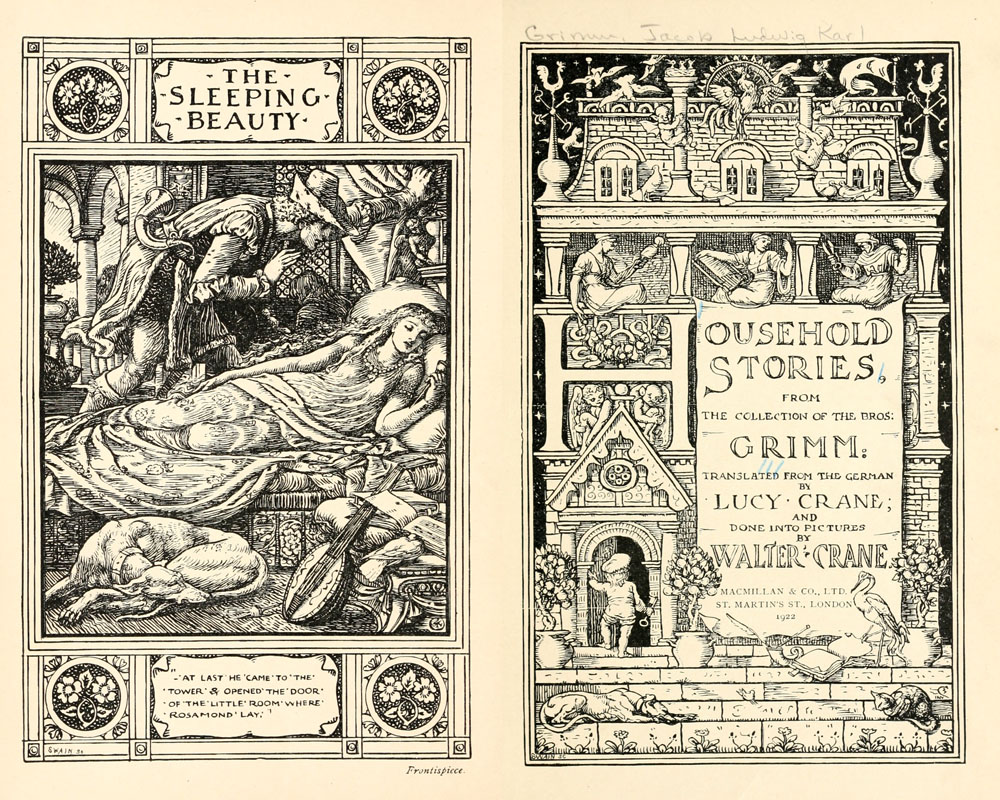
The title page design above can be added to my ongoing obsession with the Exposition Universelle of 1900. Malissa Kent’s story, The Heart is the Matter, ends with a scene at the Exposition so I had an excuse to use an elaborate banner which includes an Exposition medal. (The same medal, incidentally, that you still see on the labels of Campbell’s Soup). The illustration below is adapted from one of Walter Crane’s Socialist drawings, and I feel bad now that we didn’t credit him for it. Sorry, Walter.

srev05.jpg

srev03.jpg

srev04.jpg

Continue reading “Steampunk Revolution”

Tentacles #3: Dwellers in the Mirage

dwellers01.jpg

Illustration by Robert A. Graef (1932).

If the predatory octopuses of the Sargasso Sea are too mundane for you, how about an extra-dimensional Kraken named Khalk’ru which has to be placated with human sacrifice? This creature is the prime menace in A. Merritt’s Dwellers in the Mirage (1932), a novel I’m afraid I haven’t read despite its quite evident tentacular delirium. The story is a Lost Race adventure with the unlikely setting of a warm valley in Alaska where the usual heroic outsider encounters the diabolical Kraken worshippers. Merritt’s work is out of copyright in Australia so the text of the book can be found at the Australian Project Gutenberg. There you’ll discover that chapter four is entitled Tentacle of Khalk’ru.

A handful of covers and illustrations follow.

dwellers06.jpg

Virgil Finlay (1941).

Continue reading “Tentacles #3: Dwellers in the Mirage”

The Garden of Adompha

adompha1.jpg

…the growths of that garden were such as no terrestrial sun could have fostered, and Dwerulas said that their seed was of like origin with the globe. There were pale, bifurcated trunks that strained upwards as if to disroot themselves from the ground, unfolding immense leaves like the dark and ribbed wings of dragons. There were amaranthine blossoms, broad as salvers, supported by arm-thick stems that trembled continually.

And there were many other weird plants, diverse as the seven hells, and having no common characteristics other than the scions which Dwerulas had grafted upon them here and there through his unnatural and necromantic art.

These scions were the various parts and members of human beings. Consummately, and with never failing success, the magician had joined them to the half-vegetable, half-animate stocks on which they lived and grew thereafter, drawing an ichor-like sap. Thus were preserved the carefully chosen souvenirs of a multitude of persons who had inspired Dwerulas and the king with distaste or ennui. On palmy boles, beneath feathery-tufted foliage, the heads of eunuchs hung in bunches, like enormous black drupes. A bare, leafless creeper was flowered with the ears of delinquent guardsmen. Misshapen cacti were fruited with the breasts of women, or foliated with their hair. Entire limbs or torsos had been united with monstrous trees. Some of the huge salver-like blossoms bore palpitating hearts, and certain smaller blooms were centered with eyes that still opened and closed amid their lashes. And there were other graftings, too obscene or repellent for narration.

Thus Clark Ashton Smith in The Garden of Adompha, one of the stories in the author’s Zothique cycle which was first published in Weird Tales in April, 1938. Zothique was Smith’s contribution to the Dying Earth subgenre, sixteen stories set on the last continent in the final days of the Earth, and a home to no end of sorcery and cruelty. I’ve always enjoyed this subgenre, especially in the hands of Jack Vance whose later Dying Earth stories show the influence of Zothique, so these are some of my favourites among Smith’s prodigious output. The Garden of Adompha is a particularly grotesque piece, concerning the sequestered garden of the title to which King Adompha has undesirables removed. Once there his wizard, Dwerulas, drugs the victims and grafts parts of their bodies to the garden’s hothouse plants. Virgil Finlay’s cover painting downplays the horror somewhat, and Dwerulas’s supine prey, Thuloneah, looks like a very typical American girl, but then for a story that reads like a pulp equivalent of Octave Mirbeau it’s surprising it made the cover at all.

adompha2.jpg

Re-reading some of Smith’s stories over the past week, The Garden of Adompha among them, there’s been the additional pleasure of searching for illustrations from their original publication. I knew that Virgil Finlay had painted this cover, one of the few cover features Smith received from Weird Tales, but Alistair Durie’s Weird Tales (1979) collection only has a monochrome reproduction. The always reliable Golden Age Comic Book Stories not only has a copy of Finlay’s original painting but also the interior illustration which looks like a litho drawing rather than the artist’s more usual scratchboard. The most recent book collection featuring the story was The Collected Fantasies Of Clark Ashton Smith Volume 5: The Last Hieroglyph (2010) from Night Shade Books. (I would have linked to the publisher’s page but their site seems to be broken.)

Update: Golden Age Comic Book Stories changed its name then vanished altogether. The picture links here have been updated.

adompha3.jpg

Previously on { feuilleton }
Vathek illustrated
The Vengeance of Nitocris
The House of Orchids by George Sterling
Haschisch Hallucinations by HE Gowers
Odes and Sonnets by Clark Ashton Smith
The King in Yellow
Clark Ashton Smith book covers