Rooms with a paranormal view

room1.jpg

The Room: the cosmic tabletop.

A few words of praise for the Room series from Fireproof Games. I don’t play many computer games, and I think this may be my first post dedicated to such a thing, but I maintain an interest in the medium. The Room and its sequels only came to my attention a couple of weeks ago when I was wondering if there was anything Myst-like available for the tablet. I never got to play the original Myst but enjoyed its follow up, Riven, although the enjoyment was mostly for the graphics, the music and the island environments. The game itself was less satisfying, requiring pen and paper to keep track of its complexities, and involving a great deal of fruitless journeying from one location to another in the search for new clues.

room2.jpg

The Room 2: the camera.

The Room follows the template established by Myst in presenting you with a number of mechanical artefacts, all of which have to be examined and opened or operated before you can proceed to the next stage. The dominant aesthetic is 19th-century-mechanical—there’s a lot of wood and brass to these devices—but to call it steampunk would be a mistake; there’s little steam involved, and most of the cogs are kept inside their cases. There is a hint of Jules Verne, however, in the notes from an absent inventor whose initials, “A.S.”, may be a nod to Journey to the Centre of the Earth. As the title suggests, the location is a single room, while in the sequels, The Room 2 and The Room 3, you’re presented with a series of connected spaces. The third installment is the closest to the original Myst with a central hub that leads to other areas of a rambling complex of buildings, not all of which are revealed at the outset. The main structure is based on William Beckford’s Fonthill Abbey which pushes things into Gothic territory even without the developments outlined below.

room3.jpg

The Room 3: the oscilloscope is one of several which need to be powered up and manipulated in order to open the Null portals.

The MacGuffin for all the games is a new element, the Null, whose discovery and potential obsesses the creators of the games’ devices, and whose manipulation of space creates many of the portals that lead to new rooms. As the series progresses, the Null becomes a growing menace that leads to full-on cosmic horror, with oil-slick Tentacles From Beyond writhing around the interdimensional portals you have to travel through. This development was surprising and, for this player, very welcome, turning the games from a series of eleborate puzzles into something much more sinister. The aesthetic evolves accordingly, with an increasing profusion of occult sigils and pentacles, and, in The Room 2, Tarot cards and séance devices. (Fireproof have a set of their Tarot designs available as a free download.) In the second game there’s a further requirement to piece together mundane machines—a camera or a typewriter, say—before they will function properly. This process reaches a peak in The Room 3 where you’re faced with a succession of increasingly complex tasks, from woodworking and metal forging to electro-mechanical engineering and astronomy. As with the Myst universe, there are no monsters here (although there is the occasional ghost), nothing needs to be fought with weapons, it’s just you, a room full of objects and a continual background murmur of unnerving whispers and distant sounds. The gameplay in The Room 3 is sufficiently non-linear to lead to a variety of different endings, not all of which may be survivable. I managed to escape the Tentacles From Beyond when they finally destroyed the house but I also missed finding an important artefact. I’ll be returning, wiser and, I hope, more attentive to the half-hidden details.

room4.jpg

The Room—Old Sins: the haunted doll’s house as seen at the beginning of the game.

I’m currently playing the fourth game in the series, Old Sins, which returns you to a single room but plays with scale via a large doll’s house. The exterior of the building is all detailed model work, while the interiors—accessed through Null physics—are scaled-down replicas of the rooms in a house where another Null investigator and his wife have gone missing. It’s not clear yet whether the attic where the toy house is stored is also the attic of the real house the model is based upon but having dealt with a similar model in The Room 3 this seems likely.

While I enjoyed the surface details of Riven I was never very interested in the fantasy background of the Myst universe. The Room series is much closer to my own core preoccupations, a beguiling blend of antique technology with borderline occultism and those Tentacles From Beyond, a scenario that wouldn’t be out of place in an issue of Weird Tales. Just the thing for the darkening days of October.

The hundred-year Voyage

arcturus1.jpg

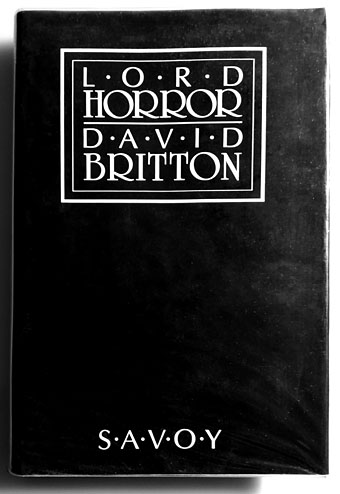
Today’s post at Wormwoodiana reminds me that David Lindsay’s unique novel of philosophical fantasy, A Voyage to Arcturus, was published a hundred years ago today. I designed a lavish reprint for Savoy Books in 2002, an edition which unfortunately used the re-edited text from earlier reprints instead of going to the original publication. This wasn’t done for lack of a first edition, it was more out of ignorance—nobody bothered to look into the history of the text—as well as convenience; Savoy’s earlier reprinting of Anthony Skene’s Monsieur Zenith the Albino had involved many weeks of text preparation, scanning pages from a photocopy of Skene’s very scarce novel, then running the copy through rudimentary OCR software and proofing the result. In Savoy’s slight defence, the reprint of Arcturus did correct a couple of typos that everyone else had missed.

arcturus2.jpg

I still think the best feature of my design was the selection of Jean Delville’s remarkable Symbolist painting, The Treasures of Satan (1895), a picture used with the permission of the Brussels Museum of Fine Art. (They supplied us with a print of the painting together with a photo of Delville’s Angel of Splendour (1894) for the back cover.) With the exception of Bob Pepper’s artwork for the 1968 Ballantine paperback, previous reprints of the novel seldom reflected the contents on their covers. I’m no longer happy with the type layout on the rest of the dust-jacket, however, although the front cover looks okay. The Savoy edition included an introduction by Alan Moore, an afterword by Colin Wilson, a collection of philosophical aphorisms by David Lindsay, plus a couple of photos of the author which I don’t think had been published before. Despite its flaws, the book was well-received. The paper was heavier stock than is generally used for hardback fiction which made for a heavy and expensive volume but the edition still sold out.

Penguin are reprinting the novel next year in an edition which continues the tradition of unsuitable cover art. According to Lindsay site The Violet Apple the figure on the cover is from an illustration for a Dostoevsky novella, so what is it doing on Lindsay’s book? Cover art aside, the novel is in a class of its own, and very highly recommended.

Previously on { feuilleton}
The art of Bob Pepper
Masonic fonts and the designer’s dark materials

Weekend links 532

ashmole.jpg

An alchemical illustration from Theatrum Chemicum Britannicum (1652) by Elias Ashmole.

• “Originally the idea was to do four parallel feuilleton stories, linked at the beginning of each episode by still shots connecting with the other episodes, rather like the old serials.” Jacques Rivette mentions a familiar word during a 1974 discussion with Carlos Clarens and Edgardo Cozarinsky about Out 1 and Céline and Julie Go Boating. I watched all 775 minutes of Out 1 last year, followed by a re-viewing of Céline and Julie, so this was good to read. Elsewhere: “The dizzying Céline and Julie Go Boating is apt viewing for a chaotic present,” says Phillipa Snow.

Away is a wordless feature-length animated film in which a boy is pursued by a lumbering monster after parachuting from a crashing aircraft. It was directed, written, edited, animated and scored by Gints Zilbalodis. Christopher Machell reviewed the film here. Watch the trailer.

• Jean Lorrain’s novel of Decadent dandyism, Monsieur Bougrelon, receives a new English translation by Brian Stableford for Side Real Press. (The Spurl translation by Eva Richter was reviewed here a few years ago.) The new edition includes illustrations by Etienne Drian (1885–1961).

El Topo again, among other things: Mike Soto on the anti-Western genre set in America’s surreal borderlands. Cormac McCarthy is a surprising absence from Soto’s lists despite almost all of his later work being concerned with the border region.

• “Whatever their pursuits, they were extremists who created literature that wasn’t so much great as it was relentless. Even now they make passive reading impossible.” Chris R. Morgan on Swift, Sade and the art of upsetting people.

• The best batch yet? Sean Kitching talks to Gary Lucas and Eric Drew Feldman about the recording of Captain Beefheart’s Doc At The Radar Station.

• Malkovich, Malkovich, Malkovich… Photographer Sandro Miller persuaded John Malkovich to recreate 41 famous photographic portraits.

• An extract from Rated SavX in which Edwin Pouncey/Savage Pencil talks with Timothy d’Arch Smith about his artistic evolution.

• At Dennis Cooper’s: Pat O’Neill Day.

Siavash Amini‘s favourite music.

Get Away (1970) by Ry Cooder | Running Away (2002) by Radar | Fly Me Away (2005) by Goldfrapp

Der Orchideengarten translated

derorchideengarten.jpg

Via the latest mailing from Side Real Press, news that the world’s first magazine devoted to fantastic art and literature, Der Orchideengarten (1919–1921), is being translated into English. This isn’t the first time the magazine’s contents have been translated—Zagava printed a facsimile edition of the first issue in 2017 that included translated inserts by Helen Grant—but the latest efforts by Joe E. Bandel are going beyond the first issue with the intention of translating the entire run. Each issue will be available for purchase at Lulu.

It’s been a pleasure watching Der Orchideengarten creep out of the shadows over the past few years. When Will at A Journey Round My Skull posted interior illustrations from back issues of the magazine in 2009 the title was barely mentioned outside German genre histories or the tantalising feature in Franz Rottensteiner’s The Fantasy Book (1978). Since then, the entire run of the magazine has been made available for free by the University of Heidelberg’s invaluable scanning programme, after which we had the Zagava facsimile. If the new translations are successful then the next stage may be the publication of an introductory collection that gathers the best work from the magazine.

Previously on { feuilleton }
• An unseasonable bloom
• Covers for Der Orchideengarten
• Der Orchideengarten illustrated
• Der Orchideengarten

Demons by rail-light: Stefan Grabiński’s weird fiction

grabinski.jpg

Thanks to the demons of distraction it’s taken me a long time to find my way to these books by Polish author Stefan Grabiński (1887–1936) but I’m very pleased to have done so at last. Grabiński was one of several writers first drawn to my attention by Franz Rottensteiner’s The Fantasy Book: The Ghostly, the Gothic, the Magical, the Unreal (1978), a lavishly illustrated popular study that charted the history of fantasy and horror fiction. The book is inevitably dominated by Anglophone authors but Rottensteiner was looking at the genres from a global perspective, to an extent that some of the writers in the sections devoted to Continental Europe were either difficult to find or, as with Grabiński, hadn’t yet been translated into English. Robert Hadji’s Grabiński entry in the Penguin Encyclopedia of Horror and the Supernatural (1986) further stoked my curiosity. Neither Rottensteiner nor Hadji mention how they came to read these obscure tales but I’d guess it was in the two collections published in Germany under the Bibliothek des Hauses Usher imprint, Das Abstellgleis (1971) and Dunst und andere unheimliche Geschichten (1974); several covers from the imprint appear in Rottensteiner’s book. Wherever it was that they read the stories, both writers praised Grabiński as an overlooked master of weird fiction. Rottensteiner notes that he was a contemporary of HP Lovecraft, and with a similar biography—briefly married and suffering artistic neglect during his lifetime—but neither Rottensteiner nor Hadji use the common shorthand descriptions of Grabiński as “the Polish Poe” or “the Polish Lovecraft”. These labels are intriguing but misapplied.

grabinski2.jpg

Bearing in mind that these stories are translated works, one of the surprises of finally reading them is how fresh they seem compared to so many British ghost stories from the same period. Grabiński was writing during the birth of Modernism but the stories of his Anglophone contemporaries can often read like the products of an earlier epoch. His economical prose lacks the ornamentation of Poe and Lovecraft, just as it lacks Poe’s morbid Romanticism and has nothing of Lovecraft’s cosmic scale. But there are recurrent themes, particularly that of possession, whether by the spirits of the dead, by inhuman elementals, or by idée fixe. The latter provides the subject of The Glance, a story that also demonstrates Grabiński’s knack of finding horror in the most mundane situations: a man whose wife died prematurely is troubled by the sight of an open door, the same door through which she walked out of his life, and subsequently, out of her own. The man’s obsession with the door grows into a fear of closed doors and the implicit tragedies they may conceal, an obsession that soon extends itself to anything that hides too much of the world: curtains, rugs, the sharp corners of city streets… Edgar Allan Poe was fond of cataloguing madness in this manner but Grabiński’s stories go beyond glib formulations of insanity. “Metaphysical” is a word often used in discussion of the Grabiński oeuvre; the fixations of his protagonists reveal truths about the world to which others are blind.

grabinski3.jpg

Continue reading “Demons by rail-light: Stefan Grabiński’s weird fiction”