La Morphine by Victorien du Saussay

morphine1.jpg

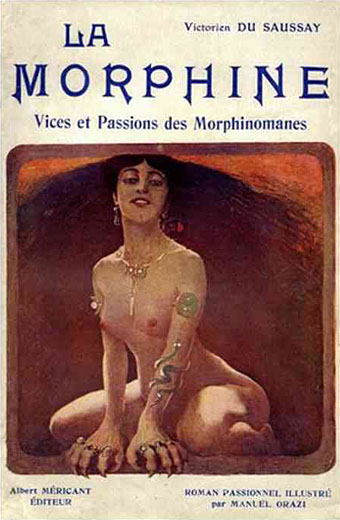
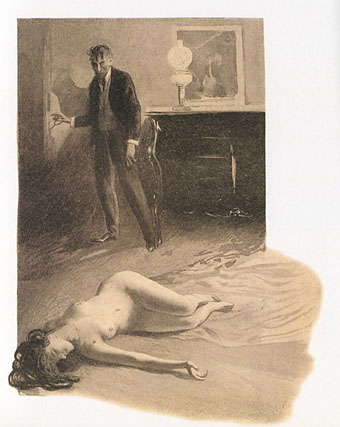
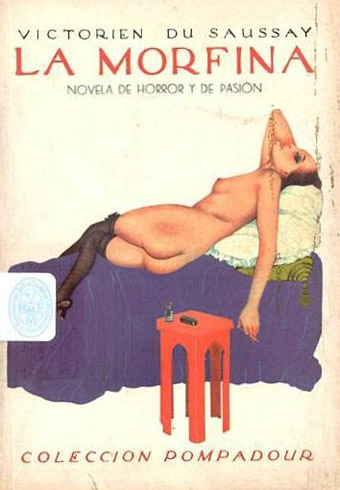
Manuel Orazi’s illustrations (above and below) have been travelling the recursive paths of the Tumblr labyrinth recently. I was hoping to find covers for other editions but the third image here (from 1930) is the only one that’s turned up. La Morphine, Vices et passions des morphinomanes by Victorien du Saussay was published in 1906, and is described by Barbara Hodgson as “a stark novel of addiction, failed cures, incest, indecent exposure and adultery” (In the Arms of Morpheus: The Tragic History of Laudanum, Morphine, and Patent Medicines (2001)). Orazi apparently produced 22 interior illustrations but (again) they don’t appear to be available for the moment.

morphine2.jpg

morphine3.jpg

Elsewhere on { feuilleton }
The book covers archive

Previously on { feuilleton }
Haschisch Hallucinations by HE Gowers
Manuel Orazi’s Salomé
Demon rum leads to heroin
La belle sans nom
German opium smokers, 1900

Weekend links 96

nunez.jpg

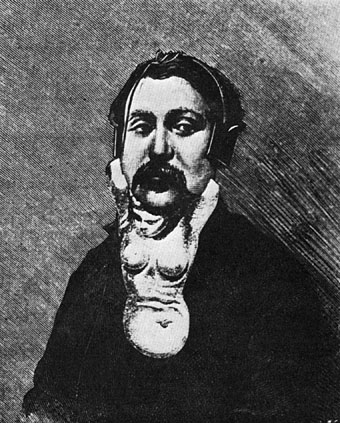
Sin título (monstruas) (2008) by Marina Núñez.   

• Salon asks Christopher Bram “Is gay literature over?” Bram’s new book, Eminent Outlaws: The Gay Writers Who Changed America, is reviewed here.

Robert Montgomery is profiled at the Independent as “The artist vandalising advertising with poetry.”

In addition to aesthetics, McCarthy noted a deeper link between great science and great writing. “Both involve curiosity, taking risks, thinking in an adventurous manner, and being willing to say something 9/10ths of people will say is wrong.” Profound insights in both domains also tend arise from a source beyond the limits of analytic reason. “Major insights in science come from the subconscious, from staring at your shoes. They’re not just analytical.”

Nick Romeo meets Cormac McCarthy at the Santa Fe Institute.

• For FACT mix 316 Julia Holter mixes radio broadcasts, street recordings and music.

• This week in the Tumblr labyrinth: fin de siècle art and graphics from Nocnitsa.

“There’s a widespread cultural barrenness across art and political culture. But there are some pockets of resistance on the extreme margins, like the techno-savvy protest movements, small press, the creator-owned comics, that seem to be getting some signs of hope for the future,” he says. “All of the genuinely interesting work is being done on the margins, with independent companies, self-producing, and alternative distribution networks.”

Alan Moore on Watchmen’s “toxic cloud” and creativity v. big business.

Stone Tape Shuffle, a 12” LP of readings by Iain Sinclair. Limited to 400 copies.

Monolake on how we cope with death: mythologies, rituals, drugs and Ghosts.

Kraftwerk perform at New York’s Museum of Modern Art in April.

Kathy Acker (in 1988?) interviewing William Burroughs.

pogany.jpg

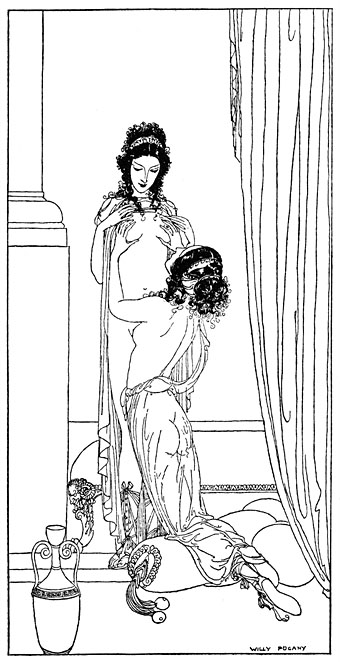
Willy Pogány’s erotica: illustrations for a 1926 edition of The Songs of Bilitis by Pierre Louÿs.

• Nicholas Lezard on David Lynch: director of dreams.

Did otherworldly music inspire Stonehenge?

Coilhouse has an Eyepatch Party.

Tanzmusik (1973) by Kraftwerk | The Model (1992) by the Balanescu Quartet | Trans Europe Express (2003) by the Wiener Sinfonie Orchestra & Arnold Schönberg Choir.

Weekend links 93

favre.jpg

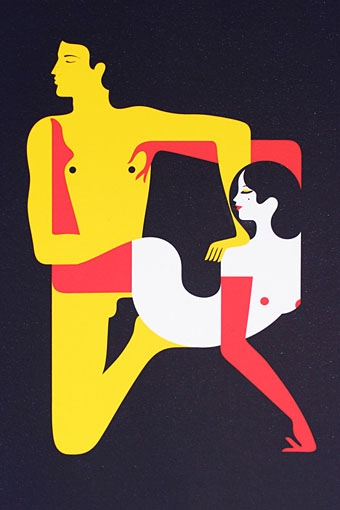
One of a series of tremendous designs by Malika Favre for a new Penguin edition of the Kama Sutra.

• New interviews: “…Americans — mired in individualism — prefer to think in terms of identity than in terms of roles and masks. An American would never have called a novel Confessions of a Mask.” Nicholas Currie, better known via his Momus mask. | “The horror in music comes from the silence,” says John Carpenter. | “It’s dangerous to be an artist. That’s what we talk about in Naked Lunch — and it’s dangerous on many different levels. Politically it can be dangerous, but psychologically it can be quite dangerous too. You make yourself very vulnerable. You put yourself out there and of course you open yourself up to criticism and attack.” David Cronenberg at the Los Angeles Review of Books.

• New books: Dotter of Her Father’s Eyes, a Joycean memoir by Mary M Talbot and Bryan Talbot. | A stack of new works from Strange Attractor including a collection of Savage Pencil‘s Trip or Squeek comic strips. | Robert Irwin’s Visions of the Jinn: Illustrators of the Arabian Nights. A shame about the high price on the latter but I’m sure it looks wonderful.

• The Blu-ray release of Wings (1927), William A. Wellman’s silent drama about air aces during the First World War, has prompted renewed attention for the passionate relationship between its two male leads, especially this deathbed scene which is tagged as the first same-sex kiss in cinema. That’s arguable, of course, but it’s certainly a touching moment.

• From 2009: Searching the Library of Babel, a list of all the stories in all 33 volumes of The Library of Babel, a 1979 Spanish language anthology of fantastic literature edited by Jorge Luis Borges.

• Lots of newpaper attention in the past week for the not-so-fresh news that magic mushrooms could help fight depression. Nature went into the detail of the latest studies.

French group Air have written the score for a rare colour print of Le voyage dans la lune (1902) by Georges Méliès. Air’s YouTube channel has extracts.

• From 1989: The Merchant of Shadows by Angela Carter.

Will Hunt on the Ghost River of Manhattan.

Selected Letters of William S. Burroughs

Sexy Boy (1998) by Air | Surfing On A Rocket (2003) by Air | Mer Du Japon (2007) by Air.

La femme 100 têtes by Eric Duvivier

femme1.jpg

La femme 100 têtes: L’immaculée conception (1929).

Salvador Dalí never lacked for attention from filmmakers, as has been noted here on several occasions. Max Ernst, on the other hand, received far less attention despite being an actor and collaborator in two of the most significant Surrealist films, L’Age D’Or (1930) and Dreams That Money Can Buy (1947).

femme2.jpg

La femme 100 têtes: Alors je vous présenterai l’oncle (1929).

One of the key works in the Ernst filmography is La femme 100 têtes, a 19-minute film from 1967 based on the series of collages Ernst created under that title in 1929, precursors to his collage masterwork Une semaine de bonté (1934). Eric Duvivier was the director, nephew of the celebrated French director Julien Duvivier, and a director of many educational films, none of which seem to be listed on IMDB. Duvivier’s film may be short but he had the resources to go to some extraordinary lengths in replicating cinematically so many of Ernst’s collages. Some of the scenes merely require a room or a street, in others bizarre or elaborate sets have had to be built then populated with actors for shots that last less than half a minute.

femme3.jpg

La femme 100 têtes (1967).

Why go to all this effort in 1967? The clue is in the name and logo of the producer—Sandoz—the pharmaceutical company that invented and manufactured LSD. Sandoz had a film division which they used to create promotional films for their products. Among the ones related to LSD are Images du monde visionnaire (1964), directed by Henri Michaux and Eric Duvivier, and (possibly) La femme 100 têtes. I say “possibly” only because I haven’t seen this confirmed but why else would a pharmaceutical company that just happened to make the world’s most famous hallucinogenic drug make a Surrealist film? Whatever the reason it’s a remarkable piece of work. See it on YouTube here.

femme4.jpg

La femme 100 têtes (1967).

Previously on { feuilleton }
Scenes from a carriage
Surrealist echoes
Max (The Birdman) Ernst
The Robing of the Birds

Weekend links 91

santosh.jpg

Untitled (1978) by GR Santosh at 50 Watts.

Evertype Publishing produces a range of Lewis Carroll special editions including Ailice’s Àventurs in Wunnerland (a translation in Scots), Alicia in Terra Mirabili (a Latin version), and an edition printed in the Nyctographic Square Alphabet devised by Carroll.

• This week’s bookshop animations: Type Books, Toronto presents The Joy of Books while at Shakespeare and Company, Paris, Spike Jonze and Simon Cahn explore the erotic life of book covers in Mourir Auprès de Toi.

• Invisible Girls and Phantom Ladies, a 1982 article on sexism in (US superhero) comics by Alan Moore. Thirty years on, things haven’t improved much at all.

I reread it now, 35 years later, and I am struck by its capacity to change like a magic mirror. Where I had originally seen it as a book about writing, about becoming a writer, I now see it as a book about reading, about taking one’s place in the chain. Where I once assumed it was a book about eternal youth, I now see it as a book about growing up, about learning to live.

Tilda Swinton on Virginia Woolf’s Orlando

Dark Water, Lovecraftian carpet designs (yes, carpets) by Kirill Rozhkov. Danish carpet manufacturer Ege has a catalogue showing the finished products.

Neil Gaiman ventures into the treacherous labyrinth of M. John Harrison’s Viriconium.

Nicholas Lezard reviews The White People and Other Weird Stories by Arthur Machen.
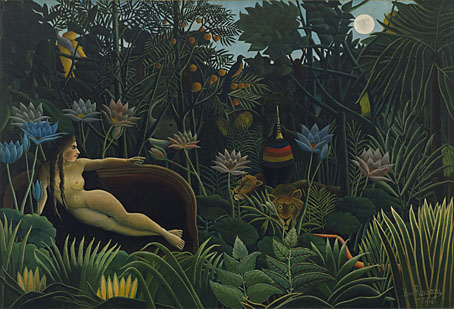
rousseau.jpg

The Dream (1910) by Henri Rousseau at the Google Art Project.

• Reassessing the Saul Bass and Alfred Hitchcock Collaboration by Pat Kirkham.

• Getting There Too Quickly: Peter Bebergal on Aldous Huxley and Mescaline.

Hidden in the Open: A Photographic Essay of Afro-American Male Couples.

Filles En Aiguilles, a new musical work by Schütze+Hopkins.

RubiCANE’s Erotic Illustrations.

Laurie Anderson has a Godplex.

Alan Bennett on Smut.

The Jungle Line (1975) by Joni Mitchell | The Jungle Line (1981) by Low Noise (Kevin Armstrong, Thomas Dolby, JJ Johnson & Matthew Seligman) | The Jungle Line (2007) by Herbie Hancock with Leonard Cohen.