The Kosmische Tarot

geitner-tarot-box.jpg

Revelation of the weekend has been the discovery that there are two sets of (for want of a better term) Krautrock Tarot cards. The first, Walter Wegmüller’s Zigeuner Tarot, is familiar for being included in the Tarot concept album released on the Kosmischen Kuriere label in 1973. The album was credited to Wegmüller but he only advised on the symbolism and acts as MC/narrator. Wegmüller’s cards are detailed and somewhat original, but their drawing is from the enthusiasm-over-technique school which goes against the grain of the rest of the album design and the accomplishment of the musicians.

mythos.jpg

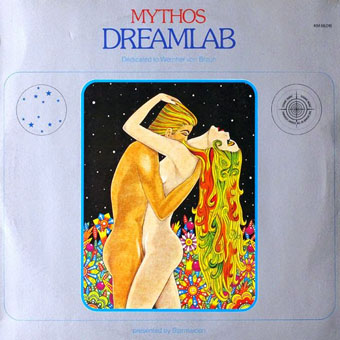
Dreamlab (1975) by Mythos. Design by Peter Geitner.

As noted a few days ago, the designer of the Tarot album was Peter Geitner working under the direction of a pair of very hands-on label bosses, Rolf-Ulrich Kaiser and Gille Lettmann. The story of Kaiser’s rise and fall has been recounted in some detail over the years (see here and here). Given the colourful saga, and the cast of notable musicians, writers and artists, I’m surprised to have seen no mention of the second Tarot set that Peter Geitner designed and illustrated in 1975 while the Kosmische Musik empire was imploding. One illustration (The Lovers) was even used as cover art for the Dreamlab album by Mythos.

geitner-tarot-back.jpg

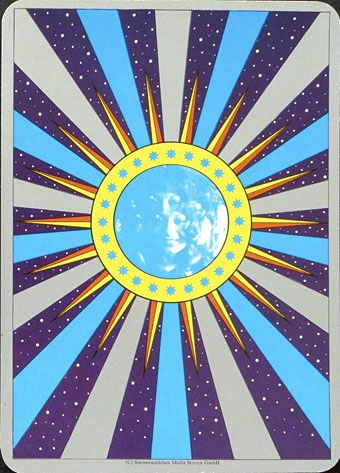
Card back for the Sternenmädchen’s Wahrsagespiel.

Sternenmädchen’s Wahrsagespiel (Star Girl’s Fortune Telling Game) is a specialised set of the Major Arcana presented as a spin-off from Gille Lettmann’s Sternenmädchen persona as featured on the Gilles Zeitschiff album; the back of the 22 cards features the photo of Gille from the album cover. I’ve said that Geitner illustrated the cards but some of the drawings may have originated as sketches by Gille Lettmann; information is scant but I’ve seen mention of her having been a textile or fashion designer. What’s most striking to me about these designs is how psychedelic they all are, more so than any of the Kosmische Musik album covers even though they maintain the cosmic themes of the record label. Many of those involved with the Kosmische empire were taking LSD at the time so this isn’t very surprising but psychedelia of this intensity was an outmoded thing by the mid-70s. Also of interest is the renaming of the cards which push the attributions away from medieval tradition and into the cosmos. I’ve not been able to find examples of all 22 designs but a list of the cards follows, together with examples of variable quality. The set was printed by AGM Müller but has never been reissued so it now commands high prices. (Many thanks to Jeff for drawing my attention to these!)

Continue reading “The Kosmische Tarot”

Weekend links 246

ngai.jpg

Love Hunter by Victo Ngai.

• “The strangeness of the lyric style, the misuse of words and awkward phraseology that have been criticized even by Poe’s fervent admirers, are here taken as virtues, heightening as they do, a given poem’s conscious and calculated formalism.” Marjorie Perloff reviews The Poet Edgar Allan Poe: Alien Angel by Jerome McGann.

• Mix of the week: Secret Thirteen Mix by Jeremy Kolosine. Starting with Michael Rother is apt when I’ve spent the past week in a Cluster/Harmonia/Kraftwerk/La Düsseldorf/Neu!/Rother loop.

• Court records “suggest that the supposedly prudish Victorians had a far more relaxed attitude to sex between men than their 1960s counterparts”. Historian Jeff Evans has the data.

• “Part of HP Lovecraft’s acknowledged debt to Machen also lies in hearing without seeing.” London Sound Survey on Arthur Machen’s “sounds from beyond the veil”.

• “…pity the designer who has to enact the stage direction that instructs rats to carry away a character’s feet.” Andrew Dickson on the extreme theatre of Sarah Kane.

• Psychedelic collage artist Wilfried Sätty receives a mention in Carey Dunne‘s piece about how LSD helped shape California’s ecstatic design legacy.

• More psychedelia: The Psychedelic Sex Book by Eric Gotland & Paul Krassner, edited by Dian Hanson.

• At Dangerous Minds: Robert Fripp demonstrates Frippertronics on The Midnight Special, 1979.

• Dreams from a Glass House: artist Josiah McElheny on the glass architecture of Paul Scheerbart.

• Director Peter Strickland on six films that fed into The Duke of Burgundy.

Vintage trade card designs

The Zero Of The Signified (1980) by Robert Fripp | Heptaparaparshinokh (1981) by Robert Fripp & The League of Gentlemen | 1984 (1981) by Robert Fripp

Weekend links 245

htbag.jpg

First English-language edition of Hard to Be a God, 1973. Cover design by Alan Peckolick.

A group of scientists is sent to the planet Arkanar to help the local civilization, which is in the Medieval phase of its own history, to find the right path to progress. Their task is a difficult one: they cannot interfere violently and in no case can they kill. The scientist Rumata tries to save the local intellectuals from their punishment and cannot avoid taking a position. As if the question were: what would you do in God’s place?

Hard to Be a God is a 170-minute Russian science-fiction film based on a novel by Arkady & Boris Strugatsky, the authors of Roadside Picnic. The film was the magnum opus of director Aleksey German (1938–2013) who died shortly before post-production was complete. German’s wife and son finished the film.

“…the wonder about this exhausting, astonishing film is not that it took so long to make, it’s that it got made at all,” says Gabriel Winslow-Yost; “one of the most consistently disgusting films ever made,” says Glenn Kenny, “…not only an unforgettable individual masterpiece but probably one of the capital-G Great Films.”; “There are no bones to be made about it, Hard to Be a God is a modern masterpiece,” says Matt Thrift.

This pushes all of my cinematic buttons, of course, so now I’m itching to see it. YouTube has trailers, and (if you must) you can also find the entire film without subtitles. I’d rather wait for a disc version. Meanwhile, Chicago Review Press have republished the novel with a new translation by Olena Blumberg and a foreword by Hari Kunzru.

• At the Guardian John Doran recommends new Middle Eastern and North African music; the playlist includes a song from the forthcoming album by Melechesh which features my cover art. At the Quietus this week Doran explored Manchester’s urban wastelands with local musician Julie Campbell aka Lonelady.

• “Research into psychedelics, shut down for decades, is now yielding exciting results,” says Michael Pollan. Related: Ryan Cooper on why the [US] government should be funding mass scientific studies of Ecstasy, magic mushrooms, and LSD, and “Early humans used magic mushrooms, opium“.

Dad combined porn with all manner of genre fiction. He wrote pirate porn, ghost porn, science-fiction porn, vampire porn, historical porn, time-travel porn, secret-agent porn, thriller porn, zombie porn and Atlantis porn. An unpublished Old West novel opens with sex in a barn, featuring a gunslinger called Quiet Smith, without doubt Dad’s greatest character name. By the end of the decade, Dad claimed to have single-handedly raised the quality of American pornography.

Chris Offutt on the prolific writing career of his father, Andrew Jefferson Offutt V

The Sound Repository 2 by Wizards Tell Lies, a free collection of “rare tracks, demos, early and alternative versions” at Bandcamp.

Jennifer Rothwell‘s new fashion collection uses prints based on Harry Clarke’s stained-glass windows.

• Mix of the week: My Body Full Of Stars, an Afrofuturism mix by Oyinboy.

Terry Gilliam’s title sequence for Cry of the Banshee (1970).

Endless Endless: Kraftwerk at Tumblr.

Sehr Kosmisch (1974) by Harmonia | Walky-Talky (1975) by Harmonia | Sometimes In Autumn (1976) by Harmonia 76

Weekend links 243

burgoyne.jpg

Genesia (2011) by Bette Burgoyne.

• “…so I started buying these old gay porn novels, just for the covers and kept on collecting them.” Maitland McDonagh on the underexamined world of gay pulp. McDonagh’s 120 Days Books is reprinting some of these scarce titles. More gay erotica: Plans are afoot to republish Des Grieux, the rare prequel to Teleny or The Reverse of the Medal (1893), a novel often attributed (without much evidence) to Oscar Wilde.

Merricat is the name under which the Turrell Brothers, John & Tom, produce their atmospheric “nacht music”. Albums with titles such as Oneiros, Widdershins and Zerkalo give an idea of the spheres of interest. They also make short films, clips from which may be seen here.

• “Fascists don’t like satire. They don’t like it at all. And they especially don’t enjoy visual satire. Because of its unique power to communicate.” Ralph Steadman talking to Robert Chalmers about recent events.

There is an unexamined commonplace now floating around the social media, which has it that satire derogates its proper function when it stops targeting the powerful, and targets the relatively powerless instead. Theodor Adorno has also been cited here and there with his remarks on satire in the Minima Moralia of 1951, but few have noticed that the account he offers there stands in direct contradiction to the current received wisdom. For Adorno, satire is in its essence wistful and traditionalist. It looks back to something that has been lost, and dismisses the straight-facedness of everyone who attempts, against all evidence, to maintain the illusion that there is anything respect-worthy about the present state of things. It targets not just elected officials, but the yokels who elected them; not just the honcho who runs the saloon, but the sucker who hands over his last possessions at the poker table. There is a need for this: the yokels and the suckers need it most of all. There is redemption in it, and I confess to harboring whatever amount of traditionalism it takes to appreciate this redemptive quality.

Paris, 2015: a lengthy meditation by Justin EH Smith on the responses of left and right to the Charlie Hebdo killings

• “When the surface of the world is so overloaded with competing narratives…there is an understandable impulse to go underground.” Iain Sinclair on the excavation of London.

• More German music: Sinai Desert (1981) and Kailash, Pilgerfahrt Zum Thron Der Götter (no date), two films with music by Popol Vuh.

Kim Fowley: Sins & Secrets of the Silver Sixties. UglyThings Magazine makes available its definitive Fowley interview from 2001.

• More electronica and mix of the week: the FACT guide to the Yellow Magic Orchestra and associates.

• Vegetable-snake Undersea Beings: Allen Ginsberg writes to the Paris Review about LSD in 1966.

• The Edge Question for 2015: What do you think about machines that think?

Life of Cats: Selections from the Hiraki Ukiyo-e Collection.

Lake Baikal frozen over

Serial Killer Barbie

NGC 891 (1974) by Edgar Froese | Overture (1974) by Tangerine Dream | PA 701 (1976) by Edgar Froese

Weekend links 236

carvalho.jpg

The Three Witches (2014) by Lorena Carvalho.

Immersion, a new album by Grey Frequency, “…is a recording of the broken signals, wraiths in the ether from lost futures and utopias which were once promised…”. Box Of Secrets (1999) is an album of electronica by Ian Boddy that’s a free download until the end of December.

• “Hothouse flowers, Egyptian statuary, jewels, Nubian servants, crystal balls, cocaine, opium and champagne were just some of the things she spent her money on…” Lucy Davies explores the riotous world of Marchesa Luisa Casati.

• “London is a network of complete nexuses, coincidences, overlaps, references…” Stephanie Boland talks to Iain Sinclair about his new book 70×70: Unlicensed Preaching: A Life Unpacked in 70 Films.

My Women’s Studies professors would say: “You don’t know how hard we fought for you.” And yet, when they told me my sexuality was not correct, I felt embarrassed. I knew I had longings that didn’t line up with the politics, but I refused to repress them, particularly in my writing. I fought to unravel a political correctness that was censoring desire.

Screenwriter Erin Cressida Wilson on sex, cinema and secrets

Cthulhu, Fiction and Real Magic, a lecture by Ian ‘Cat’ Vincent at Treadwell’s, London, on December 3rd. For those who can’t attend, Erik Davis has just posted his essay about Lovecraft and contemporary occultism.

• “John Gielgud was obsessed with trousers, loved corduroy and leather. And so he wrote a film set in a menswear shop.” Gielgud’s unfilmed screenplay for gay porn director Peter de Rome may now be filmed.

• “The stories are even more fantastic and full of marvels than those in the Arabian Nights.” Robert Irwin on the newly-translated Tales of the Marvellous.

• Mixes of the week: The Advisory Circle present Winter From Out Here; Fall by The Ephemeral Man; Secret Thirteen Mix 136 by Cosmin TRG.

Danny Cooke‘s drone views of Pripyat, Chernobyl. Related: Into the Zone: Gasworks Park (Seattle, WA) by Christina Scholz.

• Watch Dragnet’s 1967 LSD episode. More psychedelics: “Magic mushrooms change brain connections“.

• Earth Magic: Peter Bebergal on photography of witches at play and at ritual.

• Düsseldorf 1970: The crucible of Krautrock by those who were there.

• It’s Alright Ma, It’s Only Witchcraft (1968) by Fairport Convention | Witch’s Will (1973) by Wilburn Burchette | Witches’ Multiplication Table (1982) by Holger Czukay