Aether Cola

aethercola.jpg

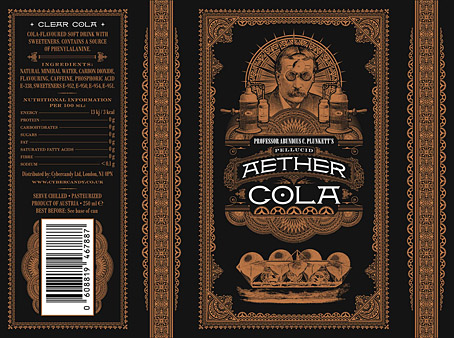
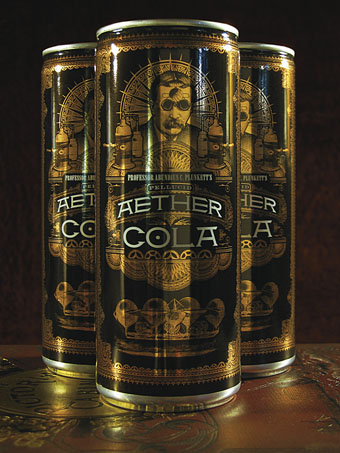
Another piece of work from the end of last year has now been unveiled. The brief this time was from UK company Cybercandy who asked for a steampunk-themed cola can. If this sounds like the mechanical shark has been well-and-truly vaulted then it’s necessary to note that Cybercandy specialise in novelty food products with science fiction (or similar) themes. They also import food products from other countries. The cans are small size (250 ml) for which I chose a bronze/copper metallic ink that looks great on the finished articles. The job made a welcome change from work for books or CDs.

aethercola2.jpg

Aether Cola is available from Cybercandy’s UK outlets. I’m not sure about the availability elsewhere but there’s a dedicated site for the drink here with details of their shops here.

aethercola3.jpg

Previously on { feuilleton }
• Crafting steampunk illustrations
• SteamPunk Magazine
• Morlocks, airships and curious cabinets
• The Steampunk Bible
• Steampunk Reloaded
• Steampunk overloaded!
• More Steampunk and the Crawling Chaos
• Steampunk Redux
• Steampunk framed
• Steampunk Horror Shortcuts

Pleasure of Ruins

beny01.jpg

The ideas ruins evoke in me are grand. Everything comes to nothing, everything perishes, everything passes, only the world remains, only time endures. How old is this world! I walk between two eternities.

Denis Diderot, 1767

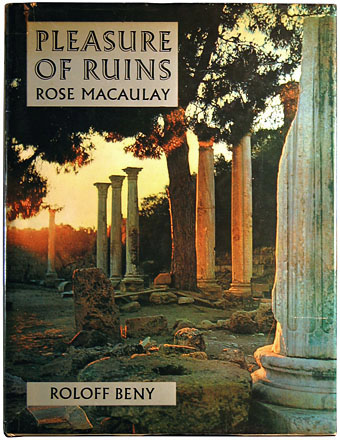
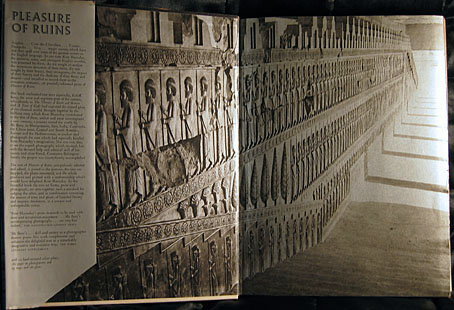
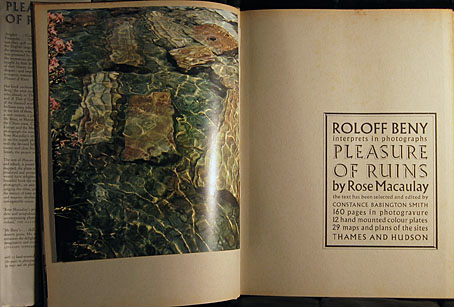
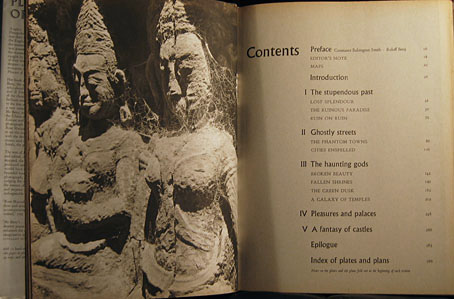
Ruins, as Diderot observed, are the memento mori of civilisations, a reminder that the apparent permanence of architecture is illusory: this too shall pass. Rose Macaulay explored the melancholy pleasure inspired by this contemplation in Pleasure of Ruins (1953), a book I was reminded of on two separate occasions this weekend. Before I get to those I can’t resist showing something of my own copy of Macaulay’s study, a heavyweight volume (286 pp, 346mm x 260mm) published by Thames & Hudson in 1964. This was the third book by Canadian photographer Roloff Beny who made a habit of photographing ancient ruins. Here he visits Angkor, Tintern Abbey, Persepolis, Petra, Baalbek, Leptis Magna, Chichen Itza, Machu Picchu and elsewhere to embellish Macaulay’s text with 160 photogravure pages, 12 tipped-in colour plates, and maps of the locations on fold-out spreads. Beny also designed the book which even in my rather scuffed and damp-afflicted copy is an impressive example of the mass-produced edition as work-of-art.
beny02.jpg

Metallic silver printing on the endpapers.

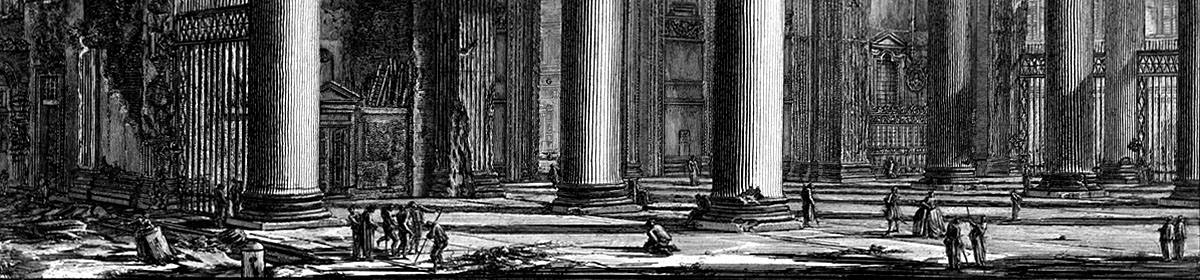
Rick Poynor provided the first mention of Macaulay’s book in a piece of polemic justifiably disputing the pejorative term “ruin porn”, an epithet that’s appeared recently among critics of those fascinated by photos of abandoned Detroit, or Battleship Island off the coast of Japan. If photos of ruins are “ruin porn” then Roloff Beny’s books must count as hardcore, while my National Trust Book of Ruins is evidently a government-sponsored sex manual. Poynor notes the criticism being a particularly American one, and wonders whether some Americans fail to appreciate the long cultural and political history of the ruin in Europe. Plenty of European cities have ruins in their midst, whether ancient ones like London Wall and the centre of Rome, or more recent ones like the Kaiser Wilhelm Memorial Church in Berlin and Coventry Cathedral, both partially destroyed during the Second World War. An appreciation of ruins began in the 18th century and evolved in tandem with the emergence of antiquarianism. Prior to this, ancient ruins were either a nuisance or a resource to be plundered for their stones. (Or, as can be seen in some of Piranesi’s Views of Rome, a convenient support for shops and houses.)
beny03.jpg

From ruin porn to Ruin lust: our love affair with decaying buildings, an essay by Brian Dillon which covers similar ground to Poynor’s piece, and discusses Rose Macaulay’s interest in ruins, an interest that survived being bombed out of her home during the war. This is a great run through the usual suspects, from the Romantics (with a nod to Fonthill Abbey) to JG Ballard’s obsession with the remnants of the Cold War and the Space Age. Dillon mentions the painting John Soane commissioned from Joseph Gandy showing his Bank of England building as a future ruin. And he also recounts the story (which I heard repeated recently in a Robert Hughes documentary) of Hitler’s demands to Albert Speer during their planning of the future capital of the Third Reich, Germania, that the buildings should make good ruins. It’s impossible to imagine anyone today planning a building as a future ruin even though many will end up that way, if they last at all.
beny04.jpg

If it wasn’t already apparent that ruins are the thing du jour, a current exhibition at Dundee Contemporary Arts is of photographic prints by Jane and Louise Wilson showing views of abandoned Pripyat, better known as the town at the heart of the Chernobyl Exclusion Zone. Rick Poynor refers to Pripyat in his piece, and it’s also an inevitable subject of discussion in Geoff Dyer’s latest book, Zona, an exploration of Andrei Tarkovsky’s Stalker where a disused power station adds a more sinister quality to the pleasure of ruins.

More pages from Roloff Beny’s book follow.

Continue reading “Pleasure of Ruins”
Le Grand Macabre

topor1.jpg

Yesterday I mentioned Leslie Megahey’s Ligeti film, All Clouds Are Clocks, an hour-long documentary based around an interview with György Ligeti filmed in 1976. A unique feature of that film was that Megahey returned to film Ligeti in the same room in 1991 where they discussed the composer’s work during the intervening period. Of these, Le Grand Macabre, written in the late 1970s, was the most ambitious piece.

topor2.jpg

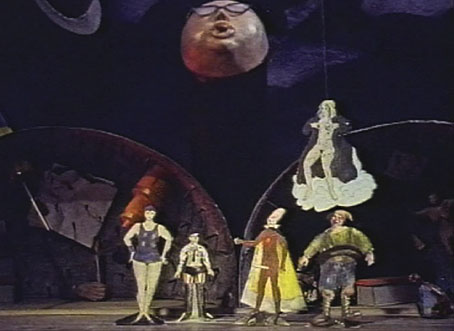
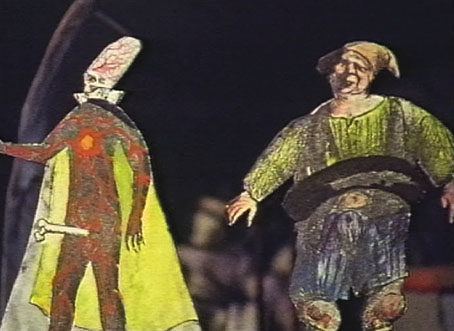
Bartók and Ligeti share some attributes: both were Hungarian, and both were forced to flee their native country. Both composers also wrote only one opera apiece. Le Grand Macabre is Ligeti’s opus, an absurdist drama based on Michel de Ghelderode‘s 1934 play, La Balade du grand macabre. In the film Ligeti explains that he didn’t want to repeat the mid-century concept of the anti-opera but was also dissatisfied with the traditional variety, hence Le Grand Macabre‘s description as an “anti-anti-opera”, a work that combines the tradition and its reaction.

topor3.jpg

Continue reading “Le Grand Macabre”

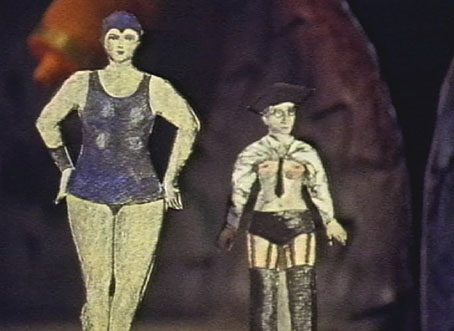
Leslie Megahey’s Bluebeard

bluebeard01.jpg

Back in the days when the BBC’s television output challenged its audience rather than pandered to it, Leslie Megahey was a name I always looked out for. During the 1970s and 80s, Megahey was one of the corporation’s outstanding producers and directors, and since his tastes often ran very close to mine seeing his name in a magazine listing was an alert for some essential viewing. Favourite Megahey documentaries would include his Omnibus film about (and interview with) György Ligeti in 1976, and the two-part Arena special about Orson Welles in 1982 that persuaded the director to talk at length for the first time about his career. Megahey’s arts films included drama documentaries about the French painters David and Gericault, and two dramas with painting themes, Cariani and the Courtesans (1987), and Schalcken the Painter (1979), the latter being an exceptional adaptation of the Sheridan Le Fanu ghost story. Duke Bluebeard’s Castle was one of the last of his BBC films, an adaptation of the Bartók opera that had this Bartók obsessive hopping with delight when it was screened in 1988.

bluebeard02.jpg

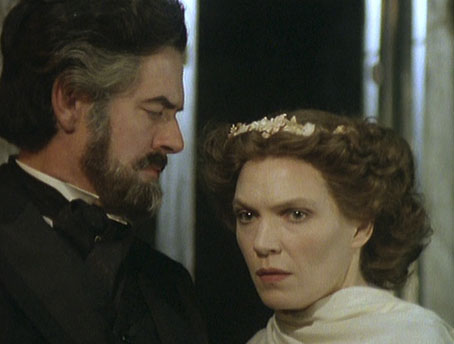
Bluebeard and Judith.

Bartók’s only opera was written in 1911, and is easier to adapt than most, being a single act of an hour or so in length with only two performers, Bluebeard (bass) and Judith (soprano). Given this it’s surprising there haven’t been more filmed versions. I wrote something a while back about the seldom-seen Michael Powell version; then there’s a version from 1981 by Miklos Szinetár scored by the London Philharmonic Orchestra with Georg Solti conducting. Megahey’s film also features the London Philharmonic with Adam Fischer conducting. Robert Lloyd and Elizabeth Laurence are the performers.

bluebeard03.jpg

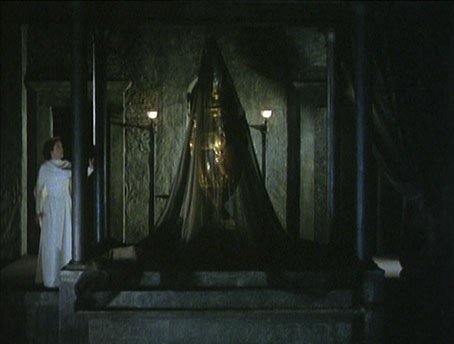
The libretto by Béla Balázs turns the old fairy tale into a psychodrama that’s also one of the first post-Freud operas, with the audience being asked in the prologue “Where is the stage? Is it outside, or inside?” Judith is ushered into the castle by Bluebeard to find seven locked doors: her curiosity and her demands to discover what lies behind the doors (or inside the mind of her husband-to-be) seals her fate. In some of the fairy tale versions the brothers of the bride arrive at the last moment to rescue their sister; not so here.

Continue reading “Leslie Megahey’s Bluebeard”

Directed by Saul Bass

bass1.jpg

Phase IV (1974).

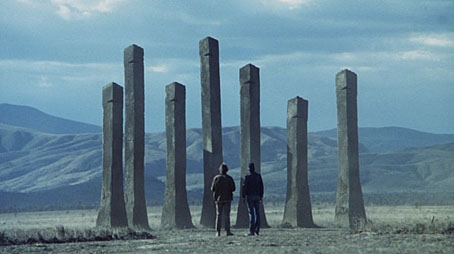
It’s been a thrill recently poring over the Saul Bass monograph, Saul Bass: A Life in Film & Design by Jennifer Bass & Pat Kirkham, a large volume that weighs a ton and is as revelatory about the career of a great designer (and his wife and frequent collaborator, Elaine Bass) as you’d hope. One pleasure was getting to read about Bass’s film work from his own viewpoint for once. The curious science-fiction film he made in 1974, Phase IV, is well-known enough to have a cult reputation but too often his long involvement with Hollywood is passed over as a footnote to the careers of the directors for whom he worked. In addition to his celebrated title sequences, Bass was also a visual consultant responsible for the planning and filming of what used to be called “special sequences” within films, the most notorious of which is the endlessly argued-over shower scene in Hitchcock’s Psycho (1960). (See this authoritative post by Pat Kirkham on Bass’s special sequences, and the disputed history of those few seconds of black-and-white film.)

bass3.jpg

Phase IV (1974).

All of which sent me to YouTube looking for some of the shorter films that Bass directed from the mid-60s on. The monograph explores these and Phase IV in some detail, for the latter showing pages of sketches for unfilmed sequences. I’m not sure these would have improved a film which I find flawed and occasionally ludicrous but it’s good to see what the director had in mind. The film on DVD has no extras at all but a trailer can be found on YouTube that shows off some of the startling imagery, and also includes a few shots that were cut by distributors foolishly eager to try and sell it as a horror film. It’s ironic that a man who gained world recognition for his poster designs wasn’t allowed to design the poster for his own film.

bass2.jpg

Quest (1984).

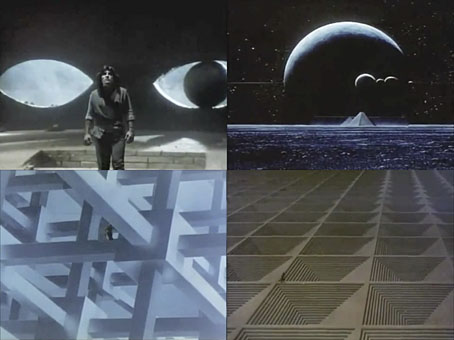
Of the short works there’s Why Man Creates (1968) here and here, an examination of the creative impulse that’s been so popular with art teachers over the years that it’s probably been seen by a lot more people than his marauding ants. Both this and The Solar Film (1980), a documentary about solar energy, utilise Bass’s hand-drawn animation. The latter is also of note for its final shot of a baby walking into a sunset, a still of which was turned by Bass into an album cover for Stomu Yamashta in 1984. Also that year, Saul and Elaine produced their strangest work, Quest, a half-hour piece of science fiction based on a Ray Bradbury short story whose quest theme is overly-familiar from a dramatic point-of-view but which typically yields a wealth of memorable visuals. In Phase IV there was a nod to Dalí with the dead man’s hand filled with burrowing ants; in Quest we find imagery borrowed from Magritte (a floating castle-topped mountain) and MC Escher (his Cubic Space Division). The copy on YouTube is rough quality but it’s certainly worth a watch. I’m amused to discover how much Saul & Elaine were prog-rock heads (not that there’s anything wrong with that…): Phase IV has Stomu Yamash’ta and David Vorhaus from White Noise on its soundtrack, The Solar Film features a dubious cover version of Tubular Bells, while the score for Quest is mostly original music (with some borrowings from Holst) that sounds much of the time like Tangerine Dream when they were leaning on their Mellotrons.

Previously on { feuilleton }
• Saul Bass album covers
• Pablo Ferro on YouTube