The world of the future

century21-01.jpg

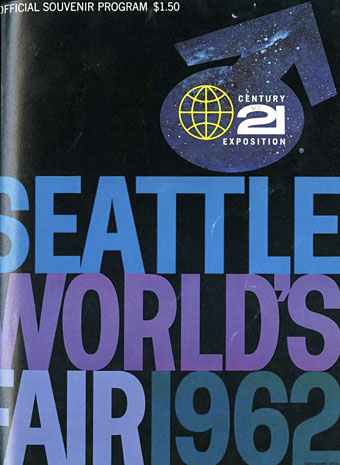
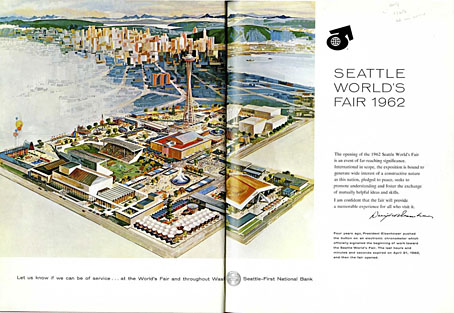
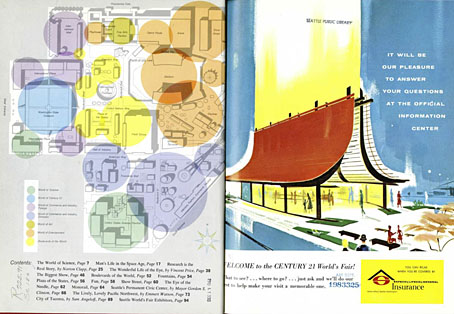
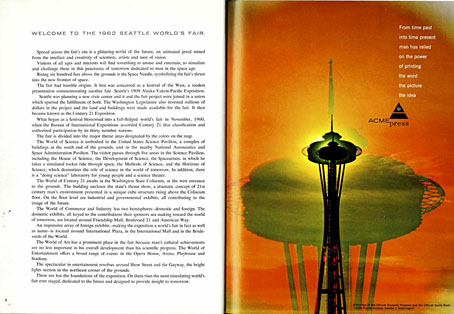
Pages from the Official Souvenir Program for the Seattle World’s Fair, 1962. Very typical corporate design by RT Matthiesen and Associates but not bad for all that. The pages give an overview of the exposition, punctuated by ads from its sponsors, while the text sets forth the purpose of the event which was intended to give a taste of life in the new Space Age. NASA’s Project Mercury missions were ongoing during the time the fair was being planned so the ethos of the event was very much tied to the obsessions of the time, obsessions fuelled by Cold War competition and a desire for an automated future. The technocratic side of things is to the fore in the booklet which trots out the usual utopian vision of life in “Century 21” as being one of short working-hours, a great deal of leisure, personal air-cars, and revolving houses. My childhood encyclopaedias were filled with this sort of thing which has only given me a lifelong suspicion of any kind of wild futurology, positive or negative. Those books were also filled with pictures of monorails, and the Seattle exposition had a monorail all of its own which I’m pleased to see is still running today.

century21-02.jpg

century21-03.jpg

century21-04.jpg

Continue reading “The world of the future”

Gigapixel ArtZoom

seattle.jpg

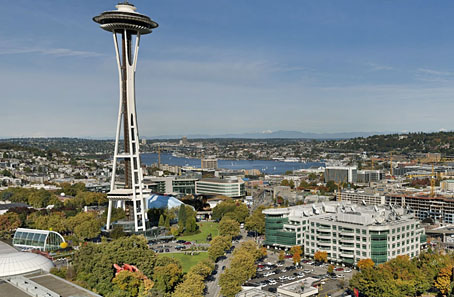
This is a few months old but I just discovered my bookmark of the page. The view is a panorama of Seattle but with a difference since this one encourages you to play hunt the artist. The streets are scattered with many of Seattle’s artists and performers, some of them easier to find than others. Michael Cohen, the director of the project explains:

We first sought out the perfect rooftop location from which to shoot such a panorama. We were lucky enough to find the Bay Vista condominium building, and thanks to the gracious owners, get access to amazing 360-degree views that include the Seattle Center, the Olympic Sculpture Park, and Seattle’s stadiums, as well Mount Rainier, Puget Sound, and Lake Union. We also discussed the project with John Boylan, who has deep roots in the Seattle art scene. He helped us attract great interest from the arts community to come out and help create this celebration of the arts in Seattle. John introduced us to Elise Ballard, who coordinated the efforts of everyone involved in producing the entire piece. And finally, videographer Kris Crews helped us assemble a team to shoot video footage of the artists and performers from the ground.

Art aside, the panorama is detailed enough to be able explore many of the otherwise hidden details of city life such as rooftop gardens and the mechanical paraphernalia that accumulate on the tops of buildings. Nice view of the Space Needle as well.

Elsewhere on { feuilleton }
• The panoramas archive

London ruins

gandy.jpg

Soane’s Bank of England as a Ruin (1830) by Joseph Gandy.

Joseph Gandy’s painting of the Bank of England does indeed show the building as a ruin but the painting was also intended to show the architectural layout of the place, hence the intact quarters in the lower left. The architect, John Soane, was a friend of Gandy’s, and owned the painting which usually hangs in the Soane Museum, one of my favourite places in London. Gandy’s painting is currently on display at Tate Britain as part of a new exhibition, Ruin Lust, which also features some other favourites of mine including John Martin’s The Destruction of Pompeii and Herculaneum (1822), and Cornelia Parker’s Cold Dark Matter: An Exploded View (1991), a work which really needs to be seen in situ. Soane’s Bank of England, incidentally, had a less Romantic ending when it was demolished in the 20th century to make way for a newer building.

dore.jpg

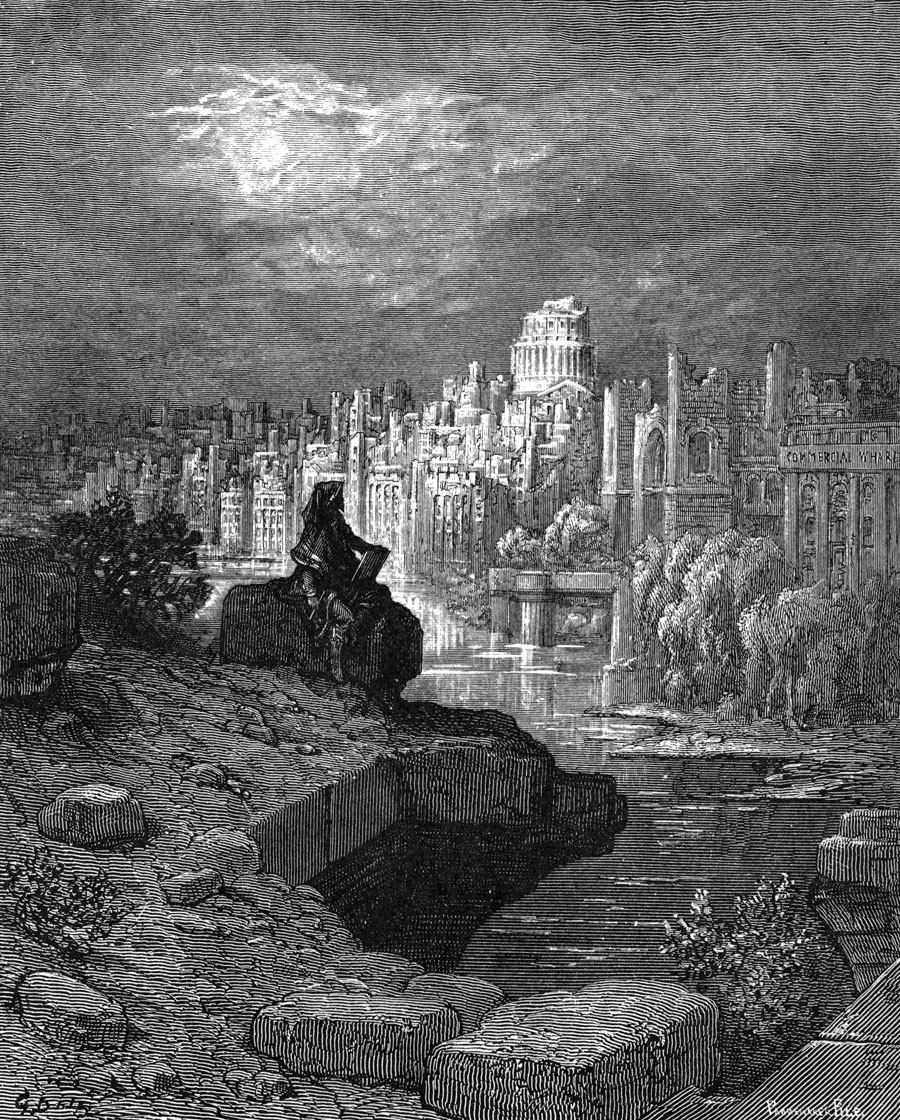
The New Zealander (1872) by Gustave Doré.

Also included in the exhibition is Gustave Doré’s surprising view of London in the distant future, the last plate in London: A Pilgrimage (1872). Visitors to Italy and Greece in the 18th and 19th century were fascinated by the idea that a city with the former splendour of Rome could have been reduced to a handful of marble ruins. This prompted the obvious thought that equally splendid cities such as London—in Doré’s time the most populous city in the world—would themselves be reduced to ruin one day. Doré’s picture illustrates a fleeting reference in Blanchard Jerrold’s text to a passage by Thomas Babington Macaulay concerning the longevity of the Roman Catholic Church. At the end of a lengthy paragraph Macaulay writes:

And she [the Church] may still exist in undiminished vigour when some traveller from New Zealand shall, in the midst of a vast solitude, take his stand on a broken arch of London Bridge to sketch the ruins of St. Paul’s.

I hadn’t traced this quote before but can see now that Doré was evidently familiar with it since he’s given his future New Zealander a sketch book. It’s typical of Doré to expand on a tiny detail in this way. There are plenty of recent views of London in ruins but this is a rare example from an earlier century. If anyone knows of any others then please leave a comment.

Previously on { feuilleton }
• Mérigot’s Ruins of Rome
• Pleasure of Ruins
• Vedute di Roma

Weekend links 201

kettelwell.jpg

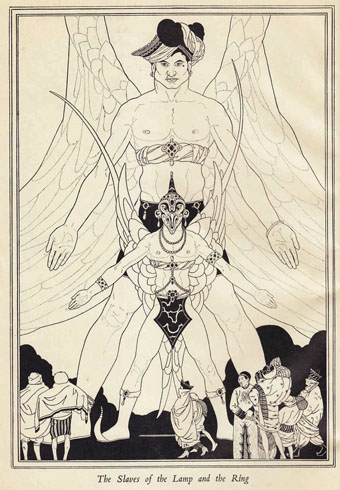
An illustration by John Kettelwell for The Story of Aladdin and the Wonderful Lamp (1928).

• “The strain in everything I write, of not being taken with the bounteousness of humankind, was also the attitude of both my parents.” Jonathan Meades talking to James Kidd about his forthcoming memoirs.

• 7 Trumps From the Tarot Cards and Pinions (1969), and album of electronic music by Ruth White, is being given a limited vinyl reissue. Related: Ruth White—An American Composer.

• 82 minutes of Michael Moorcock talking in 1972 to Jean-Pierre Turmel, co-founder of the Sordide Sentimental record label.

If Verne’s protagonists often seem to stop short of revelation, it’s because the revelation is not meant to be known. Revelation has a way of putting man back at the front of the evolution chart, moving neatly toward a happily progressing future, out of the darkness and into the light. The characters who embark upon the Voyages Extraordinares move backward and forward and all about, spun around like blindfolded children trying to pin the tail on the donkey. The point of the adventure, after all, is not to have a conclusion; it is to get knocked off your feet.

Stefany Anne Golberg on Journey to the Center of the Earth at 150.

• Photographs of pre-Haussmann Paris by Charles Marville, and photographs by Amy Heiden of industrial ruins.

• Mixes of the week: FACT Mix 427 by Wild Beasts, and Secret Thirteen Mix 108 by Kangding Ray.

• Hear Italo Calvino read selections from Invisible Cities, Mr Palomar and others.

• William S. Burroughs in Dub conducted by Dub Spencer & Trance Hill.

• Cycles, Returns & Rebirth: Alexander Tucker on Derek Jarman.

• Harold Budd: the composer with no urge to make music.

• The Museum of Imaginary Musical Instruments.

• 80 minutes of Monolake playing live in 1999.

• At 50 Watts: Dyl’s Dance.

• Owls And Flowers (2006) by Belbury Poly | Learning Owl Reappears (2011) by The Advisory Circle | The Owls (2013) by Félicia Atkinson

The Court of the Dragon

atget.jpg

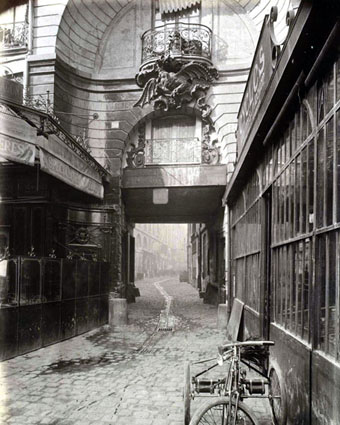
50 Rue de Rennes (1900) by Eugène Atget.

I live in the Court of the Dragon, a narrow passage that leads from the Rue de Rennes to the Rue du Dragon.

It is an “impasse”; traversable only for foot passengers. Over the entrance on the Rue de Rennes is a balcony, supported by an iron dragon. Within the court tall old houses rise on either side, and close the ends that give on the two streets. Huge gates, swung back during the day into the walls of the deep archways, close this court, after midnight, and one must enter then by ringing at certain small doors on the side. The sunken pavement collects unsavoury pools. Steep stairways pitch down to doors that open on the court. The ground floors are occupied by shops of second-hand dealers, and by iron workers. All day long the place rings with the clink of hammers and the clang of metal bars.

Unsavoury as it is below, there is cheerfulness, and comfort, and hard, honest work above.

Five flights up are the ateliers of architects and painters, and the hiding-places of middle-aged students like myself who want to live alone. When I first came here to live I was young, and not alone.

In the Court of the Dragon (1895) by Robert W. Chambers.

Drawing the King in Yellow for the Karl Edward Wagner story in Lovecraft’s Monsters (see yesterday’s post) sent me back to the Robert W. Chambers story collection where the strange and terrible regent first appears. Despite having written in the past about the covers for Chambers’ book I hadn’t read the stories for some time. Chambers’ blending of Bohemian romance, fantasy, horror, and early science fiction is just the thing to point to when people ask for a definition of weird fiction, writing that comes from a period before the straightjacket of genre definition had fastened itself about imaginative writing.

Chambers’ collection contains ten stories but only the first four are weird tales: The Repairer of Reputations, The Mask, In the Court of the Dragon, and The Yellow Sign. Of the four, In the Court of the Dragon is the weakest, although my re-reading caused some surprise when I realised that the story takes place in a location in Paris which the great photographer of the city, Eugène Atget, had memorably fixed five years after the book was published. Chambers was American but pursued a career as an artist in Paris before he took up writing; the description above can be taken as his own experience of the city.
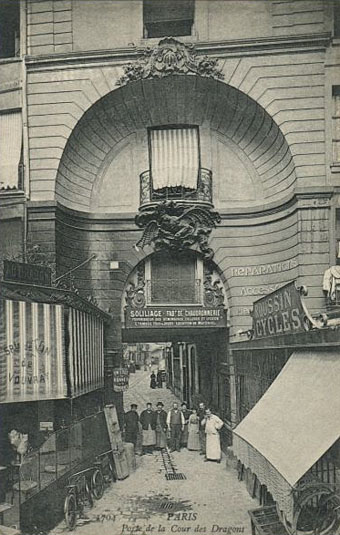
ruederennes3.jpg

Undated postcards showing wider views.
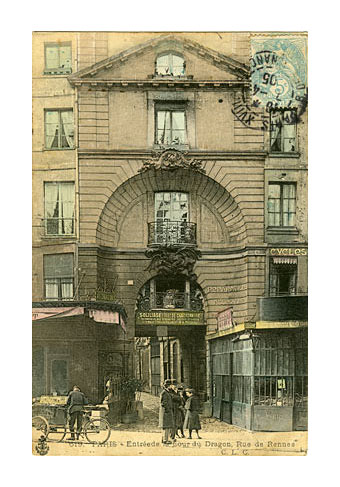
ruederennes2.jpg

Atget is a photographer whose work I’m always happy to return to, especially his views of the streets and courtyards of a Paris now cleaned and tidied, if not altogether redeveloped. His view of the dragon balcony in the Rue de Rennes features everything I like about his street scenes: an unpeopled vista, weathered cobblestones, curious architectural detail, and the hazy distance of the courtyard itself. Chambers’ story may not communicate quite the same atmosphere but the pair for me are now inextricably linked. This place couldn’t have survived, could it?
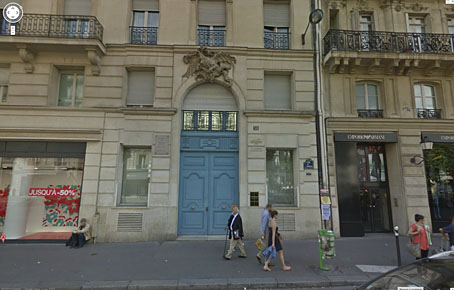
ruederennes.jpg

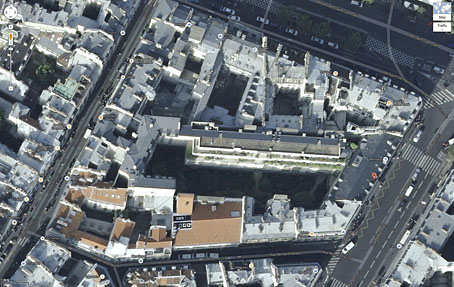
Well, yes and no. The dragon is still there on the wall at 50 Rue de Rennes but the court was apparently redeveloped in the 1950s. Behind those blue doors is a tidy little park for the use of the locals, a common feature in Paris although tourists seldom see more than a glimpse of these places when gates are opened.
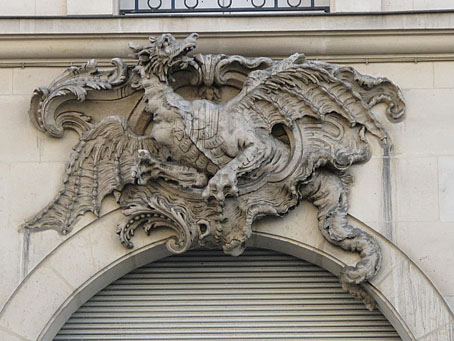
dragon.jpg

The satellite view below shows the park, the red A marking the position of the blue doors. Nothing in Paris looks like Atget’s photos any more—that’s a part of their fascination—so these kinds of changes are no surprise. But I’m pleased to discover that the dragon still exists. Next time I’m there I’ll have to pay homage.
court.jpg

ernst.jpg

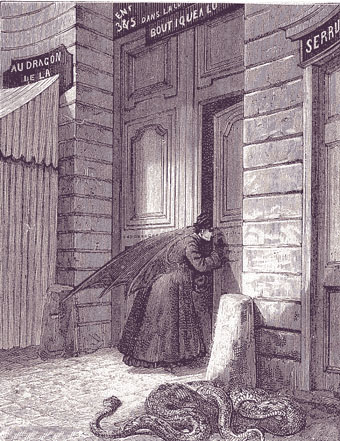
Fourth collage from the La Cour du Dragon chapter of Une Semaine de Bonté (1934) by Max Ernst.

• The King in Yellow at the Internet Archive.

Update: Added a couple more pictures.

Update 2: Thanks to Herr Doktor Bimler for reminding me of Ernst’s collage novel, Une Semaine de Bonté, whose second chapter takes its title from the court. Considering this is a favourite book I really ought to have remembered it. Two of the collages show the entrance to the court but the dragon isn’t seen, its presence having been transferred to creatures lurking at the edges of the picture, and the Doré demon wings that many of the characters are sporting.

Update 3: Laurent drew my attention to this post which includes more photos and historical detail. Thanks, Laurent!

Previously on { feuilleton }
• Atget’s corners
• Rue St. Augustin, then and now
• Brion Gysin’s walk, 1966
• The King in Yellow