
Category: {books}
Books
Banned TS Eliot portrait goes on show
Banned TS Eliot portrait goes on show
| Too phallic for 1938, apparently.
Thomas M Disch, 1940–2008
“What sort of criticism is it to say that a writer is pessimistic? One can name any number of admirable writers who indeed were pessimistic and whose writing one cherishes. It’s mindless to offer that as a criticism. Usually all it means is that I am stating a moral position that is uncongenial to the person reading the story. It means that I have a view of existence which raises serious questions that they’re not prepared to discuss; such as the fact that man is mortal, or that love dies. I think the very fact that my imagination goes a greater distance than they’re prepared to travel suggests that the limited view of life is on their part rather than on mine.”
 Thomas Disch castigating a science fiction readership which often regarded his work with a disdain born of narrow expectations. Disch (left), who took his own life a few days ago, was one of the New Worlds group of writers who frequently caused consternation among the kind of readers who only ever want to read about future technology. He was also much more than that, of course, and he wrote a lot more widely than most genre writers but it’s for his sf novels that he’ll be remembered. Rather than attempt another encomium I thought it far better to post a Charles Platt interview from 1979 which gives an insight into Disch’s character as a man as well as a writer. This was one of a number of interviews Platt conducted with leading sf writers during the late Seventies, published as Who Writes Science Fiction? in the UK (by Savoy Books) and Dream Makers: The Uncommon People who Write Science Fiction in the US.
Thomas M Disch by Charles Platt
New York, April 1979
 NEW YORK, city of contrasts! Here we are on Fourteenth Street, walking past The New School Graduate Faculty, a clean modern building. Inside it today there is a fine museum exhibit of surreal landscape photography, but the drapes are permanently closed across the windows because, out here on the stained sidewalk, just the other side of the plate-glass, it’s Filth City, peopled by the usual cast of winos, monte dealers. shopping-bag ladies festooned in rags and mumbling obscenities, addicts nodding out and falling off fire hydrants. Fourteenth Street, clientele from Puerto Rico, merchandise from Taiwan. And what merchandise! In stores as garish and impermanent as sideshows at a cheap carnival, here are plastic dinner-plates and vases, plastic toys, plastic flowers and fruit, plastic statues of Jesus, plastic furniture, plastic pants and jackets-all in Day-Glo colors, naturally. And outside the stores are dark dudes in pimp-hats and shades, peddling leather belts, pink and orange wigs, and afro-combs… itinerant vendors of kebabs cooked over flaming charcoal in aluminium handcarts… crazy old men selling giant balloons.., hustlers of every description. And further on, through the perpetual fanfare of disco music and car horns, past the Banco Populare, here is Union Square, under the shadow of the Klein Sign. Klein’s, a semi-respectable old department store, was driven out of business by the local traders and has lain empty for years. But its falling apart facade still looms over the square, confirming the bankrupt status of the area. While in the square itself—over here, brother, here, my man, I got ’em, loose joints, angel dust, hash, coke. THC, smack, acid, speed, Valium, ludes. Seconal. Elavil!
Union Square wasn’t always like this. Michael Moorcock once told me that it acquired its name by being the last major battlefield of the American Civil War. Foolishly, I believed him. In truth there are ties here with the American labor movement; many trades unions are still headquartered in the old, dignified buildings, outside of which stand old, dignified union men, in defensive lunch-hour cliques, glaring at the panhandlers and hustlers toting pint bottles of wine in paper bags and giant, 20-watt ten-band Panasonic stereo portables blaring more disco! disco! disco!
Oddly enough we are looking for an address, here, of a writer who is known in the science fiction field for his almost elitist, civilized sensibilities. He has moved into an ex-office building that has been converted from commercial to residential status. Union Square is on the edge of “Chelsea”, which is supposed to be the new Soho, a zone where, theoretically, artists and writers are moving in and fixing up old buildings until, when renovations are complete, advertising execs and gallery owners will “discover” the area and turn it into a rich, fashionable part of town.
Theoretically, but not yet. In the meantime this turn-of-the-century, 16-storey, ex-office building is one of the brave pioneer outposts. We are admitted by a uniformed guard at the street entrance, and take the elevator to the 11th floor. Here we emerge into a corridor recently fabricated from unpainted sheets of plaster-board, now defaced with graffiti, but high-class graffiti, messages from the socially-enlightened tenants criticising the owner of the building for his alleged failure to provide services (“Mr. Ellis Sucks!” “Rent Strike Now!”) and here, we have reached a steel door provisionally painted in grubby Latex White, the kind of paint that picks up every fingermark and can’t be washed easily. There’s no bell, so one has to thump the door panels, but this is the place, all right, this is where Thomas M. Disch lives.
Maldoror illustrated

Les Chants de Maldoror by Corominas (2007).
There seems to be no escaping from HP Lovecraft just now, the illustration above having been created for a PDF publication entitled CTHULHU, Cómics y relatos de ficción oscura, produced by these people. The Cthulhu-zine seems to be unavailable but you can see more of these splendid illustrations, based on Lautréamont’s Les Chants de Maldoror (1869), at Dorian Gray BD. The artist, Corominas, has an additional blog showcasing more commercial work.
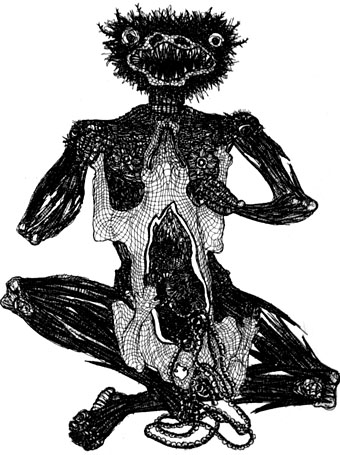
Les Chants de Maldoror by Jacques Houplain (1947).
Lautréamont’s delirious masterpiece isn’t exactly the easiest book to illustrate but the Corominas drawings certainly capture some of its ferocious energy. The Surrealists were big Maldoror enthusiasts, of course, and did much to establish Lautréamont’s current reputation. Salvador Dalí produced a series of engravings for a Skira edition in 1934 although his drawings look less like illustrations of the text than a rifling of the artist’s usual preoccupations. The picture above by Jacques Houplain is one of a series of twenty-seven engravings produced for a French edition in the 1940s. More recently, Jean Benoît created (among other things) a Maldororian dog and there’s even been an attempt at a comic-strip adaptation from Hernandez Palacios. On the whole I prefer the Corominas pictures but then I’m biased towards that style of drawing which owes something to all the comic artists and illustrators influenced by Franklin Booth.
Elsewhere on { feuilleton }
• The illustrators archive
• The etching and engraving archive
Previously on { feuilleton }
• Franklin Booth’s Flying Islands
• Carlos Schwabe’s Fleurs du Mal
• The art of Jean Benoît
New things for July
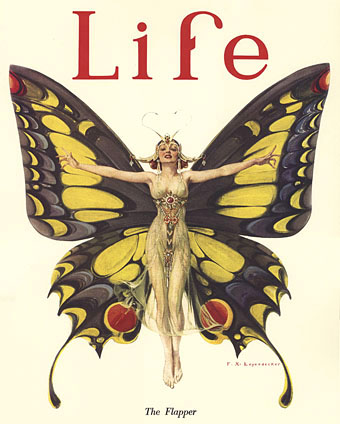
The Flapper by Frank X Leyendecker, Life magazine (1922).
• 2008 is turning out to be a great year for Lovecraft aficionados. As well as the stupendous Lovecraft Retrospective: Artists Inspired by HP Lovecraft, we’re also awaiting Frank Woodford’s feature length documentary, Lovecraft: Fear of the Unknown. I’m lucky to have my work included in Frank’s film which is easily the best documentary to date concerning the life and work of HPL. Among the interviewees are Neil Gaiman, John Carpenter, Guillermo Del Toro, Caitlin R Kiernan, Peter Straub, Ramsey Campbell and Lovecraft scholar ST Joshi. The film will receive its first (?) public screening later this month at the San Diego Comic Con:
Thursday, July 24
8:00–9:45pm
Room 26AB
• Over the weekend Arthur Magazine cleared the $20,000 it needed to keep running before the three-day deadline elapsed. A stunning piece of fund-raising which shows how much people value Jay and company’s efforts.
• The gorgeous cover above is the work of Frank X Leyendecker (1876–1924), brother of the more well-known (and gay) Joseph C Leyendecker. Makes me think I should make a post of Butterfly Women if only as an excuse to track down more pictures of Loie Fuller.
• Last but not least: happy birthday Lorraine!