Julius Klinger’s Salomé

klinger1.jpg

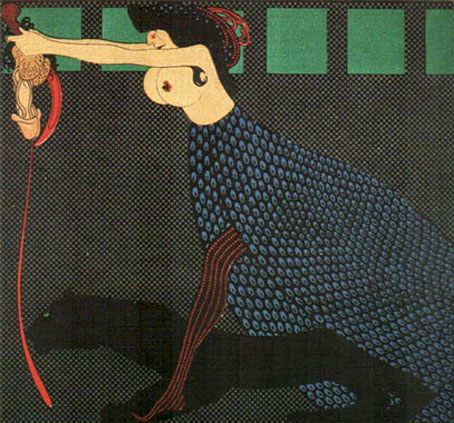
Salomé (1909).

I thought this current thread was finished yesterday but it seems not. Julius Klinger (1876–1942) was an Austrian artist and designer whose early work can be found in the first numbers of Jugend magazine. Subsequent work includes a number of erotic illustrations such as top-heavy Salomé here, a depiction which startles when you notice she’s carrying a set of severed genitals in place of the more usual human head. Given that many feminist and Freudian art critics tend to see the Salomé story as an emasculation metaphor this is perhaps appropriate.
klinger2.jpg

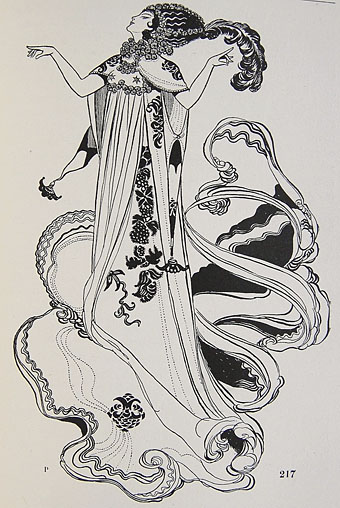
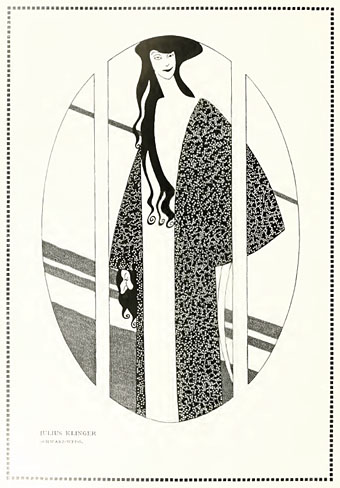
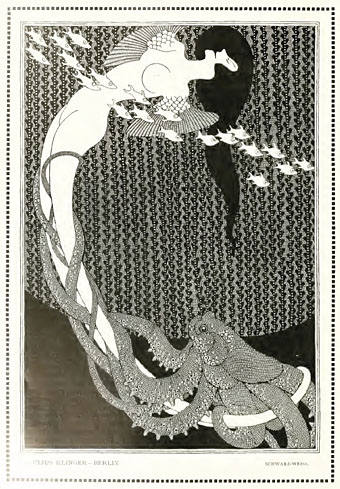
This pair of untitled pieces are from a feature on Klinger’s black-and-white work in #21 of Deutsche Kunst und Dekoration (1907), the entire edition of which can be downloaded here. The picture above may be another Salomé but is more likely that other decapitating heroine, Judith, with the head of Holofernes. The picture below, meanwhile, is entirely mysterious, and another fine addition to the artistic sub-genre of human/cephalopod encounters. Thanks to billy for pointing the way to all of these.
klinger3.jpg

Elsewhere on { feuilleton }
The illustrators archive
The Salomé archive

John Vassos’s Salomé

vassos1.jpg

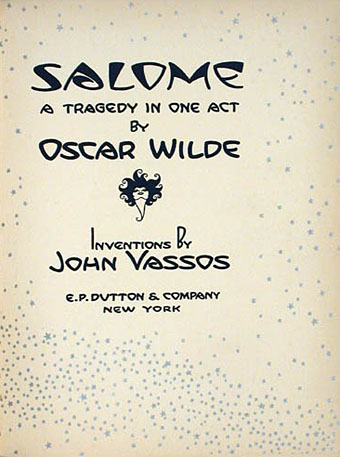
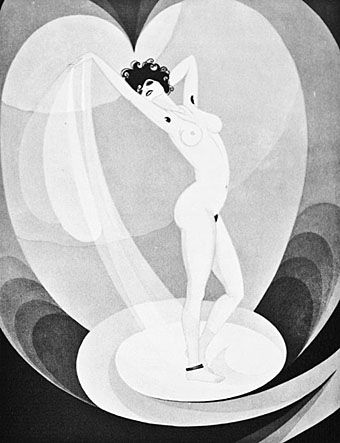
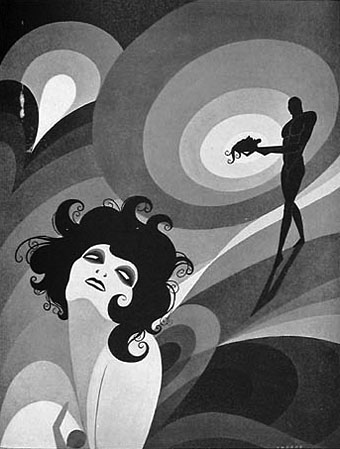
Yet another Salomé, this 1927 edition being a beautifully stylised Art Deco version by John Vassos (1898–1985), a Greek artist who moved to America in the 1920s. There aren’t many examples of these drawings online, unfortunately, I love to see a complete set of the illustrations. Salomé’s underarm hair is a detail one can’t imagine seeing in many renderings before or after this. Vassos followed Salomé with two more Wilde editions, The Ballad of Reading Gaol (1928) and The Harlot’s House and Other Poems (1929). Bud Plant’s page has more about the artist’s life and work and further examples of his monochrome art.

vassos2.jpg

vassos3.jpg

Elsewhere on { feuilleton }
The illustrators archive
The Salomé archive

René Bull’s Salomé

bull.jpg

An illustration by René Bull (1872–1942) from The Russian Ballet (1913) by AE Johnson. Bull seems to be primarily known as one of the many illustrators of that Golden Age staple, The Arabian Nights, although his interpretation is a little too comical for my taste. You can judge for yourself here.

Other Salomés turning up recently include a George Barbier picture in this BibliOdyssey post, Salomé, la Gran Diva at Bajo el Signo de Libra, and the Guardian’s review of David McVicar’s Pasolini-esque opera production.

Elsewhere on { feuilleton }
The illustrators archive
The Salomé archive

Johann Theodor de Bry’s Neiw Kunstliches Alphabet

debry.jpg

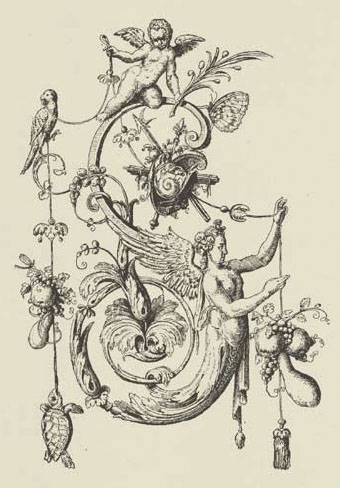
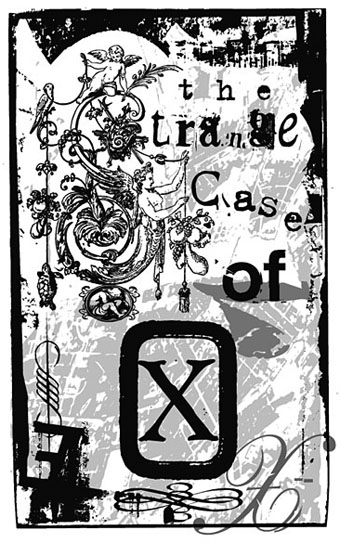
A page from Johann Theodor de Bry’s Neiw Kunstliches Alphabet (1595) which can be found in a free PDF version here, the scans being taken from a Victorian reprint. The late, lamented Giornale Nuovo featured some of these curious letter designs in 2005. Each capital is embellished with various symbolic figures—Moses appears perched on the letter M, for example—whilst also being draped with fruit, lobsters and even insects. I used a smaller redrawing of De Bry’s letter S for one of the page designs in Jeff VanderMeer’s City of Saints and Madmen in 2002. Probably not the use that De Bry intended but then I expect he’d be surprised that his work was still being used at all after four hundred years. Via BibliOdyssey.

strange.jpg

Previously on { feuilleton }
The Book of Ornamental Alphabets
Paul Franck’s calligraphy
Gramato-graphices
John Bickham’s Fables and other short poems
Letters and Lettering
Studies in Pen Art
Flourishes

Weekend links: Ghosts, Spooks and Spectres edition

spectres.jpg

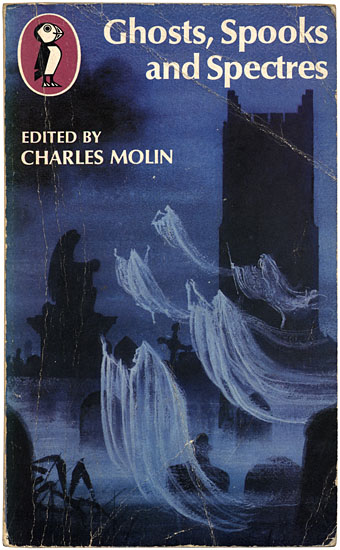
Cover design by Philip Gough.

Ghosts, Spooks and Spectres (1972 reprint). Editor Charles Molin collected nineteen ghost stories by writers including Oscar Wilde (The Canterville Ghost), Charles Dickens (The Signal-Man), J. Sheridan Le Fanu (Madame Crowl’s Ghost) and HG Wells (The Inexperienced Ghost). This was one of my favourite books when I was ten-years old. There’s nuffin like a Puffin. Puffin Books’ parent company, Penguin, is 75 this year.

• The good people at the Outer Alliance have posted an interview with me here in which I talk about the subversive sexualities of sf in the 1970s and also admit to writing fiction.

• There’s just time to mention It Came From Pebble Mill, an event which includes another screening of David Rudkin’s Penda’s Fen.

• “In our society, there has tended to be a very strong compartmentalization of different experiences, different cultural forms, different genres. We can talk in a very broad sense and say art is separate from science, for example, or body is separate from mind, or we can talk in a specific sense and say one certain form of dance music is separate from one form of, say, heavy metal. I don’t really buy those compartmentalizations. I understand why they exist, how they’ve come into being and why they’re convenient, but it’s not the way I think, it’s not the way I experience the world, it’s not the way I believe things should be.” From an interview by Colin Marshall with David Toop at 3QD. Toop’s latest book is Sinister Resonance: The Mediumship of the Listener.

The Kingdom of the Pearl by Léonard Rosenthal, illustrated by Edmund Dulac.

Ghost Stations by Dollboy, a CD package. And then there’s the Ghostly Bento.

7 Inch Cinema are Birmingham-based cultural historians.

• Mark Pilkington’s Mirage Men now has its own site.

Borges on Pleasure Island: JLB and his love of RLS.

• RIP Arne Nordheim, Norwegian composer.

• Charlie Visnic’s Modular Ghost Synth.

On the trail of Tutankhamen’s penis.

Photos by Thom Ayres.

Ghosts by Japan | Spooky Rhodes by Laika | Purple Dusk by Spectre.