A Picture to Dream Over: The Isle of the Dead

iod_basle.jpg

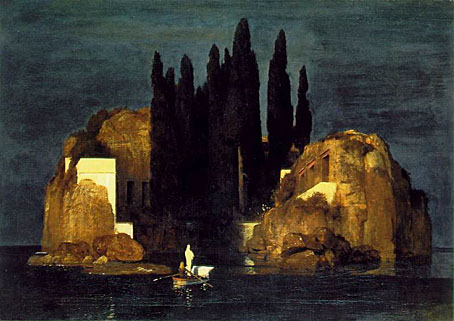
The Isle of the Dead (second version, 1880), Kunstmuseum, Basel.

In the sudden flares of light over the water, reflected off the sharp points of his cheeks and jaw, a harder profile for a moment showed itself. Conscious of Sanders’s critical eye, Father Balthus added as an afterthought, to reassure the doctor: “The light at Port Matarre is always like this, very heavy and penumbral – do you know Böcklin’s painting, ‘Island of the Dead’, where the cypresses stand guard above a cliff pierced by a hypogeum, while a storm hovers over the sea? It’s in the Kunstmuseum in my native Basel –”

The Crystal World (1966) by JG Ballard.
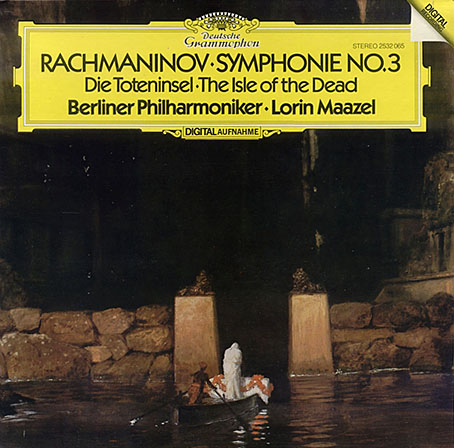
rachmaninov.jpg

A 1982 recording.

Today’s post is another guest piece over at Tor.com where I run through a history of some of the works in different media inspired by Arnold Böcklin’s The Isle of the Dead (1880–1886). The four versions of Böcklin’s painting are favourites of mine so I’ve touched on this subject a couple of times before but this is the first time I’ve gone into any detail examining their influence. Many artworks have become highly visible in the past century via copies, parodies and imitations: think of Leonardo’s Mona Lisa and The Last Supper, or Michelangelo’s David and The Creation of Adam. What’s fascinating about The Isle of the Dead is that it’s not one picture but four versions of the same scene, and they’ve all been very influential not as parodies but as direct inspirations for other artworks—musical compositions, feature films, a novel—yet few people would recognise the artist’s name. My post only scratches the surface by running through some of the more well-known works but there’s a whole website devoted to the subject for anyone wishing to investigate further.
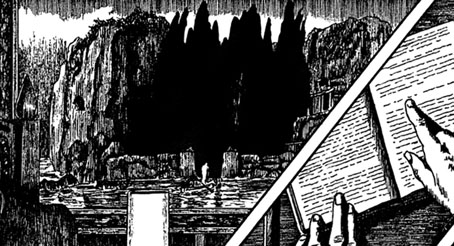
coc.jpg

The Call of Cthulhu (1988).

Modesty prevented me from mentioning my own work in the Tor post but I’ll do so here. Among the many references ladled into my adaptation of The Call of Cthulhu there’s the 1886 Leipzig version of Böcklin’s painting in the background of a panel. A prefiguring of the end of the story and also an excuse to add to the list of works acknowledging one of the great Symbolist paintings.

Previously on { feuilleton }
The Isle of the Dead in detail
Arnold Böcklin and The Isle of the Dead
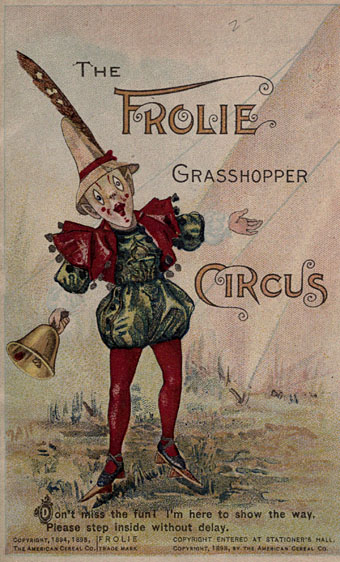
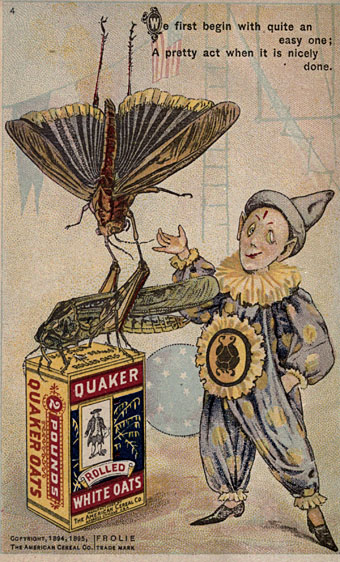
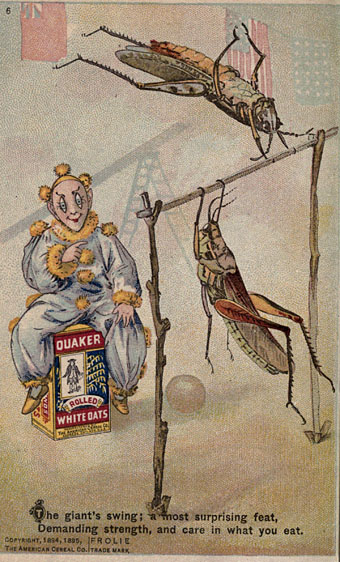
The Frolie Grasshopper Circus

frolie1.jpg

For a taste of the unalloyed strangeness of the past you have to bypass the fine art and cultivated histories and look to the ephemera. The Frolie Grasshopper Circus (1898) is an uncredited booklet for American children made to promote Quaker Oats, and it does so in a manner far removed from today’s bland and focus-grouped campaigns. The combination of grasshoppers and oats brings to mind crop-devastating swarms of locusts. And who are these slit-eyed insect-wrangling imps? The one on the cover is wearing a pair of stilt shoes like Horrabin the evil clown in Tim Powers’ The Anubis Gates while one of his confederates bears the emblem of some sinister insect cult. There’s more to this grotesque parade than meets the eye. The Internet Archive has all 16 pages if you need to know more.

Update: I’ve been informed that the illustrations were by William Cheseborough Ostrander.

frolie2.jpg

frolie3.jpg

Continue reading “The Frolie Grasshopper Circus”

Weekend links 81

wittkamp.jpg

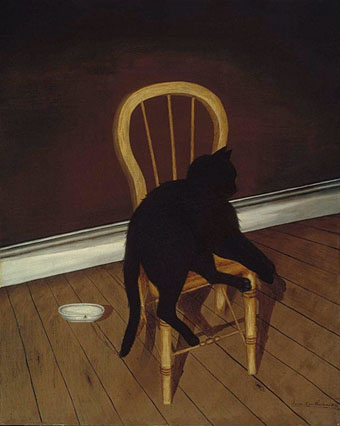
Black Cat on a Chair (1850–1860) by Andrew L Von Wittkamp.

• “A little bit of acid, lots of weed, and too much Castaneda and I was ready to move from the magical realm of Middle Earth into a world that was much stranger than any involving hairy dwarves and white wizards…” Too Much to Dream by Peter Bebergal, “a psychedelic American boyhood”.

This year’s Booker prize isn’t about the power of the new – there’s no experiment with form or strangeness of imagination. The winner may get on the bedside tables of middle England, but that’s not as important as changing the way that even one person dreams.

Jeanette Winterson throws the cat among the pigeons.

• 50 Watts continues to show us things you’d be hard-pressed to find elsewhere: illustrations by TagliaMani from a new edition of Les Chants de Maldoror, and War Is a Verb, collages by Allan Kausch.

• Don’t go in the swimming pool! Coilhouse directs us to Fantasy: music by French outfit DyE with a weird and nasty animation by Jérémie Périn.

• Ace album cover designer and photographic Surrealist Storm Thorgerson is having another exhibition at IG Gallery, London.

The Art of Leo and Diane Dillon, an art and illustration archive.

John Turturro reads a short story by Italo Calvino.

Spaceport America by Foster + Partners.

Your Body of Work by Olafur Eliasson.

Wonder-Cat cures all ailments.

Blogging Moby-Dick.

Krazy Kat (1927) by Frankie Trumbauer & His Orchestra with Bix and Lang | Pussy Cat Dues (1959) by Charles Mingus | Katzenmusik 5 (1979) by Michael Rother | Big Electric Cat (1982) by Adrian Belew | Purrfect (1996) by Funki Porcini.

Ed Wood’s Sleaze Paperbacks

wood.jpg

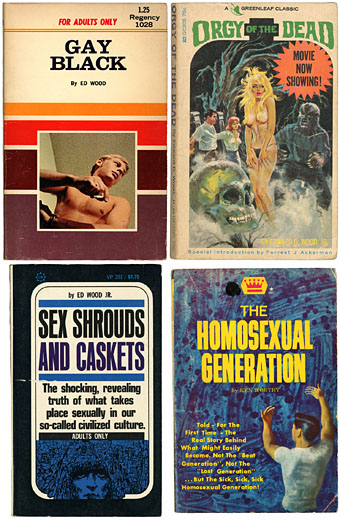
Yes, it’s that Ed Wood, Mr Plan 9 from Outer Space, who apparently supplemented his erratic film career by penning dubious porn novels and exposés of the erotic underworld. Most of what I know about him is culled from Tim Burton’s biopic so this was news to me. Ed Wood’s Sleaze Paperbacks is an exhibition at Boo-Hooray, New York, curated by Michael Daley and Johan Kugelberg:

The paperbacks are truly rare, even in an age of mass-searchable used book engines, and google ferocity. Ed Wood’s sleaze fiction is also as strange, idiosyncratic and out of step with his times and mores as his infamous movies. Wood would write porn inter-spliced with lengthy philosophical, sociological and psychological discourse, he’d write first person narratives of life as a transvestite in the buttoned up America of the 1950’s. He’d riff on psychosexual themes, and unleash his id, his ego and his superego in turn, sometimes in the same chapter. He’d write about sex and the human condition without veneer or filters, offering up the damaged and anguished voice of a desperately soul-searching drunk with a sense of self-worth that would stand in dichotomy to his self-pity.

Interesting to see Gay Black among the selected titles, a book I’d seen before in a Flickr collection of queer pulps. At the time I thought the credit must be coincidence, or some pseudonymous writer with a double-entendre name. The exhibition opens on November 2nd and runs to December 1st, 2011.

Elsewhere on { feuilleton }
The book covers archive

John Holmes, 1935–2011

holmes4.jpg

(1974).

Artist John Holmes, whose obituary was published this week, had a style that was immediately recognisable from the many paintings featured on book covers (and a few record sleeves) in the 1970s and 1980s. His painting for The Female Eunuch is by far the most well-known, of course, although I often used to wonder how many people who knew the picture could have named the artist responsible. Holmes’ art brought a touch of Magritte-like Surrealism to cover illustration (at times the debt to Magritte was quite overt), and his images are familiar to anyone in the UK who was reading science fiction or horror during the 70s. He also has the distinction of being the first artist to provide a cover for an M. John Harrison book with the painting for Harrison’s debut novel, The Committed Men, in 1971. (Or not quite… See comments.)

The McNeill Gallery has some original work for sale while the artist himself talked about some of his cover art at All Things Horror.

holmes2.jpg

(1974).

holmes3.jpg

(1981).

Elsewhere on { feuilleton }
The album covers archive
The book covers archive