Rackham silhouettes

rackham01.jpg

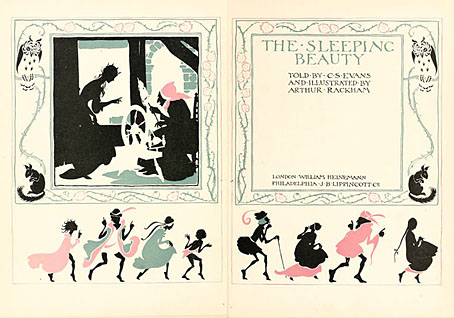
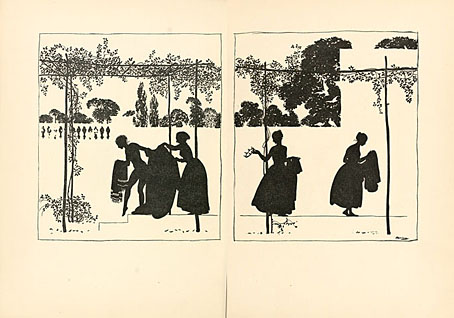
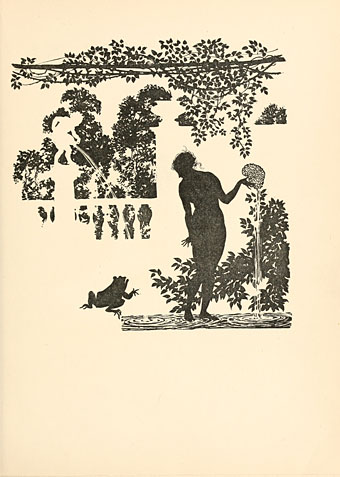
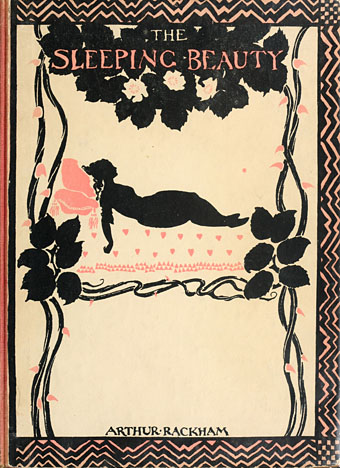
Another recent work-related discovery, this edition of the tale of Sleeping Beauty was published in 1920. The text is by CS Evans, and the book is illustrated throughout by Arthur Rackham who forgoes his usual ink-and-wash style in favour of silhouettes. Many of Rackham’s other books employ silhouettes, usually as vignettes at the ends of chapters, but this is the first book I’ve seen of his where the technique is applied to the book as a whole. The effect is stunning, with careful application of colour, and some very clever use of negative space. The combination of silhouettes with a fairy tale immediately brings to mind the animated films of Lotte Reiniger so it’s no surprise to find Rackham’s book being cited as an influence on both Reiniger and Fritz Lang. Browse the rest of the pages here or download the book here.

rackham02.jpg

rackham03.jpg

rackham04.jpg

Continue reading “Rackham silhouettes”

Weekend links 152

mackenzie.jpg

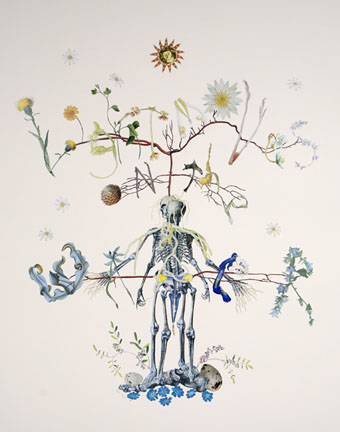
Light Moves on the Water (2010), a collage by Alexis Anne Mackenzie.

“[She] stated, emphatically and more than once, that pornography cannot and should not be linked to LGBT rights…When a gay man lives somewhere where his identity is threatened, it’s clear how sex – including pornography – and sexuality are intertwined. His sexual imagination, which is criminalized, matches the sexual images of gay pornography (which are also criminalized). Since acting out his imagination through sex would be to risk his life, the access to the images is safer. The images, created by gay men wherever it’s legal to create them, provide empowerment and diminish alienation.” An important piece by Conner Habib who asks “Why are we afraid to talk about gay porn?”

• Florida’s Parallel Universe: “The abandoned Nike Missile Site, surrounded by the Everglades, is a reminder of when humans almost destroyed the world and a warning that we could still lose everything today.” By Stefany Anne Golberg.

• In Search of Divine: A Retrospective by Katherine McLaughlin. Related: Jeffrey Schwarz, director of a new documentary, I Am Divine, talks about Divine’s career, and his film to Polari Magazine.

When Brendan Behan’s Borstal Boy was banned in 1958, it was said that a man in a pub asked him how much the book weighed, then offered to bring two thousand copies across the border instead of his usual smuggled butter. We might have called it the Black North, for being dark with Protestants, but when I was a child in the 1960s, Ulster was the place British sweets came from: Spangles, Buttons and, most notably, Opal Fruits. It was across this border that the feminists of “the condom train” staged a mass importation of illegal contraceptives in May 1971. When they arrived from Belfast into Connolly Station, the customs men “were mortified”, Mary Kenny, one of the participants, remembered, “and quickly conceded they could not arrest all of us, and let us through”.

Anne Enright on censorship in Ireland.

• Open Culture posts a copy of Nigel Finch’s 1988 Arena documentary about Robert Mapplethorpe.

The Fall of Communism Through Gay Pornography: A video by William E. Jones.

• Surrealism Made Fresh: Sanford Schwartz on the drawings of the Surrealists.

• Cult Classic: Defining Katherine Mansfield by Kirsten O’Regan.

Jonathan Barnbrook (again!) on David Bowie (again!).

Sydney Stanley illustrates Algernon Blackwood

20 Haunting Ghost Towns of the World

• At Pinterest: The Male Form

The Life Divine (1973) by Santana and McLaughlin | The Rhythm Divine (1987) by Yello feat. Shirley Bassey | Divine (2000) by Antony and the Johnsons
Terror and Magnificence

spitalfields.jpg

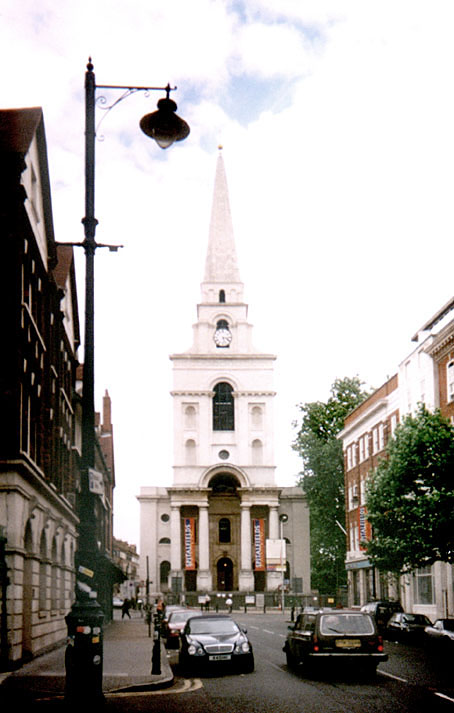
Christ Church, Spitalfields, London, in 2001. A photo I took with a disposable film camera.

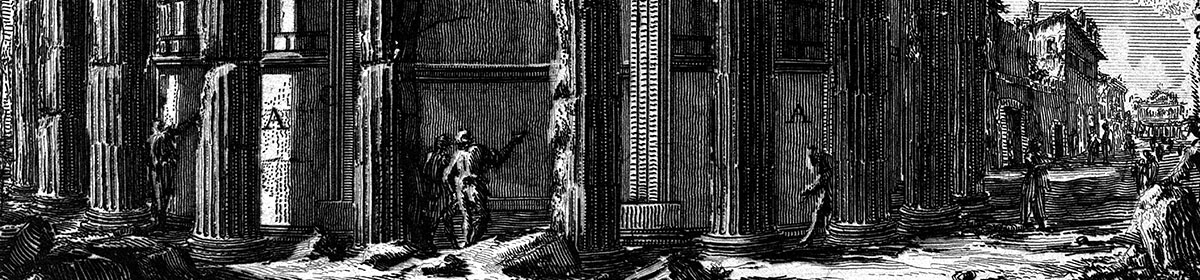
And so let us beginne; and, as the Fabrick takes its Shape in front of you, alwaies keep the Structure intirely in Mind as you inscribe it. First, you must measure out or cast the Area in as exact a Manner as can be, and then you must draw the Plot and make the Scale. I have imparted to you the Principles of Terrour and Magnificence, for these you must represent in the due placing of Parts and Ornaments as well as in the Proportion of the several Orders: you see, Walter, how I take my Pen?

Hawksmoor (1985) by Peter Ackroyd

*

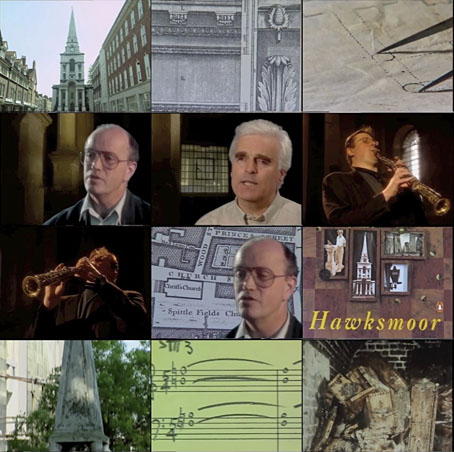
Bentley had laid down tracks for a shot that would feature the saxophonist and composer John Harle tooting away at his Terror and Magnificence in the setting of Hawksmoor’s church, which was now established, post-Ackroyd, as a cathedral of baroque speculation. Harle, in the notes published with the CD, writes that “darkness beneath the architecture and the very fabric of the stones pushed the idea towards a text.” The language here harks back to Ackroyd, towards privileged notions of place. The church was, in its proportions, a score to be unravelled; an overweening Pythagorean geometry to be tapped and sounded.

Iain Sinclair in Rodinsky’s Room (1999) by Rachel Lichtenstein & Iain Sinclair

Iain Sinclair first drew the world’s attention (or the minuscule portion of the world that was reading his books) to the strange character of Hawksmoor’s London churches in 1975 with Lud Heat, a book-length poem. Peter Ackroyd a decade later turned Sinclair’s esoteric excavation into a bestselling architectural murder mystery with his novel Hawksmoor, since when Sinclair’s psychogeography (if that term still has any valid currency) has found its way into From Hell by Alan Moore & Eddie Campbell, where Christ Church dominates the proceedings, and a musical work, Terror and Magnificence, by composer John Harle which takes its title from Ackroyd’s novel.

tandm.jpg

The short BBC film to which Sinclair refers can be seen on Harle’s YouTube channel. In addition to running through the Hawksmoor mythology we receive some glimpses of David Rodinsky’s abandoned room in the Princelet Street synagogue, a location (and a life) explored in detail in Sinclair’s book with artist Rachel Lichtenstein.

Bob Bentley’s film of Harle, Sinclair and Keith Critchlow was broadcast in 1995. In the same year Harle was commissioned by the BBC Proms to write an opera. The resulting work, Angel Magick, with libretto by David Pountney, advertises itself as “the first Dr Dee Opera”, a subject equally of interest to both Sinclair and Alan Moore, who in Sinclair’s Liquid City (1999) take a walk to John Dee’s home at Mortlake. (“We were a thrift-shop Dee and Kelley cupping our ears for whispers from tired stone.”) In that piece Sinclair mentions having been in on the early discussions for the opera but doesn’t go into any detail. I haven’t heard Angel Magick but you can hear a complete performance of Terror and Magnificence by the John Harle Band, the Balanescu Quartet, and the London Voices, here.

Previously on { feuilleton }
Mister Jarman, Mister Moore and Doctor Dee
Compass Road by Iain Sinclair

Maldoror

maldoror.jpg

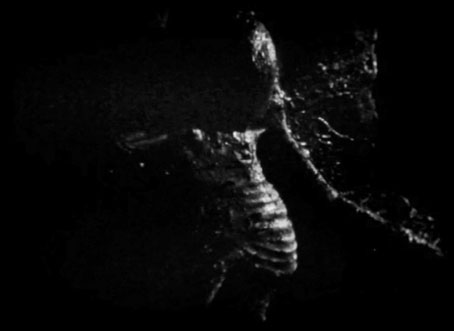
Lautréamont’s Les Chants de Maldoror continues to provoke attempts at visual illustration. B. Oliver-White’s brief Super-8 film borrows some text from the Fourth Canto which is complemented by vague and grainy shots resembling outtakes from Eraserhead. Given the difficulties of fixing Maldoror‘s shifting terrain this seems a better approach than more literal depictions. Watch it here.

Previously on { feuilleton }
Books of blood
Magritte’s Maldoror
Frans De Geetere’s illustrated Maldoror
Maldoror illustrated

Weekend links 151

yongliang.jpg

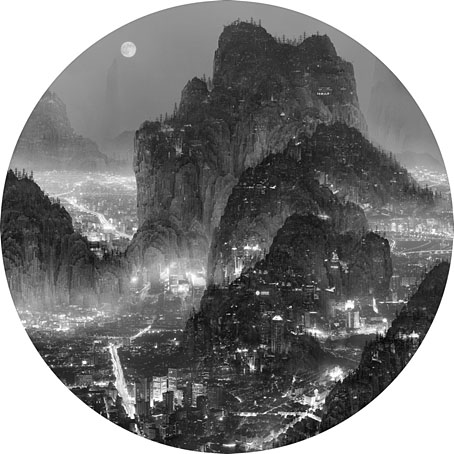
Untitled art by Yang Yongliang. There’s more at But Does It Float.

• “Newly unearthed ITV play could be first ever gay television drama“. Writer Gerald Savory, incidentally, also adapted Dracula for the BBC in 1977, still the version that’s closest to the novel.

Craig Redman and Karl Maier‘s poster designs for the Bavarian State Opera.

Lustmord: ambient’s dark star, and The Strange World of Scanner.

The cats are tapping the old man for psychic sap, milking him, stalking through rubbled dreams of the coming Land of the Dead. On subsequent US visits – to Bastrop in Texas and Phoenix, Arizona – I learned about the fellowship of those internal exiles, the hardcore writers: Michael Moorcock, Jim Sallis. Like Burroughs, they kept cats and guns (Mike’s was a replica). Cats infiltrate mystery fiction: men with coffee habits, ex-drinkers, post-traumatic spooks solving crimes the hard way. Moorcock uses cats like a scarf, like Peter Sellers in The Wrong Box; their claws scratch runes into his easy chair.

Iain Sinclair remembers visiting William Burroughs. I remember meeting those Moorcock moggies; not as interesting to reminisce about, however.

The Ghosts of Antarctica: Abandoned Stations and Huts.

• A Masterpiece of the Ridiculous by Jocelyn Brooke.

• “Chance is a good librarian,” says Alberto Manguel.

• Mix of the week: dub from Bristol duo Zhou.

The Aleph: Infinite Wonder / Infinite Pity.

Sarah Lee‘s underwater photography.

Arthur #34 is out!

Underwater (1979) by Harry Thumann | Underwater Church (1992) by Conrad Schnitzler | Underwater Flowers (2003) by John Foxx & Harold Budd