The Cardinal and the Corpse

cardinalcorpse.jpg

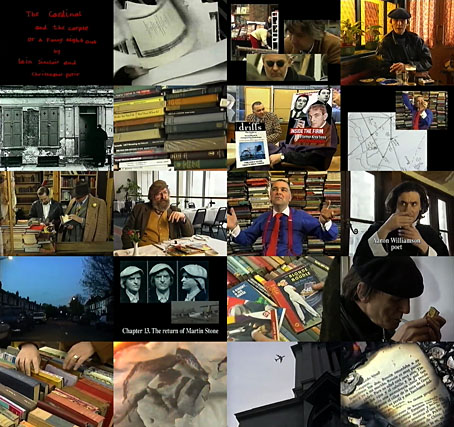
Appearing at last on YouTube (although I think it may have been there once before) is the curious TV film that Iain Sinclair (writer & “freak wrangler”) and Chris Petit (director) made for Channel 4’s Without Walls series in 1992. This is a must for enthusiasts of Sinclair’s early novels since it features the real-life models for several of his characters—guitarist/bookdealer Martin Stone, artist/author Brian Catling, crazed bookdealer Driffield—plus Sinclair’s friends Michael Moorcock and Alan Moore. The latter is seen searching for a copy of Francis Barrett’s grimoire, The Magus (1801), a year before he attached the magus label to himself; I still don’t know whether this quest was Alan’s suggestion or Sinclair’s.

Elsewhere there are fleeting portraits of crime writer Robin Cook (aka Derek Raymond), and Kray gang member Tony Lambrianou. Other notable appearances include poet Aaron Williamson, artist John Latham and David Seabrook, a writer whose Jack of Jumps book I designed a cover for in 2006. The narrative, such as it is, is a series of quests and meetings, threaded together with anecdotes about the various personalities who are the real subject of the film. It’s all very hermetic, and what sense it makes to the uninitiated I can’t say, but it holds the attention for 40 minutes. These obscurities have a way of vanishing, so if you’re interested watch it now or download it for later.

Previously on { feuilleton }
• Terror and Magnificence
• Mister Jarman, Mister Moore and Doctor Dee
• Compass Road by Iain Sinclair
The Ingenious by Darius Hinks

hinks.jpg

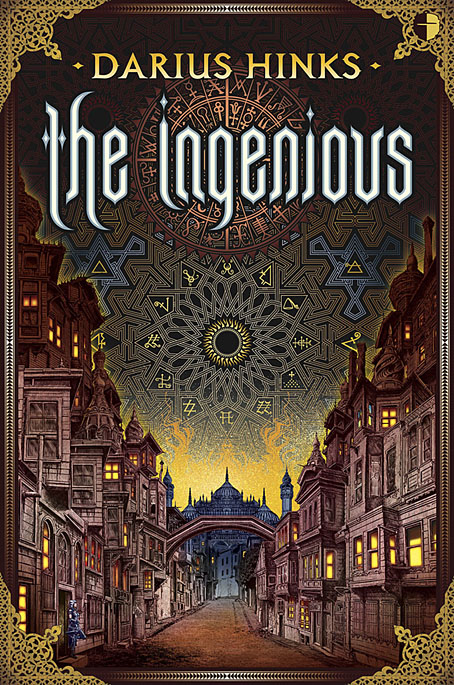
My latest cover for Angry Robot Books was revealed this week at the Barnes & Noble blog (where I talk a little about the design aspects) so here it is. The Ingenious is an alchemy-themed fantasy by Darius Hinks, the brief for which required a depiction of the city of Athanor, the central character, Isten, and some indication of the novel’s occult flavour:

Thousands of years ago, the city of Athanor was set adrift in time and space by alchemists called the “Curious Men.” Ever since, it has accumulated cultures, citizens and species into a vast, unmappable metropolis.

Isten and her gang of half-starved political exiles live off petty crime and gangland warfare in Athanor’s seediest alleys. Though they dream of returning home to lead a glorious revolution, Isten’s downward spiral drags them into a mire of addiction and violence. Isten must find a way to save the exiles and herself if they are ever to build a better, fairer world for the people of their distant homeland.

I was also asked to do something in the detailed drawing style of artists such as Philippe Druillet and Ian Miller, a challenge I was happy to accept with the proviso that both those artists are inimitable. As I say in the B&N post, I went in a Miller direction although I don’t know whether anyone would spot the influence. I was more overt years ago in some of my borrowings from Druillet whose aesthetics can be discerned in my poor artwork for Hawkwind and my much better artwork for The Call of Cthulhu. The background pattern was the kind of thing I often do where I spend hours working on something then cover it over, but more of the interlacing and symbolism (all genuine alchemical symbols) will be visible on the back of the book.

The Ingenious will be published on 9th February, 2019.

Previously on { feuilleton }
• De Sphaera
• Delineations
• Musaeum Hermeticum
• A triangular book about alchemy
• Alembic and Ligier Richier
• Atalanta Fugiens
• Splendor Solis revisited
• Laurie Lipton’s Splendor Solis
• The Arms of the Art
• Splendor Solis
• Amphitheatrum Sapientiae Aeternae
• Cabala, Speculum Artis Et Naturae In Alchymia
• Digital alchemy

Weekend links 433

ginzburg.jpg

Cover art for Six Correlations, a solo album by Emptyset’s James Ginzburg which is released later this month. Photo by Clayton Welham.

• “Every single leather S&M club in London was raided by the police at least once, but they couldn’t get any convictions because juries wouldn’t convict us.” Ed Siddons on the death of London’s gay leather scene.

• I’ve been listening to a lot of Stereolab this week so this post from Dangerous Minds last year was useful: “The intriguing origins of ‘Cliff,’ the cartoon character that’s all over Stereolab’s early album art”.

• Available for pre-order: Performance – The Making of a Classic, a book by Jay Glennie celebrating the 50th anniversary of Donald Cammell & Nicolas Roeg’s cult feature film.

• Out later this month from Strange Attractor: The Haunted Writings of Lionel Johnson, the Decadent Era’s Dark Angel, edited by Nina Antonia.

• Mixes of the week: Rosemary Hill – an Autumn Autobiography by cafekaput, and Secret Thirteen Mix 267 by Drew McDowall.

• The top 100 albums of The Quietus’ existence, as picked by tQ’s writers.

• RC Harvey on the 50th anniversary of (American) underground comix.

• At Haute Macabre: An enigmatic baroness and her collection of skulls.

• Miyu Kojima creates miniature replicas of lonely deaths.

• Scratches in Kubrick’s 2001: A Space Odyssey.

• Richard Thompson’s favourite albums.

• Wrong Airport Ghost by Sam Slater.

• Mark Valentine’s 3 Wyrd Things.

• 4/4 In Leather (1981) by Eurythmics | The Girl With The Patent Leather Face (1981) by Soft Cell | Leather Bound (1982) by Patrick Cowley

Weekend links 432

urbanowicz.jpg

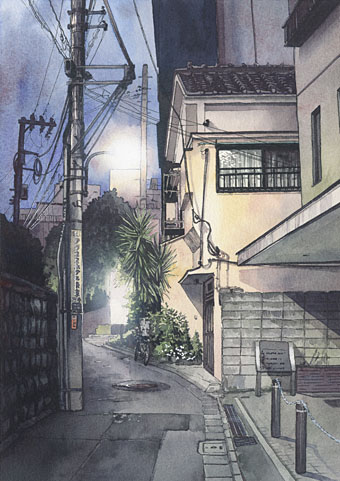
Tokyo at night, one of a series of watercolours depicting the back streets of the city by Mateusz Urbanowicz.

• “The experience of reading the book is something like watching Dr. Strangelove on one screen, Apocalypse Now on a second screen, and having both feeds interrupted by explicit gay erotica.” Bad Books For Bad People examines William Burroughs’ celebrated YA novel, The Wild Boys. The subject is a perennial one here, explored at length in this post.

• Lindsay Anderson’s The White Bus (1967), a surreal precursor to If…. and O Lucky Man!, will receive the high-quality BFI reissue treatment as part of the Woodfall Films portmanteau feature, Red, White and Zero.

• The Radiophonic Workshop have composed the score for Possum, a horror film by Matthew Holness. The main title theme is here. The film is released later next month.

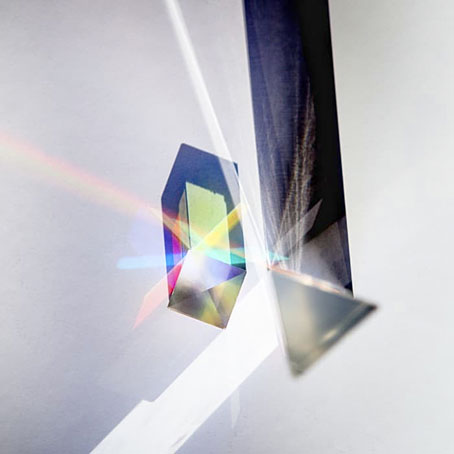
Might I have written a sober affair, had I not been under the influence? Perhaps not—I have never needed tramadol to be attended by angels, or to feel demons pricking my feet. But I think of Vincent van Gogh, who looked at the world through the yellowish haze conveyed by digitalis, and grew enraptured by sunflowers and straw chairs, and I think of a glass prism through which a beam of white light passes and is split into a rainbow. What had been a single lucid idea had passed through the drugs I took and been dispersed into a spectrum of colours I had only half foreseen.

Sarah Perry on trying to write while besieged by bodily pain and prescription drugs

• Jacques Tourneur’s masterful MR James adaptation, Night of the Demon (1957), is released on region-free Blu-ray next month by Powerhouse Films.

• Mixes of the week: FACT mix 673 is The Bug presents PRESSURE, and XLR8R Podcast 561 by Zendid.

• The Space Shifters exhibition at the Hayward Gallery, London, messes with Adrian Searle‘s mind.

• Gregory Wells on queers, faeries and revolutionaries in the psychedelic movement.

• Wide Boys (1977) by Ultravox! | On Demon Wings (2000) by Bohren & Der Club Of Gore | Spoonful (2013) by Robert Plant and the Sensational Space Shifters

Illustrating Lovecraft again

dunwich.jpg

The Dunwich Horror (1972). Art by Victor Valla.

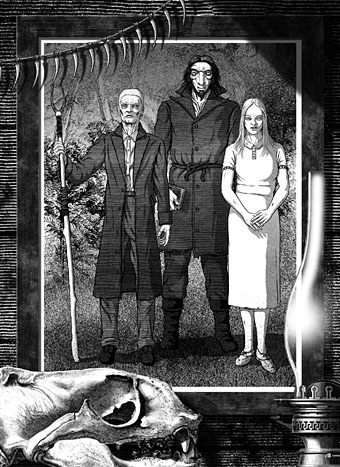
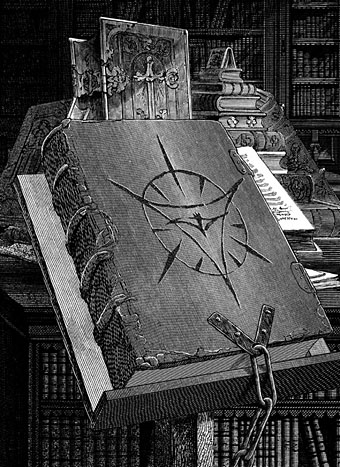
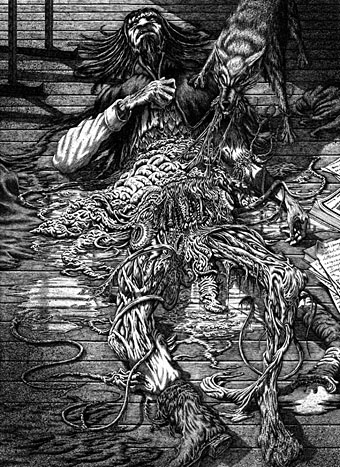
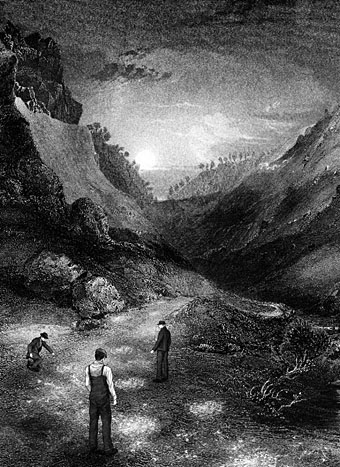
El horror de Dunwich y otros relatos is the last of the books I was working on earlier this year for Spanish publisher Editorial Alma. This was a more stimulating Lovecraft collection to work on than the previous two-story volume since three of the stories were ones I hadn’t dealt with before. The fourth story, The Dunwich Horror, I partly illustrated back in 1988/89, and I took the liberty of reusing the best of that set of pages showing Wilbur Whateley’s messy demise. This picture has been reprinted a few times elsewhere so I was reluctant to recycle it again, but the collision of deadlines earlier this year meant that once again I was pressed for time on this book, and having an illustration already done was a great help. It’s taken me 30 years to finally get round to depicting Wilbur’s monstrous brother.

hpl11.jpg

The Dunwich Horror 1.

hpl12.jpg

The Dunwich Horror 2.

hpl13.jpg

The Dunwich Horror 3.

hpl14.jpg

The Dunwich Horror 4.

Continue reading “Illustrating Lovecraft again”