The Rock Drill

epstein.jpg

The Rock Drill (original version, 1913–1914).

Jacob Epstein’s Rock Drill (1913-15) was reconstructed in polyester resin by Ken Cook and Ann Christopher in 1973–74. It is the exemplary Vorticist art work. It shows a man on a tripod who is one with his machine. His drill is also his rigid proboscis, his hard, angled phallus. The tripod has weights (embossed Colman Bros Ltd Camborne England) on each leg, just above midpoint—which look like enlarged joints, or a bee’s pollen knee-pads (only available in black).

The rib cage of the figure is exactly like the twin cylinders on a motorbike. He is recognisably human, true, but the human body, with its curves and trim little bum, has been made-over to the angular machine: it is an armoured exoskeleton. The arms are like greaves. I thought of Seamus Heaney’s description of a motorbike lying in flowers and grass like an unseated knight. And I thought too of “Not My Best Side”, UA Fanthorpe’s marvellous poem about Uccello’s St George and the Dragon in the National Gallery. In it, Fanthorpe imagines the young girl being rather taken by the dragon’s equipment, when suddenly, irritatingly, “this boy [St George] turned up, wearing machinery”.

Thus Craig Raine on Jacob Epstein’s unforgettable sculpture. It’s astonishing to think that this piece in its various forms (lost, reworked, reconstructed) is now nearly a century old. Raine was writing about the forthcoming The Vorticists: Manifesto for the Modern World, an exhibition which will be opening at Tate Britain next month. Epstein’s truncated Torso in Metal from The Rock Drill (the full-figure version was destroyed) was one of the handful of sculptures which stood out for me when I first visited the Tate Gallery (as Tate Britain used to be) and it’s since become a piece I always enjoy seeing again. Epstein’s art was frequently controversial, his Oscar Wilde Memorial of 1911 was famously declared indecent, and The Rock Drill would have seem shockingly angular and aggressive to a British art world where aged academicians were still painting medieval fantasies or trying to sculpt like Praxiteles. To us today it looks unavoidably cybernetic even though the word “robot” didn’t arrive until 1920. Flickr has some views here of the reconstructed version which I’d hope is going to be on show at the Tate. In the meantime, there’s Anthony Gormley discussing the work on BBC Radio 3 (via iPlayer) which he regards as the first Modernist British sculpture, and a favourite work of art.

Previously on { feuilleton }
Wildeana #2
Against Nature: The hybrid forms of modern sculpture
Angels 2: The angels of Paris
Deutsche Kunst und Dekoration #25

dkd25-01.jpg

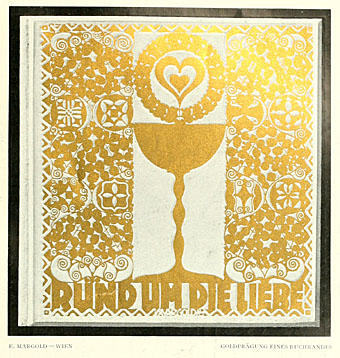
A design by Emanuel Margold.

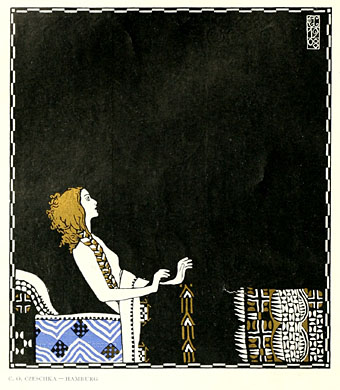
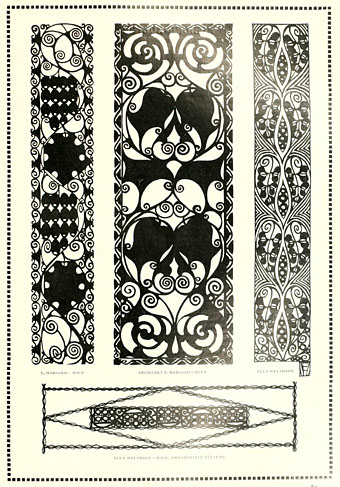
This post concludes the delve into back numbers of Deutsche Kunst und Dekoration, the German periodical of art and decoration. Volume 25 covers the period from October 1909 to March 1909, and while the Internet Archive has further editions available they make a big jump after this number to 1923. The later editions are still interesting, of course, but in presentation and content they’re very different to what went before. Despite the text of these magazines being entirely German it’s been an education going through them not only for the detailed attention given to artists often passed over in books, but also for the articles reporting notable events in European art history as they happened. We have the Robarts Library of the University of Toronto to thank for having made these publications available.

dkd25-02.jpg

An illustration from a series by Carl Otto Czeschka for Die Nibelungen by Franz Keim.

dkd25-03.jpg

Continue reading “Deutsche Kunst und Dekoration #25”

Passage 15

passage15.jpg

Directing your attention elsewhere again today, to the latest edition of Passage the Dutch webzine run by my good friend Ed Jansen. Number 15 is described thus:

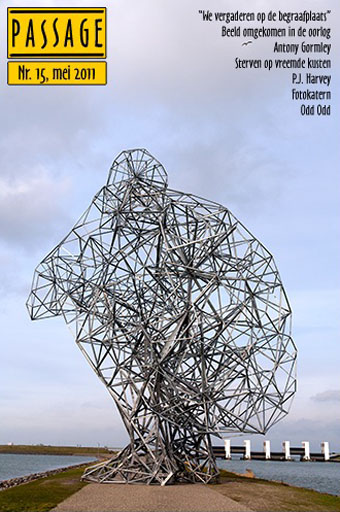
Passage 15 is, with a few exceptions, entirely devoted to art. Images govern our lives, literally and figuratively. Gaudier-Brzeska nearly a hundred years ago and Antony Gormley today affect our way of looking. Odd Nerdrum does so with his painting on a very different way. The music of Polly Jean Harvey made us curious about her sources of inspiration. The piece about Gallipoli is actually a kind of enormous footnote to her latest cd “Let England Shake”. The photo section provides an overview of exhibitions and performances in the past few months in and around The Hague, Netherlands.

Seeing Gaudier-Brzeska’s sculptures reminds me that I haven’t seen Ken Russell’s film of the artist’s life, Savage Messiah, for many years. The large Antony Gormley work on the cover (Exposure) makes a welcome change from the artist’s cast-iron clones. I’m still waiting for Gormley to create the Ejaculating Man, a seawater-spurting statue he proposed for Seattle. It was rejected, of course, and it’s difficult to imagine any American city exhibiting something of that nature given the current climate. Maybe he should try Amsterdam.

futuro.jpg

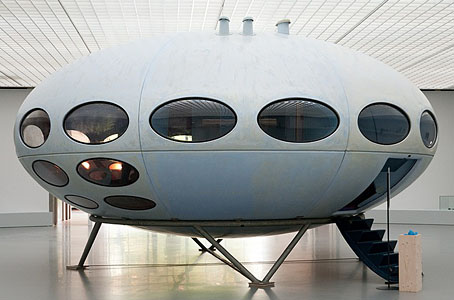
Back at Ed’s work, his varied Flickr stream includes some recent views of Futuro, a mobile holiday home designed by Matti Suuronen in 1968. What was once futuristic now has a Jetsons-like retro glamour.

Previously on { feuilleton }
Passage 14
Passage 13
Passage 12
Passage 11
Passage 10

Phallic casts

josephtailor.jpg

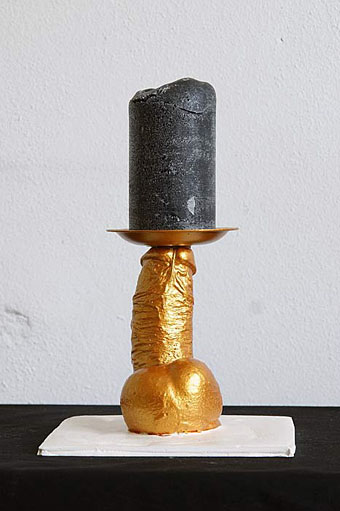
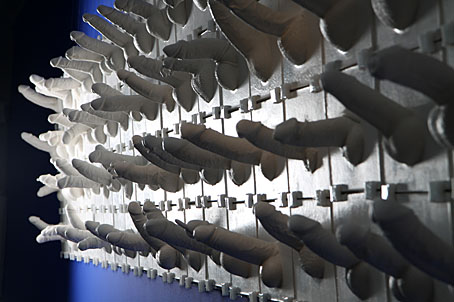
After the phallic parades of a couple of weeks ago, here’s something a bit more contemporary. Artist Jos Karis works under the name Josephtailor creating a variety of sculptural pieces in different media. Among the examples on his website there’s what appears to be a papier-mâché torso covered with a collage of gay porn pictures, and also a series of penises cast from plaster. The phallic works immediately bring to mind the penis memorials of Cynthia Plaster Caster, famous (notorious, even) for preserving in plaster form the erect members of notable musicians. Josephtailor’s casts seem to be anonymous (his site is short on detail) but he makes more of the end result. Cynthia has also made casts of women but not enough to create a Great Wall of Vagina like British caster Jamie McCartney. One of the contributors to McCartney’s wall was Ms Hayley Campbell who discussed the experience here. (Thanks to Paul for the Josephtailor tip!)

josephtailor2.jpg

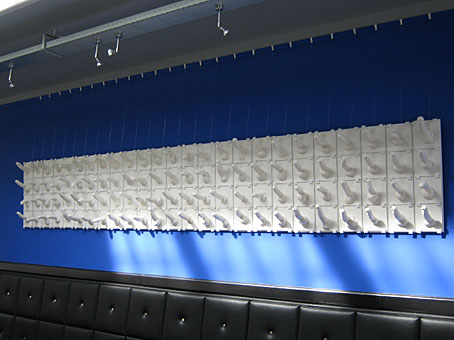
Update: Josephtailor sent some pictures of 100, his phallic wall piece.

josephtailor3.jpg

Elsewhere on { feuilleton }
The gay artists archive

Previously on { feuilleton }
Return of the Triumphant Phallus
The Choise of Valentines, Or the Merie Ballad of Nash His Dildo
The fascinating phallus
The Triumph of the Phallus
Le Phallus phénoménal
Phallic bibelots
The New Love Poetry
Phallic worship
The art of ejaculation

The mirror of Narcissus

nocq1.jpg

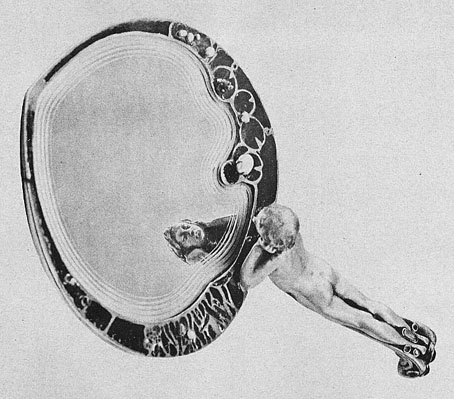
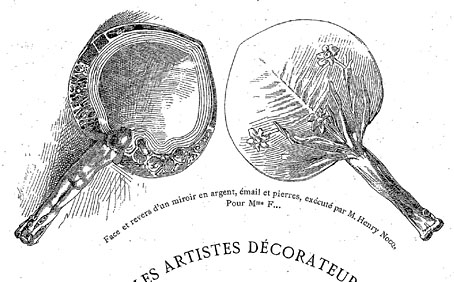
Browsing another fin de siècle magazine—Revue des Arts Décoratifs for 1897—turned up this design for a hand-mirror by Henri Nocq (or Henry as they also name him). Illustrational design was a common feature of the Art Nouveau period, and Nocq’s Narcissus-themed mirror is an ingenious confection complete with etched pond ripples, pearl-flowered lily pads, and even (though you can barely see it here) a carnelian frog. The body of the mirror was silver with narcissus flowers moulded into the obverse side. I’m surprised I haven’t come across this object before which makes me think it may not have survived. (Unless you know better…) As for Henri Nocq, there’s far more attention devoted to the portrait of him by Toulouse-Lautrec (also 1897) than there is to the designer.

nocq2.jpg

pye.jpg

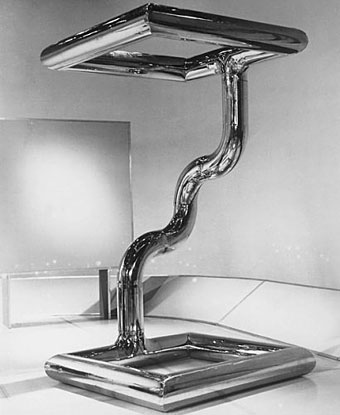
For a more contemporary sculptural take on the theme, there’s Narcissus, an early work from 1969 by British artist William Pye. See his website for other work including some gorgeous water sculptures.

Previously on { feuilleton }
Le Baiser de Narcisse
Reflections of Narcissus
Narcissus