Weekend links 63

solaris.jpg

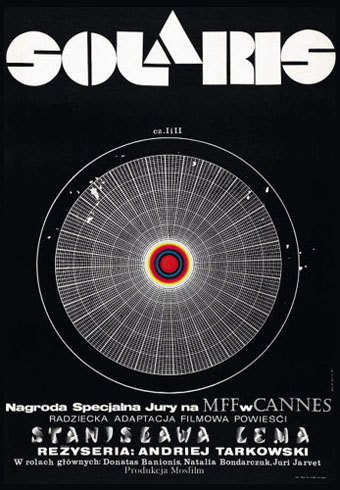
Polish poster by Andrzej Bertrandt for Andrei Tarkovsky’s 1972 film of Solaris.

• Stanisław Lem’s Solaris receives its first ever direct English translation by Bill Johnston (only on Audible for the moment), all previous editions having been sourced from a poor French translation. An all-too-common state of affairs for non-English fiction where bad or bowdlerised translations persist for years.

• Now that Minnesota politician Michelle Bachmann is running for US president it’s a good time to examine her views when (theoretically) her actions could one day impact on us all. The Daily Beast gathered together some of her worst pronouncements, including the following about gay people: “It’s a very sad life. It’s part of Satan, I think, to say that this is gay.” Her husband describes his attempts to counsel (ie: cure) gay teenagers with the words “Barbarians need to be educated.” It’s no surprise that both these people find confirmation of their views in the usual narrow interpretation of Christian doctrine. Not all American Christians are this ignorant or offensive, of course. The Heartland Proclamation calls for “an end to all religious and civil discrimination against any person based on sexual orientation and gender identity and expression”.

Journalist Andrew Sullivan in 2003 proposed a label for people like Bachmann: “I have a new term for those on the fringes of the religious right who have used the Gospels to perpetuate their own aspirations for power, control and oppression: Christianists. They are as anathema to true Christians as the Islamists are to true Islam.” It’s a term that ought to have more widespread use.
solaris-czech.jpg

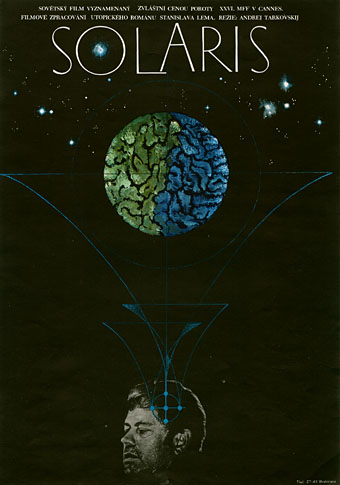
Czech poster for Solaris. No designer credited.

• Probing the secrets of psilocybin: “Scientists at the Johns Hopkins University School of Medicine have zeroed in on the dose levels of the ‘sacred mushroom’ chemical capable of yielding positive, life-changing experiences, while minimizing the chance of transient negative reactions in screened volunteers under supportive, carefully monitored conditions.”

• Rick Poynor relates a visit to the Frederic Marès Museum, Barcelona, home to the 50,000 objects Marès collected over his lifetime. Further details of the collection can be found at the museum website.

In her 1969 essay “The Pornographic Imagination,” [Susan] Sontag insisted that Story of O could be correctly defined as “authentic” literature. She compared the ratio of first-rate pornography to trashy books within the genre to “another somewhat shady subgenre with a few first-rate books to its credit, science fiction.” She also maintained that like science fiction, pornography was aimed at “disorientation, at psychic dislocation.”

If so, that aim is far more interesting than what most generic “mainstream” novels set out to do. No one could describe O as predictable or sentimental. Its vision was dark and unrelenting; everything about it was extreme. Sontag also compared sexual obsession (as expressed by Réage) with religious obsession: two sides of the same coin.

Carmela Ciuraru on the story of The Story of O by Pauline Réage.

• “No hay banda! There is no band. It is all an illusion.” David Lynch will be opening a Club Silencio in Paris (Montmartre, of course). Facebook pages here and here.

• Sad to say that Chateau Thombeau is now closed but Thom has begun a more personal journal here.

• Picture galleries of the Vorticists at the Tate here and here. Related: Into the Vortex.

• Illuminated Persian pages from 1604 at BibliOdyssey.

• Tape drawings by Chris Hosmer.

• Miles Davis and co. at the Isle of Wight Festival, 1970: part 1 | part 2 | part 3 | part 4
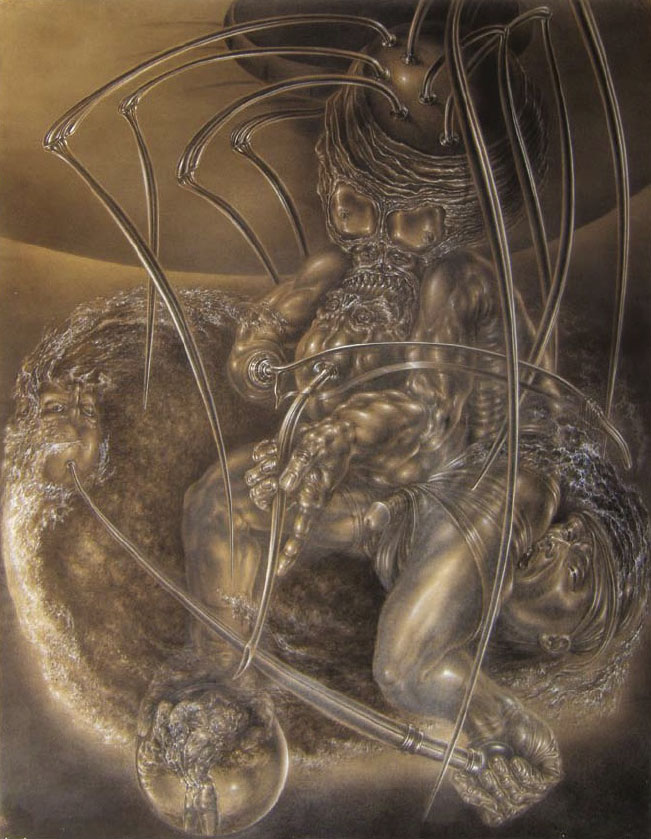
Sibylle Ruppert revisited

ruppert1-1.jpg

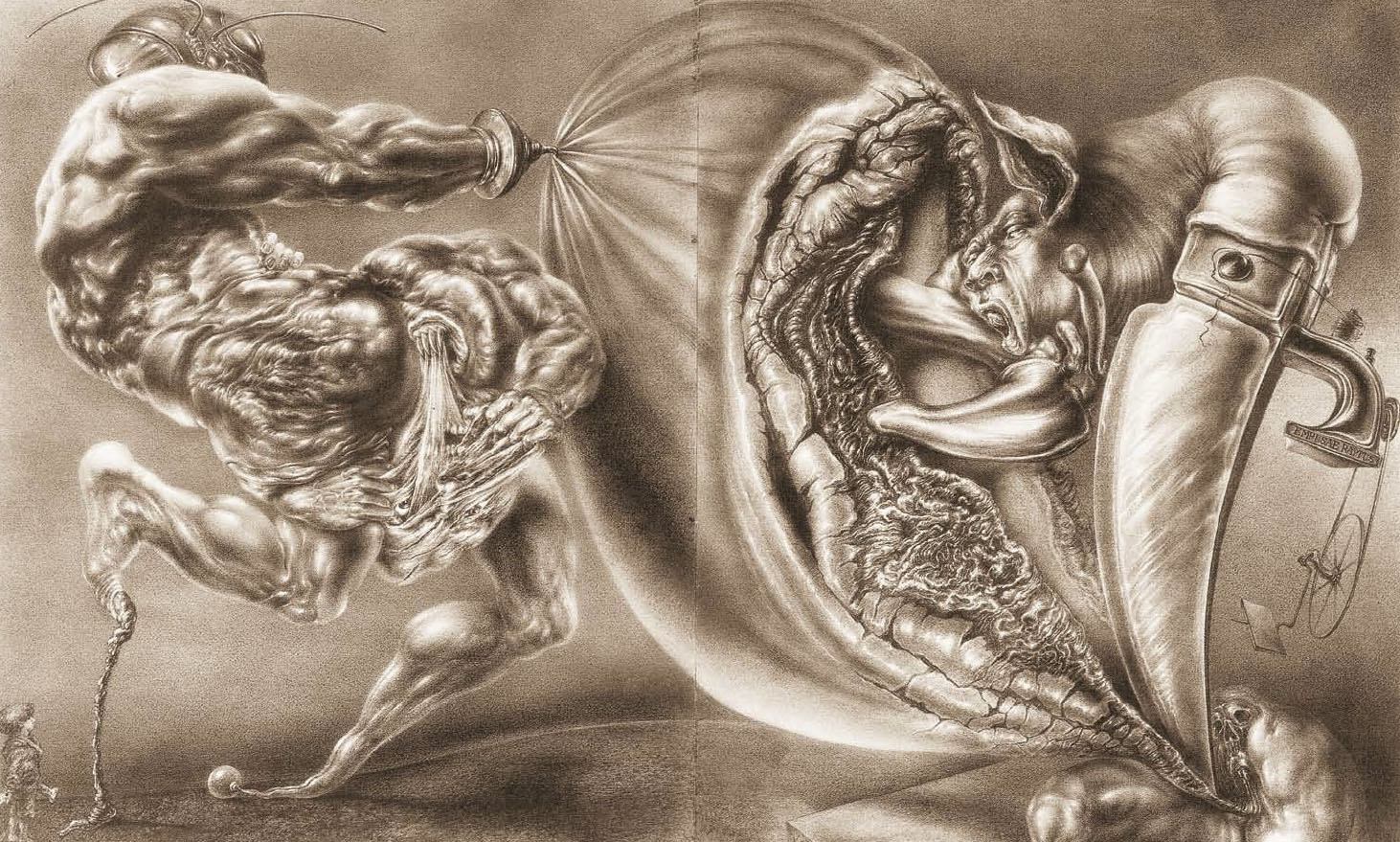
Empusae Raptus (1977).

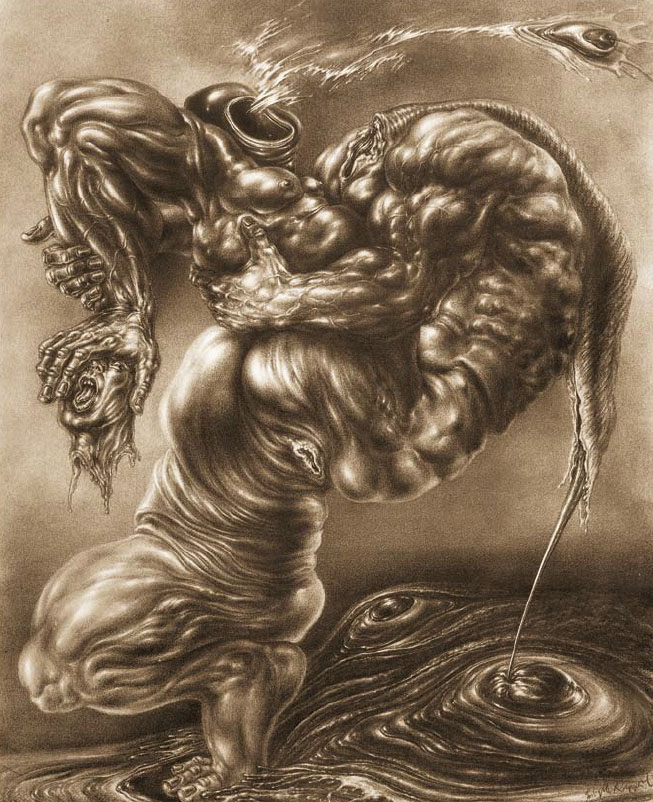
Another post about this astonishing artist (I’ll keep talking about her if no one else does…). The pictures here are taken from the catalogue for the 2010 Sibylle Ruppert exhibition at the HR Giger Museum, Gruyères, Switzerland. Leslie Barany was good enough to send me a copy of this, and the pictures are posted courtesy of the museum. To purchase a copy of the catalogue contact marcowitzig@gigerworkcatalog.com

ruppert2-1.jpg

Le Chant de Maldoror (1978).

Looking over Sibylle Ruppert’s work this week I’ve been pondering why she wasn’t better known. She was working throughout the 1970s and could easily have been swept up in the vogue for fantastic art when it was being popularised by Omni magazine. Giger, Mati Klarwein, Robert Venosa, De Es Schwertberger and others all benefited from Bob Guccione’s publication, and to a lesser degree from appearances in Heavy Metal magazine. Ruppert’s lack of visibility may have been a result of the usual situation whereby women artists were overlooked or marginalised. But I think it’s far more likely that her work was simply too intense and visceral for the newsstands. Giger could get by with paintings like the semi-abstract NY City series which were attached to science fiction stories without causing a stir. It’s difficult to imagine Ruppert’s work gaining such a popular acceptance, especially in the United States where, lest we forget, Giger’s Penis Landscape did cause a stir in 1985. One of the great benefits of the web is the way so much previously buried culture is surfacing and finding new and enthusiastic audiences. Sibylle Ruppert’s greatest audience has yet to find her but they’re surely out there, you can’t keep work of this quality buried forever.

For a few more Ruppert works see that haven of all things grotesque, Monster Brains.

ruppert3-1.jpg

Le Spectacle de l’Univers (1977).

Continue reading “Sibylle Ruppert revisited”

The Isle of the Dead in detail

bocklin1.jpg

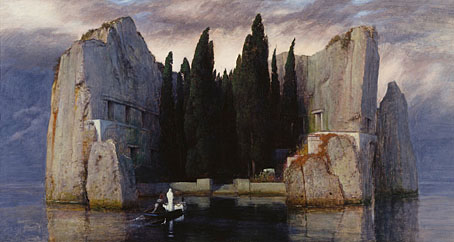
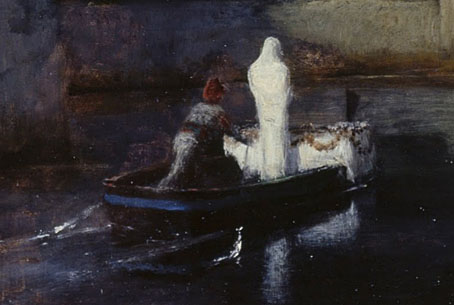
More from the Google Art Project where a couple of paintings by Swiss Symbolist Arnold Böcklin (1827–1901) may be explored, one of them an 1883 version of cult favourite The Isle of the Dead. No need to repeat the history of that work when I’ve already written about it. The version here is from the Alte Nationalgalerie, Berlin, and is the one I’ve seen reproduced in books the least so it’s good to find it in high-quality.

bocklin2.jpg

bocklin3.jpg

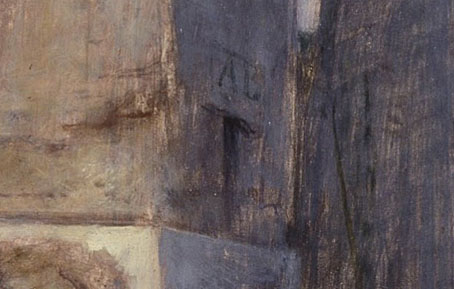
Böcklin painted five versions of this scene, one of which was lost during the Second World War. A couple of them, this one included, have his initials placed over the doorway of a tomb, a detail which isn’t always visible in reproductions.

bocklin4.jpg

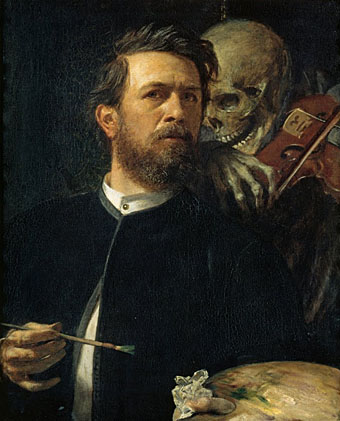
In the same collection is another gloomy Böcklin work, Self-Portrait with Death Playing the Fiddle (1872), and I hadn’t noticed before that the fiddle only has one string, the lowest, which would no doubt create a suitably dolorous melody.

For more on The Isle of the Dead see Toteninsel.net, a site dedicated to the many works in different media derived from the paintings. If you need a musical accompaniment whilst browsing, Rachmaninoff wrote the ideal piece.

Previously on { feuilleton }
Arnold Böcklin and The Isle of the Dead

Weekend links 62

pavlishin.jpg

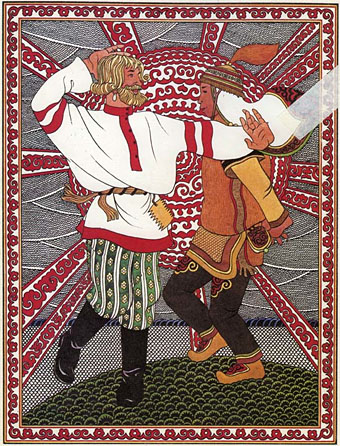
A plate from Tales of the Amur by Dmitry Nagishkin, a 1975 edition illustrated by Gennady Pavlishin.

• The week in Surrealism: Opera of the surreal gives Dalí an encore: Yo, Dalí, a previously unperformed work by Xavier Benguerel, receives its premier in Madrid. Meanwhile Tate Liverpool’s summer exhibition, René Magritte: The Pleasure Principle, is profiled here. “René Magritte has inspired more book covers than any other visual artist,” says James Hall.

If Rimbaud anticipated the Surrealists by decades, Ashbery is said to have gone beyond them and defied even their rules and logic. Yet though nearly 150 years have intervened since Rimbaud’s first declaration of independence, many readers in our own age, too, still prefer a coherence of imagery, a sameness of tone, a readable sequential message, even, ultimately, what amounts to a prose narrative broken into lines.

Lydia Davis on Rimbaud’s Wise Music.

Umberto Eco’s glimpse into the art of the novel | Return to Wonderland: an essay on Lewis Carroll’s world by Alberto Manguel | Heavy sentences by Joseph Epstein: On How to Write a Sentence and How to Read One, by Stanley Fish.

And then there’s the mystery of what happened to him for those four months in London when we have no trace of him. Rimbaud mentions Scarborough in “Promontory” and talks about “Hotels, the circular façades of the Royal and the Grand in Scarborough or Brooklyn.” Since there’s that missing period in England, people say he must have gone to Scarborough, and have even checked hotel registers for that period, but as far as I know nobody has ever found anything. Someone even checked railway and train schedules in order to pin him to this real place. I seem to remember a French writer admitting that Rimbaud was never in Brooklyn, but kind of wishfully thinking that he might have been. Which is very funny. “Rimbaud in Brooklyn”: there’s a project for someone.

A Refutation of Common Sense, John Ashberry on translating Rimbaud.

Robert Jeffrey posts a video of his nine-year-old self giving Madge a run for her money in 1991. As Boy Culture puts it: “Anyone who feebly clings to the belief that gay can be prayed away should take a look at this and give up already…” Amen.

• The mathematics of Yog-Sothoth: Richard Elwes on Exotic spheres, or why 4-dimensional space is a crazy place.

For I Will Consider My Cat Jeoffry by Christopher Smart (1722–1771).

Lesbian pulp fiction, 1935–1978 and Faber 20th century classics.

As The Crow Flies, a new album from The Advisory Circle.

New World Transparent Specimens by Iori Tomita.

79 versions of Gershon Kingley’s Popcorn.

Minor Man (1981) by The League of Gentlemen.

Alchemy & Inquiry

tomaselli.jpg

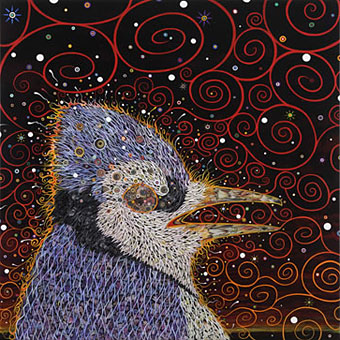
The Dust Blows Forward, The Dust Blows Back (2011) by Fred Tomaselli.

Artistic alchemy has been thriving in New York for the past few weeks. Alchemy & Inquiry is a show which has been running at the Glyndor Gallery, Wave Hill, the Bronx, since April, featuring paintings by Philip Taaffe, Fred Tomaselli and Terry Winters. “Alchemy” here is used in its broadest sense:

The word “alchemy” in the exhibition title alludes to transformation on many levels: chemical, magical and spiritual. Creative powers are summoned to transform common elements physically and metaphorically into substances of great value. With practices and insights that prefigure many important discoveries in biology, chemistry and physics, alchemy likewise fascinated and continues to fascinate poets and painters, serving as an allegory for the physical manifestation of immaterial spirit. This tradition unites the work of Winters, Tomaselli and Taaffe. (more)

A PDF catalogue containing commentary by the always enlightening Peter Lamborn Wilson can be downloaded here. A sample:

Certain extra-formal aspects of art cannot be ruled out as irrelevant to our experience of that art or to our understanding of it. A visitor from Alpha Centauri would not know that Tomaselli’s paintings actually contain real pills, maryjane leaves, spore prints, or whatever—real illegal drugs. But we earthlings cannot fail to consider this witty provocation when thinking about Tomaselli’s works. To own one of his paintings—if the Feds ever wanted to make an issue of it—would be, simply, a crime. Is a crime, actually. This fact adds nothing formal to Tomaselli’s art. But, oh, how much it adds, let’s say, conceptually. How much weight? What an aura.

If proof were needed, contra all the puritan anti-drug fascists and priests, that genuine mystical drug states are accessible via entheogenic drugs and various (illegal) ditchweeds, then we could enter Tomaselli’s paintings as evidence. The point is that if drugs could not do this then there would be no reason to make them illegal. Imagine: icons that are also reliquaries, containing edible body parts of vegetable saints, forbidden by the Babylonian Ugly Spirit, the eternal Mind Police.

The NYT reviewed the exhibition but missed a trick in not connecting it to the Alchemically Yours group art show which has been running at Observatory, Brooklyn throughout the past month. That show ends this weekend; Alchemy & Inquiry runs until June 19th. Thanks to Jay for the tip!

Previously on { feuilleton }
Alchemically Yours
Laurie Lipton’s Splendor Solis
The Arms of the Art
Splendor Solis
Amphitheatrum Sapientiae Aeternae
Cabala, Speculum Artis Et Naturae In Alchymia
Vision Quest
Digital alchemy