Hive Culture and Shamanic Illuminations

bell.jpg

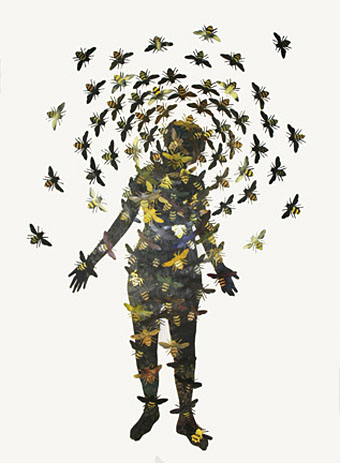
Apiphobia (2011) by Anonda Bell.

A couple of exhibitions opening this week for those in the New York area. Hive Culture: Captivated by the Honeybee is at the Glyndor Gallery at Wave Hill where 18 artists present works inspired by our favourite pollinating insects:

Painting, prints, sculpture, photography and video are featured, by artists Jennifer Angus, Anonda Bell, Deborah Davidovits, Anda Dubinskis, Cara Enteles, Rose-Lynn Fisher, Sally Gall, Hope Ginsburg, Talia Greene, Judi Harvest, Rob Keller, Andrea Lilienthal, Holly Lynton, Lenore Malen, Julia Oldham, Michelle Rozic, Jeanne Silverthorne and Draga Šušanj.

This isn’t solely an art exhibition. In October Wave Hill will be staging a series of bee- and honey-related events, details of which can be found on their press release (PDF).
amaringo.jpg

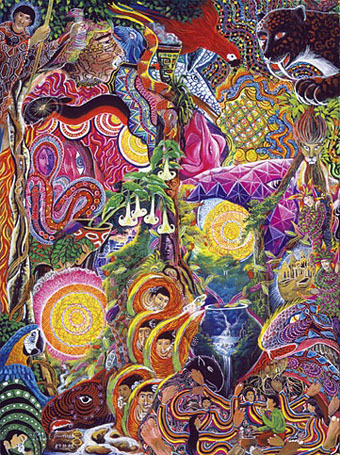
El Encanto de las Piedras by Pablo Amaringo.

Over at the ACA Galleries, Shamanic Illuminations which opens on Thursday will feature the art of Pablo Amaringo, Alex Grey and Mieshiel. There’s little detail at the moment on their website but they have a preview of the paintings including a number of Amaringo’s vivid, ayahuasca-inspired works which are psychedelic in every sense of the word. Shamanic Illuminations runs from September 15 to October 22. Via Phantasmaphile.
Danby’s Deluge

danby1.jpg

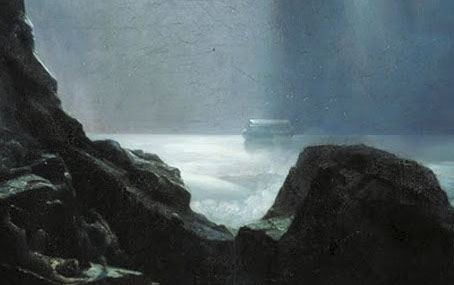
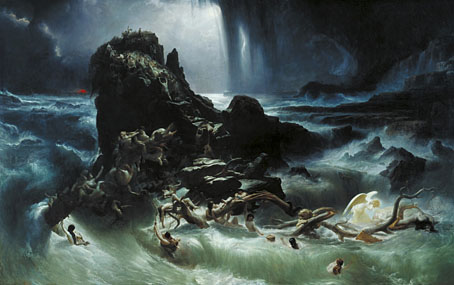
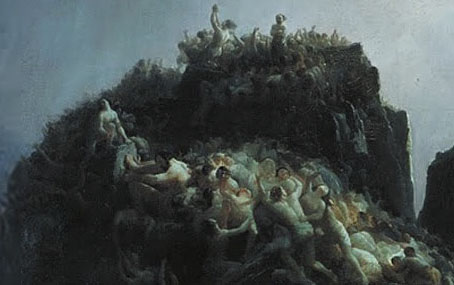
Since John Martin’s tumultuous canvases are back in the news it’s worth remembering another 19th-century painter of Biblical cataclysm, Francis Danby (1793–1861), whose enormous The Deluge (1840) used to hang in the same room as the Martins at Tate Britain. Danby was a contemporary of Martin although not as enthusiastic about this kind of subject matter. Visions of apocalypse proved to be popular, however, so Danby painted his Flood and similar works with reluctance. (Even Turner wasn’t above painting the occasional disaster.) Danby’s Deluge impressed me as much as Martin’s work when I first saw it not least for its having some believable human figures which give the vast canvas a tragic dimension. Martin’s figures are perfunctory and invariably dwarfed by the scale of events.

danby2.jpg

These details are from the Google Art Project which unfortunately don’t show us as much detail as they might. This is one of those paintings which encourages a lengthy contemplation, with a composition that draws the eye away from the swirling waters to a glowering sun and the shape of Noah’s ark on the distant horizon.

danby4.jpg

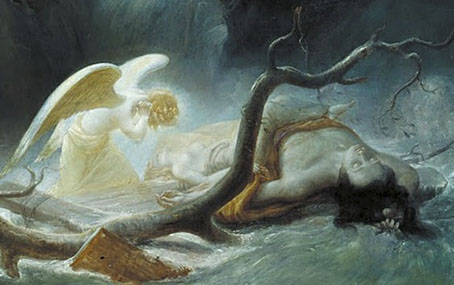
I’ve always been intrigued by the curious detail of the angel caught in the flood, and the even more curious detail of a drowned giant beside it. For the first time, however, I’ve noticed that the angel is peering into the face of a dead woman draped over the giant’s body. Paintings such as these often toured the country accompanied by the artist responsible who would lecture a paying audience about the various details. Besides the storytelling Danby gives the water in the foreground an astonishing transparent quality which Google’s photos can’t replicate. All the more reason to see his paintings for yourself if you’re in London.

Francis Danby at Tate Britain

danby3.jpg

Previously on { feuilleton }
John Martin: Heaven & Hell
Darkness visible
Death from above
The apocalyptic art of Francis Danby

Weekend links 75

darde.jpg

Eternal Pain (1913) by Paul Dardé. (And also here)

Rain Taxi caused a stir this week with its savaging of Hamlet’s Father by science fiction writer Orson Scott Card. The book is another of Card’s blatherings about the hell of being homosexual dressed in garments stolen from the unfortunate William Shakespeare. Rain Taxi made the obvious point about many of Shakespeare’s sonnets being homoerotic. For my part I was more appalled by the quoted extract which reduced one of the greatest plays in the language to that lifeless, cardboard-character-speak which is endemic in bad genre writing. News of the travesty quickly spread to gay news blogs, The Outer Alliance and elsewhere, ensuring that what’s left of Card’s reputation continues to spiral down a Mel Gibson-shaped black hole.

• “Sounds only like itself, like no one before or after.” Julian Cope on Tago Mago by Can which will be reissued in a new edition in November. Nice to see the return of the original sleeve design, something I saw once in a record shop then didn’t see again for years. For a long time I thought I’d imagined it. Related: two German art exhibitions inspired by the group.

The Responsive Eye (1965), a catalogue for the MoMA exhibition that launched Op Art. Also at Ubuweb: La femme 100 têtes, a film by Eric Duvivier based on the collage work by Max Ernst.

• More apocalyptic art: William Feaver on John Martin whose exhibition will be opening at Tate Britain later this month. There’s a trailer here.

Borges and I, an essay by Nandini Ramachandran. Related: Buenos Aires: Las Calles de Borges, a short film by Ian Ruschel.

• “Who was JG Ballard? Don’t ask his first biographer,” says Robert McCrum.

Biologically-inspired fabric and material design by Neri Oxman.

• Cross-pollinating subgenres: “Steampunk ambient” at Disquiet.

In the Shadow of Saturn, a photo by the Cassini spacecraft.

• The art and fashion designs of Alia Penner.

Fleet of hybrid airships to conquer Arctic.

• RIP Jordan Belson, filmmaker.

• Ten years of Ladytron whose new album is released on the 12th of September: Playgirl (2001), Seventeen (2002), Destroy Everything You Touch (2005), Sugar (2005), Ghosts (2008), Ace Of Hz (2011).

Whistler’s Peacock Room revisited

whistler1.jpg

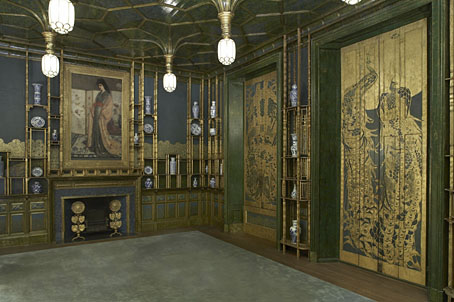
The Peacock Room (1876–1877).

More Japonism courtesy of the Google Art Project where it’s possible to pan around this view of Whistler’s Peacock Room at the Freer Gallery of Art. There’s only one view, unfortunately, it would have been good to see the reverse angle or, better still, a full panorama.

whistler2.jpg

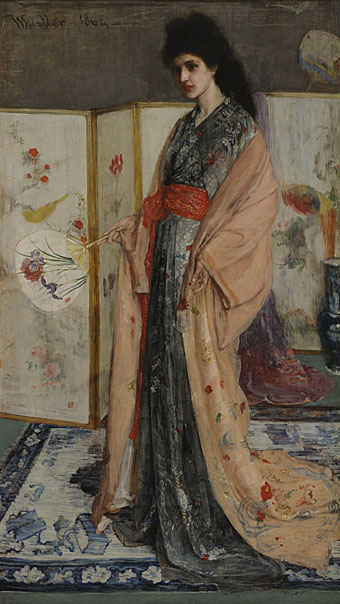
The Princess from the Land of Porcelain (1864).

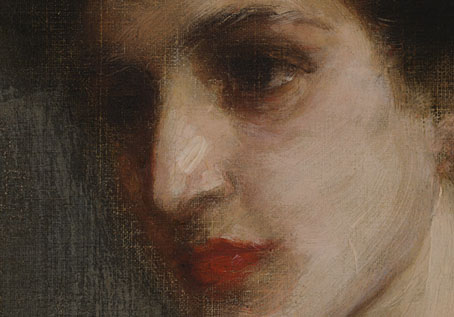
Google has a number of the Freer’s collection of Whistler drawings and paintings, including The Princess from the Land of Porcelain, the painting which the Peacock Room was designed to show to best effect along with patron Frederick Leyland’s blue-and-white china. Once again the Google views allow us to scrutinise the details of a painting in a way which would otherwise be impossible. It’s fascinating for me to see how loose Whistler’s technique was even at this early date, the brushstrokes of the face seem to have been scumbled over raw canvas.

whistler3.jpg

whistler4.jpg

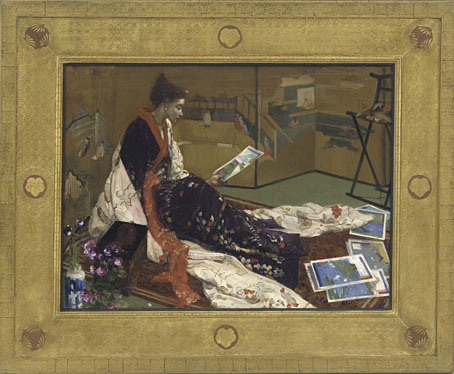
Caprice in Purple and Gold: The Golden Screen (1864).

Also at the Freer is another piece of exotica from the same period with a suitably Japanese frame. Whistler’s Japonism, and the Peacock Room in particular, leads directly to Aubrey Beardsley’s art thirty years later.

Previously on { feuilleton }
The Peacock Clock
Whistler’s Peacock Room

Wildeana 6

robinson1.jpg

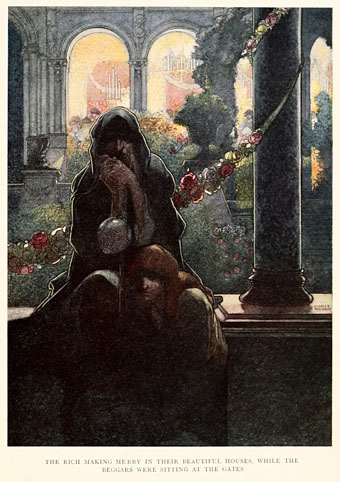
“The rich making merry in their beautiful houses, while the beggars were sitting at the gates.” Above and below: illustrations by Charles Robinson from The Happy Prince and Other Tales, an edition from 1920.

Continuing an occasional series. I’ve yet to see a copy of the recent annotated and unexpurgated edition of The Picture of Dorian Gray but Alex Ross wrote a marvellous essay for the New Yorker about the novel, its creation, its public reception, and Wilde’s decision to tone down the overt homoeroticism of its earlier drafts. This is one of the best pieces I’ve seen for a while about Wilde, replete with choice detail:

The gay strain in Wilde’s work is part of a larger war on convention. In the 1889 story “The Portrait of Mr. W. H.,” a pseudo-scholarly, metafictional investigation of Shakespeare’s sonnets to a boy, Wilde slyly suggests that the pillar of British literature was something other than an ordinary family man. In the 1891 play “Salomé,” Wilde expands a Biblical anecdote into a sumptuous panorama of decadence. Anarchists of the fin de siècle, especially in Germany, considered Wilde one of their own: Gustav Landauer hailed Wilde as the English Nietzsche. Thomas Mann expanded on the analogy, observing that various lines of Wilde might have come from Nietzsche (“There is no reality in things apart from their experiences”) and that various lines of Nietzsche might have come from Wilde (“We are basically inclined to maintain that the falsest judgments are the most indispensable to us”). Nietzsche and Wilde were, in Mann’s view, “rebels in the name of beauty.”

As for the novel, I’m feeling rather Dorian Grayed-out at the moment, having recently completed ten illustrations based on the story for a forthcoming anthology. More about that later.

Elsewhere, the William Andrews Clarke Memorial Library in Los Angeles has been running an exhibition, Oscar Wilde & the Visual Art(ists) of the Fin-de-Siecle, since July, and will continue to do so until the end of September. No word about what’s on display but this page on their website has details of their collection of Wilde materials which they say is the most comprehensive in the world.

Finally, the majority of visits to these pages in recent days have come from this post about Ivan Albright’s astonishing Dorian Gray painting in the Art Institute of Chicago. The post links to an earlier one of mine about the paintings used in Albert Lewin’s 1945 film of the book.

robinson2.jpg

Elsewhere on { feuilleton }
The Oscar Wilde archive