David Trautimas

trautimas.jpg

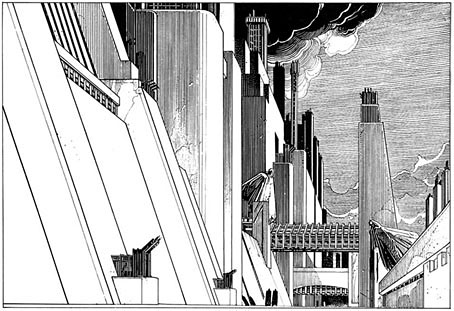
The Fishing Complex (2008).

Canadian artist David Trautimas re-purposes household and other objects into fantasy buildings by exaggerating their scale then montaging them into landscapes. This example is from his Habitat Machines series; there’s also an Industrial Parkland series. Many of the former group are pleasantly convincing, and their weathered appearance adds to the impression of having discovered the works of a lost Modernist architect. Some of these are like digital equivalents of paintings by Arnau Alemy.

Via Things Magazine.

Previously on { feuilleton }
The art of Arnau Alemany

The art of Goh Mishima, 1924–1989

goh_mishima.jpg

Untitled.

The gay artists archive is currently receiving more than twice as many visits as the rest of these pages so here’s a new addition to what is, it should be stressed, only a personal selection, not a definitive catalogue.

Goh Mishima (born Tsuyoshi Yoshida) specialised in what everyone seems to call “Yakazuza porn” although many of his men have fewer tattoos than genuine Japanese gangsters. Given the Japanese predilection for exploring every fetish imaginable someone had to cover this area. His name, of course, alludes to writer Yukio Mishima and there’s a lot about his work that Mishima would have enjoyed. The Tom of Finland Foundation has a small selection of works and there’s also an exhibition of originals running this month at the Gramercy Gallery. Their site is blighted by pointless Flash bollocks, however; go here instead for further pictures. (Dead link: try the Leslie Lohman Museum or this page at Japanese Gay Art instead.)

Note: The Tom of Finland Foundation biography page says Goh Mishima died three days before Emperor Hirohito in “1988”. Since Hirohito actually died in 1989 that’s the date I’ve listed here.

Elsewhere on { feuilleton }
The gay artists archive

Previously on { feuilleton }
The art of Hideki Koh
Mishima’s Rite of Love and Death
Secret Lives of the Samurai
Guido Reni’s Saint Sebastian
The art of Sadao Hasegawa, 1945–1999
The art of Takato Yamamoto

Jan Saenredam’s whale

saenredam.jpg

Still reading Moby Dick at a leisurely pace. After finishing Melville’s chapters on the representations of whales I thought I’d see if the pictures he most prefers are online anywhere. A vain search, as it turns out, but I did discover this splendid depiction, Stranded Sperm Whale, by Dutch artist Jan Saenredam (1565–1607).

On 19 December 1601, a sperm whale washed up near Beverwijk. Crowds of people came to see the sight. Among them Jan Saenredam, who made this print. He has depicted himself drawing on the left.

The description continues at the Rijksmuseum site from which this copy originates. Mr Peacay of BibliOdyssey has a very large copy on his Flickr pages which shows more of the fine detail. Melville is highly critical of poor depictions of whales but I suspect he would have liked this one. As well as the local colour and allegorical border elements, Saenredam faithfully renders his dead whale, even leaving space for the drooping scape of cetacean penis. In a similar, if more mundane manner, there’s this engraving by Jacob Matham.

Elsewhere on { feuilleton }
The etching and engraving archive

Previously on { feuilleton }
The Whale again
Rockwell Kent’s Moby Dick

The art of Julien Champagne, 1877–1932

champagne1.jpg

An obscure occult artist even among catalogues of obscure occult artists, Julien Champagne (also listed as Jean-Julian) is known principally for his associations with the persistently elusive 20th century alchemist Fulcanelli. Champagne provided a frontispiece (below) for Fulcanelli’s examination of architectural symbolism, Le Mystère des Cathédrales (1926), and is continually rumoured to have been Fulcanelli himself. Whatever the solution to that mystery, the alchemist’s book is rather more visible than the artist’s distinctly Symbolist paintings. There’s a French blog devoted to his life and works here but little else around. I wouldn’t mind seeing a decent online gallery of his pictures at some point.

champagne2.jpg

Previously on { feuilleton }
Digital alchemy
The art of Pamela Colman Smith, 1878–1951
The art of Andrey Avinoff, 1884–1949
The art of Cameron, 1922–1995
Austin Osman Spare

Harry Lachman’s Inferno

inferno1.jpg

Looking at Willy Pogány’s work last week I was reminded that as well as illustrating books he worked in Hollywood for a while as an art director and set designer. Among those jobs was a credit for “Technical staff” on the only film for which director Harry Lachman is remembered today, a curious 1935 melodrama, Dante’s Inferno. This stars Spencer Tracy as a fairground barker whose talent for drawing an audience helps an old showman boost the attendance at his moralising “Dante’s Inferno” attraction.

inferno2.jpg

Entrance to the fairground attraction.

A hubristic rise and fall follows for Tracy, and the film spends much of its running time in routine business and family scenes. What sets it apart is some striking fairground designs (no doubt Pogány’s involvement) and a truly startling self-contained sequence when the old showman describes for Tracy the true nature of the Inferno. This sequence takes Gustave Doré’s celebrated illustrations and brings them to life in a series of atmospheric tableaux which even manage to contain brief glimpses of nudity. Hell, it seems, is the one place you can get away with not wearing any clothes. I’ve read many times that this sequence was borrowed from an earlier silent film, also called Dante’s Inferno, but have yet to come across any definite confirmation. It’s certainly possible since studios at that time treated other films in a very cavalier fashion; when a film was remade the studio would try to buy up and destroy prints of the earlier film. If anyone can point to more information about the origin of the Hell sequence, please leave a comment.

inferno3.jpg

Stone tombs from the Inferno sequence.

If the Inferno sequence wasn’t already stolen in 1935, it works so well that it’s been plundered many times since; Kenneth Anger borrowed shots which he mixed into Inauguration of the Pleasure Dome (1954), Derek Jarman did the same for TG: Psychick Rally in Heaven (1981), and Ken Russell slipped some tinted scenes into Altered States (1980). I tinted the entire sequence red and dumped it into the one-off video accompaniment I made for Alan Moore and Tim Perkins’ stage performance of Angel Passage in 2001; it wouldn’t surprise me if it’s been used elsewhere. As with many of Hollywood’s products, Lachman’s film pretends to condemn prurience—Tracy’s character exploits Hell’s lurid attractions for gain—while revelling in the opportunity to show as much bare flesh as the censors would allow. As with Doré, Lachman’s Inferno seems populated solely by men and women in the peak of physical fitness.

Inevitably, you can see the Inferno sequence on YouTube here and here. The film doesn’t seem to be available on DVD but it’s worth seeking out to watch in full. In addition to the infernal delights, you also get to see 16-year-old Rita Hayworth’s screen debut as a dancer on a cruise ship.

Previously on { feuilleton }
Willy Pogány’s Lohengrin
Willy Pogány’s Parsifal
Maps of the Inferno
A TV Dante by Tom Phillips and Peter Greenaway
The art of Lucio Bubacco
The last circle of the Inferno
Angels 4: Fallen angels