Weekend links 22

pota.jpg

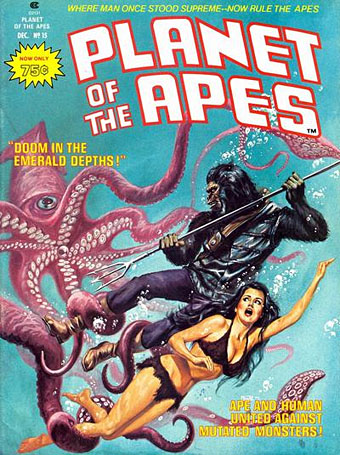
Planet of the Apes Magazine #15 (1975), art by Bob Larkin.

I never read any of Marvel Comics’ Planet of the Apes titles but the painted covers of the American editions are evidence of a distinctly lurid imagination. An excess of drugs—this was the Seventies, after all—or mere enthusiasm? You decide. Related: “The Soft Intelligence”: 5 Underrated Literary Cephalopods by China Miéville. Kudos to him for mentioning The Sea Raiders (1896) by HG Wells, a favourite story of mine when I was 12.
octopussy.jpg

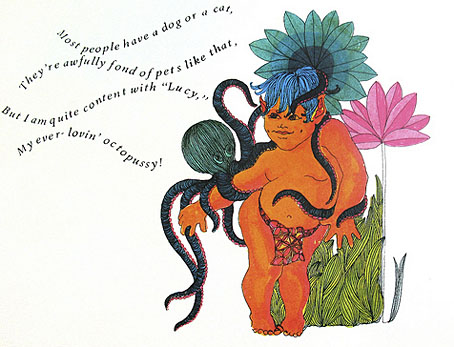
My ever-lovin’ octopussy (1970) by Jackie Black.

A Journey Round My Skull chooses selections from Ang Wyman’s flickr group Eye Candy (above), psychedelic illustration for children’s books by Nicole Claveloux, Peter Max, Heinz Edelmann and others.

• Watch out, there are “fancy gentlemen” about. It’s The Homosexual Menace!

• Design in opposition: Neville Brody announces the Anti-Design Festival.

• The Almias Rural Psychogeography Walk takes place on July 25th.

• Steven Heller on The Incredible Posters of Tadanori Yokoo.

Hipster Priest: Alan Moore interviewed at The Stool Pigeon.

FACT mix 167, a great selection by These New Puritans.

• The Orion Galaxy is a beautiful bespoke synthesizer.

• A radio portrait of Moondog at Speechification.

• RIP: Sugar Minott. RIP Tuli Kupferberg.

• Introducing Wizard’s Tower Press.

Octopus (1970) by Syd Barrett.

The Major Arcana by Jak Flash

arcana1.jpg

The Fool.

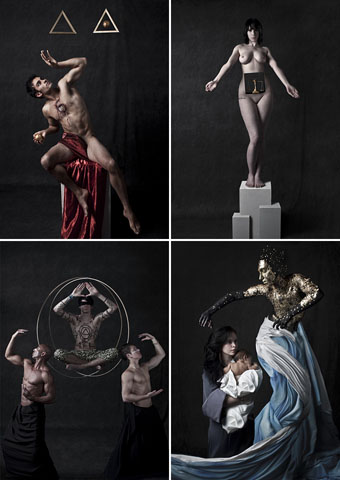
I’d like this photo series by young British photographer Jak Flash even if it didn’t feature attractive men; the eye candy is icing on a thaumaturgic cake. The Major Arcana takes the Trumps of the Tarot as its inspiration and manages to reinterpret the symbolism whilst retaining the hieratic nature of the traditional images. Of his reworking, the photographer says:

I developed my own themes based around things like geometric shapes so that I could encode my images with meaning. The images link to each other and can be read to some extent almost as a progressive story, or commentary. Various signifiers are used throughout the images such as cubes, triangles and spheres to help communicate my ideas. Cubes for example are a representation of the material world and triangles show transition. In an image such as The Hanged Man we see two men firmly seated on a large cube, whilst above their heads another cube breaks apart around them. … The Lovers image is an interpretation of the fall of man from Eden. The man represents mankind in his fall after taking the fruit of Knowledge, whilst being denied eternal life. (More.)

The Major Arcana is available in book form at Blurb. Via Homotography, doing all the leg work once again.

arcana2.jpg

top left: The Lovers; top right: Justice.
bottom left: The Wheel of Fortune; bottom right: The Sun.

Previously on { feuilleton }
The Sapphire Museum of Magic and Occultism
Strange Attractor Salon
The art of Pamela Colman Smith, 1878–1951
Layered Orders: Crowley’s Thoth Deck and the Tarot
In the Shadow of the Sun by Derek Jarman
The Major Arcana

Ghost clocks

ghost1.jpg

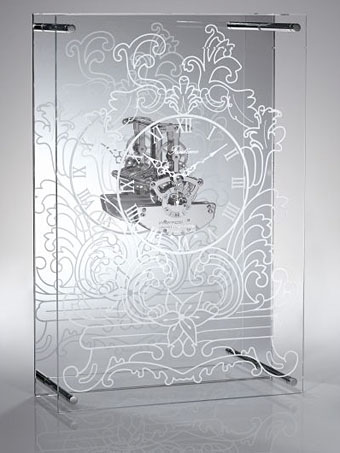
Ghost Clock by Yee Ling Wan (2005).

We’ve had skeleton clocks and mystery clocks this week, ghost clocks would seem the next logical step. There don’t seem to be many devices which fit the label unfortunately but this pair are interesting enough. Yee Ling Wan’s clock is relatively cheap (around £70) compared to yesterday’s antiques and can be purchased from a number of online outlets.

ghost2.jpg

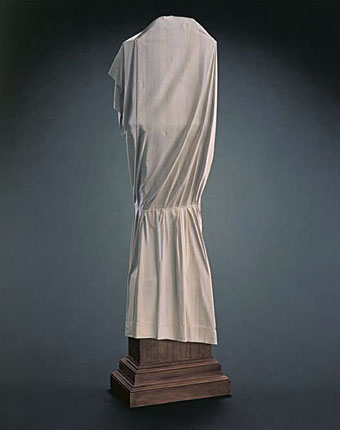
Ghost Clock by Wendell Castle (1985).

Wendell Castle’s Ghost Clock isn’t a timepiece at all but is a solid block of mahogany carved and laminated to give a trompe l’oeil impression of a sheeted grandfather clock. The wrapped object and the confounding of expectations reminds me of Magritte who may have been an inspiration. Ce n’est pas une horloge, perhaps.

Previously on { feuilleton }
Mystery clocks
Skeleton clocks
The Midsummer Chronophage
The Corpus Clock

Josh Simpson’s glass planets

simpson1.jpg

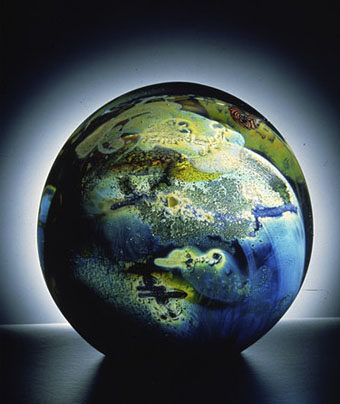
Planet.

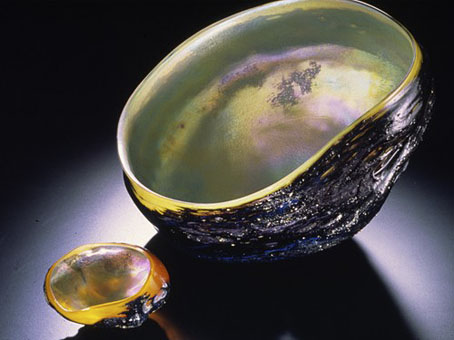
American glass artist Josh Simpson takes the paperweight-as-miniature-world to its logical conclusion by creating series of hyper-detailed spheres he calls Planets. He continues the extraterrestrial theme by also creating his own version of tektite meteor glass (below) embellished with iridescent interiors. His site is worth a browse for other glass artefacts such as his Inhabited Vases and I like the colourless glass bubble pieces. Finally, he has details of an ongoing project to hide his Planets in various remote places around the world with the intention of surprising future inhabitants or archaeologists. If that sounds intriguing, you can get involved here.

simpson2.jpg

Tektite.

Previously on { feuilleton }
Luke Jerram’s Glass Microbiology
Andy Paiko’s glass art
The art of Josiah McElheny
The art of Angelo Filomeno
Cristalophonics: searching for the Cocteau sound
Glass engines and marble machines
Wesley Fleming’s glass insects
The art of Lucio Bubacco
The glass menagerie

Weekend links 21

nagai.jpg

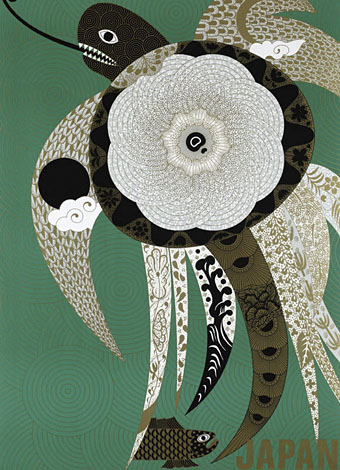
A poster by Kazumasa Nagai.

• Franco Maria Ricci creates the world’s largest maze. “The former publisher said he first confided his ambition to Jorge Luis Borges, who characteristically told him the world’s largest maze already existed and was called a desert.” Related: Mirror, Mask, Labyrinth, a review of two new collections of Borges’ poetry.

FACT mix 164 is a dubstep collection by Pinch and a promotion for the Dark Matter compilation which I designed earlier this year.

• One of the monuments of 20th century music, Bitches Brew by Miles Davis, is released in another new (and expensive) edition next month by Sony. Nice packaging, and there’s a vinyl edition included, but these things always come across as a cyncial attempt to milk the hardcore fans one more time. And have you noticed how all vinyl releases are now described as “audiophile”? If the big record companies had shown this much dedication to quality in the 1980s when they were jobbing out sub-standard vinyl pressings their reputation might be slightly higher today.

• More Gysin: Brion Gysin, William Burroughs, and the secret life of a building on the Bowery. And Ubuweb’s page of Gysin sound works and recordings.

Michael Moorcock: “I think I preferred my own imagination”. A two-part interview about the cover designs for Moorcock books.

The Pansy Project: “Artist Paul Harfleet plants pansies at the site of homophobic abuse, he finds the nearest source of soil to where the incident occurred and generally without civic permission plants one unmarked pansy. The flower is then photographed in its location and posted on his website, the image is entitled after the abuse … The Pansy Project also marks locations where people have been killed as a result of homophobic attack”

This Gaming Life: Travels in Three Cities. Jim Rossignol’s book is available as a free download.

Lost London. Also, the Victorian Catacombs of South London.

Dedalus Books had its Arts Council grant reinstated.

’Zine Lutefisk: fashion/art/escape.

Time Will Show The Wiser (1968) by Fairport Convention | She Moves Through The Fair (1969) by Fairport Convention | She Moved Through The Fair (1994) by Jam Nation.