Palladini’s Aquarian Tarot

palladini01.jpg

For the past two months I’ve been busy drawing a new set of Tarot designs. More about these later, but sporadic research has naturally led to me to look at a few earlier sets, although my Trumps have mostly been following Pamela Colman Smith’s illustrations for the Waite deck. Tarot designs have really proliferated in the past few years (Is there a Lego Tarot? Yes, of course there is), so much so that many previous designs which would once have been notable are now swamped by mediocre decks.

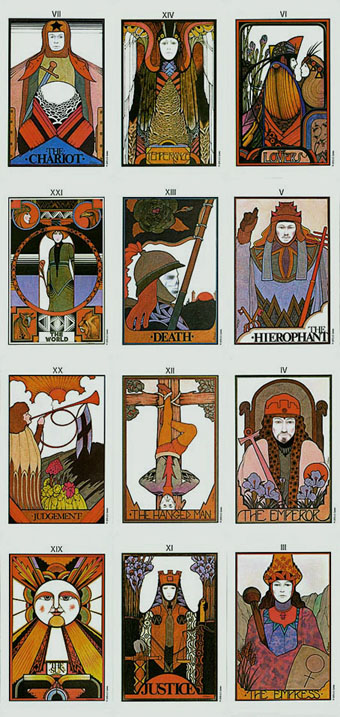
David Palladini’s Aquarian Tarot first appeared in 1970 when the occult revival was getting into its stride. Palladini had contributed to the Linweave Tarot in 1967 along with three other artists, something you can read more about at the excellent Sweet Jane’s Pop Boutique. I’m sure I must have seen the Aquarian Tarot in the past but probably dismissed it for being too modish and not occult enough; for a long time Aleister Crowley’s Thoth deck was the only one I’d look at. Palladini’s art is a lot more familiar now that his fabulous poster for Nosferatu the Vampyre looks down on me every day, and I’ve grown to enjoy his combination of Art Nouveau and Deco motifs so much that I wouldn’t mind a pack of these cards. The Aeclectic site reviews the deck, and has a few more examples of the designs. They also review the New Palladini Tarot which the artist produced in 1996. Given the choice I’d still go for the earlier set.

palladini02.jpg

Continue reading “Palladini’s Aquarian Tarot”

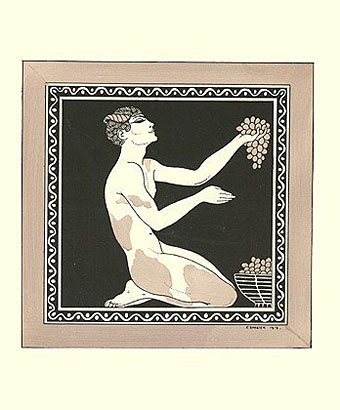
George Barbier’s Nijinsky

barbier05.jpg

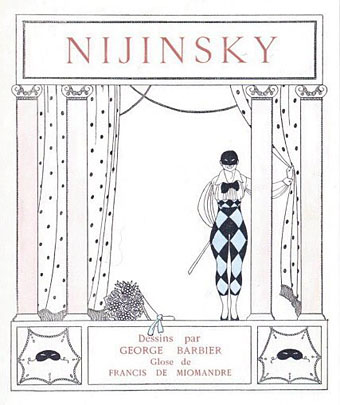
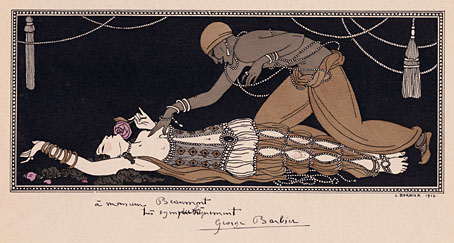
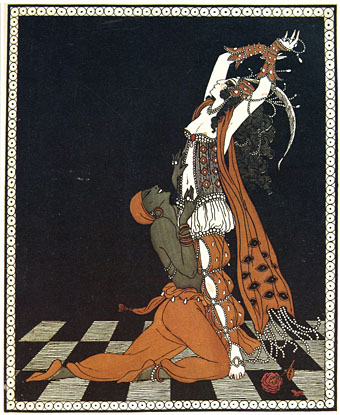
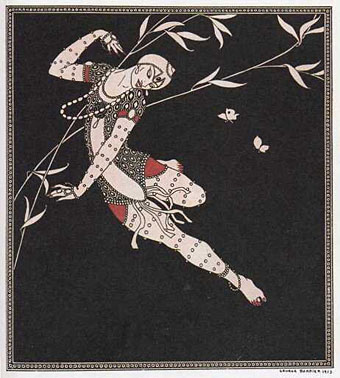
An inevitable one this, given the amount of times that George Barbier’s work has been featured here. Designs on the Dances of Vaslav Nijinsky was a series of prints published in 1913 when the dancer was at the height of his celebrity. All of Nijinsky’s major roles are represented although this isn’t quite the complete set. There did used to be a Japanese site with several galleries of Barbier’s early prints but this has now disappeared.

barbier04.jpg

Schéhérazade.

barbier02.jpg

Prélude à l’après-midi d’un faune.

barbier01.jpg

Schéhérazade.

barbier10.jpg

L’oiseau de feu.

Continue reading “George Barbier’s Nijinsky”

Weekend links 161

descent.jpg

My friend James Marriott died last year. He was 39. His final book, The Descent, a study of Neil Marshall’s acclaimed horror film, is launched on Friday at the Cube Microplex in Bristol. The book is published by Auteur, a UK imprint, in their Devil’s Advocates series. James was finishing the book a year ago this month, and sent me a late draft for comments. In addition to examining Marshall’s film in detail he also looks at its sequel and explores the micro-genre of cavern-oriented horror. When it came to literature James preferred Robert Aickman and Thomas Ligotti; he enjoyed their cinematic equivalents too but he also had a great appetite for horror films of any description, and would happily wade through hours of giallo trash in the hope of finding something worthwhile. I miss our long, digressive email exchanges, and the opportunity they afforded to swap new discoveries.

• “For artists not working in digital media — those who cut, build, draw, paint, glue, bend, and make things in the more traditional manner — there is something of a ‘Surrealist’ popularity at hand today,” says John Foster.

• At Open Culture: Duke Ellington’s Symphony in Black starring a 19-year-old Billie Holiday, and Nina Simone performs six songs on The Sound of Soul (1968).

• I’m not remotely interested in Baz Luhrman’s latest but I do like the Art Deco graphics and logos created by Like Minded Studio for The Great Gatsby.

Alejandro Jodorowsky: “I am not mad. I am trying to heal my soul”

• The Clang of the Yankee Reaper: Van Dyke Parks interviewed.

• A 45-minute horror soundtrack mix by Spencer Hickman.

• At But Does It Float: Album art by Robert Beatty.

Topological Marvel: The Klein Bottle in Art

Anne Billson on The Art of the Voiceover.

Soviet board-games, 1920–1938

A Brief History of Robot Birds

Le Chemin De La Descente (1970) by Cameleon | Descent Into New York (1981) by John Carpenter | The Descent (1985) by Helios Creed

Fatality by OCTiV

fatality.jpg

Catching up with more recent work, this was a quick collage for Fatality, a single by US musician OCTiV. This has been out for about a month. The main track—a kind of dubstep/metal hybrid—can be heard here. The request was for something on the cosmic horror spectrum which would also incorporate geometric elements, hence the swiping of a couple of polyhedra from Wenzel Jamnitzer’s wonderful Perspectiva Corporum Regularium (1568).

Among the other things which have yet to materialise there’s a book cover design for Tor, and the Ghosts in Gaslight, Monsters in Steam anthology which features some of my fiction as well as my cover design. I’m very pleased that the latter has achieved its Kickstarter funding. More about these projects later.

Abraxas: The International Journal of Esoteric Studies

abraxas.jpg

A welcome arrival in the post recently was two issues of Abraxas, the book-format journal of esoteric studies from Fulgur Esoterica. I’ve always observed the contemporary occult scene from a distance, being more interested in cultural spin-offs whether those happen to be music-oriented—as was the late, lamented Coil—or art-oriented. Something I always enjoyed about Kenneth Grant’s books was the amount of unique art material they contained, much of it by his wife, Steffi Grant, or previously unseen work by Austin Osman Spare. Fulgur have for many years continued this artistic focus, starting out by reprinting Spare’s books (and publishing new ones, such as the revelatory Zos Speaks!), and more recently turning their attention to the work of contemporary artists following similar paths.
kostromitin2.jpg

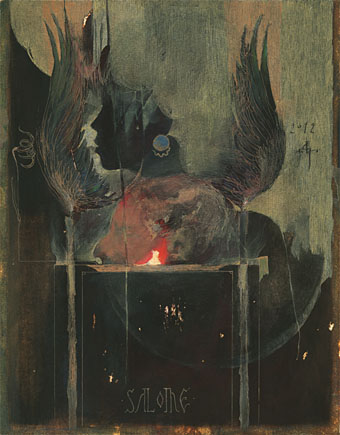
Study for Salome (2012) by Denis Forkas Kostromitin.

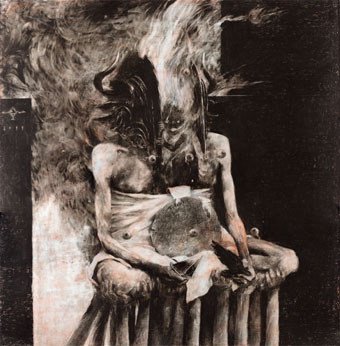
Abraxas is a venue for the latter group, especially in the most recent issue, no. 3, which features a wealth of new art, photography, essays and poetry. In the past I’ve complained about the misunderstandings Austin Spare’s work used to generate among otherwise intelligent and sensitive critics when faced with the artist’s occult obsessions; the usual response would be to lazily dismiss this side of his work as “black magic”, and therefore either kitsch or nonsense. Things have improved in recent years but it’s taken a long time for critics and curators who would show the greatest respect to a minority belief from South America, say, to offer the same respect to equally sincere artists who happen to be working in London or New York. One of the values of Abraxas for artists such as Jesse Bransford and Denis Forkas Kostromitin, both of whom are interviewed here, is that they can have a conversation with someone who won’t treat their work or their interests in a condescending manner. I’m particularly taken with Kostromitin, a Russian artist whose work I only discovered recently.
kostromitin3.jpg

M L K (Moloch) (2011) by Denis Forkas Kostromitin.

Elsewhere in Abraxas 3 there’s a feature on the recent exhibition of Aleister Crowley’s extravagant daubs, an article by Francesco Dimitri about tarantism in southern Italy, a piece about Dada by Adel Souto, and text by Paracelsus with illustrations by Joseph Uccello which is printed on a different paper stock. The production quality is as good as any art book but then that’s standard for a Fulgur publication. Mention should be made of the interior design of this issue which far exceeds the often perfunctory layout of many publications from smaller publishers. Tony Hill is credited on the masthead as Creative Director so I’m assuming he’s the person responsible. Abraxas is an essential purchase for anyone interested in contemporary occult art. The hardback of no. 3 is a limited edition that includes a signed and numbered lithograph by Denis Forkas Kostromitin.

Previously on { feuilleton }
I:MAGE: An Exhibition of Esoteric Artists