Street Fair, 1959

sf1.jpg

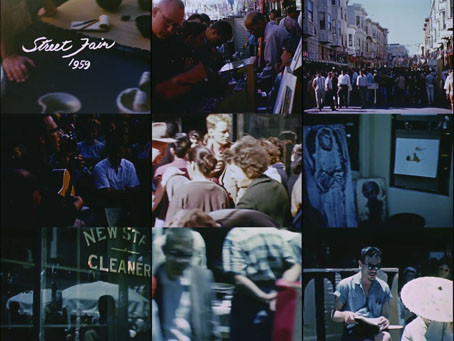
The street is upper Grant Avenue, San Francisco, seven minutes of local colour captured on silent 16mm film by Edward Silverstone Taylor:

This edited Ektachrome home movie with professional titles documents a 1959 street fair, upper Grant Avenue, San Francisco—the center of Beat culture. The film includes shots of filmmaker Dion Vigne and his wife Loreon, artist and occultist Marjorie Cameron, and artist Wallace Berman, displaying and selling their art works.

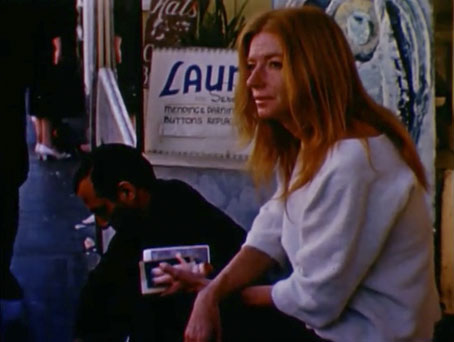
The presence of Marjorie Cameron (below) is what fascinates in these quarters, recognisable thanks to her red hair and the distinctive profile seen when she played the Scarlet Woman in Kenneth Anger’s Inauguration of the Pleasure Dome five years earlier. You also see what appear to be a couple of her paintings. The street fair looks pretty bohemian for the late 50s but a glance at Anthony Stern’s frenetic San Francisco short from a decade later shows a much wilder place. (Via Dangerous Minds.)
sf2.jpg

Previously on { feuilleton }
San Francisco by Anthony Stern
Kenneth Anger on DVD again

Weekend links 156

leonard.jpg

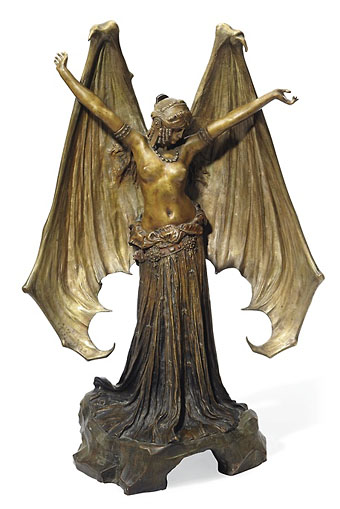
Le Vampire (c. 1903) by Agathon Léonard. Via Beautiful Century.

• Two masters of rumbling atmospherics interviewed at The Quietus: Bobby Krlic aka The Haxan Cloak talks to Maya Kalev while Thomas Köner talks to Joseph Burnett.

Discussions about the arts now have an awkward, paralyzed quality: few judgments about the independent excellences of works are offered, but everyone wants to know who sat on the jury that gave out the award. It’s become natural to imagine that networks of power are responsible for the success or failure of works of art, rather than any creative power of the artist herself.

We’ve reached the point at which the CEO of Amazon, a giant corporation, in his attempt to integrate bookselling and book production, has perfectly adapted the language of a critique of the cultural sphere that views any claim to “expertise” as a mere mask of prejudice, class, and cultural privilege.

Too Much Sociology, an essay by The Editors at n+1

• Prints of Karl Blossfeldt‘s plant portraits can be seen at the Whitechapel Gallery, London.

Stephen J. Gertz on Samuel Roth, “The Most Notorious Publisher In American History”.

• Max Beerbohm is Cranky: Mary Mann on the appeal of the curmudgeon.

• Travel brochure graphics: Graphic design from the 1920s to the 1970s.

• Still returning to its constituent components: Chernobyl’s ghost town.

Thoughtless Grin: a new Arthur Mixtape

Richard Williams: the master animator

Ketch Vampire (1976) by Devon Irons | A Vampire Dances (Symmetry) (1988) by Jon Hassell with Farafina | Vampires (1999) by Pet Shop Boys

Doorways

doorway1.jpg

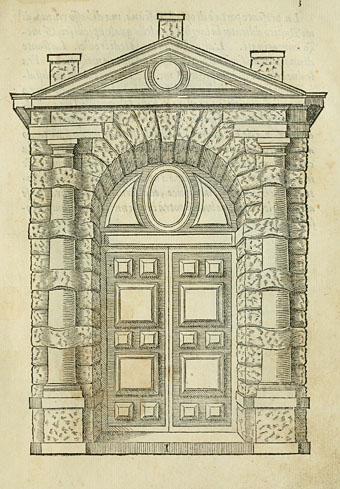
Another fine book for us collagists, Libro estraordinario di Sebastiano Serlio bolognese : nel quale si dimostrano trenta porte di opera rustica, mista con diuersi ordini, & uenti di opera dilicata di diuerse specie : con la scrittura dauanti, che narra il tutto (1566) is a guide to “porte rustiche”, or old doorways. There are fifty in all, of which I’ve chosen seven random examples. Browse the rest here or download the book here.

doorway2.jpg

doorway3.jpg

doorway4.jpg

Continue reading “Doorways”

Julius Klinger’s Sodom

klinger1.jpg

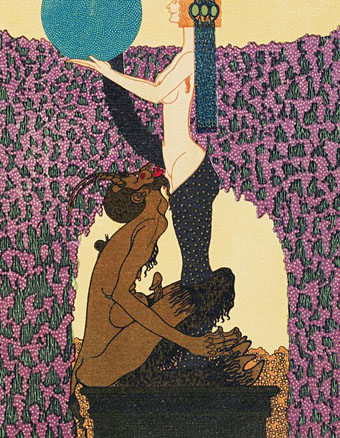
The more I look at the work of Austrian artist Julius Klinger (1876–1942), the more I like what I see. This Pinterest sample shows his versatility, equally at home with detailed illustration, often with a Beardsley-like quality, as he was with more Modernist design. Sodom (1689) (aka The Farce of Sodom, or The Quintessence of Debauchery) is the notorious Restoration drama attributed to John Wilmot, the second Earl of Rochester, which is here illustrated by Klinger for an edition privately published in Leipzig in 1909. The play is one of the most flagrantly outrageous works in the English language, with a cast of characters that includes Bolloxinion, the King of Sodom, Cuntigratia, his Queen, and so on; you can see parts of it performed in The Libertine (2004) with Johnny Depp playing Rochester, and taking the role of Bolloxinion.

Klinger produced 16 illustrations in all. His picture of Salomé gets linked to this series on a number of websites but I’ve seen other sites that list it as a separate piece. Since Salomé isn’t mentioned anywhere in Sodom I’d also be inclined to keep them separate.

klinger2.jpg

klinger3.jpg

klinger4.jpg

Elsewhere on { feuilleton }
The illustrators archive

Previously on { feuilleton }
Deutsche Kunst und Dekoration #21
Julius Klinger’s Salomé

Weekend links 155

austin.jpg

Poster design by Mishka Westell for this month’s Austin Psych Fest. Billy Gibbons’ pre-ZZ Top psychedelic outfit, The Moving Sidewalks, surprised everyone by reforming for a New York gig last month, their first performance together in 44 years.

• Pye Corner Audio played the Boiler Room, London, last week, and remixed a track from FC Judd’s Electronics Without Tears. Also on the latter is Chris Carter who talks about his own remix (and the “Radiophonic” Mr Judd) here.

Tom Bianchi’s Fire Island Pines, Polaroids of New York’s gay enclave from 1975–1983. Related: In Conversation with the Violet Quill: Andrew Holleran, Felice Picano, and Edmund White.

• From 2011: Sex, prison and lost ligatures: The story of Herb Lubalin’s Avant Garde typeface. Related: The ITC Avant Garde Gothic group at Flickr.

• Music reissues: Tape Works 1981–1982 by Laughing Hands is out now, and Scott Walker’s early solo albums will be reissued in the summer.

fraser.jpg

Drugs and the Mind (ii), a cover design from 1957 by Eric Fraser (1902–1983) whose illustrations and designs are in exhibition at the Chris Beetles gallery, London.

• At Ubuweb: William S. Burroughs + Brion Gysin + Genesis P-Orridge – Cold Spring Tape (1989).

The World According to John Coltrane, an hour-long documentary.

Neko Font: for when you need a word made of cats.

Fuck yeah, Sarah Bernhardt

Sordid Spheres!

99th Floor (1967) by The Moving Sidewalks | Over Fire Island (1975) by Brian Eno | Ledge (1980) by Laughing Hands