
April, Works in a Garden (1614) by Jan Wildens.
The cruellest month in paintings. Snowy scenes abound for this time of year but I’ve avoided those.
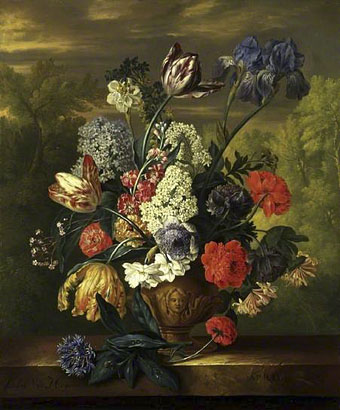
Twelve Months of Flowers: April (no date) by Jacob van Huysum.
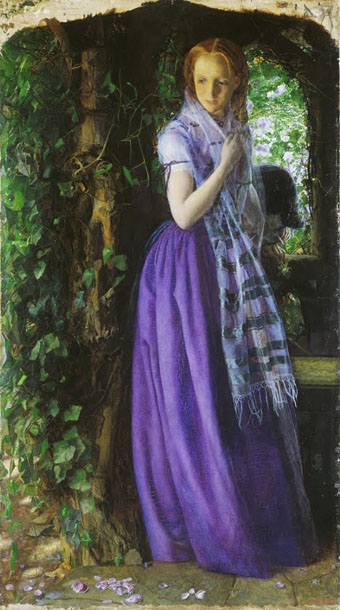
April Love (c. 1855) by Arthur Hughes.
A journal by artist and designer John Coulthart.
Art
April, Works in a Garden (1614) by Jan Wildens.
The cruellest month in paintings. Snowy scenes abound for this time of year but I’ve avoided those.
Twelve Months of Flowers: April (no date) by Jacob van Huysum.
April Love (c. 1855) by Arthur Hughes.
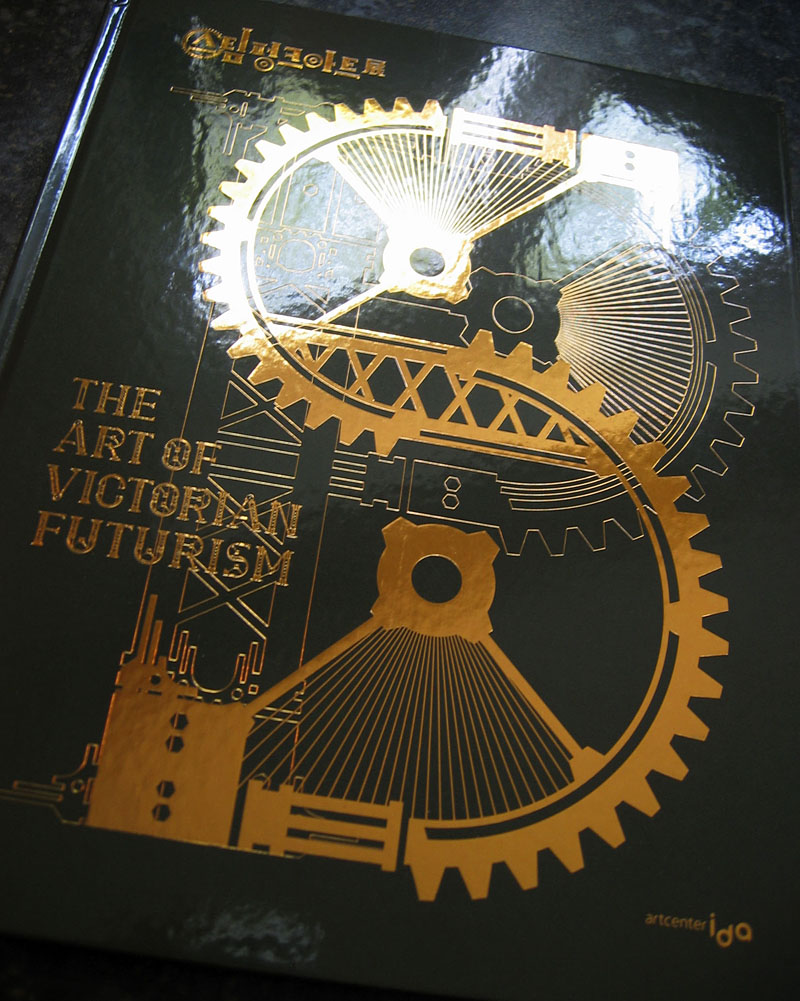
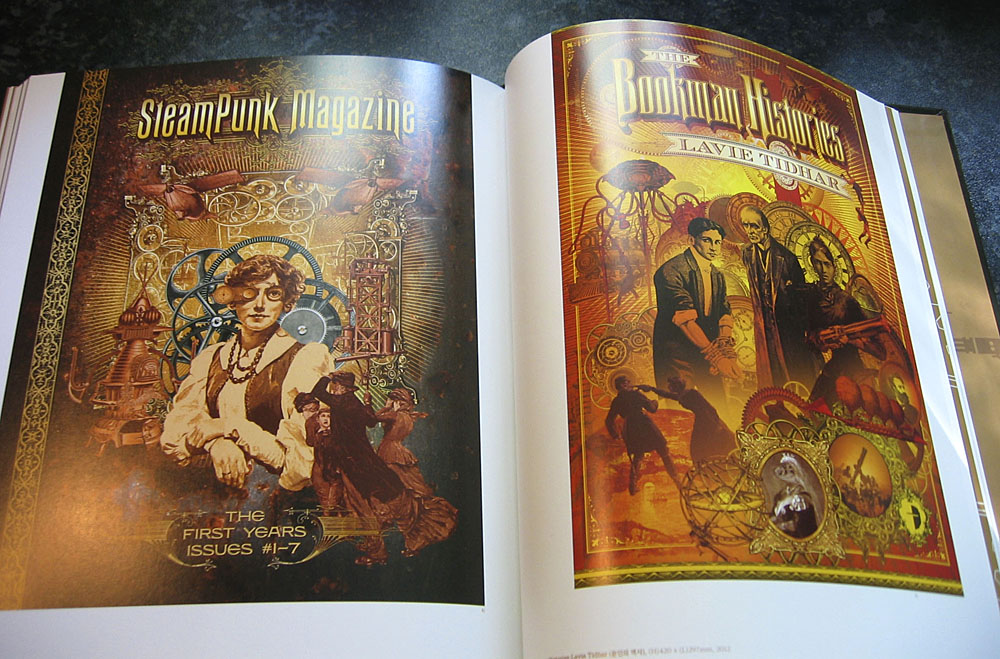
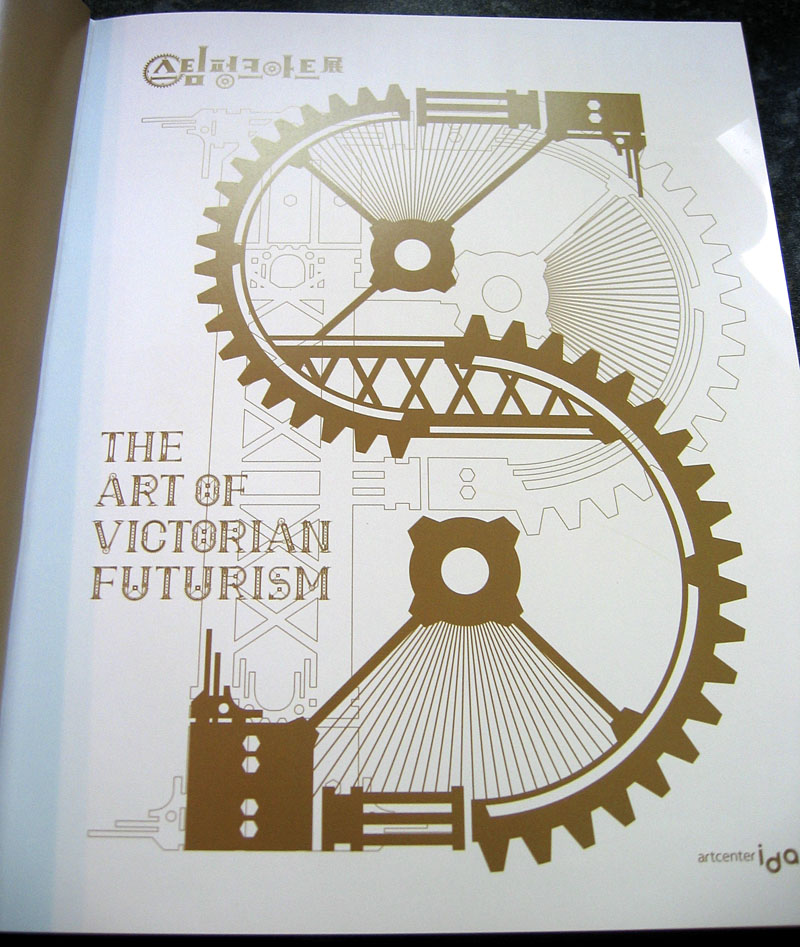
Another month, another exhibition catalogue. Steampunk: The Art of Victorian Futurism is still running at Artcenter IDA in Seoul with a selection of my book covers on display among a great variety of mechanical sculptures, costumes and other creations. The catalogue is a suitably lavish affair, so much so that it puts to shame many of the bandwagon-jumping coffee-table books that have been appearing recently. Excellent printing with lots of gold-ink embellishment, and all the exhibits are given substantial space. I especially like the mechanical type designs, and can now credit them to designers Se Byeol Moon and Han Woong Yoon. Korean TV news has run a couple of reports about the exhibition, the best of which may be seen here. The exhibition itself continues until May 18th.

Previously on { feuilleton }
• Steampunk: The Art of Victorian Futurism
• Steampunk Calendar
• Words and pictures
• Nathanial Krill at the Time Node
• Fiendish Schemes
• Ghosts in Gaslight, Monsters in Steam
• Steampunk Revolution
• The Bookman Histories
• Aether Cola
• Crafting steampunk illustrations
• SteamPunk Magazine
• Morlocks, airships and curious cabinets
• The Steampunk Bible
• Steampunk Reloaded
• Steampunk overloaded!
• More Steampunk and the Crawling Chaos
• Steampunk Redux
• Steampunk framed
• Steampunk Horror Shortcuts

Discovered via the latest issue of The Wire magazine in a feature about compilation albums, The Rock Machine Turns You On (1968) was the first budget sampler album. Given the success of this release I’m sure I must have seen it over the years but that cover wasn’t familiar at all. I have to assume that the “Hey, pop kids!” title would have been enough of a turn-off to ensure the fingers kept flipping through the sleeves. Priorities change with the passing of time, however, and my attention was caught by the cover art alone, another example of the engraving-collage style whose evolution I’ve been tracing over the past few years. The only design credit on the sleeve is for the back cover photo by Wadham Artists. The front cover is credited online to Milton Glaser, some of whose album covers have already featured here. He was working for Columbia/CBS in the late 60s so it’s a possibility. If anyone out there has a copy of the vinyl then maybe they can tell me if that’s an artist credit in the lower right of the picture. A CD reissue in 1996 only copied the album credits.
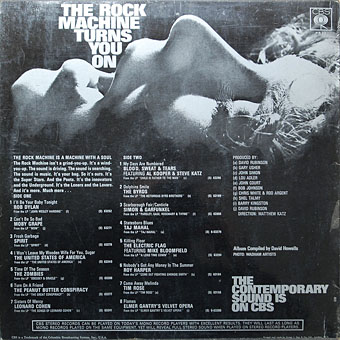
As to the music, it’s a pretty good compilation, lots of familiar names together with a track from cult favourites of mine The United States of America whose one and only self-titled album had been released that year. One of the few negatives about the superb United States of America album is the cover design which isn’t bad but does nothing to reflect the extraordinary musical invention within. It’s a shame that whoever designed The Rock Machine… couldn’t have worked on that sleeve as well.
Update: Rick Poynor writes to say that this cover appears in Milton Glaser: Pop, so the Glaser attribution is accurate.
Elsewhere on { feuilleton }
• The album covers archive
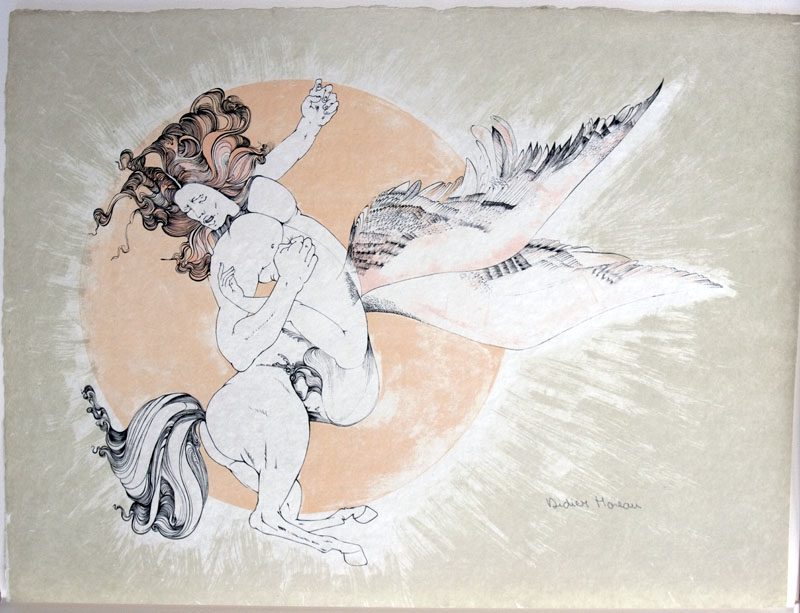
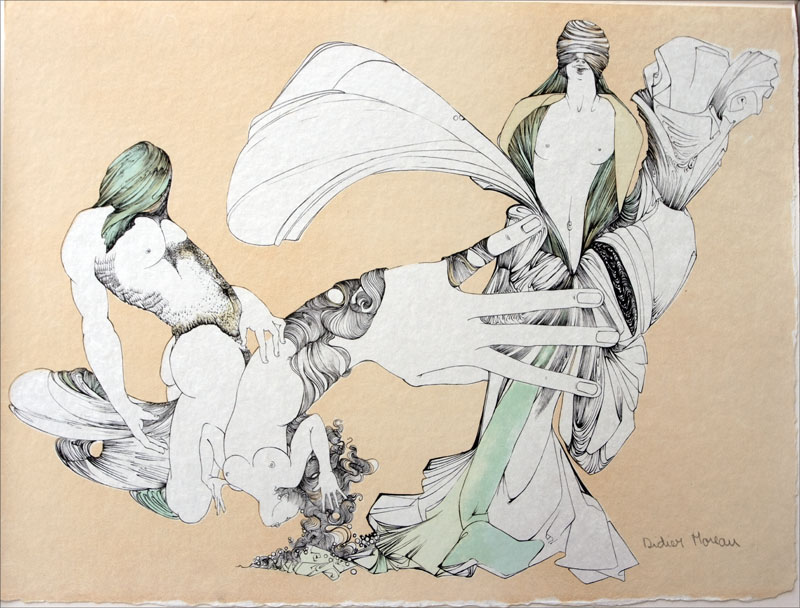
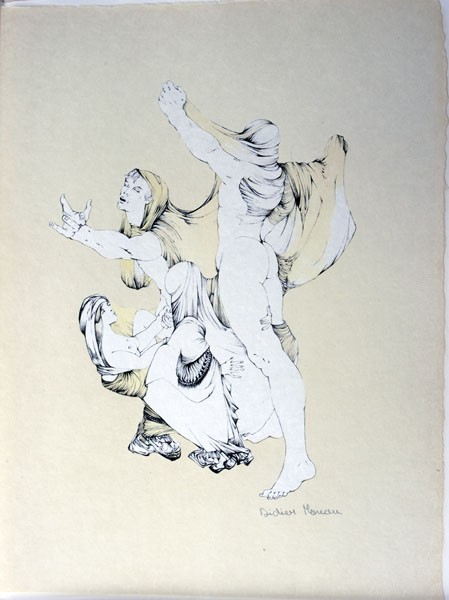
Didier Moreau is one of a handful of obscure artists whose work I go searching for now and then in the hope that more of it may have been posted somewhere. Moreau’s drawings first came to my attention via the marvellous Art Nouveau Revival 1900 . 1933 . 1966 . 1974 exhibition catalogue but details about either the artist or his work are scant, especially on Anglophone sites where more recent French artists tend to be marginalised at the best of times. Matters aren’t helped by there being several Didier Moreaus in the world, and the possibility that Didier the artist may not have produced a great deal of work after the early 1970s.
L’Amour, a portfolio of drawings from 1973 was discovered on an auction site. The drawings themselves date from 1970, and look very much like improvised pieces. The examples in Art Nouveau Revival were vaguely erotic in tone but distinctly Beardsley-like in style; the pieces here are much more erotic (hence the title) but with a style that’s closer to Hans Bellmer: all those fused bodies, multiplied limbs and sinuous, organic forms. If something like this can turn up out of the blue you have to wonder what else may come to light in the future.
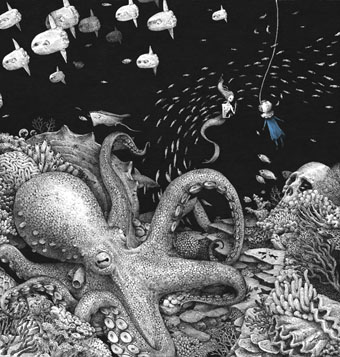
The Blue Girl (2013) by Sungwon.
• “Meanwhile, in her parents’ room [Max] Ernst painted aardvarks eating ants and big human hands around the windows. ‘Sexual connotations, I think,’ she says shyly.” Agnès Poirier talks to Cécile Eluard about her childhood among the Surrealists.
• “Thrilling and prophetic”: why film-maker Chris Marker‘s radical images influenced so many artists. Sukhdev Sandhu, William Gibson, Mark Romanek and Joanna Hogg on the elusive director.
• At Dangerous Minds: Throbbing Gristle live in Manchester in 1980, and Brian Butler talks about the rediscovered early print of Kenneth Anger’s Lucifer Rising. There’s a trailer!
• From 1981: The Art of Fiction No. 69 at The Paris Review, an interview with Gabriel García Márquez. Related: Thomas Pynchon reviewed Love in the Time of Cholera in 1988.
• “Seven years ago, a stolen first edition of Borges’s early poems was returned to Argentina’s National Library. But was it the right copy?” Graciela Mochkofsky investigates.
• “What was Walter Benjamin doing with his shirt off in Ibiza?” Peter E. Gordon reviews Walter Benjamin: A Critical Life by Howard Eiland & Michael W. Jennings.
• A video by Marcel Weber for Måtinden, a track from Eric Holm’s Andøya album. Another album on the Subtext label that I helped design.
• More Ian Miller: Boing Boing has pages from his new book, The Art of Ian Miller, and there’s an interview at Sci-Fi-O-Rama.
• Outrun Europa, a free compilation of 80s-style electronic music. There’s a lot more along those lines here.
• Praise Be! Favourite religious and spiritual records chose by writers at The Quietus.
• Ralph Steadman illustrated Alice’s Adventures in Wonderland in 1973.
• British Pathé is uploading 85,000 of its newsreel films to YouTube.
• Drawings by Lebbeus Woods at The Drawing Center, New York.
• At Pinterest: Ian Miller and Kenneth Anger.
• Lucifer Sam (1967) by Pink Floyd | The Surrealist Waltz (1967) by Pearls Before Swine | Which Dreamed It (1968) by Boeing Duveen And The Beautiful Soup