Weekend links 387

liquidsky.jpg

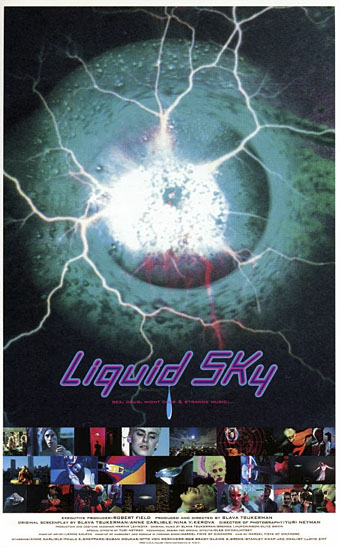
Japanese (?) poster for Liquid Sky (1982).

• The announcement this week of the death of Carl T. Ford, former editor of Dagon magazine, prompted a handful of memorial pieces. Dagon was notable for being a small British magazine devoted to Lovecraftian and other weird fiction (and the Call of Cthulhu games) at a time when the majority of such publications were American; it was also very well-produced, its later issues being typeset and filled with quality black-and-white illustration. Dagon interviewed many notable writers, including people such as Thomas Ligotti whose work at the time was still only known to a small group of enthusiasts. Mark Valentine posted a reminiscence at Wormwoodiana; Yog-Sothoth.com has an interview with Carl from 2010.

Michael “Dik Mik” Davies, manipulator of an audio generator and tape echo for Hawkwind, also died this week. Dik Mik’s primitive background electronics, augmented by Del Dettmar’s synthesizers, were an essential component of the early Hawkwind sound.

• Erik Davis talks to writer, photographer, and curator Joanna Ebenstein about Goth obsessions, memento mori, Santa Muerta, and her extraordinary new illustrated collection Death: A Graveside Companion.

• Slava Tsukerman’s cult film Liquid Sky (1982) finally gets a blu-ray release. From 2014: Punks, UFOs, and Heroin: Daniel Genis on how Liquid Sky became a cult movie.

Geeta Dayal explores the MOMA exhibition Thinking Machines: Art and Design in the Computer Age: 1959–1989.

You Should Come With Me Now is a collection of new fiction by M. John Harrison published this week.

VinylHub: “Our mission is to document every physical record shop and record event on the planet.”

Vladimir Nabokov‘s dream diary reveals experiments with “backwards timeflow”.

• Flawed Greatness: DB Jones on beauty and balance in John Ford’s The Searchers.

Irakli Kiziria on 9 synth artists who defined Eastern Europe’s post-Soviet sound.

• Edgar Allan Poe’s Hatchet Jobs: Mark Athitakis on Poe’s book reviews.

• Mix of the week: FACT mix 627 by Oneohtrix Point Never.

• At Creative Review: The design of Mute Records.

How generative music works.

Laraaji‘s favourite albums.

We Do It (1970) by Hawkwind | Adjust Me (1971) by Hawkwind | Electronic No. 1 (1973) by Hawkwind
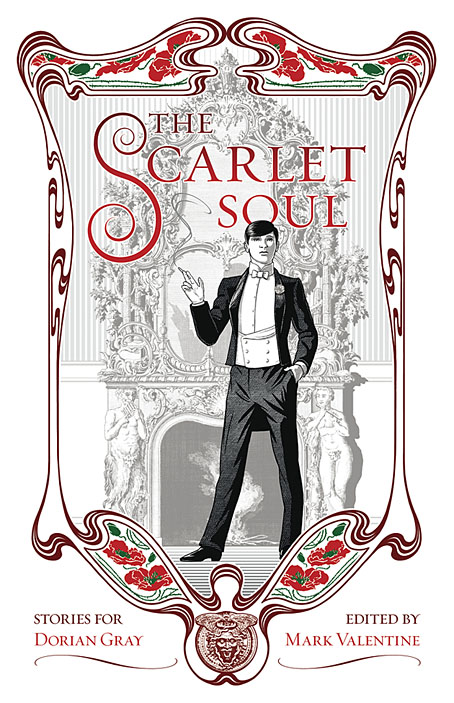
The Scarlet Soul: Stories for Dorian Gray

scarlet.jpg

With the running out of the year it’s time to start posting some of the things I’ve been working on for the past few months. This year has been an incredibly busy one with little breathing space between projects. Last month I mentioned not having enough time to put together a decent mix for Halloween; I also haven’t had enough time to prepare a calendar for next year. The latter isn’t a great loss since last year’s effort was a particularly bad seller but I still like doing them when I have the opportunity.

Before I get to one of the big illustration projects, here’s a cover I put together last month for Dublin’s Swan River Press. The theme should be self-evident, and this marks my second entry into Dorian Gray territory. It’s also the second thing that I’ve worked on this year with a connection to Mark Valentine (see this post for details of the first). Swan River publish a range of elegant hardback editions so I’m looking forward to seeing this one in print. As to the artwork, the frame is adapted from a 1900 calendar design by one Oscar Ziemann which I found in an issue of Deutsche Kunst und Dekoration. There’s next to nothing about Herr Ziemann on the web so his design may have been a one-off. The poppies are my own replacement for Ziemann’s floral designs; they relate to the hints that Oscar Wilde gives to Dorian Gray’s opium indulgence, and they’re scarlet flowers, of course.

The Scarlet Soul will be published next month but it’s available for pre-order here. My next work for Swan River Press will be a major edition of William Hope Hodgson’s weird masterwork, The House on the Borderland. More about that later.

Previously on { feuilleton }
Picturing Dorian Gray

Weekend links 386

ward.jpg

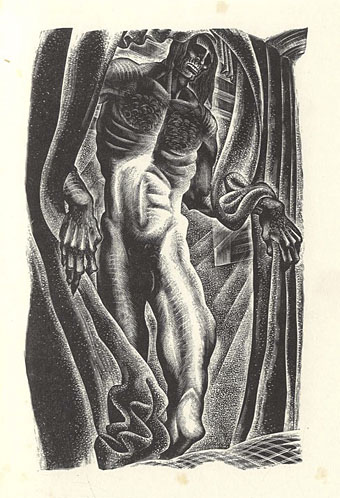
Lynd Ward again, and one of his illustrations for Frankenstein (1934).

• “Julio Mario Santo Domingo was a collector and visionary who filled his homes and warehouses with the world’s greatest private collection related to the subjects of drugs, sex, magic, and rock and roll: a library of more than 50,000 items…” Altered States: The Library of Julio Santo Domingo by Peter Watts catalogues some of the artefacts.

• “His vision of Gay Liberation was deeply, and uniquely, inflected by his study of, and belief, in anarchism.” More on the late Charles Shively: Michael Bronski remembers a pivotal figure in the gay liberation movement.

• William Friedkin’s Sorcerer was released on region-free blu-ray a couple of years ago but it’s being reissued again in the UK for its fortieth anniversary. Julian House has created a series of designs for the insert.

• Electronic musician and podcaster Marc Kate talks to Erik Davis about nihilism, horror movies, New Age music, and transmuting Nazi black metal into the ambient soundscapes of his latest album, Deface.

• “Beware the polished little man“: an extract from The Guesthouse at the Sign of the Teetering Globe by Franziska zu Reventlow which is available now from Rixdorf Editions.

• Another welcome blu-ray release, Sergei Parajanov’s The Colour of Pomegranates appears later this month in a special edition from Second Sight.

• Mixes of the week: FACT mix 626 by Sharp Veins, XLR8R Podcast 515 by Sammy Dee, and Secret Thirteen Mix 236 by Beta Evers.

The Witch Wave with Pam Grossman is a podcast for bewitching conversation about magic, creativity, and culture.

• Call me by the wrong name: Benjamin Lee on Hollywood’s perennial attempts to straight-wash gay films.

• At Dennis Cooper’s: Spotlight on…Ronald Firbank Concerning the Eccentricities of Cardinal Pirelli (1926).

• Zoë Lescaze reviews Frankenstein: The First Two Hundred Years by Christopher Frayling.

• Angry Optimism in a Drowned World: A Conversation with Kim Stanley Robinson.

• Stewart Smith on The Strange World of…Linda Sharrock.

Colors (1969) by Pharoah Sanders | Frankenstein (1972) by The Edgar Winter Group | Pomegranate (2001) by Transglobal Underground

Weekend links 385

picasso.jpg

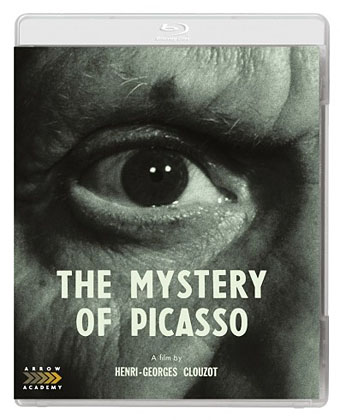
• It won’t be out until late January—and then in the UK only—but the blu-ray premiere of The Mystery of Picasso (1956) by Henri-Georges Clouzot was announced this week. The initial run of the discs (there’s also a DVD) will include a booklet containing my essay about the film, something I was very pleased and honoured to be asked to write. Clouzot’s remarkable study of Picasso drawing and painting for the camera was made immediately after his masterwork, The Wages of Fear (also newly available on UK blu-ray), and this new edition will include two short extras, one of which, A Visit to Picasso (1949) by Paul Haesaerts, is an excellent precursor/companion to the main feature. More on this subject later.

• At the Internet Archive: an almost complete run of The Twilight Zone Magazine (1981–1989). While masquerading as a TV-series spin-off, TZ under the editorship of TED Klein was an excellent periodical devoted to horror and dark fantasy. In addition to running original fiction by major authors (Stephen King was a regular), the magazine contained features about older writers such as Lovecraft and Machen along with book reviews by Thomas Disch, film reviews by Gahan Wilson, interviews and more.

• “Bram Stoker was gay,” says Tom Cardamone in a review of Something in the Blood: The Untold Story of Bram Stoker, the Man Who Wrote Dracula by David J. Skal. I’ve not read Skal’s book so can’t comment on its claims but his earlier Hollywood Gothic (about Dracula on page and screen) includes some discussion of “sexual ambiguity” in Stoker’s work.

• Mixes of the week: FACT mix 625 by Elena Colombi, Secret Thirteen Mix 235 by Rhys Fulber, and XLR8R Podcast 514 by Tommaso Cappellato.

Help, Help, The Globolinks! is a previously unreleased electronic soundtrack by Suzanne Ciani, out next week.

La Région Centrale (1971), Michael Snow’s epic of landscape gyrations in two parts, here and here.

Alexander Calder and the Optimism of Modernism: Jed Perl in Conversation with Morgan Meis.

• Illustrations by Lynd Ward for The Haunted Omnibus (1935) edited by Alexander Laing.

Daniel Dylan Wray on the gay-porn music of disco pioneer Patrick Cowley.

• It’s that man again (and his drawings): Ernst Haeckel: the art of evolution.

• At Dennis Cooper’s: Steve Erickson presents A Black Psychedelia Primer.

Bootsy Collins‘ favourite albums.

Picasso (1948) by Coleman Hawkins | Pablo Picasso (1976) by The Modern Lovers | Picasso Suite pt. 1 (1993) by David Murray Octet

An unseasonable bloom

orchid1.jpg

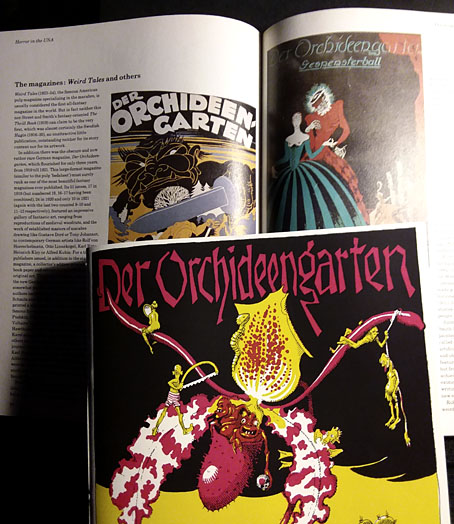
It’s a strange thing to compare the covers of Der Orchideengarten in Franz Rottensteiner’s The Fantasy Book (1978) with the facsimile of the first issue which has just been published by Zagava. For years the two covers and Rottensteiner’s laudatory description were all I knew of a magazine that nobody else seemed to write about. As with all such enigmas, this made the magazine all the more intriguing. Der Orchideengarten was short-lived, running from 1919 to 1921, and German, which no doubt did little to aid its post-war reputation. Whatever reputation it may have had was quickly eclipsed by Weird Tales and a host of other Anglophone publications some of whose creations still dominate the fantasy landscape today. One of the many services Rottensteiner’s study provided was to treat fantasy as a genre with manifestations all over the world, not only in Britain and America.

orchid2.jpg

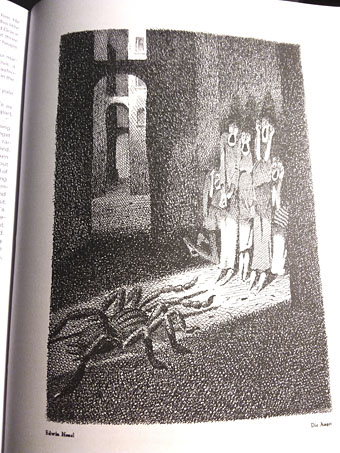
The visibility of Der Orchideengarten began to change in 2009 when Will at the now-defunct A Journey Round My Skull, having also had his curiosity piqued by Rottensteiner’s book, acquired a few copies of the magazine. I ran some of the interior illustrations here, the sight of which was genuinely revelatory since these weird and macabre drawings had been buried for 90 years. The situation changed again late last year when the entire run of the magazine was made available at the University of Heidelberg’s remarkable online archive.

What struck me in 2009—and what continues to strike me today—is the difference in tone between the illustrations, covers included, of Der Orchideengarten with its later Anglophone counterparts, especially Weird Tales. The latter presented itself very much in the pulp tradition, and many of the illustrators of the early issues were just as happy working with adventure or detective titles as they were with fantasy or horror. The German artists are less illustrational and much more grotesque, closer at times to Expressionist painting than anything you’d find in an American magazine. I continue to wonder how fantasy as a genre might have developed if it had owed less to Britain’s ghost stories and America’s adventure idioms.

orchid3.jpg

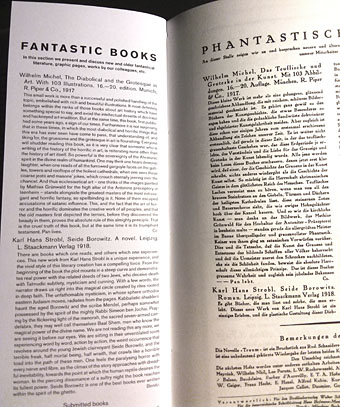
Any speculation is easier now we have this facsimile of the first issue which (as I mentioned in a weekend post) contains a translation into English by Helen Grant of the complete contents of the magazine. This has been cleverly achieved by interleaving narrower pages of translated text with the originals so the integrity of the magazine is maintained. The facsimile is a quality production with superb printing of all the illustrations and graphics. One of the ironies of our connected world is that contemporary magazines continue to be killed off while the easier accessibility of so much culture from the past makes resurrections like this one more likely.

orchid4.jpg

Whether we see more facsimile issues will no doubt depend on the success of this first number which may be ordered here. A few more page samples follow.

Continue reading “An unseasonable bloom”