Weekend links 385

picasso.jpg

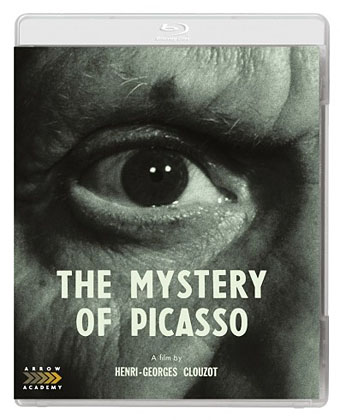
• It won’t be out until late January—and then in the UK only—but the blu-ray premiere of The Mystery of Picasso (1956) by Henri-Georges Clouzot was announced this week. The initial run of the discs (there’s also a DVD) will include a booklet containing my essay about the film, something I was very pleased and honoured to be asked to write. Clouzot’s remarkable study of Picasso drawing and painting for the camera was made immediately after his masterwork, The Wages of Fear (also newly available on UK blu-ray), and this new edition will include two short extras, one of which, A Visit to Picasso (1949) by Paul Haesaerts, is an excellent precursor/companion to the main feature. More on this subject later.

• At the Internet Archive: an almost complete run of The Twilight Zone Magazine (1981–1989). While masquerading as a TV-series spin-off, TZ under the editorship of TED Klein was an excellent periodical devoted to horror and dark fantasy. In addition to running original fiction by major authors (Stephen King was a regular), the magazine contained features about older writers such as Lovecraft and Machen along with book reviews by Thomas Disch, film reviews by Gahan Wilson, interviews and more.

• “Bram Stoker was gay,” says Tom Cardamone in a review of Something in the Blood: The Untold Story of Bram Stoker, the Man Who Wrote Dracula by David J. Skal. I’ve not read Skal’s book so can’t comment on its claims but his earlier Hollywood Gothic (about Dracula on page and screen) includes some discussion of “sexual ambiguity” in Stoker’s work.

• Mixes of the week: FACT mix 625 by Elena Colombi, Secret Thirteen Mix 235 by Rhys Fulber, and XLR8R Podcast 514 by Tommaso Cappellato.

Help, Help, The Globolinks! is a previously unreleased electronic soundtrack by Suzanne Ciani, out next week.

La Région Centrale (1971), Michael Snow’s epic of landscape gyrations in two parts, here and here.

Alexander Calder and the Optimism of Modernism: Jed Perl in Conversation with Morgan Meis.

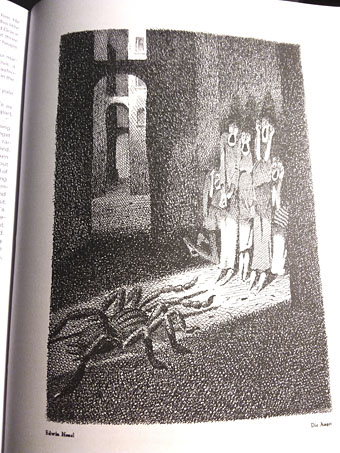
• Illustrations by Lynd Ward for The Haunted Omnibus (1935) edited by Alexander Laing.

Daniel Dylan Wray on the gay-porn music of disco pioneer Patrick Cowley.

• It’s that man again (and his drawings): Ernst Haeckel: the art of evolution.

• At Dennis Cooper’s: Steve Erickson presents A Black Psychedelia Primer.

Bootsy Collins‘ favourite albums.

Picasso (1948) by Coleman Hawkins | Pablo Picasso (1976) by The Modern Lovers | Picasso Suite pt. 1 (1993) by David Murray Octet
An unseasonable bloom

orchid1.jpg

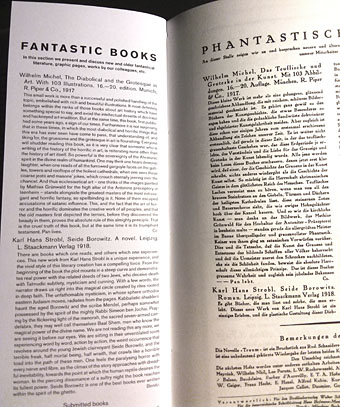
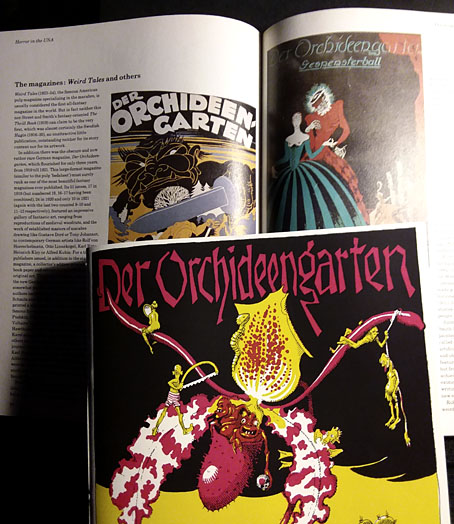
It’s a strange thing to compare the covers of Der Orchideengarten in Franz Rottensteiner’s The Fantasy Book (1978) with the facsimile of the first issue which has just been published by Zagava. For years the two covers and Rottensteiner’s laudatory description were all I knew of a magazine that nobody else seemed to write about. As with all such enigmas, this made the magazine all the more intriguing. Der Orchideengarten was short-lived, running from 1919 to 1921, and German, which no doubt did little to aid its post-war reputation. Whatever reputation it may have had was quickly eclipsed by Weird Tales and a host of other Anglophone publications some of whose creations still dominate the fantasy landscape today. One of the many services Rottensteiner’s study provided was to treat fantasy as a genre with manifestations all over the world, not only in Britain and America.

orchid2.jpg

The visibility of Der Orchideengarten began to change in 2009 when Will at the now-defunct A Journey Round My Skull, having also had his curiosity piqued by Rottensteiner’s book, acquired a few copies of the magazine. I ran some of the interior illustrations here, the sight of which was genuinely revelatory since these weird and macabre drawings had been buried for 90 years. The situation changed again late last year when the entire run of the magazine was made available at the University of Heidelberg’s remarkable online archive.

What struck me in 2009—and what continues to strike me today—is the difference in tone between the illustrations, covers included, of Der Orchideengarten with its later Anglophone counterparts, especially Weird Tales. The latter presented itself very much in the pulp tradition, and many of the illustrators of the early issues were just as happy working with adventure or detective titles as they were with fantasy or horror. The German artists are less illustrational and much more grotesque, closer at times to Expressionist painting than anything you’d find in an American magazine. I continue to wonder how fantasy as a genre might have developed if it had owed less to Britain’s ghost stories and America’s adventure idioms.

orchid3.jpg

Any speculation is easier now we have this facsimile of the first issue which (as I mentioned in a weekend post) contains a translation into English by Helen Grant of the complete contents of the magazine. This has been cleverly achieved by interleaving narrower pages of translated text with the originals so the integrity of the magazine is maintained. The facsimile is a quality production with superb printing of all the illustrations and graphics. One of the ironies of our connected world is that contemporary magazines continue to be killed off while the easier accessibility of so much culture from the past makes resurrections like this one more likely.

orchid4.jpg

Whether we see more facsimile issues will no doubt depend on the success of this first number which may be ordered here. A few more page samples follow.

Continue reading “An unseasonable bloom”

Weekend links 384

muljat.jpg

Sultans of Swing by Samantha Muljat.

• Pain & Pleasure, Indivisible: Mat Colegate talks to Stephen Thrower (Coil, Cyclobe) about the meeting between Coil and Clive Barker that would have led to Coil scoring Barker’s Hellraiser if the studio hadn’t rejected the music.

• “From Arsedestroyer to Zoogz Rift: 50 underground albums you’ve never heard of” The usual presumption—I’ve been listening to The Groundhogs since the mid-1980s—but it’s a good list.

• More magazines at the Internet Archive: an incomplete run of British science-fiction monthly Interzone; and a complete (?) run of the film magazine for horror (and gore) obsessives, Fangoria.

• “…it’s background music, is what it is. But there’s nothing wrong with that. I’m very proud of it.” John Carpenter discussing his soundtrack music and his new album, Anthology.

• Mixes of the week: Aral Mix 05 by Ellen Arkbro, Secret Thirteen Mix 234 by FOQL, and Samhain Séance Six: Triffid Witch by The Ephemeral Man.

• Dallas Killers Club: Nicholson Baker reads a stack of books about the Kennedy assassinations then draws his own conclusions.

Michael Flanagan on searching for LGB histories of Neopaganism, the paranormal and the occult in San Francisco.

• At Lounge Books: author Amelia Mangan on horror, old and new, and her favourite things.

• At Monoskop: the (almost) complete works of James Joyce in one convenient epub.

Jillian Steinhauer on Duchamp’s last riddle.

Hell Raiser (1973) by Sweet | Hell’s Bells (1989) by Rhythm Devils | Hell’s Winter (2011) by Earth

Weekend links 383

nomata.jpg

Arcadia-24 (1988) by Minoru Nomata.

Dark Entries and Honey Soundsystem Records release a video of edited moments from gay porn film Afternooners to promote the release of the film’s electronic soundtrack by Patrick Cowley. The album, which is the third and final collection of Cowley’s porn soundtracks, is out now.

Emily Temple looks at some of the art inspired by Italo Calvino’s Invisible Cities. I explored the same subject a couple of years ago in a week of Calvino art posts. From 2014: Peter Mendelsund on designing covers for Calvino.

Jim Downes on the late Charley Shively, a gay liberation activist who wasn’t interested in equality. Not an uncommon attitude in some gay circles but it’s one you seldom see aired in the mainstream press.

Geeta Dayal on A Little Electronic Milky Way of Sound by Roland Kayn, a 14-hour composition of “cybernetic music” which has been released in a lavish 16-CD box set by Frozen Reeds.

• An introduction to Henri-Georges Clouzot in seven films by Adam Scovell. Clouzot’s masterwork, The Wages of Fear (1953), is released on blu-ray by the BFI next week.

• Ubu Yorker: Menachem Feuer interviews Kenneth Goldsmith, writer and the man behind Ubuweb.

• Why Oscar-winning cinematographer Vittorio Storaro thinks the film vs. digital debate is bullshit.

David Barnett on supernatural fiction’s “best kept secret”, Robert Aickman.

Michèle Mendelssohn on how Oscar Wilde’s life imitates his art.

• Mix of the week: Secret Thirteen Mix 233 by Mick Harris.

Invisible Limits (1976) by Tangerine Dream | Invisible Cities (1990) by Jah Wobble’s Invaders Of The Heart | Invisible Architecture (1995) by John Foxx

Weekend links 382

yoshida.jpg

Raven (2015), a metal sculpture by Taiichiro Yoshida.

• “Lumia: Thomas Wilfred and the Art of Light [at the Smithsonian American Art Museum] restores Thomas Wilfred (1889–1968) to his rightful place in the history of modern art.”

• At Brown Noise Unit: a fascinating, lengthy interview by Philip Kaberry with Stephen O’Malley of Sunn O))) et al, with particular focus on O’Malley’s work with Japanese musicians.

• Erik Davis talks to scholar, writer, and mythographer William Rowlandson about Jorge Luis Borges, magical trees, Yankee mysticism, and the power of the weird and murky.

• The first issue of the world’s first magazine of fantastic art and literature, Der Orchideengarten (previously), has been reprinted in full with additional English translation.

• At Muddy Colors: the month in covers for September/October which includes my cover for Under the Pendulum Sun by Jeannette Ng (and which is on sale now).

• At 3:AM Magazine: Adam Scovell talks to horror author Ramsey Campbell about the ghost stories of MR James.

Paralysis: Live at Silent Night #8, a new release on (limited) cassette and digital by The House In The Woods.

• At Dangerous Minds: Jozef van Wissem buries the dead in his new video, Virium Illarum.

PKD Files — A podcast about the life and work of Philip K. Dick.

• Russell Cuzner on The Strange World of Nurse With Wound.

Clark Collis on the rise and fall of Fangoria.

• The North Star Grassman And The Ravens (1971) by Sandy Denny | Flight Of The Raven (1979) by Emerald Web | Kill The Great Raven (1979) by Snakefinger