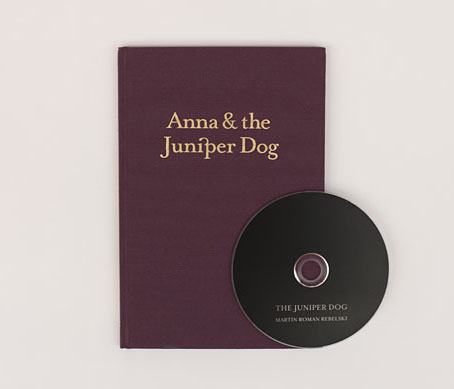
Anna & the Juniper Dog

juniper.jpg

The Juniper Dog strained its twisted roots against an ember red sky, snarling out swarms of night moths, barking flocks of owls from its splintery jaws. It howled the sea. Spat stars. Clouds roiled and clotted through the tree dog’s teeth.

Anna & the Juniper Dog was published this summer although it’s a tale which seems more suited to the gloom of autumn. (Having said that, summer this year was so persistently cold, wet and dreary it’s been autumn in all but name.) The story is by Geoff Cox, and the slim clothbound volume from Blackmaps Press comes profusely illustrated by Rohan Daniel Eason, and with an accompanying CD containing 30 minutes of beautiful instrumentals by Martin Roman Rebelski. This is the second book in a trilogy of tales about Cox’s Anna character, wherein we follow Anna through a succession of dream-like episodes freighted with mysteries, epiphanies and ritual moments.
eason.jpg

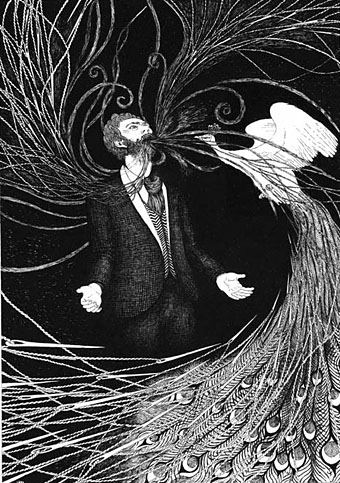
“Thorns burst from the Old Man’s mouth.”

The combination of another character named Boy, and various encounters with anthropomorphic animals, reminded me of Mervyn Peake’s wonderful Boy in Darkness, while the illustrations bring to mind the cross-hatched art of Edward Gorey. Eason’s drawings add a great deal to the fairytale atmosphere without merely replicating Cox’s evocative descriptions. The icing on the cake is a book design by La Boca with the attention to detail this kind of self-contained project requires: the typesetting uses the ligatures common to better typefaces but which one seldom sees employed today. A great example of the book as an object to be treasured, and ideal reading (and listening) for longer and chillier evenings.
Maps and legends

nineworlds1.jpg

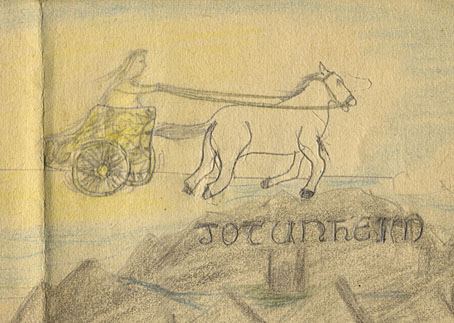
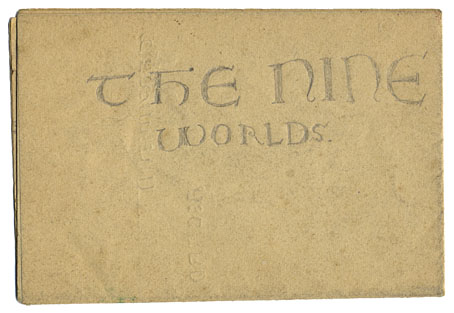
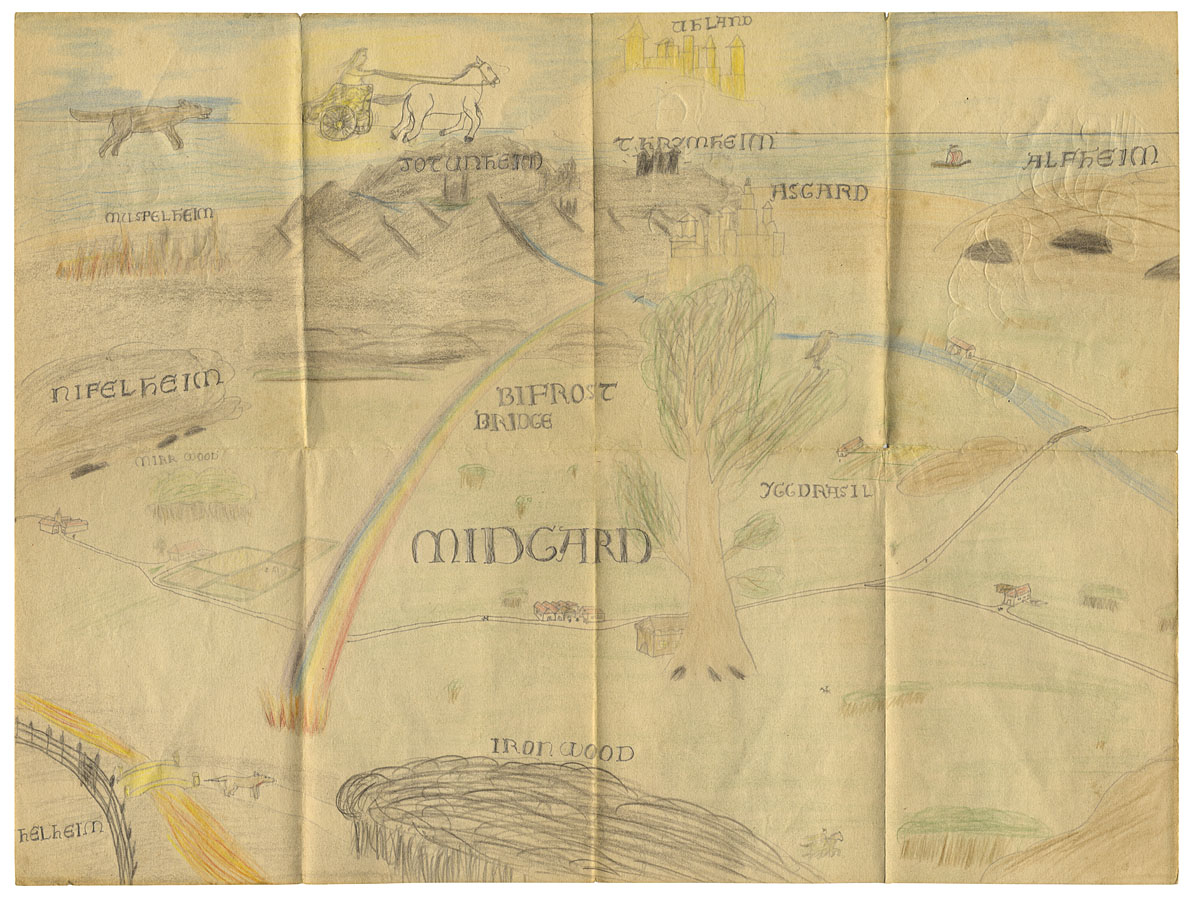
Following the mention yesterday of my facsimile John Speed map I set about searching for the map in question since it’s managed to survive all these years. For the moment I haven’t been able to find it but going through a portfolio of old drawings I finally found this item, a map or chart or the Nine Worlds of Norse mythology which I drew when I was 11 years old. Various family traumas mean a lot of my early artwork hasn’t survived so this drawing is the earliest piece of my work that I own. (Click below for a bigger view.)

nineworlds2.jpg

nineworlds3.jpg

Sol in her Sun Chariot. The horse evidently looked better after a second attempt.

I can be specific about my age since I remember drawing this in 1973 shortly after moving to secondary school. The paper is the horrible stuff that was standard issue at that place, rough and terrible for pencil work. I’d been given a new set of coloured pencils so took advantage with this to use just about every colour in the box.

Continue reading “Maps and legends”

Kay Nielsen’s East of the Sun and West of the Moon

nielsen05.jpg

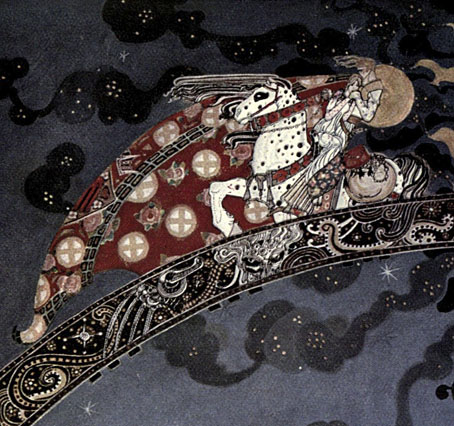
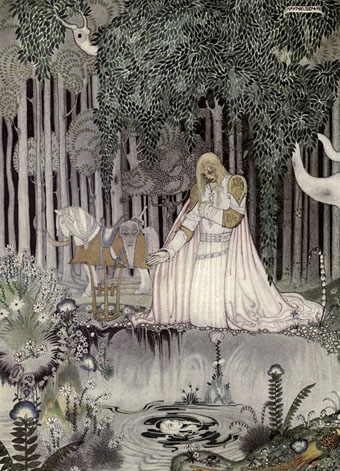
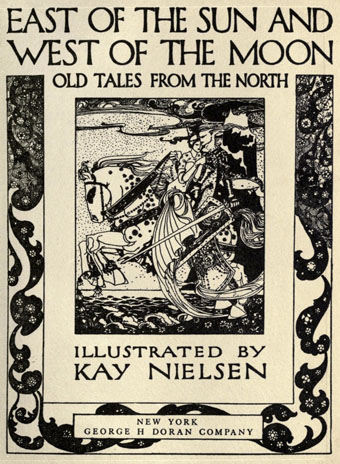
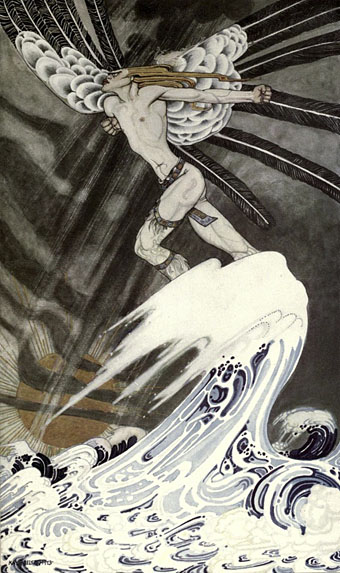
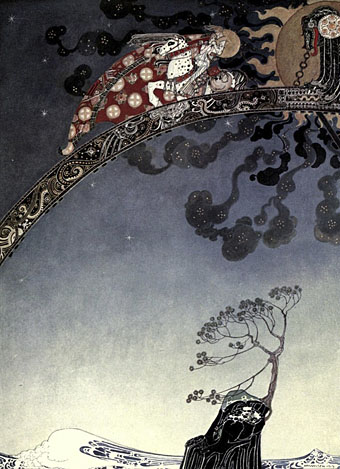
Kay Nielsen’s meticulous approach to illustration is shown to great effect in the colour plates for this 1914 collection of fairy tales subtitled Old Tales from the North. The theme might be northern but Nielsen (who was Danish) maintains his beautifully hybrid style with its hints of Japonism and Persian miniatures. The whole book can be viewed or downloaded in a variety of formats here.

• Kay Nielsen at Bud Plant

nielsen01.jpg

nielsen02.jpg

nielsen03.jpg

nielsen04.jpg

Elsewhere on { feuilleton }
• The illustrators archive

Wildeana 6

robinson1.jpg

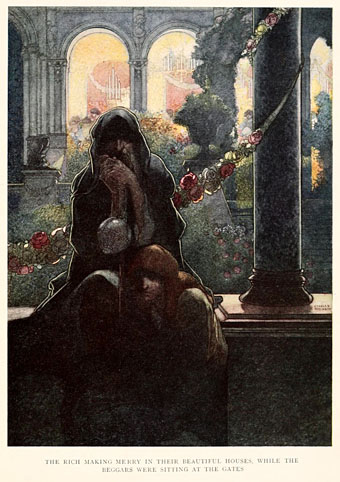
“The rich making merry in their beautiful houses, while the beggars were sitting at the gates.” Above and below: illustrations by Charles Robinson from The Happy Prince and Other Tales, an edition from 1920.

Continuing an occasional series. I’ve yet to see a copy of the recent annotated and unexpurgated edition of The Picture of Dorian Gray but Alex Ross wrote a marvellous essay for the New Yorker about the novel, its creation, its public reception, and Wilde’s decision to tone down the overt homoeroticism of its earlier drafts. This is one of the best pieces I’ve seen for a while about Wilde, replete with choice detail:

The gay strain in Wilde’s work is part of a larger war on convention. In the 1889 story “The Portrait of Mr. W. H.,” a pseudo-scholarly, metafictional investigation of Shakespeare’s sonnets to a boy, Wilde slyly suggests that the pillar of British literature was something other than an ordinary family man. In the 1891 play “Salomé,” Wilde expands a Biblical anecdote into a sumptuous panorama of decadence. Anarchists of the fin de siècle, especially in Germany, considered Wilde one of their own: Gustav Landauer hailed Wilde as the English Nietzsche. Thomas Mann expanded on the analogy, observing that various lines of Wilde might have come from Nietzsche (“There is no reality in things apart from their experiences”) and that various lines of Nietzsche might have come from Wilde (“We are basically inclined to maintain that the falsest judgments are the most indispensable to us”). Nietzsche and Wilde were, in Mann’s view, “rebels in the name of beauty.”

As for the novel, I’m feeling rather Dorian Grayed-out at the moment, having recently completed ten illustrations based on the story for a forthcoming anthology. More about that later.

Elsewhere, the William Andrews Clarke Memorial Library in Los Angeles has been running an exhibition, Oscar Wilde & the Visual Art(ists) of the Fin-de-Siecle, since July, and will continue to do so until the end of September. No word about what’s on display but this page on their website has details of their collection of Wilde materials which they say is the most comprehensive in the world.

Finally, the majority of visits to these pages in recent days have come from this post about Ivan Albright’s astonishing Dorian Gray painting in the Art Institute of Chicago. The post links to an earlier one of mine about the paintings used in Albert Lewin’s 1945 film of the book.

robinson2.jpg

Elsewhere on { feuilleton }
• The Oscar Wilde archive

Weekend links 70

swinburne1.jpg

Faustine (1928) by Harry Clarke.

• This week’s Harry Clarke fix: 50 Watts reposts the Faust illustrations while Golden Age Comic Book Stories has the illustrated Swinburne.

• What Goes Steam in the Night is an evening with contributors to The Steampunk Bible hosted in London by The Last Tuesday Society on September 6th:

Co-author S. J. Chambers invites you to the official U.K. celebration of her book The Steampunk Bible (Abrams Image). Part lecture, part signing, and part entertainment, S. J. will be accompanied by contributors Jema Hewitt (author of Steampunk Emporium ) and Sydney Padua (Lovelace & Babbage) for a discussion of the movement, a special performance by Victorian monster hunter, Major Jack Union, and inevitable hi-jinks and shenanigans to later be announced.

• RIP Conrad Schnitzler, an incredibly prolific electronic musician, and founder member of Tangerine Dream and Kluster/Cluster.

• Golden Pavilion Records reissues fully-licensed late 60’s and 70’s psychedelic, progressive, acid-folk & art-rock music.

• Dressing the Air is “an exclusive consulting and online resource for the creative industries”.

• Luke Haines explains how to cook rabbit stew whilst listening to Hawkwind.

• Wood pyrography by Ernst Haeckel from his home, the Villa Medusa.

swinburne2.jpg

Satia Te Sanguine (1928) by Harry Clarke.

The truth is, the best novels will always defy category. Is Great Expectations a mystery or The Brothers Karamazov a whodunnit or The Scarlet Letter science fiction? Does Kafka’s Metamorphosis belong to the genre of fantasy? In reality men don’t turn into giant insects. And it’s funny. Does that mean it’s a comic novel? […] At a time when reading is in trouble, those readers left should define themselves less rigidly.

Howard Jacobson: The best fiction doesn’t need a label.

• Pace the redoubtable Jacobson, Alan Jacobs believes We Can’t Teach Students to Love Reading.

• How Ken Kesey’s LSD-fuelled bus trip created the psychedelic 60s.

• Salvador Dalí creates something for Playboy magazine in 1973.

• JG Ballard: Relics of a red-hot mind.

• Electric Garden (1978) by Conrad Schnitzler | Auf Dem Schwarzen Kanal (1980) by Conrad Schnitzler.