Beardsley’s Rape of the Lock

pope1.jpg

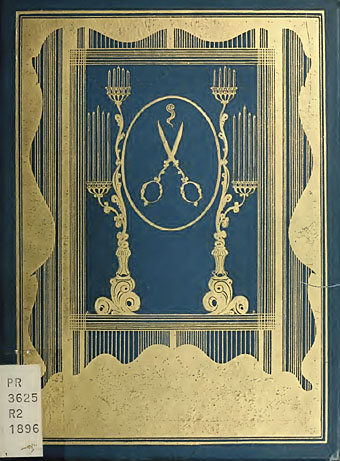
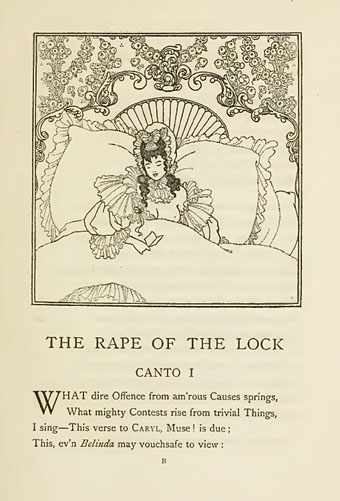
This week’s reading has been Virginia Woolf’s Orlando, a capricious novel which features in its 18th century scenes encounters with some of the great poets of the era, including Alexander Pope. A number of references are made to Pope’s satiric The Rape of the Lock (1717), one of his most notable works which received an equally notable set of illustrations in 1896 from Aubrey Beardsley. The pictures here are from a copy of the first edition published by Leonard Smithers which can be seen at the Internet Archive where the collection features a large number of books created by or written about the artist. Even though Beardsley’s illustrations are endlessly reprinted I do like to see how they were first presented to the world, how the pages were typeset and so on. One detail from this first edition is that we see the credit on the title page: “Embroidered with nine drawings by Aubrey Beardsley.” The cover design is often reproduced in its original black-and-white state which fails to convey the intended effect of those great slabs of gold, while the illustrations within are some of the finest and most detailed of the artist’s career. If the PDF doesn’t really do them justice there are better copies to be found, here and here, for example.
pope2.jpg

Leonard Smithers was notorious in Victorian London for his publishing of pornography but he tried to use the proceeds to occasionally produce works with a better reputation such as this. Beardsley had also been tarred as a pornographer, of course, but here he restrained himself in order to do justice to a book he admired. There is one possible exception in the cover design; I’m afraid I couldn’t find the reference but one of Beardsley’s critics asserts that the open scissors and fatal lock of hair shown in the mirror create a surreptitious image of the female pudenda. With many other artists this interpretation might be dismissed as fanciful but Aubrey filled his early drawings with phalluses and breast shapes, and his unfinished novel, the erotic fantasy Under the Hill, has a title referring to the mons pubis. No other artist of the time would be so daring even with a pornographer for a publisher; it was just this sort of impudence which infuriated his more staid contemporaries. Under the Hill is far more overt in its sexuality and its writing style owes something to Pope’s era which Aubrey adored. The posthumous edition of that book, containing other Beardsley ephemera, can be found here.

Elsewhere on { feuilleton }
The Aubrey Beardsley archive
The illustrators archive
The book covers archive

Weekend links 29

dancer.jpg

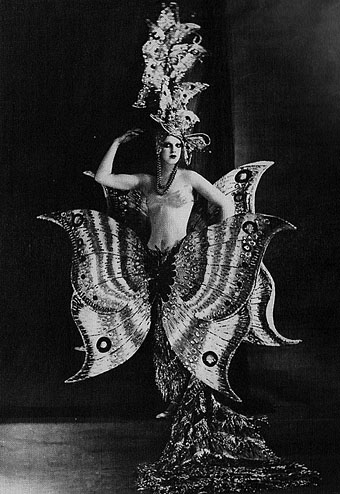
A Folies Bergère dancer, c. 1909.

Six Novels in Woodcuts: The Library of America publishes a boxed set of Lynd Ward’s works: Gods’ Man, Madman’s Drum, Wild Pilgrimage, Prelude to a Million Years, Song Without Words and Vertigo.

• RIP ace graphic designer Raymond Hawkey. Related: Raymond Hawkey: An eye for detail, and Hawkey’s James Bond cover designs from the mid-60s.

The Record: Contemporary Art and Vinyl, an exhibition at Duke University, North Carolina, features work by 41 artists from around the world, from the 1960s to the present, using vinyl records as subject or medium.

decaris.jpg

The Île de la Cité, a steel engraving by Albert Decaris (1950).

Fred Tomaselli will have a new exhibition of his work at the Brooklyn Museum next month.

Socialist Monuments in Bulgaria photographed by Linda Ferrari.

• What would Howard think of the Mythos Art Dildo?

Space is Process, a film about Olafur Eliasson.

Thurston Moore’s Indie Books.

Chris Colfer in a leather bar.

Ephemeral New York.

• Chrome! Helios Creed’s YouTube channel.

Tranquillo Marangoni bookplates

marangoni1

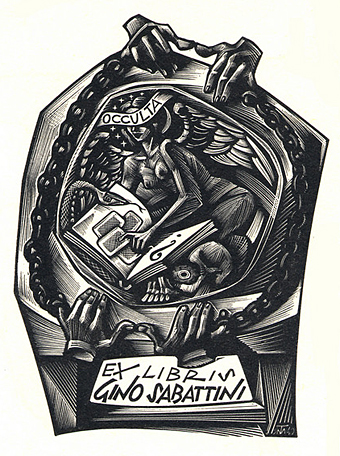
Occulta (1949).

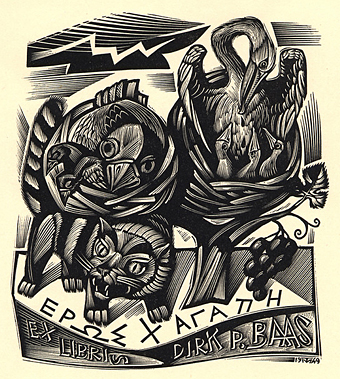
Two of the many bookplates produced by Italian artist Tranquillo Marangoni (1912–1992). The official site (in Italian) has three pages of ex libris work as well as further pages devoted to his woodcut book illustrations, postage stamp designs and other graphic productions.

marangoni2

Eros x Agapi (1949).

Elsewhere on { feuilleton }
The illustrators archive

Previously on { feuilleton }
Book-plates of To-day
Louis Rhead bookplates
Pratt Libraries Ex Libris Collection
The Evil Orchid Bookplate Contest
David Becket’s bookplates

Weekend links 28

/shah1.jpg

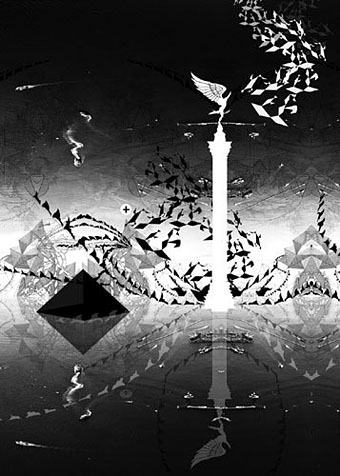
The Expansion of the First Great Ornamental Age: 3 Distances (2009) by Seher Shah.

Great Female Artists? Think Karachi. “One reason for the unusually high ratio of female artists in Pakistan has to do with the fact that the art industry has not traditionally been viewed as a lucrative business by men, says South Asian art historian Savita Apte, who administers the internationally renowned Abraaj Capital Art Prize. Until very recently, creatively inclined males tended to focus on fields such as advertising or illustration, leaving the art field wide open for some very talented women.” Related: artist Seher Shah (and also here).

• Hardformat looks at the luxury/collectors/whatever edition of the forthcoming Brian Eno album. “What’s the music like?” Colin asks. Indeed.

Strange Flowers is “a celebration of the most extraordinary, eccentric and unfairly forgotten figures of the past 200 years”.

Warsaw Warble: Illustration and design in Poland, 1917 to 1938. More marvels from A Journey Round My Skull.

• Strange Attractor hosts talks at London’s Little Shoppe of Horrors throughout the autumn.

• Barney Bubbles in Mojo and more details of the new edition of Paul Gorman’s BB book.

• A blog devoted to all things having to do with Howard Pyle (1853–1911).

Erik Davis on Dreaming, Writing, Philip K Dick and Lovecraft.

10 Reading Revolutions Before E-Books.

Secular Exorcisms by Evan J Peterson.

• RIP Jean Benoît.

Street haikus.

I Put A Spell On You (1965) by Screamin’ Jay Hawkins; I Put A Spell On You (1965) by Nina Simone; I Put A Spell On You (2001) by Natacha Atlas.

The Art Nouveau dance goes on forever

nouveau1.jpg

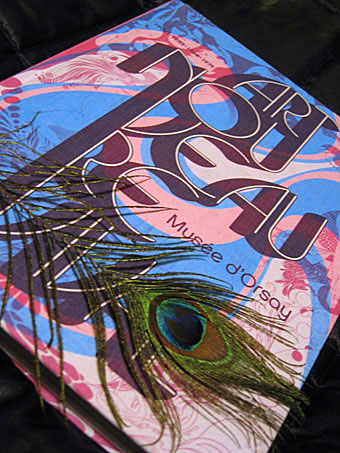
Catalogue for Art Nouveau Revival 1900 . 1933 . 1966 . 1974. Peacock feather not included.

Regular readers may recall my mention of the Musée d’Orsay exhibition Art Nouveau Revival which was launched late last year. I didn’t get to see the exhibition, unfortunately, but this week I finally ordered a copy of the catalogue, an expensive cloth-bound volume with essays (in French) by Philippe Thiébaut, Stephen Calloway, Irene de Guttry, Thierry Taittinger and Philippe Thieryre. Despite the ruinous postal charges incurred by the book’s weight this was worth every euro, it being the kind of polymorphous production which in solipsistic moments one can choose to believe was created solely for your own benefit.

nouveau3.jpg

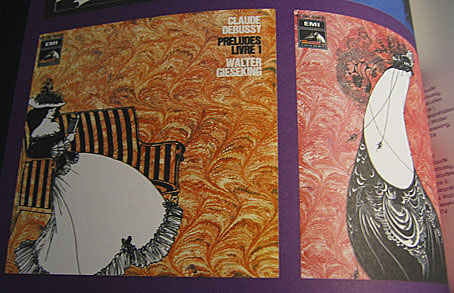
Aubrey again, album covers from 1974.

Much of the subject matter has been explored here in various small ways, with the curators following the influence of Art Nouveau through Surrealism (mainly Dalí) to the psychedelic art of the 1960s and on into the Pop Nouveau (for want of a better term) which flourished in the first half of the 1970s. Among the familiar Aubrey Beardsley graphics and psychedelic posters there are also some pleasantly surprising inclusions, including illustrations by Philippe Jullian (yes, I’m still intending on writing about him at some point), yet more Beardsley album covers, film posters, and even some of the sillier films of the late-60s such as Casino Royale. Being a French exhibition there’s a section devoted to comic strips which includes work by Moebius, Philippe Druillet and Guido Crepax.

nouveau2.jpg

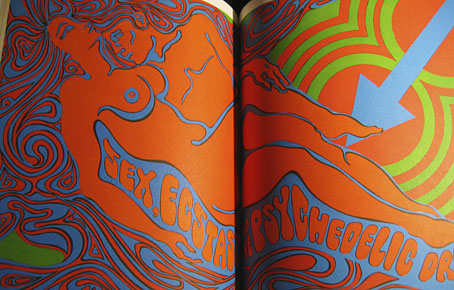
Sex and LSD, a spread from Playboy, 1967.

It’s common to see parallels drawn between the 1890s and the 1960s but the strange blooms of vulgarised fin de siècle style which burgeoned in the wake of psychedelia are seldom given much attention. One of the great things about this catalogue is the amount of ephemera the curators chose to include such as magazine ads and trend-chasing album sleeves. It was precisely this blend of 1890s + 1960s + 1970s I sought to capture in my recent cover for Dodgem Logic. As I said, it’s an expensive book but for anyone drawn to this aesthetic hothouse it’s also an essential purchase. Art Nouveau Revival can be ordered direct from the museum shop. Further samples follow.

Continue reading “The Art Nouveau dance goes on forever”