Reverbstorm in print

rev1.jpg

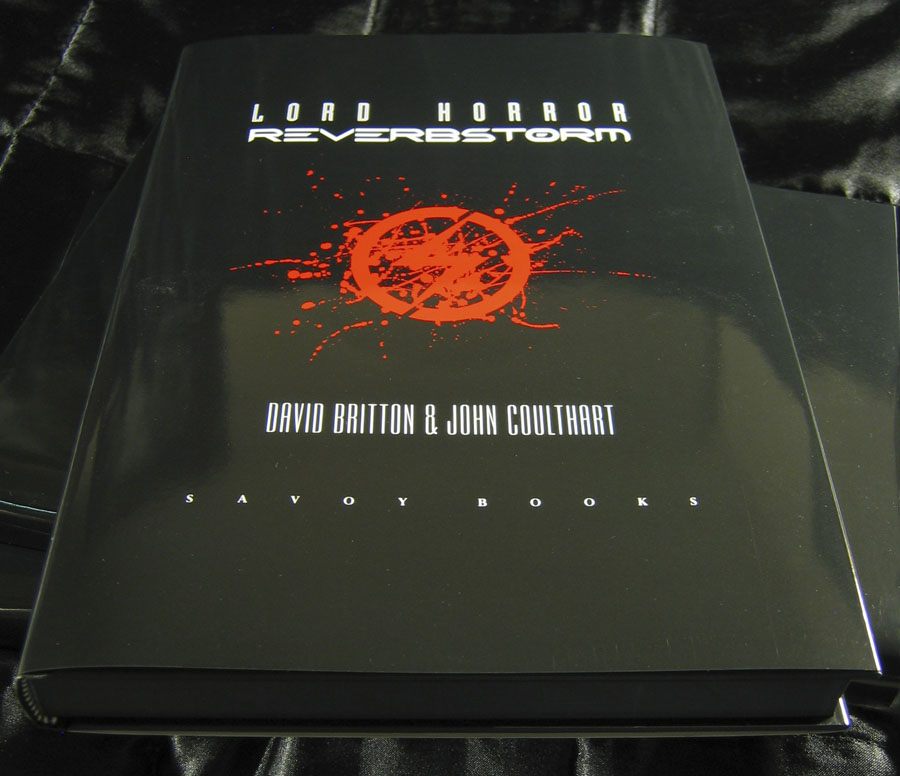
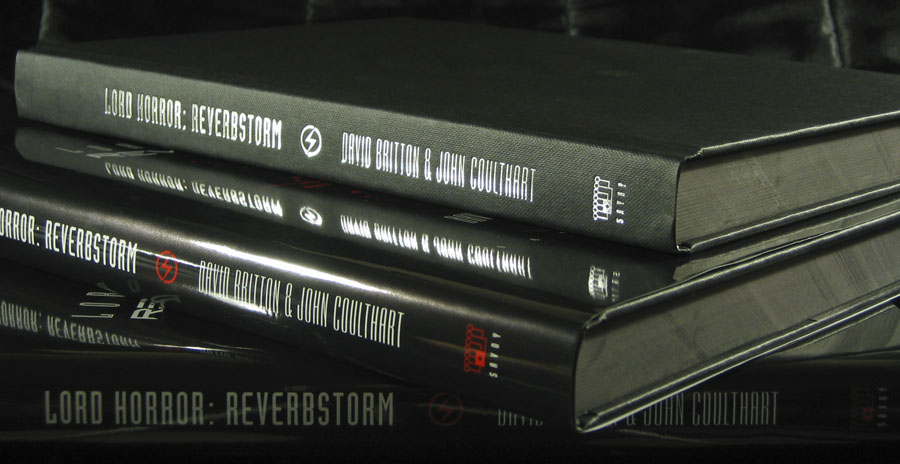
A couple of months ago I was starting to wonder whether I’d ever see this book printed, the production process became so tortuously drawn out. But Reverbstorm is finally in print and looking exactly the way I intended with black boards, black endpapers and black ink on the page edges. The latter proved to be a costly extra which explains why it’s an uncommon effect.

rev2.jpg

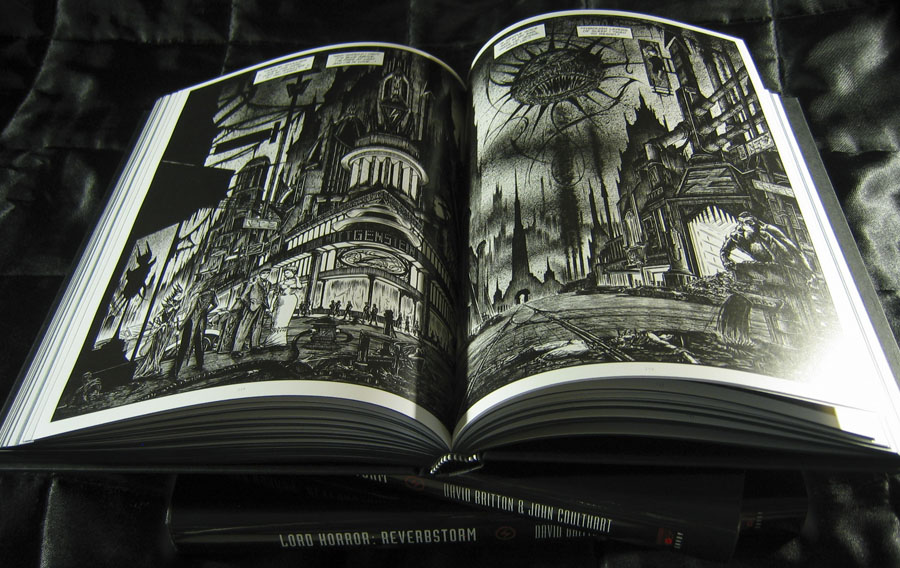
More important than the book design is that the printing of the artwork is excellent, with rich blacks and pin-sharp detail throughout. You’d think that printing black-and-white pages was a fairly straightforward business but the first set of proofs were pretty disastrous, the ink bleeding over the edges of many panels and detail elsewhere being blacked in. A combination of copious cross-hatching, spattered ink and—on later pages—brush shading and monochrome painting proved to be too much when the A3 artwork was reduced to half its size. This was particularly galling since these pages had never been properly printed since they were drawn: the original comics looked glossy enough but were all produced by back-street printers who didn’t bother too much about quality, and even made mistakes. They were a necessary evil at a time when other Savoy books had been refused by printers who objected to the material they contained. The relief at finally seeing the series completed and printed to this standard is considerable.
rev3.jpg

However, I’m afraid would-be purchasers still have a slight wait before they can buy a copy. The official publication date will now be early February but copies will be available to buy from the first week in January after distribution details have been finalised. I tried to persuade Savoy to relent on this and let a few copies go out prematurely but that won’t be happening. Sorry to anyone who’s been waiting since April (!) for the book but the decision is out of my hands. I believe it’ll be worth the wait. This is a better book than The Haunter of the Dark, and the best (and last) thing I’ll do in the comics medium. Next up is Axiom, a different world entirely. More about that later.
rev4.jpg

Previously on { feuilleton }
Reverbstorm update
James Joyce in Reverbstorm
A Reverbstorm jukebox
Reverbstorm: Bauhaus Horror
Reverbstorm: an introduction and preview
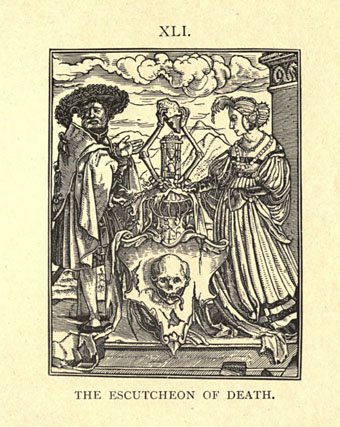
Holbein’s Dance of Death

holbein01.jpg

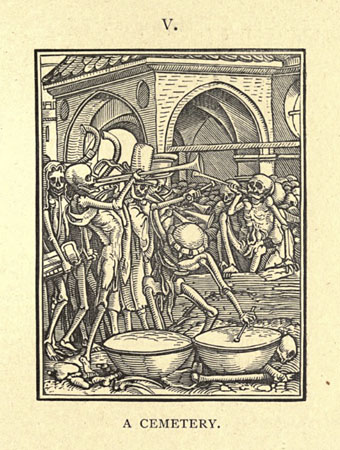
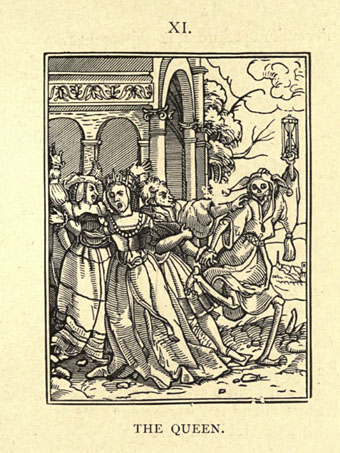
A post for Día de los Muertos. The Internet Archive has several books reprinting the Dance of Death by Hans Holbein the Younger (1497–1543). These samples are from an 1892 edition. There’s also a complete copy of the very rare original printing, Les Simulachres & Historiees Faces De La Mort, Autant Elegamme[n]t Pourtraictes, Que Artificiellement Imaginées (1538), but the reproductions aren’t as good as the later copies. Later this month the Wellcome Collection in London hosts Death: A Self-portrait, an exhibition of memento mori and related art from the Richard Harris collection. They don’t say whether Holbein will be included but I’d be surprised if he wasn’t, these images of popes, kings and paupers being hauled to the grave by grinning skeletons have been reproduced endlessly. For an example of Holbein’s astonishing painting try his portrait of Charles de Solier.

holbein02.jpg

holbein03.jpg

holbein04.jpg

Continue reading “Holbein’s Dance of Death”

Gloves

klingerglove.jpg

A Glove: Anxieties (1881) by Max Klinger.

Although the Glove‘s scenario was given its due Germanic explication by contemporary critics, it defies rational analysis. The last picture, which was seen as a kind of happy ending to the glove’s peregrinations, is particularly ambiguous and leaves the whole meaning of the series in doubt. The story is a parable of loss based on a trivial lost article, like the lost keys in Bluebeard and in Alice, like Desdemona’s missing handkerchief, or like the philosopher’s spectacles in Klinger’s own Fantasy on Brahms, which have slid out of their proprietor’s reach just as he was nearing the summit of a kind of Matterhorn. There are overtones of erotic symbolism and fetishism in the glove and the phalloid monster who abducts it, heightened for a modern viewer by the Krafft-Ebing period costumes and décors (the engravings appeared in 1881, and the drawings were apparently finished in 1878).

John Ashbery describing Max Klinger’s extraordinary series of etchings A Glove (aka Paraphrase on the Finding of a Glove) which in their inexplicable narrative of fetishist obsession anticipate Surrealism. See the entire sequence here or here. For A Glove in print there’s The Graphic Works of Max Klinger from Dover Publications.

dechirico.jpg

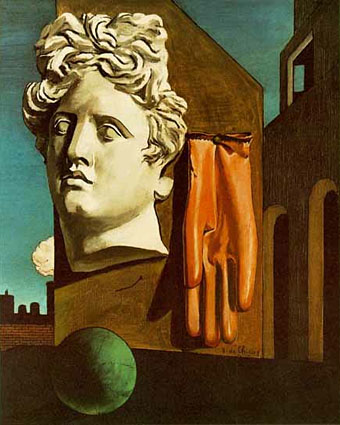
The Song of Love (1914) by Giorgio de Chirico.

Ashbery begins by discussing Giorgio de Chirico’s enthusiasm for Klinger’s work, a passion and influence that provides one of the many connections between the Symbolists and the Surrealists. This “metaphysical” painting looks back to Klinger and forward to Magritte.

michalsglove.jpg

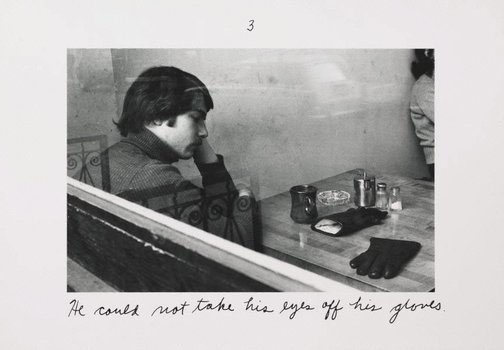
The Pleasures of the Glove, 3 (1974) by Duane Michals.

The enigmatic encounter of ‘The pleasures of the glove’ follows the lead character as he fantasises about a pair of gloves on the hands of a mannequin in a shopfront window. The perverse pleasure of desiring the gloves but not acquiring them leads him on a surreal adventure of first imagining his own glove as a queer furry tunnel that swallows his hand to the fantasy of stroking the naked body of a woman he sees on the bus with her own glove. (more)

A more contemporary take on the same idea, albeit without the intercession of a pterodactyl-like thief. If Klinger is pre-Surrealism then this is the post- version; Michals photographed René Magritte, and many of his other works run in a distinctly Surreal direction. (Thanks to Anne Billson for the tip!)

bartagloves.jpg

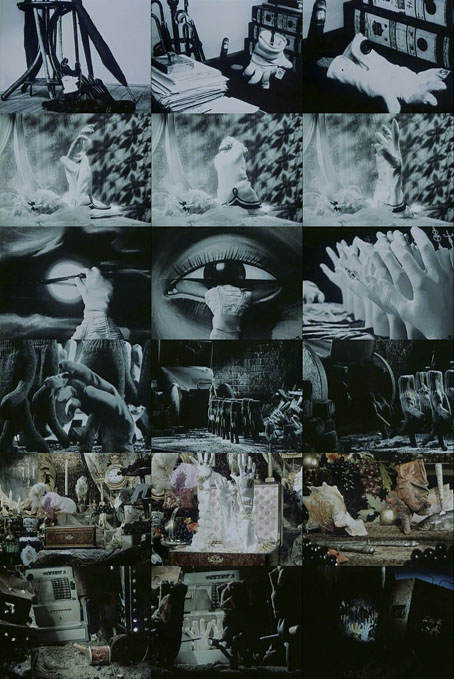
The Vanished World of Gloves (1982) by Czech animator Jiří Barta features sex, Surrealism and a lot more besides, all in the space of 16 minutes. A can of film is unearthed which contains a series of short episodes pastiching different cinematic styles: Chaplinesque slapstick, swashbuckling romance, Buñuel Surrealism, a war film, a Fellini orgy and a science fiction apocalypse. All the parts are played by gloves, of course, and if you didn’t see the credits you might take this at first for a Svankmajer short.

The Vanished World of Gloves: part one | part two

Update: I knew I’d forgotten something… Added de Chirico’s The Song of Love.

Previously on { feuilleton }
More Golems
Max Klinger’s New Salomé
Barta’s Golem

Posters: A Critical Study, 1913

posters01

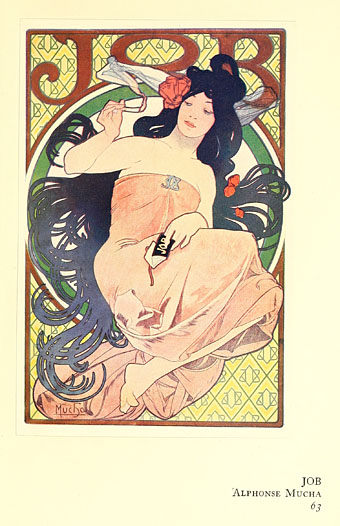
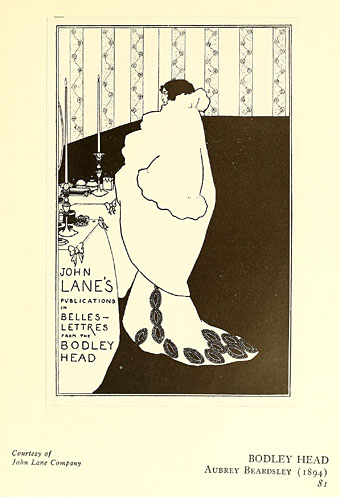
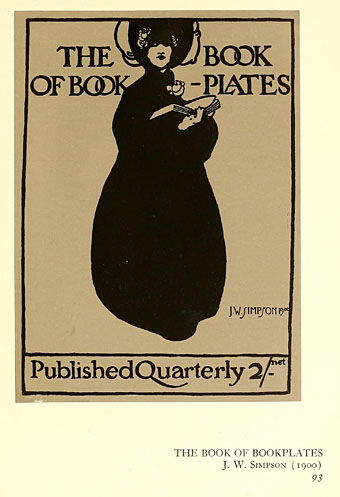
An appraisal of the state of poster design from almost a century ago by Charles Matlack Price. Lots of the names you’d expect from Europe and the United States—Steinlen, Mucha, Beardsley, Will Bradley, Maxfield Parrish, etc—plus a number of examples I hadn’t seen before. Also a surprising scarcity of Italians and Germans. Scroll down for a remarkably advanced dancer with a guitar by Will Bradley from 1895, a design that anticipates the flourishing of Cubism and abstracted graphics a few years later. Price’s book may be browsed here or downloaded here.

posters02

posters03

posters04

Continue reading “Posters: A Critical Study, 1913”

Weekend links 127

whirlpool.jpg

M15, The Whirlpool Galaxy photographed by Martin Pugh. The overall and deep space winner of Astronomy Photographer of the Year, 2012.

The Final Academy, the series of William Burroughs-themed events that took place in London and Manchester in 1982, will be celebrated at the Horse Hospital, London, on 27th October. Academy 23, a publication edited by Matthew Levi Stevens, will include my report on the Manchester Haçienda performances.

• “Architects are the last people who should shape our cities,” says the thrillingly pugnacious Jonathan Meades in a piece from his new writing collection Museums Without Walls. Andy Beckett reviews the book here.

• Ex-Minimal Compact singer/bassist Malka Spigel talks about her new album, Every Day Is Like The First Day, which can be streamed in full here.

What’s new about the current acknowledgments page is that it’s unsolicited—it appears like an online pop-up ad, benefiting no one but the author and his comrades. This is surely why these afterwords are often so garrulously narcissistic and strewn with clichés. The most radical experimentalist adheres to the most mindless acknowledgments-page formula; the most stinging social critic suddenly becomes Sally Field winning an Oscar.

Sam Sacks at the New Yorker on the blight of novelists’ acknowledgments pages. DG Myers at Commentary Magazine piles on.

• Another streaming album: Composed by Jherek Bischoff. Try Insomnia, Death & The Sea featuring Dawn McCarthy.

• Film of Lindsay Kemp being interviewed in 1977 about his production of Salomé.

Electronic Performers (2004): a video by Machine Molle for the song by Air.

djuna.jpg

One of a series of Beardsley-like drawings by Djuna Barnes posted at Strange Flowers. The resurgent Ms. Barnes is mentioned three times in this Terry Castle review of All We Know: Three Lives by Lisa Cohen.

Fictitious Dishes, meals from novels photographed by Dinah Fried.

• Life, the Dinosaurs & Everything: Cosmicomics by Italo Calvino.

The Baby Died: Morbid Curiosities found in Old Newspapers.

• Portishead’s Adrian Utley gives a tour of his synth collection.

• Minimal Compact: Babylonian Tower (1982) | Not Knowing (1984) | When I Go (1985) | Nil Nil (1987).